
4V Cordless Tool Set Qualification Matrix: Tool Sets, Screwdriver Sets and Staple Guns
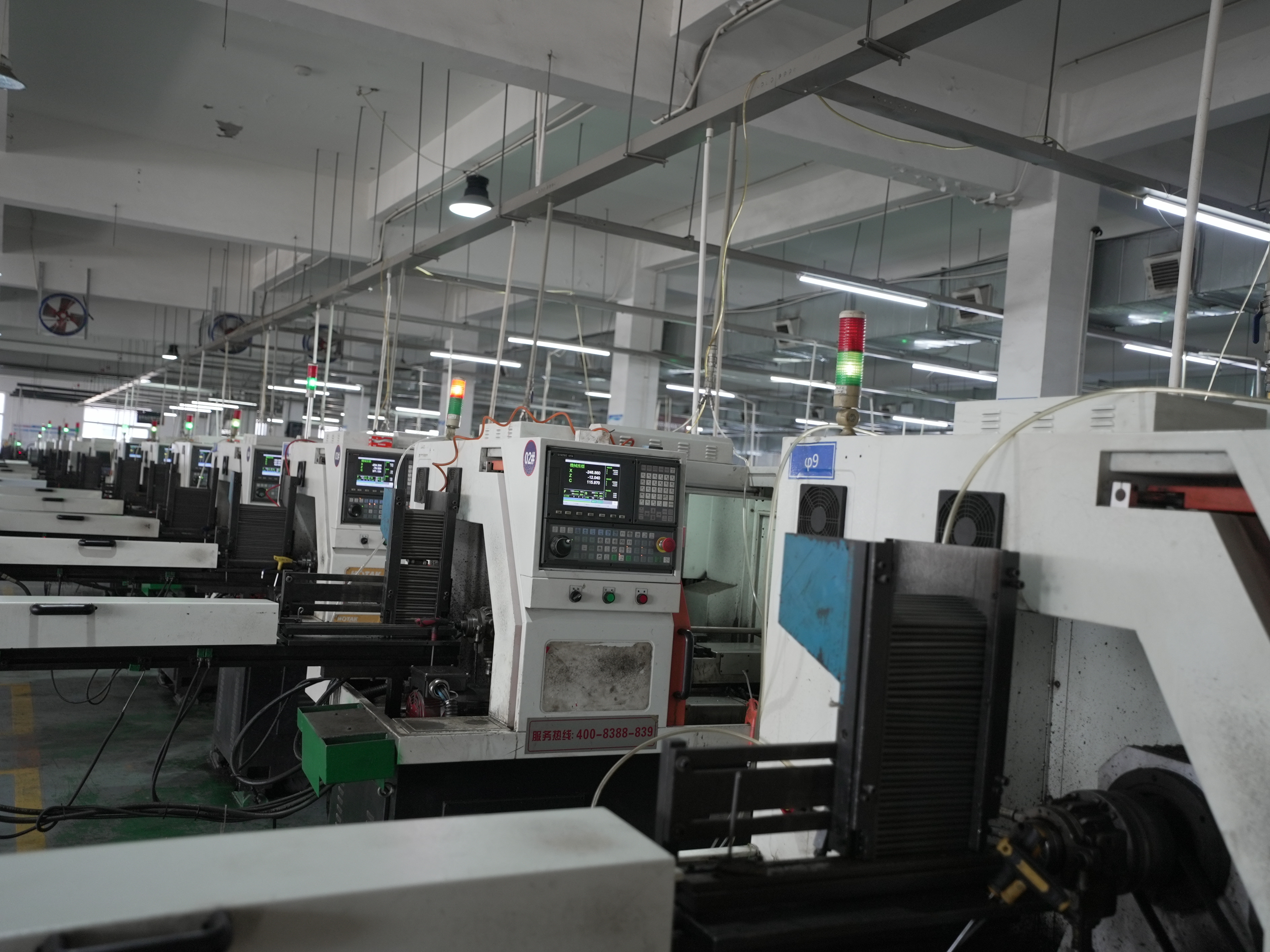
Manufacturing evidence is one of six columns in a 4V cordless tool qualification matrix. CNC-machined components, Ningbo production base.
4V cordless tools are usually bought in mixed baskets. A single order in the low-voltage class — the platform that also appears on specification sheets as 3.7V — commonly combines a cordless screwdriver, a cordless staple gun, a bits set, a hand tool set and a set of hex keys. Each of those items is qualified by different evidence, and a supplier questionnaire written for one of them will not cover the other four.
This article sets out a qualification matrix for that basket. It maps the product families that typically travel together in a 4V/3.7V programme — tool sets, bits sets, screwdriver sets, staple guns, cordless electric tools and hex key formats — against the evidence a buyer can request before comparing suppliers. The approach is procedural: which question belongs to which family, which answer can be documented, and which answer has to come from a physical sample.
HOTAK PRO TOOLS is the tool brand under which the ranges described here are presented. The manufacturing operation behind the range, Ningbo Yingzhou Yongjia Electrical Tools Co., Ltd., was founded in 2000 and is headquartered in Ningbo, Zhejiang Province, China. It runs an integrated in-house production chain covering mould development, forging, stamping, heat treatment, surface finishing, precision machining, assembly and packaging, and exports to more than 100 countries and regions, with export business accounting for 95% of sales.
Why one 4V checklist fails on a mixed tool order
Four properties of the low-voltage class make a generic checklist unreliable when the order contains more than one product type.
- Voltage naming. The cordless items described in this article declare a rated voltage of 3.7V (YJSG-501, YJSG-500, YJPS-902, YJPS-912, YJPS-906, YJGG-001), while retail and search language refers to the same class as 4V. A checklist that only asks “is this 4V?” cannot be reconciled line by line against a specification sheet.
- Two torque figures. Cordless screwdrivers declare electric (power) torque and manual torque as separate values. YJPS-902 lists electric torque of 2 / 3.5 / 5 N·m against a manual torque of 10 N·m; YJPS-906 lists 0.15 N·m electric against 3 N·m manual. Selecting a tool on one number and ignoring the other misstates what it will actually do.
- Consumable-specific compatibility. Staple guns are defined by staple series rather than by category name. YJSG-196 accepts JT21, T50, T25, T20 and 18GA staples; YJSG-115 is compatible with Arrow T50 and 140 staples in sizes from 1/4" to 9/16"; YJSG-120 covers heavy duty staples of 6–14 mm (1/4"–9/16"), light duty staples of 6–10 mm (1/4"–3/8"), cable staples of 10–14 mm (3/8"–9/16") and 18 ga brad nails of 15 mm.
- An incomplete public data picture. The category data used in this article records no separately published unit-sales figure for the 4V/3.7V class, because low-voltage tools are normally reported inside a “below 12V” band. Buyers comparing suppliers on volume or installed base are working with an estimate, not a documented number.
The practical response is to stop treating 4V cordless tools as one product and start treating them as a basket of families, each with its own evidence path.
The qualification matrix: six evidence columns
Every family in the basket can be reviewed against the same six columns. The columns stay constant; only the answers change.
- Platform declaration — rated voltage, power rating and battery capacity as published for the specific model.
- Interface and consumable — bit drive profiles and sizes, staple series and leg lengths, socket sizes.
- Material and mechanical limit — steel grade (CR-V6150 or S2), hardness (HRC) and torque values where declared.
- Energy and charging — no-load operating time, charge current, charge output voltage and charge time.
- Application fit — the documented working environment and fastening or repair task.
- Documentation and traceability — the model-level certificate, batch record and supplier-level audit file the buyer chooses to request.
The sixth column is deliberately phrased as a request rather than an assumption. A manufacturer-level quality system or retail audit approval does not automatically extend to every SKU, so any certificate copy should name the exact model and the market it is intended for. That is a documentation habit, not a claim about which approvals exist.
| Product family | Primary qualification question | Documented evidence to request | Sample or physical check |
|---|---|---|---|
| Tool sets (YJTS-3018, YJTS-3545, YJTS-3506, YJTS-3147) | Does the kit contain the drive profiles and sizes the job actually uses, in the declared count? | Itemised content list, piece count, material declaration (CR-V6150 or S2), surface finish, case specification | Count and seat every bit and socket; test fit on the intended fastener |
| Bits sets (YJTS-3110, YJTS-3109) | Is the bit steel rated for the driver the buyer will use? | Bit material and finish, bit lengths and counts, drill bit sizes, magnetic holder, case material | Drive representative fasteners; inspect deformation after repeated use |
| Screwdriver sets, manual and precision (YJPS-6851, YJPS-6852, YJTS-3138) | Which repair and assembly profiles are covered, and down to what bit size? | Bit profile list, extension bar length, socket sizes, handle features | Fit the smallest listed bits into the corresponding fasteners |
| Cordless screwdrivers (YJPS-902, YJPS-912, YJPS-906, YJPS-907, YJTS-3526) | What torque and run time is declared, and in which mode? | Rated voltage, battery capacity, no-load operating time, electric and manual torque, output speed, charge current, charge output voltage | Measure no-load run time; verify the torque cut-off point |
| Staple guns, manual (YJSG-120, YJSG-115, YJSG-196, YJSG-080, YJSG-009 and others) | Which staple series and leg lengths does the tool actually accept? | Compatible staple series list, leg length range, magazine type, jam-release mechanism | Load the staple the buyer will source locally and fire into the target substrate |
| Cordless staple and nail guns (YJSG-501, YJSG-500) | Does the cordless mechanism match the consumable and the duty cycle? | Rated voltage, battery capacity, power rating | Fire a rated sequence; confirm which fastener the tool drives |
| Hex key formats (105221K1, 71821D1, YJHK-3347, YJHK-3226) | Is hardness and torque declared per size? | Material, HRC range, torque value per size, ball-end angle, size marking | Torque test on the smallest and the largest size in the set |
| Cordless hot-glue pen (YJGG-001) | Does the thermal specification match the material being bonded? | Rated voltage, battery capacity, power rating, operating temperature, glue flow time, charge time | Bond the intended substrate and observe open and release time |
Tool sets and bits sets: qualify by contents and steel
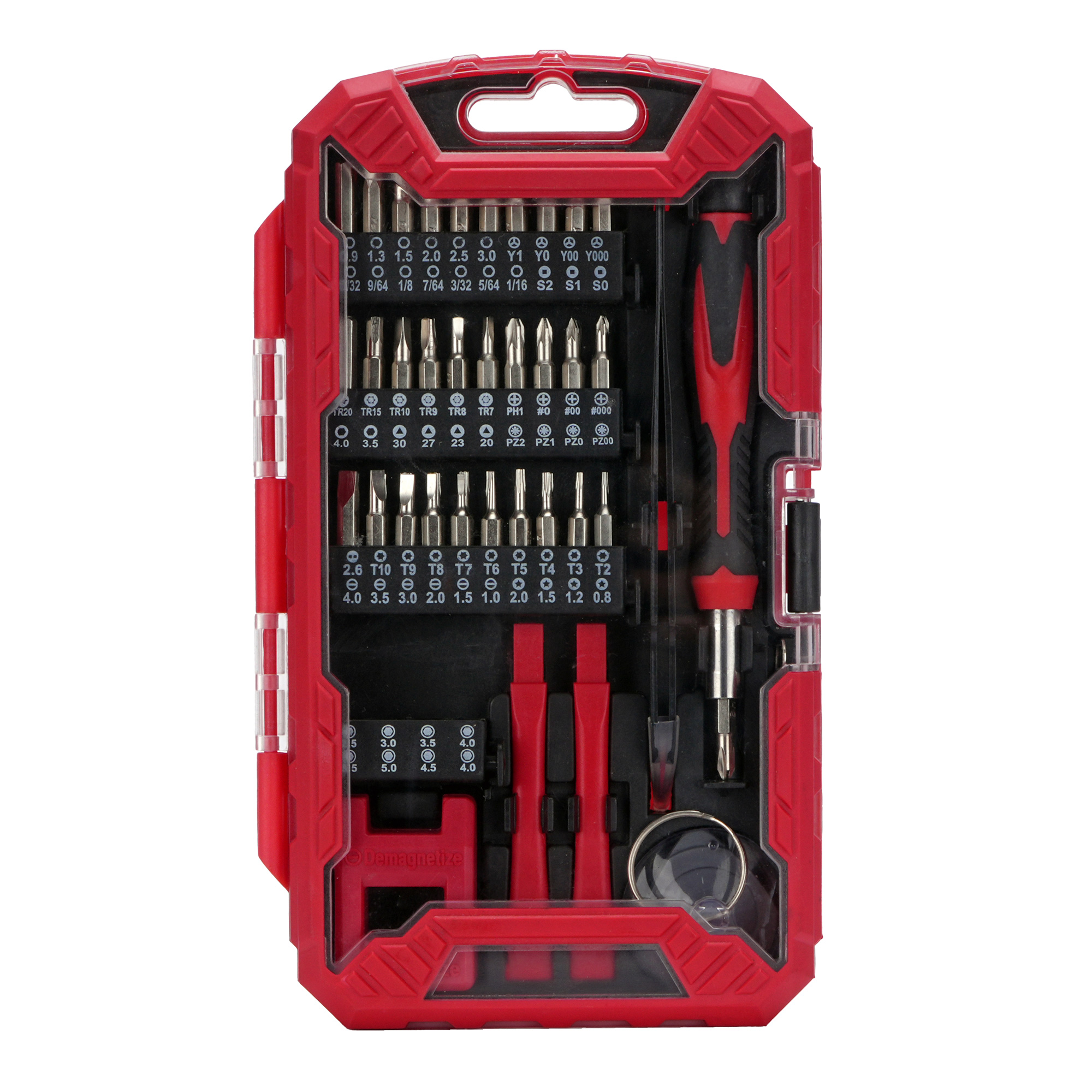
YJTS-3018, a 77-piece smartphone repair kit in CR-V6150 with a nickel finish — kit composition, not category name, is what gets qualified.
Tool sets are the most mis-specified item in a mixed order, because two kits of similar piece count can cover completely different fastener systems. YJTS-3018 is a 77-piece kit built for small-device work: 8 mini sockets from 2.5 mm to 5.5 mm, 6 slotted bits from 1.0 mm to 4.0 mm, 5 Phillips bits from PH000 to PH2, 4 Pozi bits, 8 metric hex bits from 0.9 mm to 4 mm, 7 SAE hex bits, 9 Torx bits from T2 to T10, 6 tamper-proof Torx bits, 3 square bits, 4 triangle bits, 4 pentalobe bits from 0.8 mm, 4 tri-wing bits and a spanner bit, in CR-V6150 with a nickel finish.
YJTS-3545 goes the other way: 32 pieces aimed at 1/4" drive work, with a 1/4"×60 mm quick-release extension rod, a 1/4"×25 mm socket adaptor bit and 30 bits covering Phillips PH1–PH3, Pozi PZ1–PZ3, Torx T10–T40, Torx with hole TT10–TT40, hex 3.0–6.0 mm and slotted 3.0–6.0 mm. The two kits share a category name and share almost nothing else.
Bits sets follow a different rule again, because the steel changes with the driver. YJTS-3110 is a 26-piece impact tough drill and drive set using S2 bits with a black phosphate finish in a PP case, containing 16 one-inch standard bits, 6 two-inch standard bits and 3 drill bits in 5 mm, 4 mm and 3 mm. YJTS-3109 is the 18-piece version of the same logic: 8 one-inch bits, 4 two-inch bits and 5 drill bits in 6, 5, 4, 3 and 2 mm. When a buyer asks for “a bits set” without specifying impact rating, the two answers look identical on a quotation and different in use.
For ratchet-format tool sets, the declared material is CR-V6150: YJTS-3506 is a 26-piece ratchet handle set with 11 sockets from 4 mm to 14 mm, 13 bits and a 1/4"×50 mm socket extension bar; YJTS-3147 is a 51-piece T-handle driver set with 9 sockets from 4 mm to 13 mm and 39 CR-V bits. Precision sets such as YJTS-3138 are specified by bit profile depth instead: 48 bits at 5/32"×28 mm including pentalobe sizes from 0.8 to 2.0 mm, a tri-point Y000 and a SP6 spanner bit, with a 115 mm extension bar.
Screwdriver sets: three qualification layers
Screwdriver sets in this range split into manual, precision and cordless layers, and the evidence request changes at each layer. The manual layer (YJPS-6851 with 19 bits, 4 sockets and an LED handle providing 360 degrees of illumination; YJPS-6852 with 15 bits from slotted 1.5 mm to Torx T10) is qualified by profile coverage and handle ergonomics. The precision layer is qualified by the smallest bit the set can reach.
The cordless layer is where published parameters matter most, because torque, run time and charging are declared per model and differ substantially across the family.
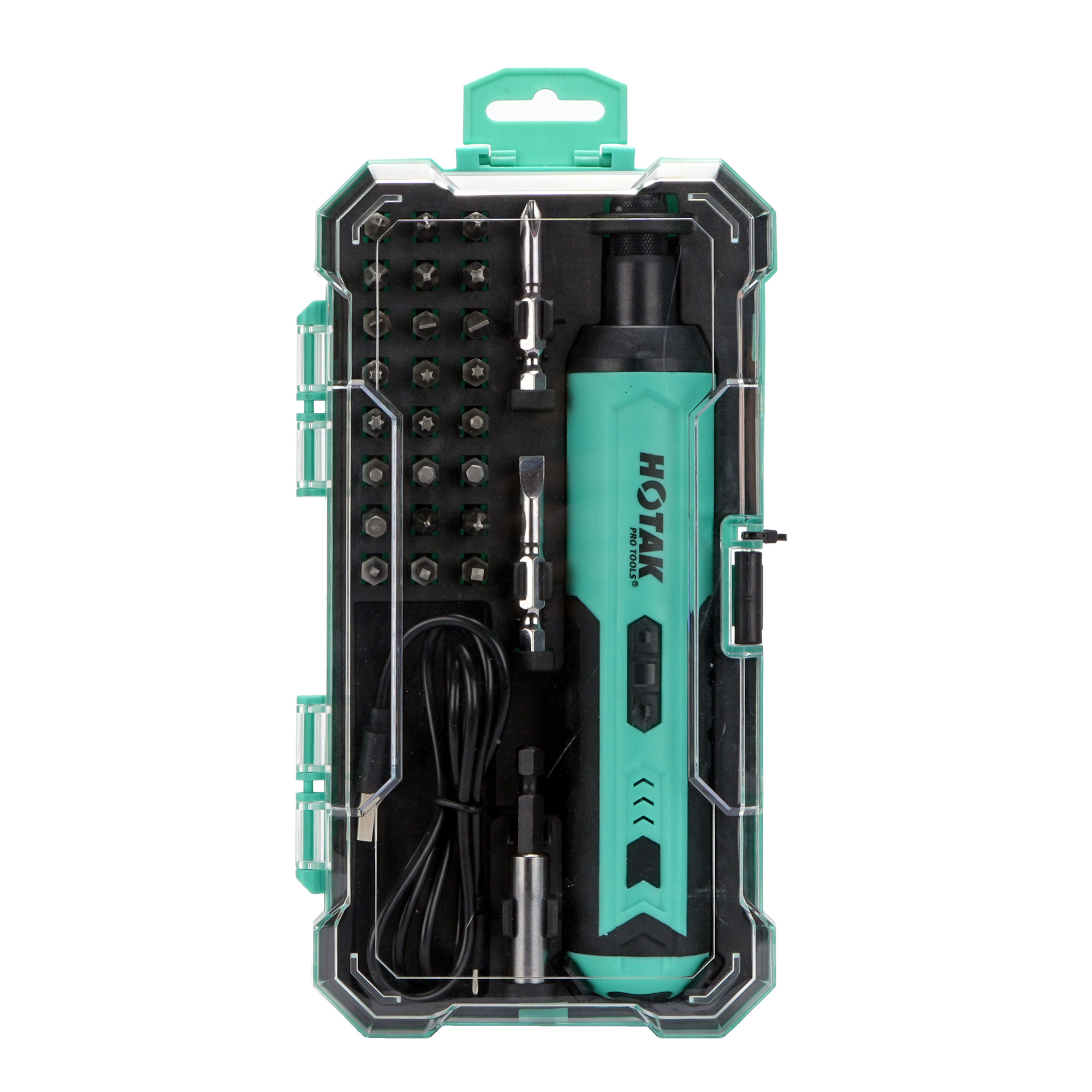
YJPS-902 publishes rated voltage, battery capacity, no-load operating time, electric torque, manual torque, output speed, charge current and charge output voltage — eight fields a qualification file can be checked against.
| Model | Format | Rated voltage | Battery | Run / charge | Torque | Speed |
|---|---|---|---|---|---|---|
| YJPS-902 | Power screwdriver | 3.7V | 2000mAh | No-load ≥60 min; charge current 1–1.5A; charge output 5V | Electric 2 / 3.5 / 5 N·m; manual 10 N·m | 0–280 rpm |
| YJPS-912 | Power screwdriver set | 3.7V | 800mAh | No-load ≥50 min; charge current 500mA | Electric 2.5 N·m; manual 10 N·m | 0–250 rpm |
| YJPS-906 | Electric precision repair tool set | 3.7V | 320mAh | No-load ≥30 min; charge current 500mA | Electric 0.15 N·m; manual 3 N·m | 0–220 rpm |
| YJPS-907 | 26 pc cordless precision power screwdriver set | 3.7V lithium | 320mAh | Charging time 1 hour | Power 0.15 N·m; hand 3 N·m | 220 r/min |
| YJTS-3526 | 41 pc household electrical screwdriver tool set | 3.7V lithium | 320mAh | Charging time 1 hour | Power 0.15 N·m; hand 3 N·m | 220 r/min |
Two practical readings follow from this table. First, the family spans an order of magnitude in electric torque, from 0.15 N·m for precision electronics work to 5 N·m for general fastening, so a single “torque” line in a comparison sheet is not comparable unless the mode is stated. Second, battery capacity ranges from 320mAh to 2000mAh, and run time follows it. Buyers who compare only the voltage will see five similar products; buyers who compare capacity and run time will see five different use cases.
Staple guns and cordless staplers: the consumable is the specification
A staple gun is qualified by what it can load, not by what it is called. The manual range alone covers several different consumable systems, and each model should be matched against the staple the buyer can actually source in the destination market.
| Model | Type | Compatible consumable |
|---|---|---|
| YJSG-120 | 4-in-1 heavy duty staple gun | Heavy duty staples 6–14 mm; light duty staples 6–10 mm; cable staples 10–14 mm; 18 ga brad nails 15 mm |
| YJSG-196 | 6-in-1 staple gun | JT21, T50, T25, T20, 18GA staples |
| YJSG-115 | Heavy duty staple and nail gun | Arrow T50 and 140 staples, 9/16", 1/2", 3/8", 5/16", 1/4" |
| YJSG-009 | Professional staple gun | Fine wire staples 4–14 mm; Rapid 530 and Arrow JT21 |
| YJSG-140 | Medium duty staple gun (CR-V6150) | Fine wire staples 6–10 mm (1/4"–3/8") |
| YJSG-063 | Heavy duty staple gun | Flat wire staples 6–14 mm |
| YJSG-080 | Medium duty staple gun | 23 series, 13 series and 10F staple pins; leg lengths 6 mm, 8 mm, 10 mm |
| YJSG-023 | Heavy duty 3-way staple gun set | Flat wire staples 4–14 mm; 7.6 mm cable staples 10–14 mm; brad nails 10–14 mm |
| YJSG-035 | Heavy duty hammer tacker | Flat wire staples 6–14 mm |
| YJSG-105 | Medium duty staple gun | Fine wire staples 4–8 mm |
The cordless half of the staple range is qualified differently, because the mechanism adds battery and power parameters on top of the consumable question. YJSG-501 is a five-use lithium electric nail gun rated at 3.7V with a 2000mAh battery and 25W power rating; YJSG-500 is the two-use equivalent at the same 3.7V, 2000mAh and 25W. The published platform data is therefore consistent across the two models, and the differentiator a buyer should probe is functional coverage and fastener compatibility, requested model by model.
Hex key formats: hardness and per-size torque
Hex keys look like a commodity and are not, because hardness and torque are declared per size rather than per product. Across the range, the published material is CR-V6150 alloy steel with a hardness of HRC 52–55, and the declared torque scale runs from 0.82 at 1.5 mm to 220 at 10.0 mm as published.
| Set | Format | Material / hardness | Declared torque scale |
|---|---|---|---|
| 105221K1 | 9 pc short arm ball point, metric | CR-V6150 / HRC 52–55 | 0.82 (1.5 mm) to 220 (10.0 mm), as published |
| 71821D1 | 9 pc short arm ball point colour, metric | CR-V6150 / HRC 52–55 | Same per-size scale; ball end works at angles up to 25° |
| YJHK-3347 | 8 pc folding, metric | CR-V6150 / HRC 52–55 | Same per-size scale; flexible angle |
| YJHK-3226 | 14 pc T-handle, metric and SAE | CR-V6150 / HRC 52–55 | 1/16": 1.19 to 3/8": 242.92, as published |
The qualification point is that two suppliers can quote the same key count while publishing different per-size torque values. Asking for the torque table by size is a faster filter than asking for the piece count.
Cordless electric tools beyond fastening
The low-voltage platform also extends into bonding and craft work. YJGG-001 is a cordless hot-glue pen rated at 3.7V with a 320mAh battery and 4.2W power consumption, an operating time of at least 120 minutes, a glue flow time of 60 seconds with release in 30 seconds, an operating temperature of 150°C, a charge current of 1–1.5A, a charge output voltage of 5V and a full charge time of 120 minutes ±10 minutes. In a qualification file this model is checked against the substrate and open time, not against torque, which is why the matrix keeps application fit as a separate column.
Where these tools are specified
The documented working profile for this hand and cordless tool range is household indoor environments and open air construction site environments, covering repair work and the repair and fastening function, matched with screws, nuts and nails, with impact resistance listed as a special requirement. Markets recorded for the profile include the United States, Germany, France, Russia, Japan, Malaysia, Mexico and Canada.
That profile explains the basket shape. A single site or household task set will mix a cordless driver for repetitive fastening, a staple gun for sheeting or upholstery, a precision screwdriver for small assemblies and a hex key set for furniture hardware — four families, four qualification paths, one purchase decision.
Market context: what third-party data does and does not confirm
The macro picture supports the category, but not at the level of detail buyers usually want. Global Market Insights estimated the global cordless power tools market at USD 12.2 billion in 2024, and Market.us describes low voltage cordless tools below 12V — the band that includes 4V and 3.7V platforms — as a primary segment for DIY and light-duty household tasks.
Adjacent categories are measured separately. Maximize Market Research valued the global staple gun market at USD 1.54 billion in 2024 with a forecast CAGR of 3.13% through 2032. DataHorizzon Research valued the household electric screwdriver market at approximately USD 1.8 billion in 2024, with North America holding a 35% share. Global Market Insights projects the cordless multi-rotary tools market to reach USD 1,024.95 million by 2026, a figure published with medium confidence.
Two cautions belong in any qualification file built on this data. Market-size baselines for cordless power tools vary between research houses — the comparison set used here records estimates from USD 12.2 billion upward to around USD 26 billion, most likely because hobbyist and industrial grades are included differently. And the segment has a documented data gap: unit sales for 4V/3.7V tools are not published separately, and USB-class charging adoption rates for 4V cordless tools are recorded as an open question. On the trade side, HS Code 846729 covers hand tools with self-contained electric motors, which is the classification most cordless screwdrivers and specialty 4V tools fall under.
Where the 4V class stops: limits and comparison with conventional alternatives
The honest boundary of this platform is torque and duty cycle. Within the cordless screwdriver family described here, electric torque ranges from 0.15 N·m to 5 N·m and manual torque from 3 N·m to 10 N·m. That is a light fastening envelope. It suits electronics repair, furniture assembly, household maintenance and repetitive low-torque driving; it is not a substitute for higher-voltage platforms in structural fastening, continuous production driving or work requiring sustained high torque. Several models declare a manual torque well above their electric torque, which is a clear signal that the design expects the final tightening to be finished by hand.
Run time is a second boundary, and it varies more than voltage suggests: published no-load operating time ranges from at least 30 minutes on the 320mAh precision models to at least 60 minutes on the 2000mAh power screwdriver, with the cordless hot-glue pen declaring at least 120 minutes of operating time on the same 3.7V platform. Users who plan a full day of continuous work should size the battery, not the label.
Manual tools remain the reference point in two situations. Where a fastener range is fixed by an existing staple supply, a manual staple gun matched to that series (for example YJSG-196 across JT21, T50, T25, T20 and 18GA, or YJSG-080 across 23 series, 13 series and 10F pins) may be the lower-risk choice regardless of cordless availability. And where repeated heavy fastening is the task, the hammer tacker format (YJSG-035, flat wire staples 6–14 mm) covers duty cycles that a cordless unit is not positioned for.
A documentation boundary applies as well. A qualification matrix tells a buyer what to ask for; it does not replace a sample. Certificates, batch records and audit documents are requested at model level, and a sample test remains the only way to confirm that a specific tool, consumable and substrate combination performs as intended.
Future outlook
Three directions are visible from the data currently available. First, the low-voltage band keeps its DIY and light-duty identity, which means the competitive ground is kit composition and consumable coverage rather than raw power. Second, charging interfaces are converging on 5V-class inputs — several models in this range already publish a 5V charge output voltage with 1–1.5A charge current — but connector and protocol standardisation is not yet documented at category level, so buyers asking specifically for USB Type-C charging should confirm the interface model by model rather than assume it across a range.
Third, private label and custom programmes continue to shape how these baskets are bought. The manufacturing operation behind this range offers ODM and OEM customisation, which means a buyer's qualification matrix increasingly doubles as a specification brief: the staple series, bit profiles, capacities and kit counts that are verified during sourcing become the parameters of the custom order rather than fixed catalogue values.
Frequently asked questions
What does “4V cordless” mean when the specification shows a 3.7V rated voltage?
They refer to the same class. The cordless tools described in this article declare a rated voltage of 3.7V — for example YJSG-501, YJSG-500, YJPS-902, YJPS-912, YJPS-906 and YJGG-001 — while market and retail language groups them as 4V. Category data describes low voltage cordless tools below 12V, including 4V and 3.7V platforms, as the segment used for DIY and light-duty household tasks. When comparing quotations, the rated voltage on the datasheet is the value that can be checked.
Which qualification evidence should be requested first for a cordless staple or nail gun?
Start with the platform declaration and the consumable definition, in that order. For the cordless models in this range the platform data is a 3.7V rated voltage, a 2000mAh battery capacity and a 25W power rating for both YJSG-501 and YJSG-500. After that, confirm which staples or nails the tool is intended to drive, since staple guns are defined by consumable system rather than by category, and a specification sheet that omits the series cannot be verified against locally sourced consumables.
Are 4V or 3.7V cordless tools a substitute for 12V or 18V cordless tools?
Not for high-torque or continuous-duty work. Within this range, cordless screwdrivers declare electric torque between 0.15 N·m and 5 N·m, with manual torque between 3 N·m and 10 N·m, and no-load operating times from at least 30 minutes to at least 60 minutes depending on battery capacity. Those parameters suit light fastening, assembly and repair tasks. Low voltage tools are described in category data as a DIY and light-duty household segment rather than a replacement for higher-voltage professional platforms.
What should be checked in the tool sets and bits sets that ship with a 4V cordless tool?
Piece count alone is not informative. Two kits in this range illustrate the point: YJTS-3018 is a 77-piece kit covering small-device profiles including pentalobe, tri-wing and Torx down to T2 in CR-V6150 with a nickel finish, while YJTS-3545 is a 32-piece 1/4" drive kit with Phillips PH1–PH3, Pozi PZ1–PZ3, Torx T10–T40 and slotted 3.0–6.0 mm. Bit steel also differs by application: YJTS-3110 and YJTS-3109 declare S2 bits with a black phosphate finish for impact drill and drive use, while the ratchet and hand sets declare CR-V6150. The check is whether the declared profiles and steel match the fasteners and the driver the buyer will use.
How can hardness and torque claims on hex keys be verified?
Ask for the torque value per size rather than a single set-level figure, then verify the smallest and largest sizes on a sample. In this range, hex key sets declare CR-V6150 alloy steel at HRC 52–55, with published torque values running from 0.82 at 1.5 mm to 220 at 10.0 mm, and the T-handle set YJHK-3226 publishing a scale from 1.19 at 1/16" to 242.92 at 3/8". Ball-end designs in the range work at angles up to 25 degrees, which is a functional limit worth testing alongside the torque figure.
Why is there no separate sales figure for the 4V segment?
Because low-voltage tools are normally reported inside a broader band. Category data records the below-12V band, which includes 4V and 3.7V platforms, as the segment for DIY and light-duty household tasks, and lists specific unit-sales data for the 4V/3.7V category as a data gap. Market-size estimates for cordless power tools overall range from USD 12.2 billion in 2024 to baselines around USD 26 billion across research houses, most likely because hobbyist and industrial grades are counted differently. Segment-level demand should therefore be treated as directional rather than exact.
Reference material
The full range described in this article — cordless 3.7V tools, tool sets, bits sets, screwdriver sets, staple guns and hex key formats — is documented in the manufacturer catalogue, which can be downloaded here.