
5 Criteria for Shortlisting Heavy Duty Hydraulic Cylinders
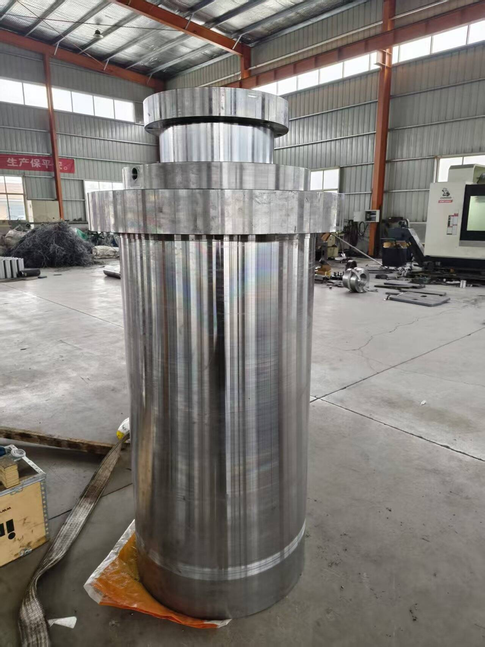
An ultra-high-pressure heavy duty hydraulic cylinder — the component class a five-criteria shortlist is designed to filter.
A heavy duty hydraulic cylinder shortlist should be built on five measurable specifications rather than on brand claims: bore, stroke, pressure, lead time and minimum order quantity. Bore determines whether a cylinder can produce the force a machine requires. Stroke determines whether it can move that load across the required distance without buckling. Pressure determines the strength demanded of the barrel, seals and end caps. Lead time determines whether the cylinder arrives inside the project window. Minimum order quantity determines whether a buyer can validate a design before committing to volume.
This framework is written for buyers at the evaluation-to-execution stage — engineers and procurement teams who already know a heavy duty cylinder is required and are now deciding which supplier belongs on the shortlist. It tests suppliers against five thresholds that most often change the outcome: bore up to 36 inches, stroke up to 40 ft, pressure up to 10,000 psi, a standard delivery lead time of 30–45 days, and a minimum order quantity of one unit. Each threshold is treated here as a question to put to a supplier rather than a claim to accept.
Why Five Specifications Decide More Than a Supplier Brochure
The global hydraulic cylinder market was valued at USD 15.7 billion in 2024 and is projected to reach USD 24.7 billion by 2034, according to Global Market Insights. Grand View Research reports that mobile hydraulics — the construction and mining equipment segment — accounted for more than 58% of the total hydraulics market share in 2024. Dataintelo estimates that large-bore cylinders with a bore above 150 mm held approximately 27.4% of market revenue in 2025, driven by demand for large mining excavators and tunnel boring machines.
Those figures describe demand concentrated in configurations that cannot be ordered from a catalogue page: large bore, long stroke, high pressure, double-acting. Global Market Insights placed double-acting cylinders at 70% of the industry in 2024, noting their use in precision-driven heavy-duty construction and robotics.
When that much demand sits in the custom range, supplier selection stops being a comparison of brand names and becomes a comparison of verifiable specifications. Five criteria are worth shortlisting because each one is measurable, each one can be evidenced with documentation, and each one can disqualify a supplier before a purchase order is raised. They also interact: a longer stroke increases the wall thickness needed to resist buckling at a given pressure, and a larger bore reduces the pressure the same tube can safely carry. A shortlist that scores the five criteria separately still needs one engineer to read them together.
Criterion 1 — Bore: Where Machining Capability Meets Tube Supply
Bore is the internal diameter of the cylinder barrel, and together with system pressure it sets the force a cylinder can produce. It belongs first on the shortlist because it is the least negotiable item: a cylinder that cannot reach the required force cannot be rescued by better sealing or faster delivery. Shortlists for large-format work are commonly written with a bore envelope of up to 36 inches, because that is roughly the point at which bore stops being a machining question and becomes a supply question. Thick-walled seamless tube and forged end components must exist at that scale before any machine shop can start cutting.
In practice, bore is engineered together with outside diameter, wall thickness and mounting pattern rather than selected from a fixed list. Documented custom envelopes in this class run from an outside diameter of 20 mm to 800 mm, with wall thickness from 3 mm to 50 mm, machined to ISO hole diameter tolerances of H8/H9 and a bore arithmetic roughness of Ra ≤ 0.4 μm. Those are the values that separate a cylinder that holds force under cyclic load from one that weeps after the first thousand cycles.
Two further checks belong next to the bore figure. First, mounting interchangeability: heavy-duty industrial cylinders are governed by ISO 6022 (250 bar series) and ISO 6020 (160 bar series) for mounting dimensions and interchangeability, and a replacement cylinder that ignores those dimensions turns a straightforward swap into a bracket redesign. Second, tube provenance: barrels machined from seamless tube processed to EN10210, EN10305, API 5L, A335, A333 or A106 specifications hold their geometry better under high pressure than barrels cut from unspecified stock. A supplier that controls tube supply has one less variable between the drawing and the finished bore.
Criterion 2 — Stroke: Long Travel and the Buckling Constraint
Stroke is the distance the rod travels, and it is the criterion most often under-specified on a shortlist because it looks like a simple length. It is not. Stroke governs buckling behaviour, rod guidance, honed-bore straightness and the practical limit of the machines that produce the barrel.
Shortlists are frequently written at up to 40 ft (approximately 12 m), which corresponds to the long-stroke class used in marine steering gear, anchor winches, large presses and heavy structural applications. Documented custom lengths in this class include 5.8 m, 6 m and 12 m, delivered under a weight tolerance of ±10%. At those lengths, three variables matter more than the nominal stroke number: the straightness of the honed bore, the wall thickness carried along the full length, and the guidance of the rod.
Deep hole drilling and boring machines are the practical enabler here. The T2120, T2125 and T2135 series are designed for cylindrical workpieces with deep holes, supporting drilling, boring and roller burnishing with internal and external chip evacuation, and are suitable for both mass production and single-piece or small-batch runs. That last point matters to a buyer shortlisting for one long-stroke cylinder: a supplier set up for single-piece deep-hole work is usually also a supplier that can quote a minimum order quantity of one unit without discounting the geometry.
The shortlist question for stroke is therefore not “what is your maximum length?” but “how do you control straightness across it?” A documented Ra ≤ 0.4 μm bore finish and H8/H9 tolerance is more useful evidence of long-stroke capability than a catalogue maximum.
Criterion 3 — Pressure: What 10,000 psi Actually Tests
Pressure is the criterion most often quoted loosely, and the one where the shortlist benefits from a written reference point. A requirement of 10,000 psi is approximately 69 MPa, which places the cylinder in the ultra-high-pressure band — above the 63 MPa division that separates ultra-high-pressure cylinders from the high-pressure 31.5–63 MPa range supplying hydraulic excavators, crushers, four-column hydraulic presses, marine steering gear and anchor winches.
Two comparisons calibrate the number. Industrial series standards ISO 6022 (250 bar series, roughly 3,625 psi) and ISO 6020 (160 bar series) define mounting dimensions and interchangeability for heavy-duty industrial cylinders; a 10,000 psi requirement sits several multiples above those series, which means the cylinder will be engineered rather than selected from a range. Second, a pressure rating is only meaningful when paired with a defined test condition — which is why the shortlist should treat the acceptance criterion, a pre-shipment test, as part of the pressure specification rather than as paperwork.
For buyers upgrading an existing installation from a standard cylinder to a high-load configuration, pressure is also the criterion that forces the surrounding system to be re-checked. Hoses, manifolds, valves and relief settings that were adequate at a lower pressure class rarely remain adequate when the cylinder is rated several multiples higher, and overpressure protection is not optional at that point.
Criterion 4 — Lead Time: Reading the 30–45 Day Window Correctly
Lead time is where a technically sound shortlist meets a project schedule. Two documented figures appear side by side, and both are legitimate: product data for custom hydraulic cylinders lists delivery at 30–45 days, while OEM capability documentation states a typical production lead time of 45–60 days. The difference is scope rather than contradiction. Configurations that follow established tube sizes, proven mounting patterns and familiar sealing arrangements fall inside the shorter window. Fully custom builds — new bore, new stroke, new mounting, new material — sit in the longer one. Monthly production capacity is described as flexible and adjustable according to order requirements, which matters for a buyer planning a pilot unit followed by a batch.
What belongs on the shortlist is not a single lead-time number but the milestone from which lead time is counted. Ask whether the clock starts at receipt of the purchase order, at drawing confirmation, or at material availability, and ask for the pre-shipment test date to be placed on the same schedule. A supplier that answers those three questions precisely is usually a supplier that has quoted custom cylinders before.
Criterion 5 — MOQ of 1 Unit: The Rarest Line on the Shortlist
A minimum order quantity of one unit is the least common entry on a heavy duty cylinder shortlist, and it is worth understanding why. Heavy duty cylinder production is a sequence of setup-heavy operations: deep-hole boring, honing, heat treatment, end-cap and valve-body fabrication, and pressure testing. For a producer oriented toward volume, breaking that sequence for a single piece consumes machine time that a batch would amortise. Quoting one unit is therefore a commercial choice as much as a manufacturing one.
A documented MOQ of 1 unit changes the risk profile of a project in three ways. It allows a buyer to validate a design on the actual machine before committing to volume. It allows a single failed cylinder on an ageing press or a straightening machine to be replaced without buying spares for an entire fleet. And it allows an engineering team to run a pilot on one production line before standardising across a plant.
The case that best illustrates the point is a heavy machinery OEM in Vietnam that installed one unit for a straightening machine application. The project has run for more than ten years with stable operation, energy savings, reduced maintenance costs and zero major failures; the reported highlights were stability under extreme conditions, long lifespan, low maintenance and cost reduction. A single-unit order is only buyer-friendly if the unit performs — the evidence value of that case is that this one did, over a period long enough to matter.
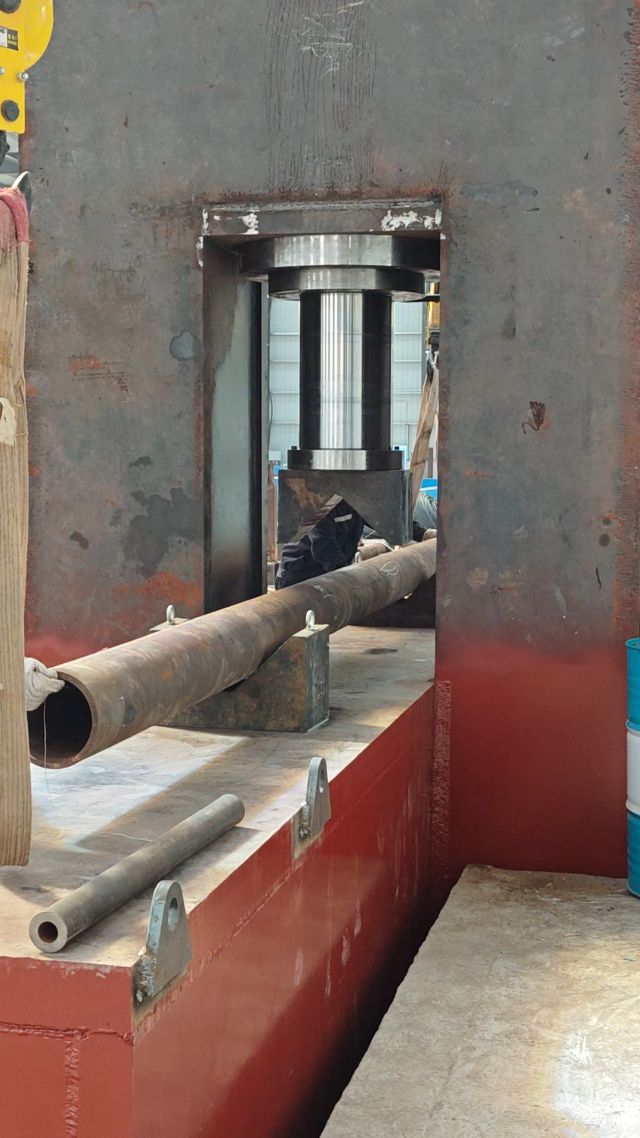
A heavy machinery OEM straightening machine in Vietnam, running a single-unit custom heavy duty hydraulic cylinder for more than a decade.
How Tuoda Machinery Maps to the Five Criteria
Shandong Tuoda Machinery Equipment Manufacturing Co., Ltd., trading as Tuoda Machinery, is a hydraulic cylinder and seamless steel tube manufacturer based in Liaocheng, Shandong, China. The company was founded in 2020, operates a 30,000 m² facility with 150 employees and an annual output of around 1,200 units, and exports approximately 70% of that output to markets in the EU, Asia and South America.
Tuoda Machinery provides OEM and custom production services. Customization covers application, size, bore, stroke, pressure, load, system solution, cylinders and logo printing — in effect the same axes that appear on a buyer's shortlist. Documented export markets include India, Turkey, Vietnam, Indonesia, Canada, Germany, the United Kingdom and Sweden. After-sales services include repair, spare parts and a service network. The table below sets documented values against the five criteria so a buyer can see which thresholds are already addressed and which still require verification.
| Shortlist criterion | Documented data | What to verify before ordering |
|---|---|---|
| Bore | Custom bore engineering; outside diameter range 20–800 mm; wall thickness 3–50 mm; ISO hole tolerance H8/H9; bore roughness Ra ≤ 0.4 μm | Tube grade and availability for the required bore and barrel size |
| Stroke | Custom lengths documented at 5.8 m, 6 m and 12 m (6–12 m class); weight tolerance ±10% | Rod guidance and straightness control for long travel |
| Pressure | High-pressure range 31.5–63 MPa; ultra-high-pressure class above 63 MPa; 10,000 psi is approximately 69 MPa | Test pressure definition, sealing method and overpressure protection |
| Lead time | 30–45 days per product data; 45–60 days typical production lead time; monthly capacity flexible | The milestone from which lead time is counted, and the test date |
| MOQ | 1 unit | Whether a single-piece run is accepted for the required configuration |
| Materials | ST52, S355, E355, C45, SAE1045, 42CrMo4 | Material certificate and grade confirmation per component |
| Cylinder types | Piston, plunger, telescopic (multi-stage), rotary (oscillating) | Type match to the duty cycle and mounting arrangement |
| Quality control | Pressure testing performed as part of quality control | Test report format and pre-shipment acceptance record |
| Trade terms | EXW, FOB, CIF, CFR, DDP | Incoterm choice and division of freight and customs responsibility |
| Payment | TT or LC | Milestone structure tied to documentation and testing |
Technical Explanation: From Tube to Tested Cylinder
The reason specification data can be trusted at all is that it is produced by a defined process rather than assembled from purchased parts. Documented customization runs end to end: application analysis, drawing verification, material selection, manufacturing and honing, inspection, testing and final delivery. Steel pipe inputs are manufactured in strict compliance with international standards including ASTM and CE, and specifically to specifications such as EN10210, EN10305, API 5L, A335, A333 and A106, with precision honing, surface treatment and heat treatment applied to maintain structural integrity under high pressure and cyclic loads.
For a buyer building a shortlist, that sequence answers a practical question: how many handoffs sit between the raw tube and the finished bore? Each handoff is a point where clearance, roundness and surface finish can drift, and where a sealing system that depends on tight tolerances — metal-to-metal sealing, high-performance polyurethane seals — can lose the margin it was designed to have. A supplier that processes its own tube, machines its own deep bores and performs its own pressure testing has fewer such points than a supplier that assembles from third-party components. That is why “tube to test” traceability is worth ranking alongside the five headline criteria.
Application Scenarios the Criteria Are Built Around
The five criteria are not abstract. Each maps to a documented application class where the numbers decide whether the cylinder survives.
- Construction machinery and mobile hydraulics. Mobile hydraulics accounted for more than 58% of total hydraulics market share in 2024, per Grand View Research. Excavators and crushers in this segment depend on the bore and pressure criteria simultaneously, because force must be produced inside a machine envelope that cannot grow.
- Mining equipment and tunnel boring. Large-bore cylinders above 150 mm held approximately 27.4% of market revenue in 2025, according to Dataintelo, driven by large mining excavators and tunnel boring machines. This is the segment where the 36-inch bore and 10,000 psi thresholds are actually tested.
- Industrial presses. Four-column hydraulic presses sit inside the documented high-pressure 31.5–63 MPa band and are among the applications most sensitive to bore tolerance and bore roughness.
- Marine and heavy lifting. Marine steering gear and anchor winches combine long stroke with high pressure, which is where the 40 ft stroke criterion and buckling control meet.
- Specialised ultra-high-pressure equipment. High-pressure water jet cutting machines, material pressure-testing apparatus and similar systems operate above 63 MPa and are the clearest case for the ultra-high-pressure division.
- Straightening and rework machinery. The documented Vietnam project — one unit for a straightening machine, running more than ten years with zero major failures — illustrates how a single-unit order can carry a production line for a decade.
Documented applicable industries for these cylinders include engineering machinery, the automobile industry and general manufacturing, which is why a shortlist framework written around five measurable criteria transfers across sectors more reliably than a shortlist built around industry labels.
Market Trend Analysis: What the Numbers Say About Shortlisting
Three trends are visible in third-party data, and each one shifts how a shortlist should be weighted.
Double-acting dominance. Double-acting cylinders held 70% of the industry in 2024, per Global Market Insights, favoured for precision-driven heavy-duty construction and robotics. For buyers, this means the sealing and porting arrangement of a double-acting cylinder is increasingly the default rather than a premium option, and conversion or replacement discussions should be framed around bore, stroke, pressure and mounting rather than around the acting principle itself.
Concentration at the top, fragmentation beneath it. Global Market Insights identifies Caterpillar as the market leader in hydraulic cylinders with over 8% of global market share in 2024, while Worldmetrics reports Parker Hannifin at approximately 12% share of the hydraulic cylinder industry in 2023. Even the largest participants hold single-digit to low-double-digit share, which leaves a long tail of specialised manufacturers serving custom, low-volume and large-format work. That structure is precisely why a specification-based shortlist outperforms a brand-based one.
Cross-border sourcing is normal, not exceptional. China's exports of hydraulic power engines and motors, including cylinders, to the United States reached approximately USD 80.4 million in 2024, according to the World Integrated Trade Solution. Buyers comparing domestic and imported supply should therefore treat trade terms and export documentation as part of the technical evaluation, not as a post-award administrative step.
Heavy Duty Custom Cylinders vs Standard Cylinders: Where the Trade-Off Really Sits
Standard industrial cylinders governed by ISO 6020 (160 bar series) and ISO 6022 (250 bar series) exist for good reasons: they are dimensionally interchangeable, they can be specified without engineering input, and they can usually be delivered faster. Where the duty cycle is moderate, where mounting dimensions must match an existing machine, and where pressure stays inside the standard series, a catalogue cylinder is normally the cheaper and quicker answer.
A custom heavy duty cylinder becomes the correct choice when at least one of the five shortlist criteria falls outside the standard envelope — a bore that requires bespoke tube and forging, a stroke long enough that buckling governs the design, a pressure requirement several multiples above ISO 6022, or a schedule that cannot absorb a large-batch minimum order quantity.
The limits deserve to be stated as plainly as the advantages, because a shortlist that ignores them produces expensive mistakes.
- Custom engineering requires accurate input. If the buyer cannot supply true load, stroke, mounting and duty-cycle data, a custom design stops being an advantage and becomes a risk. Drawing verification and application analysis are not formalities; they are where a specification becomes buildable.
- Custom builds sit in the longer lead-time band. Documented production lead time for fully custom work is 45–60 days, against a 30–45 day window for configurations built on established tube sizes and mounting patterns. A custom heavy duty cylinder is not an emergency-breakdown solution unless the schedule is planned around it.
- A 1-unit MOQ removes the volume barrier, not the setup cost. The value of a single-unit order is validation and replacement, not unit-price economy. Buyers should expect single-piece economics and plan the wider rollout separately.
- Long stroke is a design problem before it is a purchasing problem. At lengths approaching 12 m, no sealing technology compensates for inadequate rod guidance or insufficient tube straightness. The stroke criterion should always be read together with the honing quality and mounting data behind it.
Procurement Terms, Acceptance and Payment
Documented purchasing terms for custom heavy duty hydraulic cylinders are specific enough to score on a shortlist. The minimum order quantity is 1 unit. Delivery terms cover FOB, CIF, CFR, EXW and DDP. Acceptance criteria are a pre-shipment test. Payment terms are TT or LC.
Each term carries a practical consequence. EXW shifts inland freight, export clearance and insurance to the buyer, while DDP shifts them to the supplier — the presence of both ends of that range means a shortlist can be evaluated on landed cost rather than on an ex-works price that hides logistics. A pre-shipment test as the acceptance criterion means payment release can be tied to a documented test rather than to an inspection visit, which shortens the gap between approval and shipment.
Future Outlook
Large-bore, long-stroke and high-pressure demand is being pulled forward by mining, tunnelling and heavy industrial equipment, and the specification thresholds in this framework are likely to stay relevant for that reason. What is changing is how capability is proven. Buyers who once shortlisted on catalogue ranges now ask for bore roughness values, hole tolerances, material grades, test pressures and pre-shipment test records, because those are the items that can be compared without visiting a plant.
Two further shifts are worth planning for. First, as custom single-unit and small-batch capability becomes a documented differentiator rather than an informal favour, prototype validation before volume commitment is likely to become a standard step in heavy equipment procurement. Second, as cross-border supply of hydraulic components continues at scale, trade terms and export documentation will keep moving from the commercial annex into the technical evaluation.
Frequently Asked Questions
What bore and stroke ranges can be customized for heavy duty hydraulic cylinders?
Documented custom envelopes run from an outside diameter of 20 mm to 800 mm, with wall thickness from 3 mm to 50 mm, and custom lengths documented at 5.8 m, 6 m and 12 m within a 6–12 m class. Bore is engineered to the application alongside wall thickness and mounting pattern, machined to ISO hole diameter tolerances of H8/H9 and a bore arithmetic roughness of Ra ≤ 0.4 μm. Large-format shortlists are commonly written at thresholds of up to 36 inches of bore and up to 40 ft of stroke; whether a specific configuration can be quoted depends on the availability of seamless tube and forged components at that scale, not only on machining capability.
What pressure class do custom heavy duty cylinders cover?
Documented pressure bands are 31.5–63 MPa for high-pressure hydraulic cylinders — used on hydraulic excavators, crushers, four-column hydraulic presses, marine steering gear and anchor winches — and above 63 MPa for ultra-high-pressure cylinders used in specialised equipment such as high-pressure water jet cutting machines and material pressure-testing apparatus. A shortlist requirement of 10,000 psi is approximately 69 MPa and therefore falls inside the ultra-high-pressure band. Pressure capability is verified through pressure testing performed as part of quality control, and the acceptance criterion for an order is a pre-shipment test.
Why does a minimum order quantity of one unit matter for a custom cylinder?
Heavy duty cylinder production involves setup-heavy operations — deep-hole boring, honing, heat treatment, end-cap and valve-body fabrication and pressure testing — and volume-oriented producers usually require a batch to justify that setup. A documented MOQ of 1 unit allows a buyer to validate a design on a single machine, replace one failed cylinder without buying fleet spares, or pilot a design on one production line before standardising. One documented single-unit project, a heavy machinery OEM in Vietnam running a straightening machine, has operated for more than ten years with stable operation, energy savings, reduced maintenance costs and zero major failures.
What is the typical production lead time, and what explains the difference between quoted windows?
Two documented figures apply. Product data for custom hydraulic cylinders lists delivery at 30–45 days, while OEM capability documentation states a typical production lead time of 45–60 days. The shorter window generally corresponds to configurations built on established tube sizes, proven mounting patterns and standard sealing arrangements; the longer window corresponds to fully custom builds with new bore, stroke, mounting or material requirements. Monthly production capacity is described as flexible and adjustable to order requirements. Buyers should confirm which milestone lead time is counted from.
How is quality verified before shipment?
Quality control includes pressure testing performed as part of the manufacturer's procedures, and the documented acceptance criterion for an order is a pre-shipment test. Material grades available for cylinder bodies and components include ST52, S355, E355, C45, SAE1045 and 42CrMo4, and production follows international standards including ASTM and CE, with steel pipe specifications such as EN10210, EN10305, API 5L, A335, A333 and A106. Requests for material certification and test documentation are best specified at the quotation stage rather than after the order is placed.
What trade terms, payment methods and after-sales support are available?
Documented delivery terms are FOB, CIF, CFR, EXW and DDP, and payment terms are TT or LC, with a minimum order quantity of 1 unit and a pre-shipment test as the acceptance criterion. Documented export markets include India, Turkey, Vietnam, Indonesia, Canada, Germany, the United Kingdom and Sweden. After-sales services include repair, spare parts and a service network.
Cylinder specifications, materials and customization scope are set out in the company's downloadable product brochure: https://cdn.socialarks.com/sbsp/24818/0/2026/0507/69fc2cae5c851.pdf