
50 L Magnetic Rack Orders: A Buyer's Decision Framework
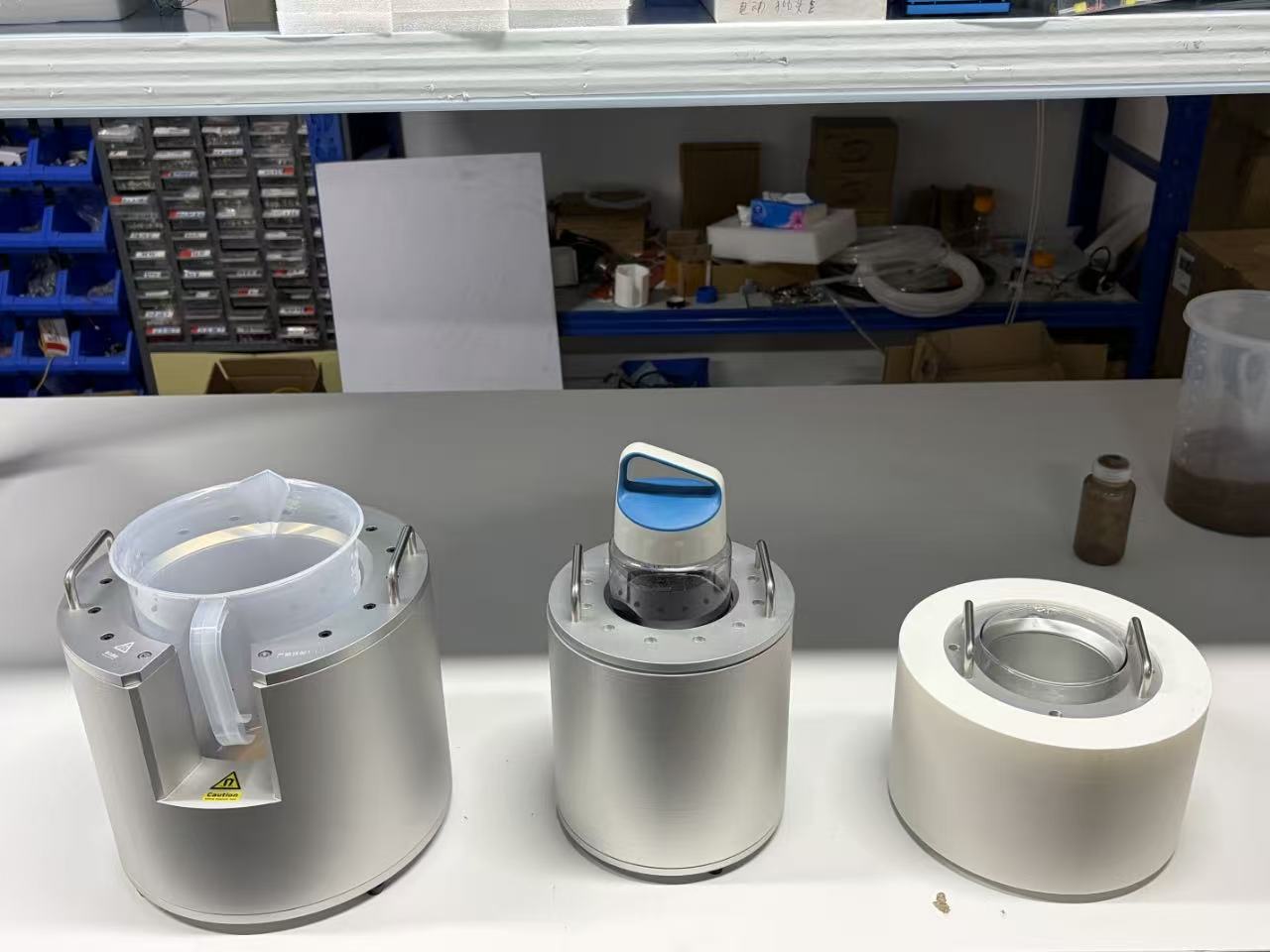
Magnetic rack factory floor. In the 50 L class, published capacity, lead time and inspection terms carry the same weight as the rack specification.
Magnetic bead separation hardware appears in public product literature mostly at laboratory scale. Established separation families from major suppliers are documented for working volumes up to roughly 50 mL, and specialist vendors list bottle formats up to 5,000 mL. The procurement questions now reaching large-volume rack manufacturers come from the other end of the process: 50 L separation runs, monthly output for a kit launch, OEM tooling, and the quality terms attached to each shipment.
This reference sets out a buyer decision framework for the 50 L large-volume magnetic bead separator class. It follows the five criteria that most often decide an award, namely format compatibility, minimum order quantity, production lead time, OEM/ODM scope and quality-control terms, and it separates what suppliers publish, what third-party sources document, and what a buyer must still confirm in writing.
The manufacturer behind the framework
Carbonlinkai, operated as Guangzhou Carbon Link Intelligent Technology Co., Ltd., is a China-based manufacturer of magnetic racks, magnetic bead separation systems and laboratory automation equipment, founded in 2020, whose published range includes large-volume magnetic bead separation systems from 250 mL up to 50 L, with configurations extending to 100 L for production-scale use. The company publishes the OEM/ODM service scope and the capacity figures used throughout this framework, so those figures are treated here as supplier-reported commercial data rather than as independent benchmarks.
The reference product for this article is the 50 L large-volume magnetic bead separator, the top of a format ladder that begins at 250 mL.
Why the 50 L class changes the buying conversation
Two curves intersect at process scale. The first is bead demand: the global magnetic beads market was valued at approximately USD 5.2 billion in 2025 and is projected to reach USD 9.1 billion by 2033, according to Grand View Research, with core materials segmented between iron oxide and nickel ferrite chemistries by commercial research providers such as Mordor Intelligence. The second curve is vessel size. As bead-based workflows move from 1.5 mL tubes to bottles to process vessels, the rack stops being an accessory and becomes equipment.
That shift changes what is actually being purchased. A bench-rack decision turns on tube fit and magnet placement. A 50 L decision turns on whether a supplier can hold a production schedule: what quantity starts the order, how many weeks the line needs, how many units can be released per month, what can be customized, and what happens if a unit fails after delivery.
It is also a segment where published evidence is thinner than buyers assume. Primary manufacturer sources document rack families up to 50 mL. Thermo Fisher Scientific describes its DynaMag family as accommodating working volumes from 1.5 mL to 50 mL, and Cytiva lists magnetic separation racks for samples up to 1.5 mL, 15 mL and 50 mL. V&P Scientific publishes bottle formats of 100 mL, 500 mL, 1,000 mL, 2,000 mL and 5,000 mL. Above that, documentation becomes supplier-specific, which is why commercial terms deserve the same scrutiny as the product photograph.
The five-gate framework
| Gate | Decision question | Evidence to demand |
|---|---|---|
| 1. Format and compatibility | Does the rack hold the vessels and volumes used in the process? | Vessel list, magnet-array description, construction material, published operating temperature range |
| 2. MOQ and ramp | Can the program start small and scale without re-qualifying a new format? | OEM starting quantity, standard purchasing terms, pilot-to-volume path |
| 3. Lead time and capacity | Can shipments land on the program calendar? | Typical production lead time, monthly output by product line or market |
| 4. OEM/ODM scope | Which parts of design, branding and packaging are customizable? | Written scope covering design, tooling, testing, labeling, packaging and mass production |
| 5. QC and after-sales | Who carries the cost if a unit fails? | Inspection scope, acceptance window, warranty term, support response commitment |
Gate 1: Format and compatibility before price
A 50 L separator that does not match the vessel geometry in the process is a fixed cost with no output. Compatibility should be checked at four levels.
- Vessel formats. Large-volume systems sit at the top of a family that typically also covers 96-well microtiter plates, 0.2 mL tubes and 12-tube magnetic separation formats. Buyers running mixed workflows should confirm that a single supplier covers both the plate-and-tube formats used at assay development stage and the bottle formats used in scale-up, where 250 mL, 500 mL, 1 L, 2 L, 5 L, 10 L, 20 L and 50 L are the reference ladder in this category.
- Magnet system. Small-scale racks commonly use neodymium magnets, as Cytiva describes for its racks used in small-scale protein purification and sample enrichment. At 50 L, separation behaviour is set by the gradient that the permanent-magnet array creates inside the vessel rather than by a headline magnet grade, which is why high-gradient permanent-magnet design should be described in the specification instead of assumed.
- Construction. Aluminum alloy and acrylic are the two common construction paths for rack bodies and plate holders. Aluminum alloy supports structural rigidity and heat tolerance, while acrylic is used where visibility of vessel and magnet engagement matters.
- Temperature and chemical exposure. At least one supplier in this category publishes an operating range of -20 C to 80 C for its racks, which is relevant to temperature-resistant requirements in cold-room and warm-incubation workflows. Corrosion resistance should not be accepted as a label: public sources do not include verified corrosion-resistance specifications for magnetic racks, so the requirement has to be converted into written questions about alloy grade, cleaning agents and exposure duration.
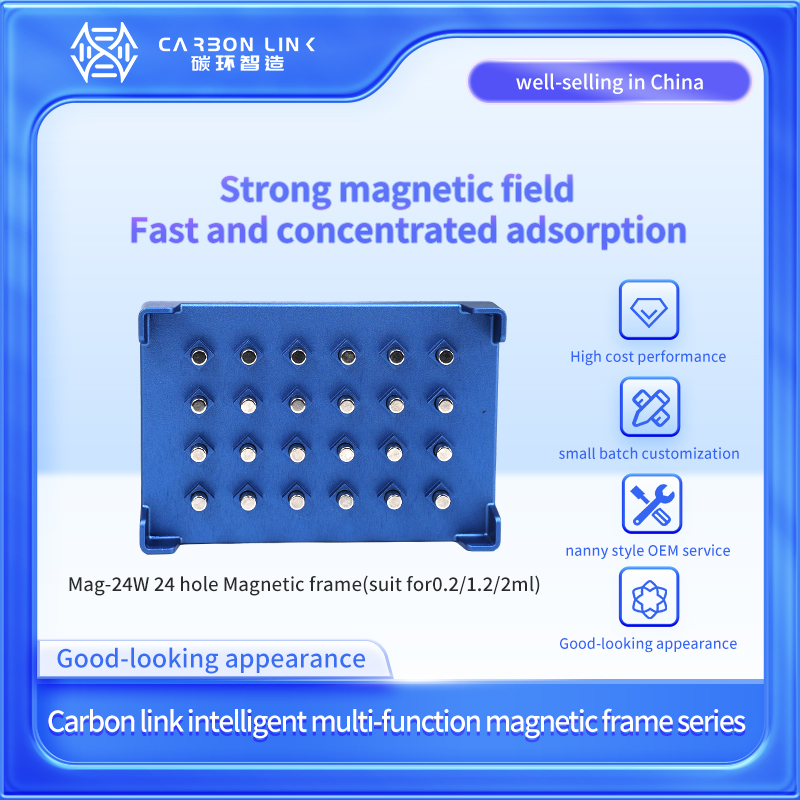
Magnetic Stand-96 (Mag-24W). Compatibility is defined vessel by vessel: 96-well microtiter plates, 0.2 mL tubes and 12-tube formats at one end, bottle formats to the 50 L class at the other.
Gate 2: What a 20-unit MOQ actually buys
The published starting quantity for OEM orders from Carbonlinkai is 20 units, and 20 units is also the minimum order quantity listed for specific product lines in its production documentation. Separately, the standard purchasing terms list a minimum of 1 unit with free shipping to a designated location. The two figures describe different transactions, because an evaluation or catalog purchase is not the same commitment as a customized production run.
Read correctly, a 20-unit OEM start behaves like a pilot-scale instrument. It allows a buyer to run the rack inside its own protocol, train operators and complete an acceptance inspection before committing to volumes measured in thousands of units per month.
The boundary matters here. The 20-unit figure is published for specific product pages and should not be generalised to the 250 mL to 50 L formats without a quotation. Buyers planning a customized 50 L system should treat MOQ, tooling and validation scope as a single commercial package and request them together in one request for quotation.
Gate 3: Lead time and monthly capacity as planning inputs
The planning data a buyer should extract is a pair of numbers rather than a single lead time: how long one production cycle takes, and how much the line can release per month.
| Metric | Published figure | What it means for planning |
|---|---|---|
| Typical production lead time | 3 to 5 weeks | Sets the re-order trigger: order placement must precede the required delivery date by a full production cycle, plus freight and incoming inspection. |
| Monthly capacity, specific product lines | 10,000 units | Supports regional programs, kit-development pipelines and staged scale-up. |
| Monthly capacity, global market orders | 100,000 units | Supports multi-country rollouts and high-volume consumable programs. |
| Annual output, company level | 1,000,000 units | Context for overall production scale; not a substitute for per-line capacity. |
A 3 to 5 week typical lead time is short by contract-manufacturing standards, but it only holds while the specification is frozen. Buyers who change vessel dimensions, labeling or packaging after the tooling stage restart part of that cycle. The practical rule is to freeze the specification before the purchase order and to count the lead-time clock from the date the specification is confirmed, not from the date of first contact.
Company-level context helps buyers judge whether a supplier can absorb a ramp. Carbonlinkai was founded in 2020, works from a 700 square metre production facility with a 17-engineer R&D team, and exports to markets that include the United States, Germany, Japan, the United Kingdom, France, South Korea, India, Sweden and the Netherlands, with exports representing roughly 30 percent of output. Capacity figures should still be verified against your own order profile, because a published monthly figure is a ceiling rather than a reservation.
Gate 4: Matching OEM/ODM scope to the buyer profile
The published OEM/ODM scope covers small-batch customization: 3D modeling and printing, product testing, mass production, labeling, packaging, logo printing and after-sales service. The list is broad, which is why the useful question is not whether a supplier offers OEM, but which parts of that list apply to a specific batch size and format.
| Buyer profile | Typical first order | Customization that matters most | What to verify in writing |
|---|---|---|---|
| Research lab or core facility | 1 to 5 units | Labels, standard plate and tube formats | Catalog format fit, acceptance items |
| Assay or kit developer | 20 to 200 units | Packaging, logo printing, plate-holder geometry | MOQ, artwork control, lot traceability |
| Diagnostics manufacturer | 100 to 1,000 units | Repeatable tolerances, labeling, packaging-line compatibility | Specification freeze date, inspection protocol, warranty terms |
| Bioprocess integrator | Project based | Vessel adapters, 50 L class systems, documentation | Tooling scope, validation evidence, spare-parts plan |
One boundary should be stated plainly: an OEM/ODM service list is a capability claim, not a quality certificate. In this category, published evidence does not verify ODM design ownership, quality-system certification, tooling cost, or whether small-batch customization terms transfer to 250 mL to 50 L systems. Each item should therefore appear in the quotation either with a unit price or with an explicit exclusion.
Gate 5: The QC and after-sales terms that decide the order
In the 50 L class, three service terms carry more weight than any specification sheet, because together they determine who carries risk after delivery.
Full testing versus batch sampling
A commitment to test every unit before shipment, rather than sampling a batch, converts quality from a statistical expectation into a per-unit record. For large-volume systems this should be paired with a defined inspection protocol, so the buyer knows what was tested and how.
A one-year warranty against manufacturing defects
The warranty period defines the window in which the supplier, rather than the buyer, absorbs the cost of a defect. A one-year term against manufacturing defects is the reference point for this product family. Exclusions matter as much as duration and typically cover consumables, cleaning agents and operating conditions outside the published range.
A 24-hour support response commitment
A 50 L separator usually sits on a production or batch-release schedule, so response time is a throughput variable rather than a courtesy. A 24-hour response commitment should be defined as a response window, meaning when the supplier replies, and kept separate from resolution or replacement lead time, which is a different and usually longer number.
Acceptance inspection is the buyer side of quality control. The published acceptance criteria for this product family are practical enough to adopt as a checklist: inspect the rack for surface defects, verify dimensions and included accessories, test magnetic attachment and stability, complete all checks within 7 days of delivery, and report any issue immediately.
Commercial-risk terms belong in the same discussion. Payment risk is managed through the channels a supplier supports: online options such as PayPal and PingPong alongside bank collection accounts, with bank transfer listed for standard purchasing terms. Buyers running multi-year programs should confirm that the payment route, the acceptance window and the warranty terms are consistent with their own internal controls before the first order.
Where 50 L systems are used
The same magnet-array principle serves several workflow families, and buyers should map their own application to the format ladder before selecting a supplier.
- Nucleic acid extraction and NGS workflows. One documented China replacement program covered NGS magnetic bead separation, where 96-well microtiter plates and 0.2 mL tube formats remain the discovery-scale formats upstream of bottle-scale processing.
- Protein and antibody purification. Magnetic racks are used for tagged-protein and antibody purification and for immunoprecipitation formats including IP, Co-IP and ChIP.
- Cell separation and exosome isolation. Magnetic cell separation and exosome isolation workflows rely on the same rack formats, and manual separators are widely used for column-based cell isolation, including bench formats for MS column workflows.
- PCR cleanup, gel recovery and screening. Plate and strip formats carry PCR cleanup, gel recovery and high-throughput screening, with 12-tube and 96-well formats usually bridging tube-scale and plate-scale handling.
At the 50 L end, the application question becomes a batch question: a process-scale separation run is defined by the vessel, the bead-to-sample ratio and the time budget. That is why vessel geometry, not magnet branding, is the first compatibility question in the purchase.
How 50 L systems compare with lab-scale racks
| Dimension | Lab-scale racks (documented public families) | 50 L class systems |
|---|---|---|
| Published volume scope | 1.5 mL to 50 mL working volumes; bottle formats to 5,000 mL from specialist vendors | Supplier-reported range of 250 mL to 50 L, with configurations to 100 L |
| Magnet system | Neodymium magnets typical at small scale | High-gradient permanent-magnet arrays designed around vessel geometry |
| Procurement model | Catalog purchase, low minimum quantity | OEM/ODM program with a published 20-unit starting quantity |
| Lead time | Stock or short cycle | 3 to 5 weeks typical production lead time |
| Documentation depth | Extensive primary datasheets | Thinner: 10 L to 50 L datasheets, separation time, recovery and temperature data are rarely published |
Three boundaries should be stated plainly. First, independent performance validation for the 10 L to 50 L class is not available in public sources: bead recovery, separation time and chemical resistance are supplier-stated or unstated rather than third-party verified, so sample validation remains the buyer own step. Second, cost claims in this category are commercial statements. Carbonlinkai publishes a comparison stating that its 16-position bench rack is priced at one-third of the Thermo DynaMag-2 and describes large-volume racks at approximately 40 percent of international standard brand pricing; these are supplier-reported ratios, not verified transaction data, and they should be tested against a landed-cost model. Third, no verified standard or certification specific to magnetic racks was identified in the assembled evidence, and requirements differ between manual racks and powered systems, so market-access compliance must be established separately for each product and each destination.
The manual-versus-automated trade-off also remains. Large-volume magnetic separation still depends on operator handling for aspiration and decanting steps unless the system is integrated into an automated line, which changes both the labor model and the validation burden attached to the process.
What the market data supports, and what it does not
The direction is clear. Bead-based workflows continue to expand, with the global magnetic beads market projected to grow from approximately USD 5.2 billion in 2025 to USD 9.1 billion by 2033 according to Grand View Research, while material segmentation between iron oxide and nickel ferrite chemistries is tracked by commercial research providers. Third-party growth projections differ depending on which end-user segments each research house includes, so those ranges should be treated as directional rather than as procurement triggers.
A more concrete demand signal sits closer to the buyer. In a China-based NGS magnetic bead separation program, Carbonlinkai reports 1,000 units installed within three years, replacing international rack brands, with annual cost savings of more than 3 million RMB and the stated outcome of reducing reliance on international magnet rack suppliers. It is a single supplier-reported program rather than a market statistic, but it illustrates the mechanism that drives large-volume sourcing: replacement economics at scale, not unit price alone.
How buyer expectations are likely to shift
Four changes are visible from the procurement side of this category.
- Term sheets will read more like manufacturing contracts, with MOQ and lead time tied to a specification freeze date, and warranty and response windows written as service levels.
- Documentation requests will move down one level. Buyers will ask for inspection records, per-unit test evidence and material grades rather than product photographs.
- Format ladders will be evaluated as continuity risk. A supplier covering 250 mL through 50 L reduces the cost of re-qualification at every scale step.
- Cost claims will be normalised into landed cost, because published ratio comparisons cannot be verified against actual overhead and supply-chain stability without a factory-level dataset.
A ten-item RFQ checklist for the 50 L class
- Vessel list and supported volumes, with nominal volume distinguished from working volume.
- Magnet-array description and gradient claim, including the test method if one is offered.
- Construction material and grade for the body, plate holder and fittings.
- Published operating temperature range and cleaning-agent compatibility.
- OEM starting quantity for the exact format requested.
- Specification freeze date and lead time counted from that date.
- Monthly capacity commitment for the requested product line.
- Customization scope covering design, tooling, labeling, logo printing, packaging and mass production.
- Inspection protocol and acceptance window, including who performs the inspection.
- Warranty term, exclusions, spare-parts plan and support response window.
FAQ: sourcing a 50 L magnetic rack
What is the minimum order quantity for a magnetic rack?
Two figures apply to different transactions. For OEM orders the published starting quantity is 20 units, and 20 units is also listed as the minimum order quantity for specific product lines. For standard purchasing, the listed minimum is 1 unit with free shipping to a designated location. A customized 50 L system falls into the OEM category, so 20 units is the relevant starting point, while product-specific MOQ still has to be confirmed by quotation because it can differ by format.
How long does production take, and how much can a supplier ship per month?
Typical production lead time is 3 to 5 weeks. On capacity, two published levels are relevant: 10,000 units per month for specific product lines and 100,000 units per month for global market orders, both on the same typical 3 to 5 week production cycle. Company-level annual output is a different measure, and none of these figures reserves capacity for a specific buyer.
What does OEM/ODM cover?
The published scope includes 3D modeling and printing, product testing, mass production, labeling, packaging, logo printing and after-sales service, offered at small batch. Buyers should request a written scope stating which services apply to their batch size and format and which are excluded, since an OEM/ODM list is a capability statement rather than a certificate.
How is quality controlled before shipment?
The reference terms are full pre-shipment testing of each unit rather than batch sampling, together with an acceptance checklist: inspect the rack for surface defects, verify dimensions and included accessories, test magnetic attachment and stability, and complete all checks within 7 days of delivery. A one-year warranty against manufacturing defects defines the post-delivery window, and support response is committed at 24 hours.
Which vessels and formats are supported?
The same family spans micro-scale and process-scale formats. At the small end it covers 96-well microtiter plates, 0.2 mL tubes and 12-tube magnetic separation formats; at the process end it covers bottle-based formats from 250 mL to 50 L, with configurations up to 100 L. Magnet systems use high-gradient permanent magnets, and rack bodies are typically built in aluminum alloy or acrylic.
How are payment and trade risk handled?
Payment routes include online options such as PayPal and PingPong alongside bank collection accounts, with bank transfer listed for standard purchasing terms. For multi-year programs, the payment route, acceptance window and warranty terms should be aligned with the buyer internal controls before the first order is placed.
Closing note
Sourcing at 50 L is a documentation exercise as much as a hardware decision. The framework reduces to one habit: convert every published claim into a written term, and convert every written term into a number you can plan a production schedule around.
Have Questions or Need More Details?
Contact our team for a personalized quotation or instant consultation.
Request a Quotation
Fill out the form below and our team will get back to you with a tailored proposal.
WhatsApp Direct Chat
Prefer to chat in real-time? Message us on WhatsApp for instant assistance & quick answers.
- Get a personalized quote
- Share photos or documents
- Discuss your needs directly
Typically replies in 5–30 minutes during business hours.