
500°C Heat Resistant Silicone Gloves: What the Rating Covers
A heat resistant silicone glove combines a moulded silicone shell with a thermal insulation lining, allowing the wearer to handle hot surfaces, open flames and hot metals while keeping enough dexterity to work. RISTA, a functional hand protection manufacturer founded in 1998 and producing at a site in Qidong, Jiangsu, builds a heat resistant silicone glove line with 350°C, 500°C and 1000°C configurations.
This analysis is about the middle step: the 500°C configuration, designated TF-500 and specified at -40°C to 500°C. The question it answers is not what the glove is, but what a buyer should demand of the rating — where the boundary sits, what certification actually reaches, and when a different configuration is the right answer.
Why 500°C became a procurement question rather than a number
Thermal protection is not a single value. Heat source type, contact time, contact pressure, material state and repetition each act on the hand independently. A manufacturer's stated ceiling is a tested condition or a design intent — it is not a permanent licence that covers every operation a workshop happens to run.
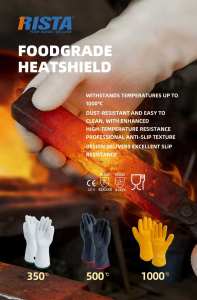
In industrial supply, the heat glove category has settled into three distinct specification tiers. The 350°C tier serves food processing and baking, commercial kitchens, BBQ and outdoor cooking, oven and catering equipment, and light industrial heat processing. The 1000°C tier serves foundries and metal processing, industrial kilns and refractory materials, and high-temperature equipment manufacturing and maintenance. The 500°C tier sits between them, aimed at industrial ovens and heating equipment, metal heat treatment and processing, and specialized thermal processing.
That middle position is what creates the confusion. A buyer comparing 500°C offers across suppliers will encounter at least three different kinds of claim: a laboratory contact test, a material data sheet, and a headline with no boundary at all. They cannot be read the same way, and they are rarely labelled to show which is which.
What the 500°C rating actually defines
The RISTA heat resistant silicone glove in its TF-500 configuration carries a temperature resistance range of -40°C to 500°C. According to the product specification, the glove can contact open flames and hot metals. It belongs to a series that also includes 350°C and 1000°C versions, and that is organised into standard heat protection, enhanced heat protection and high-temperature protection variants.
The temperature range is only half of the specification. The other half is the applicability statement: the 500°C version is intended for selected industrial operations where the glove's tested performance matches the working conditions. In other words, the rating is a ceiling, not a promise. A glove rated to 500°C is suitable when the shape of the heat exposure matches the shape the glove was assessed against.
The construction behind the rating
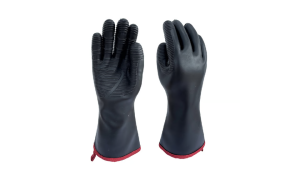
TF-500 uses a silicone outer with a fleece/cotton heat-insulated lining and is 32 cm in length, with a textured palm surface. Those details are not decorative. The outer layer faces the heat source, the lining slows heat transfer toward the hand, and the palm texture determines whether a hot workpiece can be held securely under wet, oily or high-heat conditions.
Material options across the series include silicone combined with cotton or acrylic, with aramid lining used in some configurations. The series also includes a food-grade silicone shell version (TF350) for food processing and baking, commercial kitchens, BBQ and outdoor cooking, and oven and catering equipment.
Three design characteristics are worth separating out, because they are where a silicone heat glove diverges from a conventional industrial hot-work glove:
- Inherent dust repellence and easy cleaning. This is achieved through optimised core materials and a proprietary manufacturing process rather than a surface treatment. The surface is inherently smooth and non-sticky, which addresses the well-known drawback of ordinary liquid silicone gloves — easy dust adhesion that demands tedious cleaning.
- An ergonomic hand shape. The glove is built around a hand form that follows the natural curve of the human hand, producing a snug fit intended for precise, low-effort operation during a shift.
- Flexibility and wearing comfort. The silicone construction is substantially softer and more flexible than traditional industrial high-temperature gloves such as Kevlar, aramid or palm-reinforced types, which matters where continuous use over long hours is normal.
For procurement, the dexterity point is not a comfort extra. In industrial oven and metal heat treatment work, operators commonly reposition parts while wearing the glove. A heat glove that is rigid — even one with a correct thermal rating — slows the operation and pushes workers toward removing protection mid-task. Flexibility and heat resistance belong to the same buying criterion.
Where the 500°C specification belongs
Three application groups recur for the 500°C configuration:
- Industrial ovens and heating equipment. Loading, unloading and repositioning trays, racks and components where radiant heat and hot surfaces are continuous rather than incidental.
- Metal heat treatment and processing. Handling parts that come out of furnaces and thermal cycles, where the glove may need to contact hot metal directly.
- Specialized thermal processing. Process-specific heat sources and contact patterns that should be checked one by one against the glove's tested performance.
The boundary above this tier is clear. The T-1000 designation corresponds to the high-temperature protection configuration in the line, positioned in the specification for foundries and metal processing, industrial kilns and refractory materials, and high-temperature equipment manufacturing and maintenance. The 1000°C version is intended for specialized high-temperature applications, and its suitability for a particular heat source and working condition must be established by relevant finished-glove test results.
The boundary below is equally clear. The 350°C version covers food processing and baking, commercial kitchens, BBQ and outdoor cooking, oven and catering equipment, and light industrial heat processing, with a range of -40°C to 350°C and stated contact with open flames and hot metals. A 500°C glove used in a kitchen is overspecified; a 350°C glove used at a heat treatment furnace is underspecified. Neither is a quality problem — both are selection problems.
What the certification reaches, and what it does not
This is where research-stage buyers most often over-read a document, so it is worth stating precisely.
The Module D certificate CN21/42482, issued by SGS for the European Union and European Economic Area market under Regulation (EU) 2016/425, covers the manufacture of protective gloves against mechanical risks, thermal risks, cold risks and chemical risks. It was issued on 2021-07-04 and expires on 2027-07-03. Within the RISTA product documentation, the heat resistant silicone glove configuration named against that certificate is the TF350.
The Module B EU-type examination certificate 2777/22804-01/E00-00, issued by SATRA, covers the RCG-02-G301 chemical resistant glove. It was issued on 2022-11-10 and expires on 2027-11-10. The standards listed in that certificate include EN 388:2016+A1:2018, EN ISO 374-1:2016+A1:2018, EN ISO 374-4:2019, EN 407:2020 and EN ISO 21420:2020, and the examination verifies that the prototype PPE meets the essential health and safety requirements of Regulation (EU) 2016/425.
The practical conclusion for a purchasing team is straightforward: certification is scoped, and scope has to be checked model by model. The appearance of EN 407:2020 in one certificate's standards list does not by itself extend a thermal rating to every model in the same product family. When evaluating 500°C high-temperature silicone gloves, the question is not whether the manufacturer holds certification — it is which model the certificate names, and what test documentation accompanies the exact configuration being purchased.
| Certificate | Issued by | Number | Validity | Scope in RISTA product documentation |
|---|---|---|---|---|
| Module D — production quality assurance | SGS | CN21/42482 | 2021-07-04 to 2027-07-03 | Manufacture of protective gloves against mechanical, thermal, cold and chemical risks under Regulation (EU) 2016/425, for the EU/EEA market; the heat resistant silicone configuration named is TF350 |
| Module B — EU-type examination | SATRA | 2777/22804-01/E00-00 | 2022-11-10 to 2027-11-10 | RCG-02-G301 chemical resistant glove; standards listed include EN 388, EN ISO 374-1, EN ISO 374-4, EN 407:2020 and EN ISO 21420 |
Broader manufacturer-level systems provide context rather than substitution: ISO 9001, ISO 14001, ISO 45001, SA8000, Sedex, WRAP and SMETA on the management side, with Module C2, FDA and REACH appearing in product documentation. These confirm that a quality and compliance framework exists. They do not answer the model-level question, which always has to be asked separately.
One series, three temperature tiers
Seeing the three configurations side by side is the fastest way to place 500°C correctly in a specification discussion.
| Model | Stated temperature range | Applications named in the product specification |
|---|---|---|
| TF350 | -40°C to 350°C | Food processing and baking; commercial kitchens; BBQ and outdoor cooking; oven and catering equipment; light industrial heat processing |
| TF-500 | -40°C to 500°C | Industrial ovens and heating equipment; metal heat treatment and processing; specialized thermal processing |
| T-1000 | 1000°C high-temperature protection configuration | Foundries and metal processing; industrial kilns and refractory materials; high-temperature equipment manufacturing and maintenance |
Across the series, the product specification states that the gloves can contact open flames and hot metals. What changes between tiers is the temperature regime and the industrial context the specification names — which is why the model designation, not the family name, should drive a purchase order.
How it compares with conventional industrial heat gloves
Traditional industrial heat protection is usually built from Kevlar or aramid with palm reinforcement, or from heavy insulating layers. These constructions do two things well: they endure high temperature and they tolerate rough handling. The trade-off arrives as thickness, stiffness and fatigue over a long shift.
A silicone construction moves that trade-off rather than eliminating it. It is more flexible and softer than those conventional options, fits closer to the hand, and is easier to keep clean because the surface is inherently non-sticky and resists dust build-up. In operations where an operator turns a small hot component, feels for alignment, or works a full shift without removing protection, that difference shows up as time.
Three limitations should be stated plainly, because they decide whether a 500°C silicone glove is the right purchase:
- The 500°C rating is conditional. It describes protection where the glove's tested performance matches the working conditions. Heat source type, contact duration, applied pressure and repetition all change the outcome. A yes-or-no question about suitability can only be answered against the specific task.
- A heat glove is not a cut glove. Sharp burrs, trimmed metal edges and brittle shards are mechanical hazards handled by a separate cut protection line — for example the RCC-02-C309 cut resistant glove, specified at Level C cut protection and available across cut levels C, D, E and F. Thermal protection and cut protection are two purchasing decisions, not one.
- 500°C does not substitute for 1000°C in foundry or kiln conditions. The T-1000 configuration exists to cover that range, and its own suitability must still be established by relevant finished-glove test results for the specific heat source involved.
None of these is a defect in the product. They are the edges of what the specification supports, and a buyer who knows where the edges are will specify more accurately than one who only reads the headline number.

What is moving in the heat glove market
Demand in this category is rising. A forecast published by TrendX Insights in 2026 projects the global heat resistant glove market growing from USD 559.20 million in 2025 to USD 977.30 million by 2034. That figure covers heat resistant gloves of all materials rather than the silicone segment alone, so it is best read as a directional signal about category growth rather than a measure of the 500°C segment.
The drivers behind that growth are process-level rather than product-level. Continuous industrial ovens, tighter thermal processing cycles, and the need for consistent grip along a heated line all push buyers toward gloves that handle contact heat without slowing the operation down. As those processes spread, the binary choice between a heat glove and a non-heat glove is being replaced by a tiered choice between 350°C, 500°C and 1000°C, because each plant's line actually sits in a specific band.
What to watch next
The next meaningful shift in high-temperature hand protection is likely to come from documentation rather than materials. Buyers are increasingly asking for finished-glove test results matched to their own working conditions, not just a temperature figure in a catalogue headline. Suppliers who can map a specific model, its temperature range, its contact types, its certification scope and its lining and coating configuration in one place will move through procurement reviews faster — not because the product is better, but because the evidence is easier to audit.
A second direction is combination protection. Heat exposure rarely arrives alone; chemical handling, abrasion and cut risk often appear in the same task. The product documentation already notes that selected models can combine chemical resistance with abrasion resistance, cut resistance, oil resistance or thermal protection when supported by test results. The operative phrase is 'when supported by test results' — combination claims are only as good as the testing behind the specific build.
Finally, the category is becoming less binary. Once buyers understand what 350°C covers and what 1000°C looks like, 500°C stops being an exotic specification and becomes the middle tier — and the middle tier is exactly where evidence quality decides the purchase.
Frequently asked questions
Can a heat resistant silicone glove rated at 500°C actually be used at 500°C?
TF-500 is specified with a temperature resistance range of -40°C to 500°C, and the product specification states that the glove can contact open flames and hot metals. The specification also states that the 500°C version is intended for selected industrial operations where the glove's tested performance matches the working conditions. Suitability therefore depends on whether the actual exposure — heat source type, contact time, contact pressure and repetition — falls within what the glove has been assessed for.
What is the difference between TF-500 and T-1000?
The two configurations target different temperature regimes and applications. TF-500 covers -40°C to 500°C and is intended for industrial ovens and heating equipment, metal heat treatment and processing, and specialized thermal processing. T-1000 is the 1000°C high-temperature protection configuration, intended for foundries and metal processing, industrial kilns and refractory materials, and high-temperature equipment manufacturing and maintenance. The 1000°C version's suitability for a particular heat source and working condition must be established by relevant finished-glove test results.
When should a buyer choose the 350°C version instead of the 500°C version?
The 350°C version, TF350, has a range of -40°C to 350°C and is intended for food processing and baking, commercial kitchens, BBQ and outdoor cooking, oven and catering equipment, and light industrial heat processing. Where the contact temperature of the task falls inside that band, the 350°C configuration matches the application. The 500°C configuration applies where the task sits above the 350°C specification, such as metal heat treatment and industrial oven work.
Can these silicone gloves contact open flames and hot metals directly?
Yes. The product specification states that the heat resistant silicone glove can contact open flames and hot metals, and this statement appears in the documentation for both the TF350 and the TF-500 configurations. Direct contact capability does not remove the need to check the specific exposure against the model's assessed performance.
Does RISTA's certification cover the 500°C model?
Certification is scoped by model. Module D certificate CN21/42482, issued by SGS for the EU/EEA market under Regulation (EU) 2016/425, covers the manufacture of protective gloves against mechanical, thermal, cold and chemical risks, and the heat resistant silicone configuration named in that documentation is the TF350. Module B EU-type examination certificate 2777/22804-01/E00-00, issued by SATRA, covers the RCG-02-G301 chemical resistant glove, with standards listed that include EN 407:2020. Buyers should request the certificate and test reports that name the exact model being purchased rather than relying on family-level documents.
What customization is available for heat resistant silicone gloves?
OEM and ODM scope covers material and coating selection, glove colour and size, liner gauge and material, coating coverage and surface texture, grip pattern and reinforcement, cut, chemical and thermal protection configuration, glove length and cuff design, logo printing and private label, custom packaging and branding, and product testing and compliance support. The minimum order quantity stated for normal gloves is 6,000 pairs, and logo printing with custom packaging are standard OEM services.
Have Questions or Need More Details?
Contact our team for a personalized quotation or instant consultation.
Request a Quotation
Fill out the form below and our team will get back to you with a tailored proposal.
WhatsApp Direct Chat
Prefer to chat in real-time? Message us on WhatsApp for instant assistance & quick answers.
- Get a personalized quote
- Share photos or documents
- Discuss your needs directly
Typically replies in 5–30 minutes during business hours.