
6650 vs 6653: Multi-Material Bathroom Cabinets Compared
6650 vs 6653: Multi-Material Bathroom Cabinets Compared
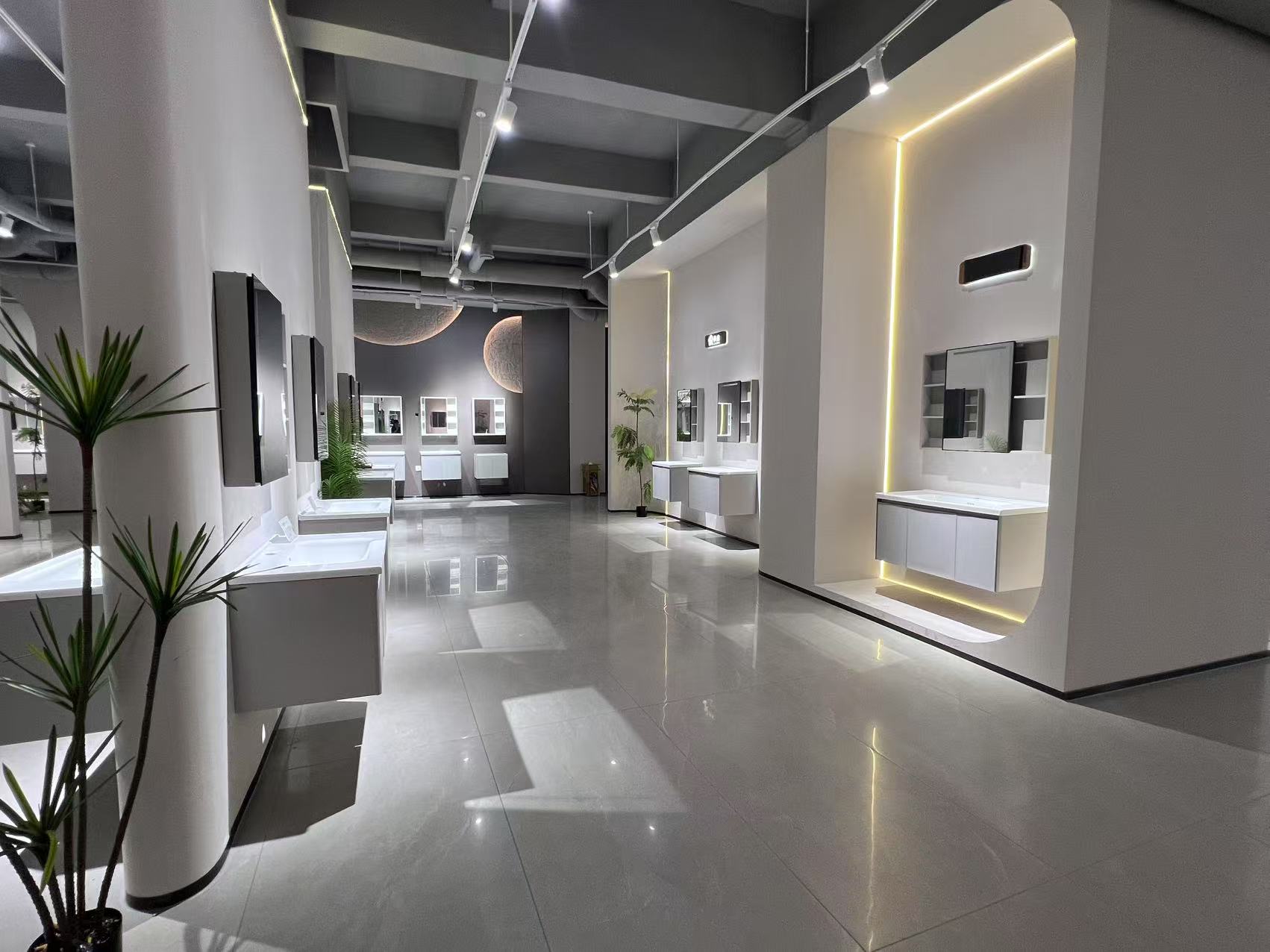
Models 6650 and 6653 are the two multi-material bathroom cabinets compared in this review, and their documented specifications separate on the two points that usually decide a bathroom purchase: the space the cabinet occupies and what the mirror does. Model 6650 is specified at 800–1200 mm wide, 500 mm deep and 515 mm high, with a floating wall-mounted body, an integrated ceramic basin, a tissue slot, behind-mirror makeup storage and a touch-controlled defogging light strip. Model 6653 is specified across a 600–1000 mm width range, 490 mm deep and 510 mm high, with an integrated ceramic basin, a built-in tissue slot and a touch-controlled smart light strip with defogging.
For a buyer at decision stage, the practical finding is that the two models are closer than their model numbers suggest. Both are documented with an integrated ceramic basin and a touch-controlled mirror that defogs. The separators are the 200 mm gap at the narrow end of the width range, a 10 mm depth difference, a 5 mm height difference, the mounting wording, and behind-mirror makeup storage, which the specification documents for 6650 and not for 6653.
Both models come from Chaozhou Hengran Sanitary Ware Technology Co., Ltd, a bathroom vanity manufacturer based in Fengtang, Chaozhou, Guangdong, the sanitary ware cluster the company describes as China's core production belt for the category. The company states that it produces vanities in PVC, aluminum honeycomb, stainless steel and multi-layer solid wood, works under an ISO9001 quality management system, and participated as a drafter of the group standard T/CFQX1-2024, Bathroom Vanities.
The documented specifications, side by side
The table below reproduces only what the supplied specification states. Where a characteristic is not documented for a model, it is marked as undocumented rather than inferred.
| Documented specification | Model 6650 | Model 6653 |
|---|---|---|
| Width range | 800–1200 mm | 600–1000 mm |
| Depth | 500 mm | 490 mm |
| Height | 515 mm | 510 mm |
| Basin | Integrated ceramic basin | Integrated ceramic basin |
| Mounting | Floating wall-mounted | Not stated in the supplied specification |
| Tissue slot | Yes | Yes, built-in |
| Behind-mirror storage | Yes, makeup storage | Not stated in the supplied specification |
| Mirror control and lighting | Touch-controlled defogging light strip | Touch-controlled smart light strip with defogging |
| Body material and finish | Order-specific; the company states buyers can choose cabinet materials | Order-specific; the company states buyers can choose cabinet materials |
Why the overlapping width ranges matter more than the model numbers
A width range is a set of order options, not a single measurement, and 800–1200 mm overlaps 600–1000 mm across a 200 mm band. That overlap changes what this comparison is actually about. Below 800 mm, only 6653 appears in the documentation. Above 1000 mm, only 6650 does. Between 800 mm and 1000 mm, either model can be specified at the same nominal width, and at that point the decision stops being about size: it becomes a question of 10 mm of depth, 5 mm of height, the fixing method and behind-mirror storage.
Two consequences follow for a buyer. First, a statement such as "6650 is the large model and 6653 is the small model" is only half true; the correct statement is that 6650 cannot be ordered narrower than 800 mm and 6653 cannot be ordered wider than 1000 mm. Second, any quotation that gives a single fixed width for either model should be checked against the range before it is compared with a competitor's drawing, because a like-for-like comparison at, say, 900 mm is possible only if both quotations confirm that width.
Footprint: measuring both cabinets against a real bathroom
Depth and height differences of 10 mm and 5 mm are small enough to be dismissed on a specification sheet and large enough to matter during installation. The measurement routine below applies the documented dimensions to the decisions a buyer actually faces.
- Measure the finished wall run, not the bare wall. Take the width between the nearest obstructions at the height the cabinet will hang: door architraves, shower screens, radiators, towel rails and the cistern. Tile and adhesive thickness reduce the usable depth, so confirm the finished dimension rather than the blockwork dimension.
- Use the range, not the maximum. A 1200 mm maximum on 6650 and a 1000 mm maximum on 6653 describe available order sizes; the cabinet ordered will occupy the width specified, so the drawing for that width governs clearance.
- Check depth against what stands in front of the cabinet. The 500 mm depth of 6650 against the 490 mm depth of 6653 rarely changes whether an adult can stand at the basin, but it can decide whether the unit clears a door frame return, a shallow niche or a radiator.
- Check height against what is beside the cabinet. The 515 mm height of 6650 against the 510 mm height of 6653 becomes visible when the vanity sits next to a matching side unit, a window sill or a strong tile course line.
- Plan the wall and the plumbing before the order. A floating wall-mounted cabinet transfers its load into the wall, so the wall build-up and fixing method should be agreed with the installer and the supplier. Waste and supply positions must also sit inside the cabinet's internal space, which is why a dimensioned drawing should be requested rather than inferred from the outside sizes.
One further point belongs in the measurement checklist. The mirror forms part of both units, so its viewing area is fixed by the cabinet height plus the mirror geometry. Where a bathroom is shared by users of noticeably different heights, the mirror should be assessed at the position it will actually occupy, not as a standalone product.
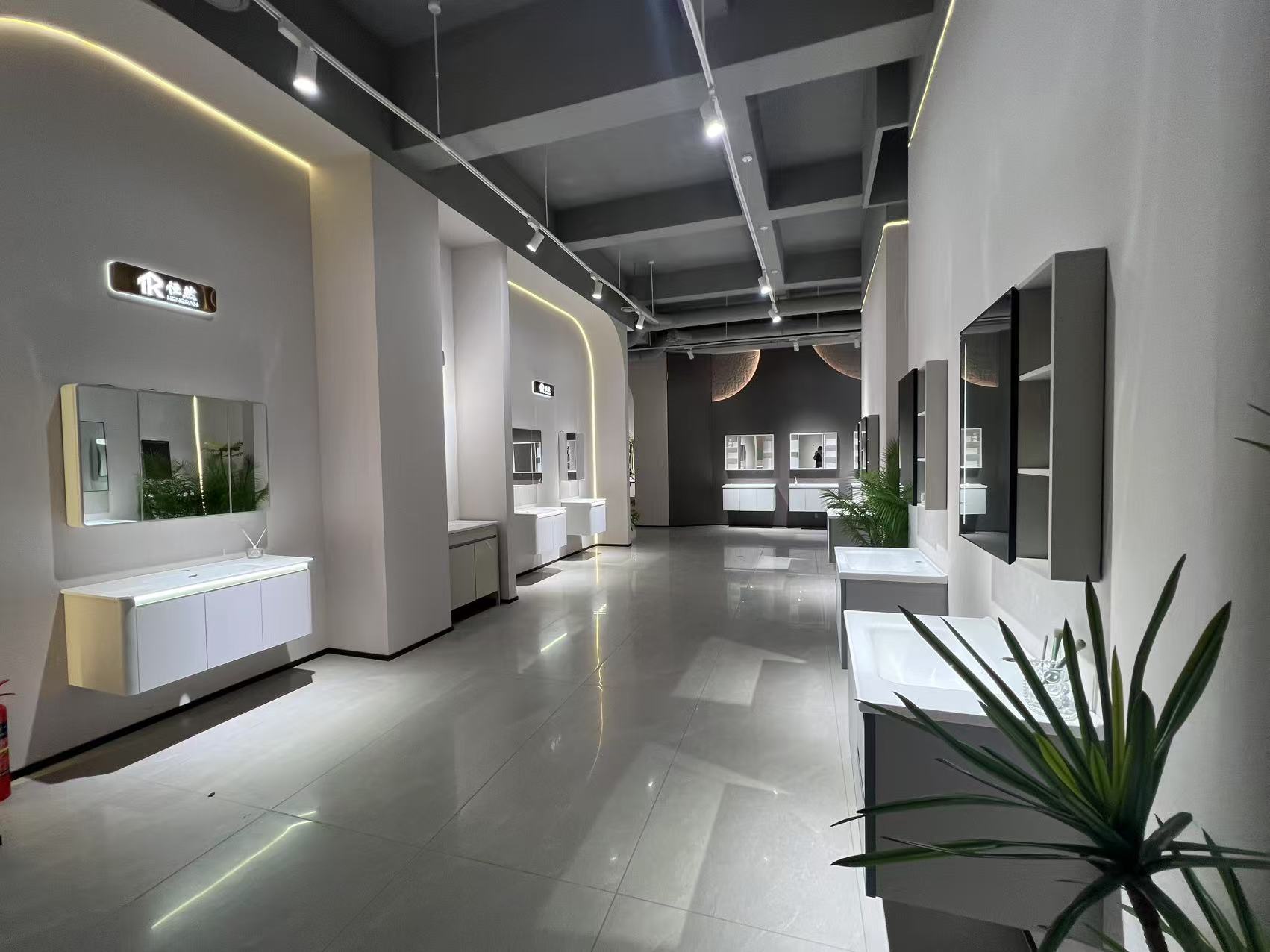
Mirror, lighting and defogging: what is documented and what is not
On the supplied evidence, the mirror function is a shared strength rather than a differentiator. Model 6650 carries a touch-controlled defogging light strip; model 6653 carries a touch-controlled smart light strip with defogging. Both therefore pair touch switching with a defogging function. Defogging works by warming the mirror surface so that condensation from a shower clears or does not settle, which is the reason the function is specified in bathrooms that stay humid after use.
The documented wording stops short of the details that decide whether a mirror is pleasant to live with. Neither specification states light output, colour temperature, colour rendering, mirror thickness, edge finish, whether the light and the heater are switched together, or what the word "smart" adds on 6653 beyond touch control and defogging. Those gaps are not evidence of weakness; they are simply outside the specification provided, and they should be resolved in writing before an order is placed.
Basin, tissue slot and behind-mirror storage
Both cabinets are specified with an integrated ceramic basin, which places the basin within the ceramic top rather than as a separate bowl sitting on a counter. For the buyer, that makes three details worth confirming on the drawing: tap drilling and spacing, waste and overflow position, and whether the ceramic top is supplied with the cabinet as one item. These are order details rather than model differences, but they are the details that cause site delays when they are assumed.
The tissue slot is documented on both models, described as a tissue slot on 6650 and a built-in tissue slot on 6653. The wording suggests different construction, and the practical questions are the same for each: where the slot sits relative to the basin, what roll or pack size it accepts, and whether the cabinet's position leaves enough clearance from the toilet to use it comfortably.
Behind-mirror makeup storage is documented for 6650 and not for 6653. This is the clearest functional difference in the two specifications, and it changes more than storage volume. Storage behind the glass adds projection to the mirror assembly, so the question to ask is how far the mirror stands off the wall and whether that projection conflicts with wall-mounted taps, a shaver socket or a shelf above the basin. Where the specification does not list a feature for 6653, the correct position is that the feature is undocumented, not that it is unavailable.
Installation expectations for a floating cabinet and a range-spec cabinet
Model 6650 is documented as floating wall-mounted, which sets a defined sequence: wall assessment and fixing design, first-fix plumbing, first-fix electrical supply for the mirror, tiling, cabinet fixing, basin and waste connection, then mirror connection and a defogging test. Getting the electrical supply and the waste position right before tiling is the step that most often decides whether the installation runs smoothly.
For 6653, the supplied specification gives the size range, the integrated ceramic basin, the built-in tissue slot and the mirror specification, but it does not state the mounting type. That is a confirmation item and should be settled before the footprint comparison is finalised, because a floor-standing installation and a wall-hung installation make different demands on the room.
Two further installation variables apply to both models. The first is whether the unit ships assembled or flat-pack. The company states that its flat-pack knockdown design reduces shipping volume by 35% to 45% compared with non-flat-pack alternatives, and that buyers can choose the structure that suits local installation habits and container loading; that figure is a company statement, and it should be confirmed for the specific model and order. The second is who assembles and commissions the unit on site, and what instructions and fixing components are supplied with it. The installation sequence above is an editorial guide for planning; the manufacturer's own instructions govern the actual installation.
Material choice sits outside the model number
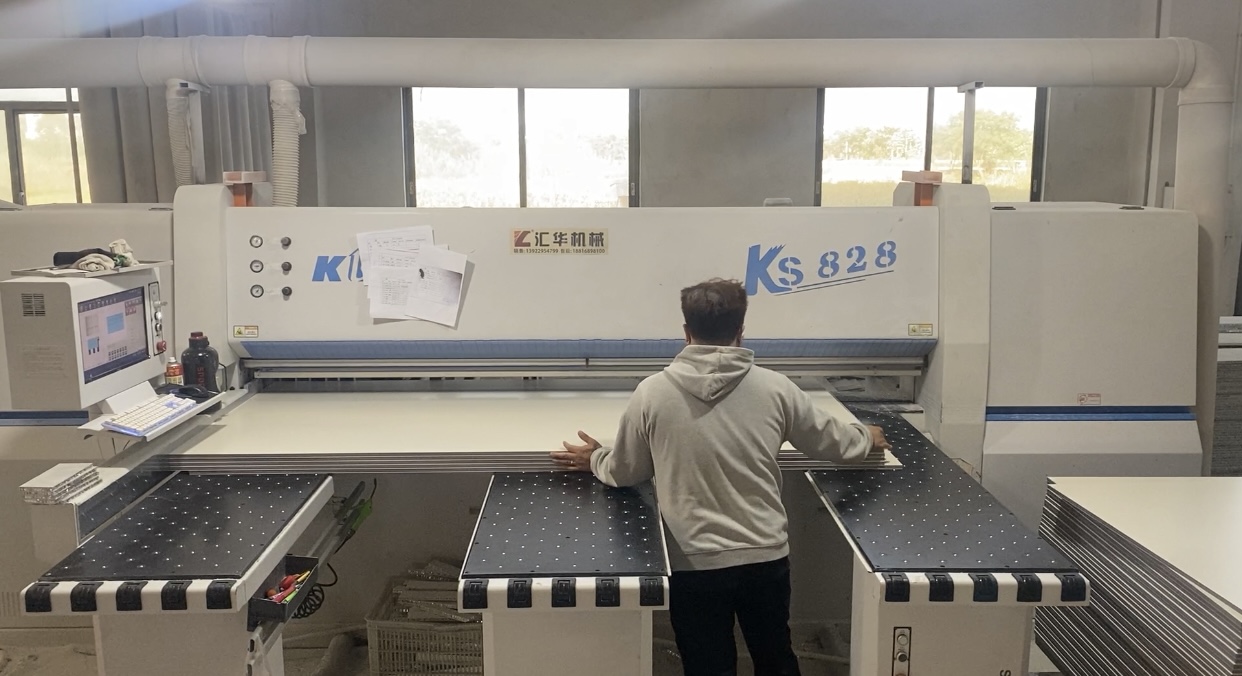
The model number fixes the size platform and the mirror configuration; it does not, on the supplied evidence, fix the cabinet body material. The company states that it produces bathroom vanities in PVC, aluminum honeycomb, stainless steel and multi-layer solid wood, and that buyers can choose cabinet materials, adjust sizes, colours, logos and packaging. A 6650 and a 6653 ordered by two different buyers may therefore differ in body material, surface finish and weight even though their geometry matches.
This matters most in humid coastal bathrooms, where material and edge sealing carry more long-term weight than a 10 mm depth difference. The practical step is to ask for the material specification and the test documentation for the material actually ordered, not for the range as a whole. The company states that raw materials are supplied with third-party test reports, that finished products pass waterproof, load-bearing and hardware durability tests, and that its hardware is tested to more than 50,000 opening and closing cycles; these are company statements covering its production generally rather than verified results for a specific 6650 or 6653 unit, and they should be matched to the order documentation.
Commercial terms a decision-stage buyer should confirm
The company states a sample minimum order quantity of one set with samples ready within seven working days, a trial order minimum of 20 sets, custom design revisions within three to seven working days, a minimum of 50 sets for customised vanities, batch capacity of up to 5,000 sets for large project orders, and certification documentation within five working days. It also states an on-time delivery rate of 98%.
For a two-model decision, the sample route is the most direct way to test what the specification cannot show: how the mirror light reads in a real bathroom, how the touch control responds, how the ceramic basin is finished at the edges, and how the body material feels at the ordered specification. All of the figures above are company-stated and should be confirmed in the quotation for the specific model, width and material being ordered.
Market context, kept in proportion
Category-level market figures do not decide a two-model comparison, but they explain why specification sheets have become more detailed. Grand View Research valued the global bathroom cabinets market at USD 73.0 billion in 2023 and projected USD 93.5 billion in 2026, according to the research summary supplied for this review. A separate commercial research summary reports that wall-mounted cabinets held 48.2% of the product-type segment in 2024; that source's methodology was not independently validated for this review, so the figure should be read as directional context rather than as a measured market fact. The usable conclusion for a buyer is narrower than either number: mounting type and mirror specification are now standard comparison dimensions, which is exactly why the 6650 and 6653 documents are worth reading line by line.
A short decision framework
The following rules resolve the comparison using only the documented specifications. Each assumes the bathroom has been measured at the finished wall surface.
- Available wall run under 800 mm: 6653 is the only model of the two that can be specified at that width.
- Available wall run between 800 mm and 1000 mm: both models fit on width; decide on depth (500 mm versus 490 mm), height (515 mm versus 510 mm) and whether behind-mirror makeup storage is required.
- Available wall run above 1000 mm: 6650 is the only model of the two that reaches beyond 1000 mm.
- Behind-mirror makeup storage is a requirement: 6650 documents it; 6653 does not, so treat 6653 as unconfirmed until the supplier responds in writing.
- The cabinet must be wall-hung: 6650 is documented as floating wall-mounted; confirm 6653's mounting type before proceeding.
- The mirror is the main purchase driver: request voltage, ingress protection, driver access and switching detail for both models before choosing, because neither specification states them.
- Humid coastal installation: confirm the body material and edge finish for the unit ordered, since material is a separate choice from the model number.
Bottom line
Model 6650 answers a wider, deeper brief: up to 1200 mm wide and 500 mm deep, wall-mounted, with behind-mirror makeup storage and a touch-controlled defogging light strip. Model 6653 answers a narrower one: from 600 mm wide, 490 mm deep, with a built-in tissue slot and a touch-controlled smart light strip with defogging. Both share the integrated ceramic basin, the tissue slot and a defogging mirror, and neither specification establishes a general performance advantage over the other.
The honest conclusion for a decision-stage buyer is that the models should be separated by measurement and by two written confirmations: whether behind-mirror storage is required, and whether each model's mounting and mirror electrics match the room and the destination market. Where those answers are clear, the choice between the 6650 and the 6653 is a short one. Where they are not, the sample stage is the cheapest place to resolve them.
Frequently asked questions
What is the main difference between the 6650 and 6653 bathroom cabinets?
The documented differences are size and storage. Model 6650 is specified at 800–1200 mm wide, 500 mm deep and 515 mm high, with a floating wall-mounted body and behind-mirror makeup storage. Model 6653 is specified across a 600–1000 mm width range at 490 mm deep and 510 mm high, and its specification lists a built-in tissue slot but no behind-mirror storage. Both models have an integrated ceramic basin and a touch-controlled mirror with defogging.
Which model fits a smaller bathroom?
On documented width, model 6653 reaches down to 600 mm while model 6650 begins at 800 mm, so 6653 is the only one of the two that can be specified below 800 mm. Between 800 mm and 1000 mm both models are available at the same nominal width, and the decision then depends on depth (500 mm for 6650 against 490 mm for 6653), height (515 mm against 510 mm) and whether behind-mirror storage is required.
Do both models have a defogging mirror?
Yes, as documented. Model 6650 is specified with a touch-controlled defogging light strip and model 6653 with a touch-controlled smart light strip with defogging. Neither specification states light output, colour temperature, supply voltage, ingress protection rating or driver details, so those points need to be confirmed on the technical sheet or quotation for the model being ordered.
Does the 6653 have behind-mirror storage?
The supplied specification for 6653 does not list behind-mirror storage; it lists an integrated ceramic basin, a built-in tissue slot and a touch-controlled smart light strip with defogging. A feature that is not documented is not the same as a feature that is unavailable, so the question should be put to the supplier in writing before an order is placed.
What should be confirmed before ordering either model?
Confirm four things in writing: the exact width to be produced within the model's stated range, the mounting method and wall fixing requirement, the body material and finish for the unit ordered, and the mirror's electrical specification, including voltage, ingress protection and driver access. For 6653 the mounting method is not stated in the supplied specification, which makes that confirmation essential rather than optional.
Can a buyer order a sample before committing to a volume order?
The company states a sample minimum order quantity of one set, with samples ready within seven working days, and a trial order minimum of 20 sets. These are company-stated terms and should be confirmed in the quotation for the specific model, width and material ordered, together with the packing structure and the documentation supplied with the sample.
Have Questions or Need More Details?
Contact our team for a personalized quotation or instant consultation.
Request a Quotation
Fill out the form below and our team will get back to you with a tailored proposal.
WhatsApp Direct Chat
Prefer to chat in real-time? Message us on WhatsApp for instant assistance & quick answers.
- Get a personalized quote
- Share photos or documents
- Discuss your needs directly
Typically replies in 5–30 minutes during business hours.