
7-Meter Acrylic Swim Spas: Hotel vs. Residential Community Buyers
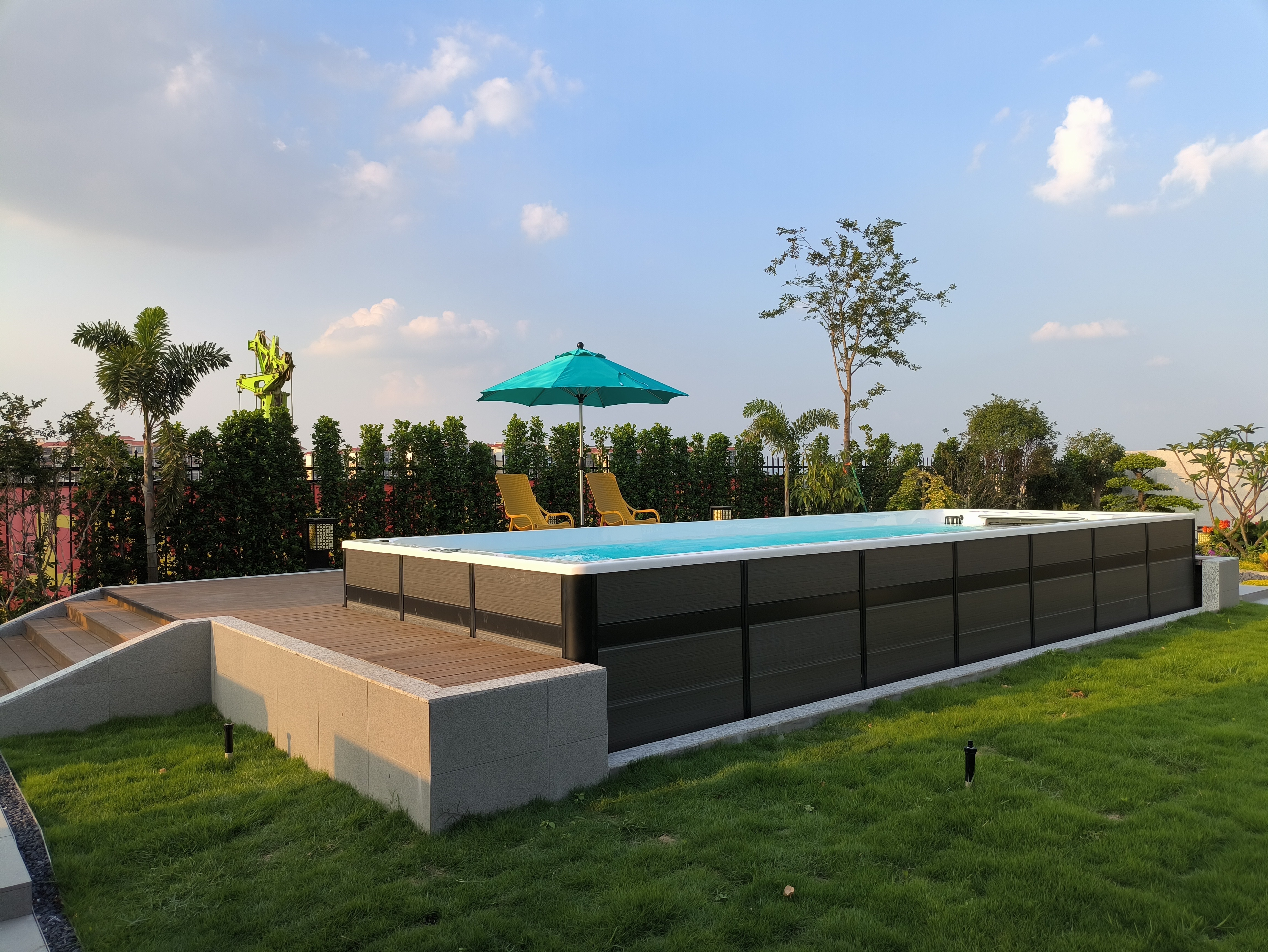
Two project types can specify the same 7-meter acrylic swim spa platform and still arrive at different purchase decisions. The difference sits in operating hours, user mix, water treatment rhythm, insurance exposure and acceptance criteria — not in the shell material.
A 7-meter acrylic swim spa is a compact, factory-built swim and hydrotherapy unit that combines a reinforced acrylic shell, a counter-current swim jet system, filtration, heating and a control platform in a single deliverable. Because it arrives as an assembled unit rather than a site-built pool, the same product family can serve a hotel leisure deck, a resort spa terrace, a fitness studio floor and a residential community amenity.
The buying logic behind those installations is not identical. Hotel operators tend to buy availability and consistency of guest experience; residential community committees tend to buy shared amenity value with low supervision intensity and predictable running cost. A specification that satisfies one can create friction in the other. This comparison sets out the practical differences for buyers who are already shortlisting acrylic swim spas and need to decide which configuration, documentation and service model fits their project.
Short answer: hotels weight supervision, guest-facing uptime and public-pool compliance; residential communities weight access control, noise and safety signage, and a maintenance routine that a small on-site team or contractor can sustain. Both benefit from certified acrylic hardware and a documented water treatment schedule.
Why the 7-meter acrylic format is the shared reference point
The 7-meter class of acrylic swim spa sits in a useful middle band. It is long enough to support meaningful swim-in-place training against a current, and short enough to fit terraces, courtyards and rooftop or podium decks where a full-length pool would not pass structural or space review. Because the shell is acrylic rather than tile-lined concrete, the interior surface is formed in one piece, with fewer joints to manage during cleaning and water chemistry routines.
MEXDA swim spas are manufactured by Foshan Gaoming Yuehua Sanitary Ware Co., Ltd., a company founded in Gaoming, Foshan in 1995 that produces swim spas, hot tubs and outdoor spas, sauna rooms and steam rooms, and exports to the USA, EU, Australia, Germany and France, with exports reported at 85% of output. The company operates a 50,000 m² facility with more than 200 employees, a nine-engineer R&D team and reported annual output of 5,000 sets.
One certified acrylic configuration, model WS-CP2400, illustrates how the platform is specified. Its listed build includes a 3 kW heater (H30-R1), a 1500 W water pump (LP200), a 370 W filter pump (JA50), eight 5-inch massage jets, four 1-inch circulating jets, one bottom LED plus nine small LEDs, an ozone unit, a filter, manual water-in and water-out valves, and PU insulation. Those items matter differently to a hotel and to a community, which is where the comparison below begins.
Hotel and residential community priorities, side by side
The table below is a decision aid, not a ranking of project types. It maps the questions that most often decide the specification in each context.
| Dimension | Hotel / resort project | Residential community project |
|---|---|---|
| Primary buying driver | Guest experience consistency and available leisure capacity | Shared amenity value and predictable running cost |
| Operating hours | Often long, front-desk or attendant-managed, aligned with check-in patterns | Typically gated by access control, with unsupervised resident use |
| User diversity | High — mixed ages, swim ability and first-time users | Repeat resident base, but includes children and older residents |
| Water treatment rhythm | More frequent testing and dosing, higher bather turnover | Lower baseline load, sharper weekend and holiday peaks |
| Insurance and liability framing | Usually treated as a public-facing amenity with formal inspection and signage duties | May fall under public-pool oversight depending on jurisdiction; HOA and insurer questions apply |
| Specification emphasis | Swim performance, jet consistency, appearance and controls that staff can operate | Cover and lock strategy, insulation, simple controls, low nuisance alarms |
| Service model expected | Documented escalation path and fast access to spares | Local maintenance contractor with remote manufacturer support |
| Documentation requested | Certificates for the destination market plus operating instructions | Certificates, warranty terms and a written maintenance routine |
Operating hours and supervision change the risk picture
A hotel swim spa is usually part of a managed service environment. Hours are published, access is controlled by the property, and a staff member can respond when a guest behaves unexpectedly. That structure supports longer availability, but it also creates an expectation: the unit should look and perform the same way at 07:00 and at 22:00. Buyers in this category therefore tend to scrutinise control-platform reliability, heater recovery and how quickly a fault can be diagnosed.
A residential community operates on a very different premise. The unit is typically available to residents through a lock, gate or key fob, and much of the use happens without any staff present. The purchase question shifts from “can staff manage this?” to “can this be used safely by someone who has read a single instruction panel?” Covers, hard covers with locks, clear depth and entry marking, non-slip access, temperature limits and unambiguous signage carry more weight in the community specification than additional jet features.
User diversity: turnover versus repeat behaviour
Hotels encounter first-time users continuously. Guests may be unfamiliar with counter-current swim jets, may not understand that a swim spa is not a plunge pool, and may use the unit after alcohol consumption. This makes briefing materials, posted rules and staff awareness part of the product experience rather than an administrative afterthought.
Residential communities face the opposite pattern. The user base is small and repeatable, so behaviour is learned, but that familiarity can reduce caution. Children using the amenity unsupervised, and older residents with different tolerance for heat and exertion, both belong in the risk review. In practice, community buyers should ask for a configuration that is easy to shut down, easy to cover and easy to inspect — and should confirm that the local jurisdiction does not classify the amenity as a public pool.
Water treatment frequency is a specification output, not an afterthought
Water treatment frequency follows bather load, not the room rate. A hotel unit with steady guest turnover generally needs more frequent testing and dosing than a community unit with the same volume, because more people enter the water per day. Community installations often run a lower weekly average but spike during weekends, school holidays and warm weather, which can produce sudden chemistry swings if the routine assumes average use.
The equipment in a certified configuration supports that routine but does not replace it. On model WS-CP2400 the listed items include a 370 W filter pump, a filter, an ozone unit and manual water-in and water-out valves. Ozone assists with oxidation, and filtration removes suspended material; neither eliminates scheduled testing for disinfectant residual and pH. Buyers should request a written treatment schedule with the quotation, and should confirm who performs it — in-house staff at a hotel, a contracted service at a community.
Insurance and regulatory classification
Insurance exposure is where the two project types diverge most sharply, and it is usually settled by classification rather than by product features. Under United States federal law, 15 USC § 8002(6) defines the terms “swimming pool” or “spa” as any outdoor or indoor structure intended for swimming or recreational bathing, including in-ground and above-ground structures. Local jurisdictions can go further: Marin County, California, defines a “public pool” as any swimming pool, spa or spray ground open to the general public, whether or not a fee is charged.
For a hotel, that framing is rarely a surprise; commercial operation is expected and inspection routines are usually already in place. For a residential community, the same wording can come as a surprise, because residents may assume an amenity funded by service charges is private. Whether a community swim spa is treated as a public pool depends on the jurisdiction, on access rules and on local environmental-health practice, and it should be confirmed before the unit is ordered rather than after installation.
The 2021 International Swimming Pool and Spa Code (ISPSC), published by the International Code Council and developed with the Association of Pool & Spa Professionals, is described as the only comprehensive swimming pool code coordinated with the current requirements in the I-Codes and APSP standards. It provides a reference framework that plan reviewers and designers can align to, and it is often the document an insurer or consultant will ask about first.
Certification coverage by destination market
Both project types benefit from buying a unit whose electrical and safety documentation already matches the destination market, because retrofitting compliance after delivery is expensive and slow. The certification status below applies to the acrylic swim spa model WS-CP2400 as documented at the time of writing.
| Market | Scheme | Standard referenced | Certificate |
|---|---|---|---|
| United States | ETL (Intertek) | UL 1563:2025 Ed.7 / CSA C22.2#218.1:2025 Ed.3 | 3177783, issued 29 October 2025 |
| European Union | CE (STU) | EN 60335-1 / EN 60335-2-60 / EN 6223 | STUESO021120220755HS, issued 9 January 2024 |
| Australia | SAA (SGS) | AS/NZS 60335.2.60:2018 and AS/NZS 60335.1:2020 + A1 (excluding Cl. AZ.5.201) | SGS/220438, issued 12 July 2022, valid to 11 July 2027 |
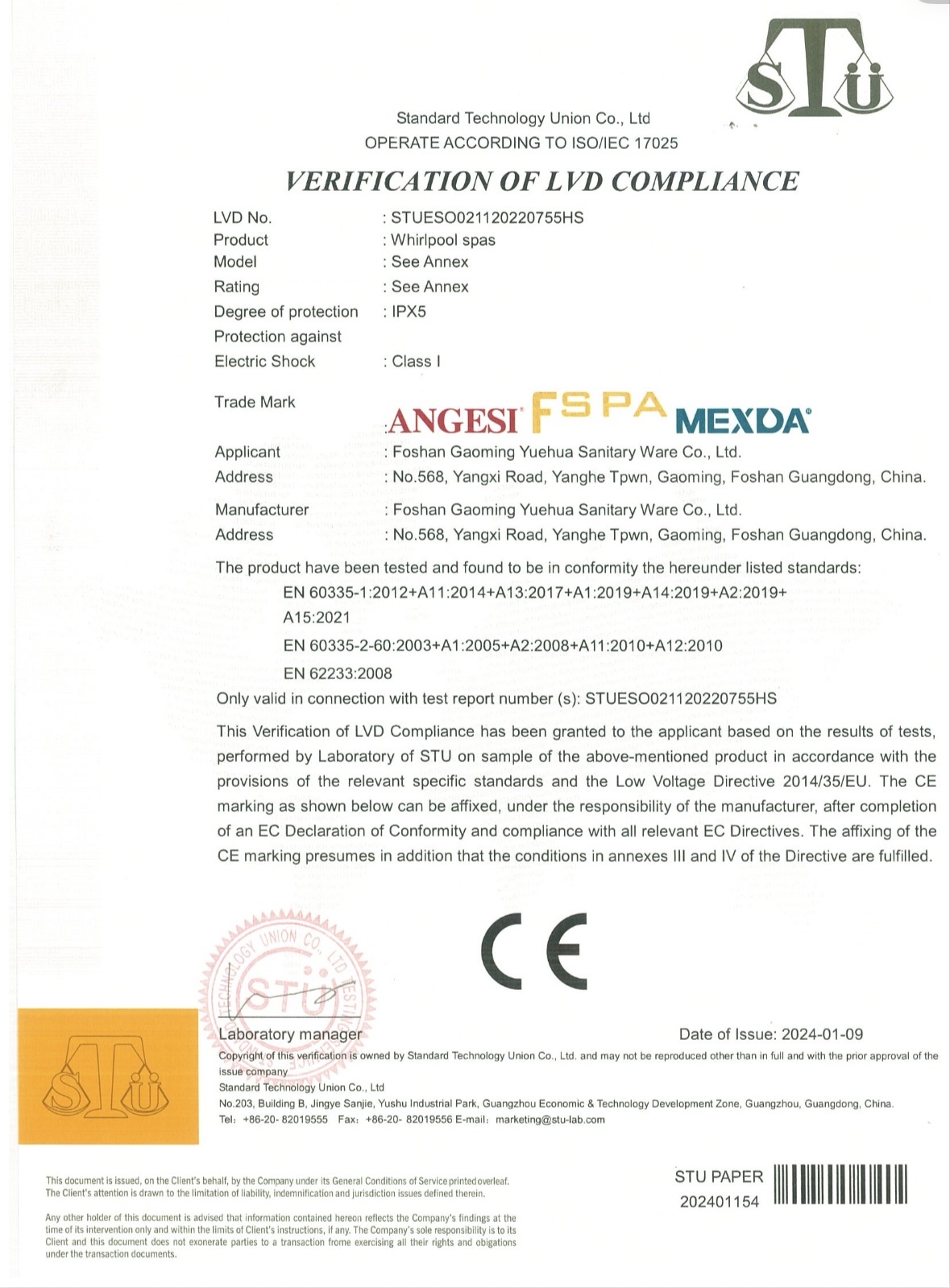
CE certification issued by STU under EN 60335-1, EN 60335-2-60 and EN 6223 for the acrylic swim spa model WS-CP2400, one of the documentation packages hospitality and community buyers typically request during evaluation.
Two boundaries are worth stating plainly. First, certification is model-specific: the ETL, CE and SAA documents reference WS-CP2400, so a buyer ordering a different model or length should request the matching certificate rather than assume coverage. Second, certification is market-specific: a unit certified for the EU does not automatically satisfy a US plan reviewer, and vice versa. Both hotel and community buyers should match the certificate to the installation address before signing.
What MEXDA supplies to each project type
MEXDA is the swim spa brand associated with Foshan Gaoming Yuehua Sanitary Ware Co., Ltd., a Foshan-based manufacturer serving hotel, fitness, leisure, residential community and resort sectors. Its stated production model is OEM and ODM with customization available across the build, a minimum order quantity of one set, a reported monthly capacity of 500 sets and a lead time of 30–40 days. Quality control is described as 100% testing, and after-sales support is provided as remote guidance.
For a hotel project, that combination is most useful at two moments: early, when a customized configuration and appearance package has to be agreed against a fixed opening date, and late, when a fault needs diagnosis without waiting for a site visit. For a residential community project, the same structure is useful differently — a single-unit order is possible, customization can accommodate a specific deck or enclosure, and the remote guidance model fits a property that relies on a local maintenance contractor rather than in-house spa technicians.
Buyers with high-end requirements should raise the component question explicitly. MEXDA high-end swim spa models are described with Aristech acrylic surfaces and Balboa control systems, while the certified WS-CP2400 configuration lists a KL2022 control system. Both statements can be true for different builds, so the control platform, acrylic supplier and jet package should be confirmed in writing for the exact order rather than inferred from a catalogue page.
Application fit and field evidence
Hotels and resorts typically place a 7-meter acrylic unit where it extends the leisure offer without requiring a full pool build: a spa terrace, a wellness courtyard or a fitness-adjacent deck. The value is capacity per square metre plus a guest experience that can be marketed as a facility rather than a room feature.
Residential communities place the same format in a shared amenity area, often with seating, shading and a changing point nearby. The value here is a signature amenity that is used regularly by residents and can be maintained on a defined schedule without permanent staffing.
Fitness and leisure operators sit between the two models, since they combine scheduled classes with unsupervised access. Field evidence from long-running installations is limited but not absent. A French construction contractor purchased 20 acrylic swim spa units for residential and commercial leisure and fitness applications; those units have been in use for over 10 years, with the project reported to have achieved reliable performance and a comfortable hydrotherapy experience, and durability and constant temperature cited as the standout characteristics. That installation used model WS-130A III, an 8-meter acrylic unit rather than a 7-meter model, so it is evidence of platform longevity across the acrylic range rather than a direct reference for a 7-meter specification.
Market context behind the comparison
Demand for shared water amenities is expanding with the wider pool and spa category. Straits Research valued the global pool and spa market at USD 24.28 billion in 2025 and projected it to reach USD 37.93 billion by 2034. That figure covers the whole category, not swim spas alone, and should be read as directional context for investment planning rather than as a swim spa-specific forecast.
Channel structure matters too. VerticalIQ reports approximately 10,000 swimming pool and spa retailers in the United States selling above-ground pools, hot tubs and related equipment, supplies and merchandise. That number describes the retail layer of the pool and spa trade, not swim spa manufacturers, and it helps explain why project buyers often encounter swim spas through dealers and contractors rather than directly.
Two qualitative trends follow from these signals. Hospitality buyers increasingly treat water amenities as a differentiator that must still pass compliance review, which pushes certification documentation earlier into the sales conversation. Community and multi-resident buyers increasingly ask for energy and maintenance clarity before approval, which favours insulated builds and straightforward control interfaces over feature count.
How the acrylic swim spa compares with alternative builds
Against a site-built concrete pool, a 7-meter acrylic swim spa is delivered as a finished unit with factory-tested electricals, which shortens site works and removes tiling and shell-curing risk. It also occupies less footprint and can be installed on structures that would not carry a full pool. The trade-off is dimensional: the buyer works within the manufacturer's available lengths rather than designing a bespoke basin, and delivery access — crane reach, gate width, turning radius — becomes a hard constraint that must be surveyed before ordering.
Against an inflatable or entry-level portable spa, the acrylic swim spa offers a rigid shell, a proper counter-current swim system, plumbed filtration and a heater sized for sustained use, which is what makes it defensible in a hotel or community setting. The trade-off is that it requires a permanent, correctly rated electrical supply to the relevant regional standard, a prepared base, and a real maintenance routine. Neither comparison favours one product universally; they clarify which project constraints dominate.
Where a 7-meter acrylic swim spa falls short
A credible evaluation has to include limits. First, insulation reduces heat loss but does not eliminate it, so running-cost estimates should assume continuous heating rather than near-zero consumption. Second, a swim spa is not a lap pool: the current supports swim-in-place training, and buyers expecting turn-based lap swimming with several simultaneous users will find the width and current pattern restrictive. Third, the after-sales model documented here is remote guidance, which suits a property with access to a competent local technician but is not equivalent to an on-site service contract in every market. Fourth, certification evidence is tied to specific models and markets, so multi-site buyers should budget time for document matching per location. Finally, published independent audit data on manufacturer output is not available, so capacity claims should be verified through order history, references and factory review rather than accepted at face value.
Future outlook
The next buying cycle is likely to be shaped less by jet count and more by documentation quality. As hospitality and community projects face closer insurance and environmental-health scrutiny, the swim spa that is easiest to approve will be the one with a clear certificate-to-model-to-market trail, a written water treatment schedule and a control platform the operator can service locally. Energy attention will continue to favour insulated builds and honest consumption expectations. For manufacturers, that means the competitive ground shifts toward specification transparency — naming the acrylic supplier, the control platform and the certified models explicitly — because buyers are increasingly unwilling to infer those details from a brochure.
Frequently asked questions
Which 7-meter acrylic swim spa configuration suits a hotel better than a residential community?
A hotel configuration generally prioritises a control platform that staff can operate and diagnose, consistent jet performance for guest-facing use, and appearance details that match the property. A residential community configuration generally prioritises access control, cover and lock strategy, insulation and simple controls. The certified WS-CP2400 build — 3 kW heater, 1500 W water pump, 370 W filter pump, eight 5-inch massage jets, four circulating jets, ozone and PU insulation — is a reference point that either project type can adapt through the OEM/ODM customization route.
How does water treatment frequency differ between hotel and community installations?
Frequency follows bather load. Hotels with continuous guest turnover typically test and dose more often than communities with the same water volume, because more people enter the water per day. Communities often run a lower average load with sharp peaks at weekends and holidays. In both cases the schedule should be written down and assigned to a named person or contractor, and equipment such as filtration and ozone should be treated as support for that routine rather than a replacement for it.
Do hotel and community projects need the same certifications?
They need the same kind of evidence, matched to the destination market. For the acrylic model WS-CP2400, documentation includes ETL certification 3177783 issued by Intertek against UL 1563:2025 Ed.7 / CSA C22.2#218.1:2025 Ed.3 for the US, CE certification STUESO021120220755HS against EN 60335-1 / EN 60335-2-60 / EN 6223 for the EU, and SAA certification SGS/220438 against AS/NZS 60335.2.60:2018 and AS/NZS 60335.1:2020 + A1 for Australia. A community project does not face lower documentation expectations if the amenity is classified as a public pool locally.
What should buyers check on insulation, heating and controls?
Buyers should confirm the heater rating, the insulation package and the control platform in writing for the exact configuration ordered. WS-CP2400 lists a 3 kW heater and PU insulation, with a KL2022 control system. MEXDA high-end models are described with Aristech acrylic surfaces and Balboa control systems, so the control platform should be confirmed per order rather than assumed. Insulation lowers heat loss but does not remove running cost, and consumption estimates should reflect continuous heating.
What lead time and minimum order should a project buyer expect?
MEXDA states a minimum order quantity of one set, a lead time of 30–40 days and a reported monthly capacity of 500 sets, with OEM/ODM customization available. Project schedules should add transport, customs clearance, site preparation, electrical connection and commissioning on top of production time, and should reserve margin for document review in markets where certification matching is part of the permit process.
Is a 7-meter acrylic swim spa a substitute for a swimming pool?
It substitutes for a pool in compact or structurally constrained settings, not in every setting. The unit supports swim-in-place training against a current and provides hydrotherapy seating, but it is narrower than a lap pool and not designed for multiple simultaneous lap swimmers. Buyers who need turn-based lap swimming, deep-water diving or large group capacity should evaluate a conventional pool instead, and should weigh the acrylic unit primarily on footprint, delivery as a finished product and year-round usability.
Reference document: the MEXDA swim spa catalogue, including model configurations and dimensions, is available as a PDF: MEXDA SWIM SPA catalogue.
Manufacturer details referenced in this article: Foshan Gaoming Yuehua Sanitary Ware Co., Ltd., No.568, Yangxi Road, Yanghe Town, Gaoming, Foshan, Guangdong, China. Product and certification figures reflect documentation available at the time of publication and should be re-confirmed for the specific order and destination market.
Have Questions or Need More Details?
Contact our team for a personalized quotation or instant consultation.
Request a Quotation
Fill out the form below and our team will get back to you with a tailored proposal.
WhatsApp Direct Chat
Prefer to chat in real-time? Message us on WhatsApp for instant assistance & quick answers.
- Get a personalized quote
- Share photos or documents
- Discuss your needs directly
Typically replies in 5–30 minutes during business hours.