
9 Promotional Bag Models Compared for Campaign Buyers
Independent Buyer Reference · Decision Stage
Promotional bags are bought as a campaign, not as a product. A single brief from a retail, sports, beauty or supermarket program can contain nine bag items that share nothing except a printed logo area: a cosmetic pouch, a flat-fold reusable bag, a beach carry, an insulated cooler, a gym bag, a knitted fashion bag, a tote, a shopping bag and a drawstring bag. Compared on unit cost alone, that shortlist usually collapses in production, because price reflects material weight, closure construction, print method and expected reuse — not only size.
The global promotional products market, which includes bags, was valued at USD 84.4 billion in 2025 with a 3.8% CAGR, according to Metastat Insights. Within that market, demand concentrates on a small number of bag formats, which is exactly why model-level comparison matters. This reference compares nine promotional bag models — cosmetic bag 1812, foldable bag FDV010, beach bag 4700, COOLR BAG 23250, gym bag 4530, knitted bag T25210, tote bag 3800, promotional shopping bag 4636 and drawstring bag 4211 — on the dimensions a buyer can verify before an order: material family, closure and insulation function, logo method, and campaign fit.
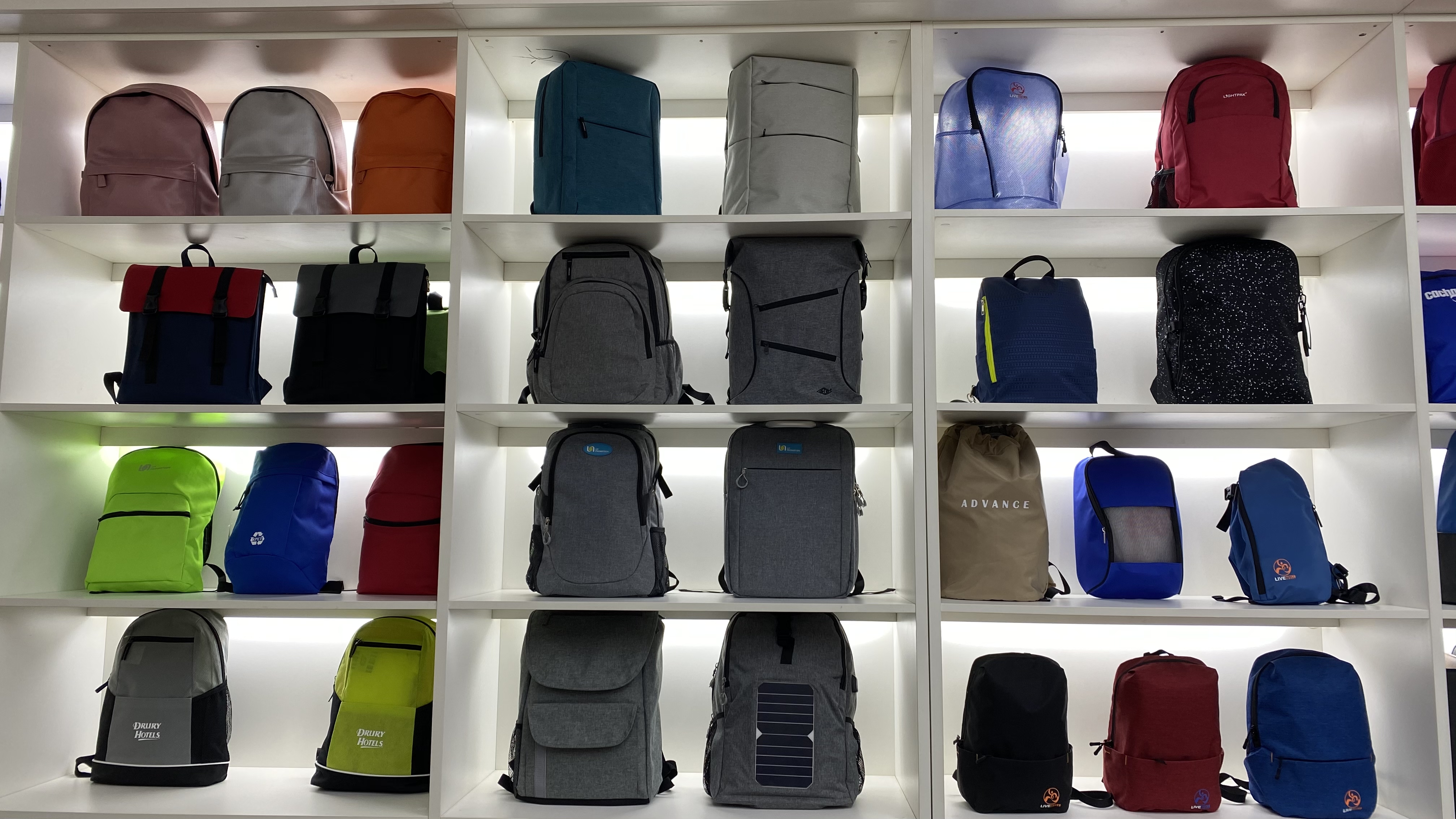
A nine-model promotional bag range covering cosmetic, foldable, beach, cooler, gym, knitted, tote, shopping and drawstring formats. Image: Yulite.
Why “Promotional Bag” Is a Buying Category, Not a Product
Search demand for this category is broad, while the underlying purchase is narrow. Tote bags ranked as the 5th most-searched category on the Advertising Specialty Institute's ESP platform in 2024, and corporate adoption of custom-branded tote bags rose 32% year over year in 2024, according to Intel Market Research. Both signals describe the same behaviour: buyers search for a generic term, then have to choose between formats that behave nothing alike.
Saturation adds a second pressure. The average urban consumer in mature markets owns 4–6 tote bags, per Intel Market Research (medium reliability). A generic tote with a one-colour print is therefore a weaker differentiator than it once was; campaign value increasingly sits in format, material weight, reuse behaviour and how well the item fits the moment it is handed out.
The Nine Models and What Each One Is Bought For
The table maps each model to the campaign context it is normally purchased for and to the first specification field a buyer should confirm in that context.
| Model | Bag family | Typical campaign context | First verification priority |
|---|---|---|---|
| Cosmetic bag 1812 | Cosmetic / beauty pouch | Gift-with-purchase, beauty counters, sampling kits | Outer and lining fiber content; closure type; usable print area on a small panel |
| Foldable bag FDV010 | Foldable / compact reusable bag | Retail hand-outs, conferences, travel give-aways | Folded size and pack volume; unfolded body dimensions; logo legibility when folded |
| Beach bag 4700 | Beach / open-top seasonal tote | Summer campaigns, resort and holiday retail | Open-top capacity; fabric behaviour with sand, moisture and sun; handle attachment |
| COOLR BAG 23250 | Insulated cooler bag | Picnic and food promotions, outdoor events, beverage programs | Insulation construction and liner; closure sealing; interior cleaning; contact documentation |
| Gym bag 4530 | Sports / gym carry | Sports events, fitness retail, member and staff kits | Load handling at full capacity; strap and handle reinforcement; closure and airing |
| Knitted bag T25210 | Knitted / textured carry | Lifestyle retail, boutique campaigns, higher-value give-aways | Knit density and shape retention; how the chosen logo method behaves on a knit surface |
| Tote bag 3800 | Everyday tote | Conferences, brand retail, trade fairs, corporate gifting | Body dimension against print area; handle strength; print method matched to fabric |
| Promotional shopping bag 4636 | Shopping / grocery bag | Supermarket loyalty, retail restocking, seasonal shopping | Volume and load capacity against material cost; durability over repeat use |
| Drawstring bag 4211 | Drawstring / cinch bag | Sports events, campus and youth programs, quick give-aways | Cord and channel quality; closure behaviour at full load; single versus multi-colour print |
Model families and campaign contexts reflect the nine-model comparison set. Dimensions, closure type and insulation construction are confirmed per model on the current specification sheet.
Size deserves a specific warning. There is no verified category-wide size standard for promotional bags, because size is a model-level attribute. The number that matters for foldable bag FDV010 is its folded size; for promotional shopping bag 4636 it is open volume; for cosmetic bag 1812 it is the flat panel available for printing. Comparing those three on a single “size” column is where many quotations lose their logic.
Materials: What the Verified Trade-Offs Actually Show
Material drives unit cost, lifespan and the documentation a buyer has to file. The verified comparison data available covers cotton against paper, non-woven and plastic.
| Compared against | Reuse and lifespan | Storage behaviour | Cost relationship |
|---|---|---|---|
| Paper bags | Cotton bags are reusable and support over 50 uses, versus 1–2 uses for a typical paper bag | Cotton can be stored for up to 10 years without damage; paper becomes fragile during storage | Cotton costs approximately 3 times as much as paper |
| Non-woven bags | Cotton supports up to 50 reuses, versus fewer than 10 for non-woven bags | Cotton can be stored for more than 10 years without aging; non-woven bags cannot be washed | Cotton costs about twice as much, but higher durability can lower long-term cost per use |
| Plastic bags | Cotton is reusable; conventional plastic bags are single-use | Cotton degrades in 6 months to 1 year; plastic takes 200–1,000 years | Cotton costs approximately 10 times as much as plastic |
Verified material comparison data as published for the promotional bag range. Load capacity is discussed separately below.
Load capacity reinforces the same pattern. A cotton bag can carry 10 kg against 3 kg for a plastic bag, and holds about 2.5 times more weight than a standard paper bag. In practice, that reduces the number of bags needed per shipment and the labour spent repacking or replacing failed ones — an operational argument that rarely appears in a quotation but shows up in campaign execution.
Two nuances are worth stating plainly. First, cotton bags are made from natural cotton fibers, while non-woven bags are typically polypropylene; the washing and aging differences above follow from that material distinction. Second, the higher entry cost of cotton is only recovered if the bag is actually reused. For a one-weekend event with 30,000 units, non-woven or paper can still be the more rational specification, and no comparison table changes that.
Fiber direction beyond standard cotton is also a live decision. The recycled PET market is estimated at USD 19.5 billion in 2025 (Custom Market Insights), which supports the RPET and recycled cotton direction appearing in promotional ranges. Recycled content, however, is a claim that must be documented rather than assumed: buyers should confirm that a recycled-content certificate covers the specific fiber lot, and where an organic cotton claim is required, they should confirm the certificate that applies to that fiber before the order is placed. For felt constructions, the surface behaves differently from woven cotton, so print method testing matters more than material branding.
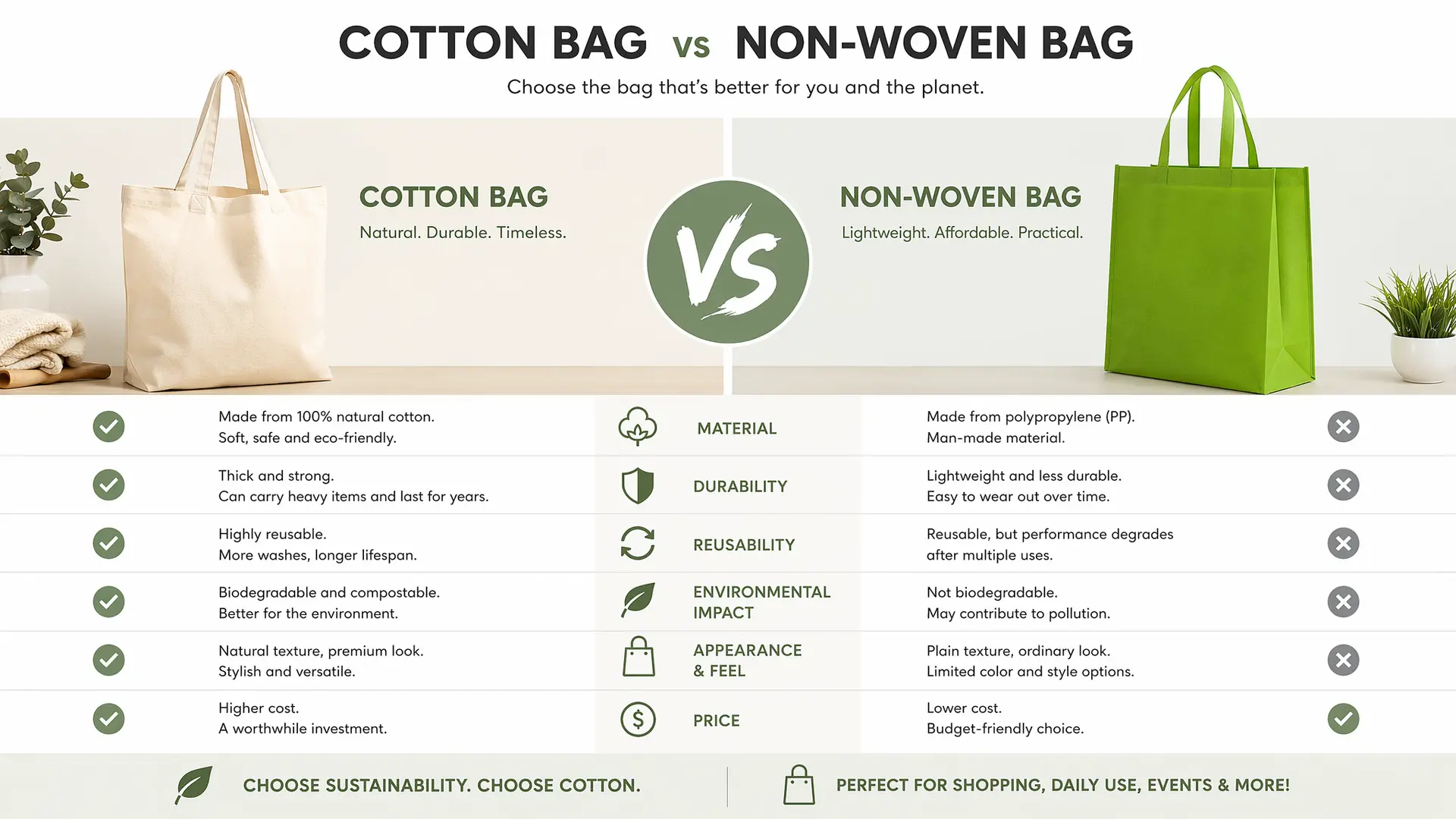
Cotton versus non-woven: reuse cycles, storage behaviour, weight and cost difference as documented for the range.
Logo Methods: Screen, Transfer, Digital and Embroidery
Yulite offers multiple logo printing methods, including heat transfer printing, screen printing, digital printing and embroidery, and supports multi-colour logo printing. Screen printing is also referred to in trade usage as silk printing. The four methods are not interchangeable across the nine models, because they respond differently to fabric surface, artwork detail and print area.
| Method | Where it usually fits | What to verify per model |
|---|---|---|
| Screen printing (silk printing) | Solid-colour or limited-colour artwork, typically at volume | Maximum print area on small panels such as cosmetic bag 1812; number of colours; behaviour on knit and felt surfaces |
| Heat transfer printing | Artwork with fine detail, gradients or photographic elements | Registration accuracy on textured surfaces such as knitted bag T25210 and felt constructions |
| Digital printing | Full-colour artwork and shorter runs | Surface preparation; colour consistency when the same model is reordered |
| Embroidery | Textured, premium finish on fabric surfaces | Stitch density against knit structure; thread colour matching; converting a print area into an embroidery area |
Logo methods available for the promotional bag range. Method selection is confirmed per model against artwork and fabric.
The method question cannot be answered from artwork alone. The two surface-sensitive formats in this set — knitted bag T25210 and any felt construction — require a print test before artwork approval, and the small-panel formats, including cosmetic bag 1812, need the usable print area confirmed in centimetres rather than assumed from a product photo.
Matching the Nine Models to Campaign Contexts
Beauty, sampling and counter programs — cosmetic bag 1812
Cosmetic bag 1812 belongs to beauty and sampling activity, where the bag is a container for product rather than a shopping carrier. The commercial question is not load capacity but panel size, closure reliability and lining quality, since these determine whether the pouch survives being opened daily at a counter. Confirm the lining fiber content and the closure type before approving artwork for a small panel.
Retail hand-outs, conferences and travel — foldable bag FDV010 and tote bag 3800
Foldable bag FDV010 and tote bag 3800 serve different jobs inside the same campaign. The foldable format is a distribution item: its value is packed volume and the ability to keep a logo legible when compressed. The tote format is a carrying item: its value is body dimension against print area and handle strength. Buyers who treat them as substitutes usually end up over-specifying the foldable bag and under-specifying the tote.
Seasonal retail and supermarket programs — promotional shopping bag 4636
Promotional shopping bag 4636 sits in loyalty and restocking programs, where repeat use is the point. Material choice matters most here: the verified comparison of cotton against paper, non-woven and plastic is directly relevant, because a grocery bag is expected to be used repeatedly. Seasonal promotional campaigns accounted for 39% of total reusable shopping bag demand in 2025 (Business Research Insights), which means the specification decision and the calendar decision are linked.
Sports, gym and campus — gym bag 4530 and drawstring bag 4211
Gym bag 4530 and drawstring bag 4211 carry different loads and therefore different risk. For the gym format, confirm reinforcement at straps and handles, closure behaviour at full load and how the bag airs after use. For the drawstring format, confirm cord and channel quality, since a cinch closure is the single point of failure in high-turnover event distribution. In the garment industry, reusable bags account for 17% of applications, with 48% of that demand specifically for promotional usage (Business Research Insights).
Outdoor, picnic and beach — COOLR BAG 23250 and beach bag 4700
COOLR BAG 23250 is the only format in this set where insulation is part of the product promise, so it should never be benchmarked against an uninsulated tote on cost alone. Buyers should confirm insulation construction, the liner, closure sealing practices and how the interior is cleaned. Beach bag 4700 answers a different question: open-top volume and how the body behaves with sand, moisture and sun. Both formats are seasonal, which is precisely why the campaign calendar constrains their lead times.
Lifestyle and premium retail — knitted bag T25210
Knitted bag T25210 competes on surface and feel, not on carrying capacity. Its constraint is the logo method: knit density affects both shape retention and how a print or embroidery sits on the surface. Where a campaign depends on perceived quality at the point of hand-over, this format deserves a physical sample before the artwork is signed off.
Market Signals Behind This Shortlist
- The global promotional products market, including bags, is valued at USD 84.4 billion in 2025 with a 3.8% CAGR (Metastat Insights, 2025).
- Tote bags ranked 5th among the most-searched categories on the ASI ESP platform in 2024 (Advertising Specialty Institute).
- Corporate adoption of custom-branded tote bags grew 32% year over year in 2024 (Intel Market Research).
- Seasonal promotional campaigns represented 39% of reusable shopping bag demand in 2025 (Business Research Insights).
- The recycled PET market is estimated at USD 19.5 billion in 2025, supporting recycled promotional bag programs (Custom Market Insights).
- Approximately 73% of Millennials and Gen Z consumers prefer to buy from sustainable brands using eco-friendly promotional items (Nielsen, cited via BagzDepot; medium reliability).
- Garment-industry applications represent 17% of reusable bag use, with 48% of that demand for promotional purposes (Business Research Insights, 2025).
One caution belongs in any buyer reference. Published tote bag market estimates diverge materially by research house and scope — Acumen Research and Consulting places the 2023 base at USD 17.1 billion, Intel Market Research estimates USD 22.7 billion, and Zion Market Research sizes the narrower reusable shopping bag segment at USD 11.25 billion. Headline market numbers should be read as directional signals, not as planning inputs, while the material and reuse comparisons above are the figures that translate directly into a specification.
Where This Comparison Has Limits
- The verified material comparisons are category-level and cover cotton against paper, non-woven and plastic. They do not declare a single material best for every campaign, and they should not be extended to felt, RPET or knit constructions without model-level confirmation.
- Cotton carries a real cost penalty: approximately 3 times paper, 2 times non-woven and 10 times plastic. For short, high-volume, single-event give-aways that penalty may not be recoverable.
- Insulation expectations apply only to the cooler format. Beach bag 4700 and the totes in this set should not be specified as insulated items.
- Logo durability on knit and felt surfaces cannot be inferred from woven-fabric experience; those formats need a print test.
- Compliance is destination-specific. Bags sold in the EU must comply with REACH Regulation Annex XVII, which restricts azocolourants in textiles to 30 mg/kg, and textile products containing at least 80% textile fibers must comply with Regulation (EU) No 1007/2011 for labelling. In the USA, California SB 1046 bans non-compostable single-use plastic carry-out bags from January 2025.
Manufacturer-Side Facts a Buyer Can Verify
The nine models above sit inside a single manufacturer's range, so buyers can cross-check that the formats being compared are produced under one quality and documentation system. Henan Yulitepromotion Co., Ltd. (Yulite) is a promotional bag manufacturer and exporter founded in 2008, based in Zhengzhou, Henan, China, exporting its full output to markets including the EU, USA, Japan and Australia, and serving more than 86 countries and regions. Its range includes cotton and canvas bags, tote bags, drawstring bags, foldable bags, cosmetic pouches, backpacks, cooler bags, polyester and nylon bags, RPET and recycled cotton bags, RPET felt bags and non-woven bags — which is what makes a nine-model comparison possible inside one supplier relationship rather than across several.
Verifiable capability points that matter for a decision-stage shortlist:
- Audits and certification: BSCI and SEDEX audits completed; ISO9001, OEKO-TEX Standard 100 and GRS certifications held.
- Sampling: an independent sampling room with professional sample workers, allowing samples to be delivered within 3 days.
- Logo methods in-house: screen printing, heat transfer printing, digital printing and embroidery.
- Restricted-substance control: each lot of fabric is lab-tested before mass production, as part of heavy-metal risk control.
- Delivery risk control: strict order planning, own power generation equipment to prevent production stoppages from power shortages, and sub-factory support to complete orders.
Product and capability reference: www.yulitepromotion.cn
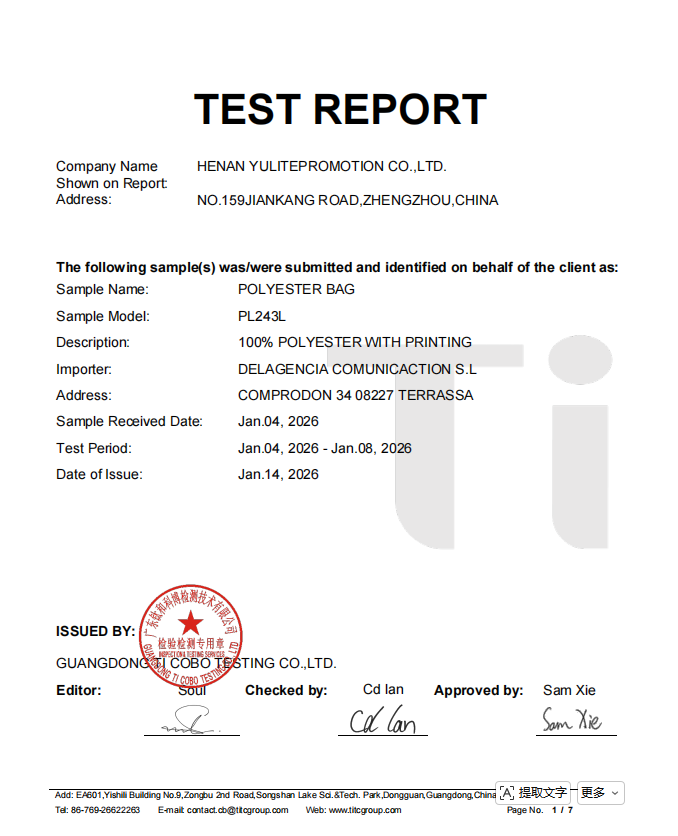
Lot-level fabric testing documentation is part of restricted-substance risk control before mass production.
Future Outlook
Three forces look likely to shape promotional bag buying over the next planning cycles. Regulation continues to push substitution: California SB 1046 restricts non-compostable single-use plastic carry-out bags from January 2025, and non-woven packaging already held a 22.2% share in Europe in 2024 under single-use plastic restrictions (Global Market Insights). At the same time, recycled fiber capacity keeps expanding, with the recycled PET market estimated at USD 19.5 billion in 2025.
Demand is also likely to stay seasonal rather than evenly spread, given that 39% of reusable shopping bag demand in 2025 came from seasonal campaigns. For buyers, the practical implication is that documentation — fiber content, recycled content, restricted substances and labelling — moves earlier in the shortlisting process, rather than arriving as a post-selection task. A nine-model comparison that already records those fields will be faster to execute than one that resolves them during production.
FAQ
How should a buyer compare promotional bag models that use different materials?
Compare within the same campaign job rather than across the whole quotation. Verified comparisons show cotton bags supporting over 50 uses, against 1–2 uses for paper bags and fewer than 10 for non-woven bags, with cotton storable for up to 10 years without damage. Where the campaign assumes repeated carrying, those figures are decisive; where the item is a single-event give-away, unit and print cost dominate instead.
Which logo method fits multi-colour artwork on these nine models?
Screen printing, heat transfer printing, digital printing and embroidery are all available, and multi-colour logo printing is supported. Screen printing is generally used for solid or limited-colour artwork, heat transfer printing where detail or gradients are required, digital printing for full-colour work, and embroidery where a textured finish is wanted. The constraint is fabric rather than artwork: knit and felt surfaces behave differently from woven cotton or canvas, so the method should be confirmed against the specific model and print area.
Is a higher bag cost ever justified in a campaign?
Verified cost relationships show cotton costing about 3 times paper, about twice non-woven and about 10 times plastic. The same sources show cotton supporting over 50 reuses against 1–2 for paper and fewer than 10 for non-woven, and a 10 kg load capacity against 3 kg for plastic. A higher unit cost is therefore justified only where the reuse assumption holds; if the bag is not carried again, the long-term advantage does not materialise.
What should be verified for an insulated model such as COOLR BAG 23250?
Insulation is a construction feature, not a material family, so the cooler format should be specified separately from uninsulated totes and beach bags. Buyers should confirm the insulation build, the liner, the closure type and how the interior is cleaned, and should establish whether the campaign requires temperature holding or only additional carry capacity. Where food or drink is involved, confirm lot-level restricted-substance test documentation before production.
Which certifications and compliance documents should be confirmed before ordering?
On the manufacturer side, Yulite has passed BSCI and SEDEX audits and holds ISO9001, OEKO-TEX Standard 100 and GRS certifications, with each lot of fabric lab-tested before mass production. On the market side, bags sold in the EU must comply with REACH Regulation Annex XVII, which restricts azocolourants in textiles to 30 mg/kg, and textile products containing at least 80% textile fibers must comply with Regulation (EU) No 1007/2011 for labelling. Buyers selling into the USA should also check state-level rules such as California SB 1046. Where an organic cotton claim is required, confirm the certificate covering that specific fiber.
Do the nine models share the same sizes and closures?
No verified size or closure data applies across the whole set, because these are model-level attributes rather than category attributes. This comparison therefore treats size, folded dimensions, closure type and insulation as fields to confirm per model on the current specification sheet, while material families, logo methods, certification and compliance requirements can be reviewed at range level.
The nine-model comparison is a matching exercise, not a ranking: each format answers a different campaign question, and the material, logo and compliance checks above are what make the final selection defensible.
Yulite publishes its current product brochure, covering the promotional bag range and finishing options, at: 2026 Yulite Spring Brochure (PDF)