
Project coating line: engineering, data, constraints
When choosing a coating line, buyers compare not only prices and delivery times: they compare how well the engineering solution reproduces their products, production rhythm, and workshop conditions. One line, by its name, may be designed for ABS+PC bumpers with robotic spraying, another for aluminum panels up to 7000 mm long, and a third for non-stick cookware with an output of 800–1000 pieces per hour. During the research and project evaluation stages, it is more accurate to analyze not a "line in general" but the suitability of a specific model to the project task: product range, material, production volume, process technology, and site limitations.
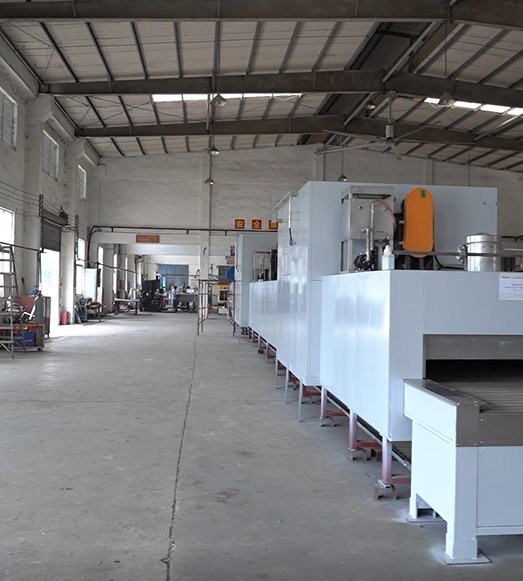
What determines the compatibility of a line with the project
The main criterion is not the maximum conveyor speed as a standalone figure, but the compliance of the entire technological chain: pre-treatment, application method, curing conditions, conveyor type, air purification and control systems. That is why there are separate product lines on the market: coating lines for auto parts, cookware, metal, wood, and industrial equipment. Each of these areas assumes different initial data.
| Line type | Typical product range | Project data affecting the calculation |
|---|---|---|
| Coating line for auto parts | Bumpers, door panels, instrument panels, switch panels, wheel hubs, hubcaps, fuel tanks, frames, interior parts, logos | ABS+PC material; temperature in the chamber 25±2°C; humidity 65±10%; cycle time 45 seconds per tray; maximum tray 1350×900×200 mm; operation mode 336 days per year, 22 hours per day |
| Coating line for cookware | Non-stick frying pans, air fryers, soup pots, rice cooker liners, baking molds, water heater housings | Products made of aluminum alloy and composites; standard size Φ220×160 mm; maximum size Φ300×160 mm; productivity 800–1000 pcs/hour; hanger pitch 450–900 mm |
| Coating line for metal | Doors, windows, steel cabinets, building materials, cabinet components, sheet metal parts, lighting fixtures, aluminum sheets and profiles | Maximum workpiece size 7000×2000×2200 mm; capacity up to 5000 m²/day; conveyor speed 3000 mm/min with adjustment 2000–4000 mm/min; reciprocating and manual spraying |
| Coating line for wood | Wooden furniture, beds, tables, chairs, cabinets, guitars, pianos, wooden speakers | Material – solid wood and MDF; output 1422 pieces per 8-hour shift; workpiece size up to 610×710×1400 mm; pitch 300 mm; line speed 4000 mm/min with adjustment 2000–6000 mm/min |
| Coating line for industrial equipment | Gondola cars, platforms, tanks, special wagons SQ6, boxcars and grain cars, buses, side frames, bogies | Large metal and aluminum workpieces; manual and robotic spraying; floor conveyor; production program from 5 to 20 units per 7.5-hour shift |
Even within the same industry, parameters can vary significantly. For example, a line for bumpers and a line for alloy wheels belong to the "auto parts" category, but require different tooling, different suspension methods, and different drying modes.
Market: why project adaptation is coming to the fore
Demand for industrial painting equipment is growing alongside production automation. According to Grand View Research, the global coating equipment market was worth USD 17.25 billion in 2022, and is expected to grow at a CAGR of 5.3% until 2030. For Russia, domestic demand is also relevant: the volume of the Russian industrial coatings market in 2024 was estimated at approximately USD 1.78 billion, according to Market Research Future.
An additional factor is stricter quality and environmental requirements. For equipment supplied to the EAEU market, it is necessary to consider EAC standards and GOST R requirements applicable to industrial equipment. For manufacturing plants themselves, ISO 9001, ISO 14001, and ISO 45001 requirements are increasingly applied, which affect both project documentation and the choice of air purification and control systems.
What technological modules does an automatic line consist of
An automatic coating line should be correctly viewed not as a single machine but as a sequence of modules linked by a conveyor. Each module contributes to the final surface quality and must be coordinated with the product characteristics.
- Pre-treatment equipment: washing, degreasing, sandblasting, surface preparation before primer application.
- Drying equipment and moisture removal zones.
- Spray booth: manual, reciprocating, or robotic.
- Preheating oven and curing oven.
- Cooling system after polymerization.
- Conveyor system: overhead, floor, mechanized, or free-moving.
- Dust removal equipment and volatile organic compound (VOC) treatment system.
- Electronic control system, often PLC-based, and if necessary, MES production management system.
The choice of each module type depends on the product. For plastic bumpers, temperature and humidity in the booth are critical; for wooden furniture, minimizing dust defects; for aluminum profiles, the length of the workpiece and how it is moved; for large industrial equipment, a floor conveyor and the ability for manual access to complex areas.
Application scenarios by industry
Below are reference configurations that help the customer verify what initial data the manufacturer uses in the calculation. These values are not universal for all projects but demonstrate the logic of coordination.
Auto parts, bumpers, and wheel hubs
For plastic automotive interior and exterior parts, stability of the microclimate and repeatability of robotic spraying are important. In the Attractivechina reference configuration, the auto parts coating line is designed for operation 336 days per year, 22 hours per day, with a spray booth temperature of 25±2°C and humidity of 65±10%. The production cycle is 45 seconds per tray, giving 1760 trays per day. The maximum process tray size is 1350×900×200 mm, and the equipment utilization rate is 85%.
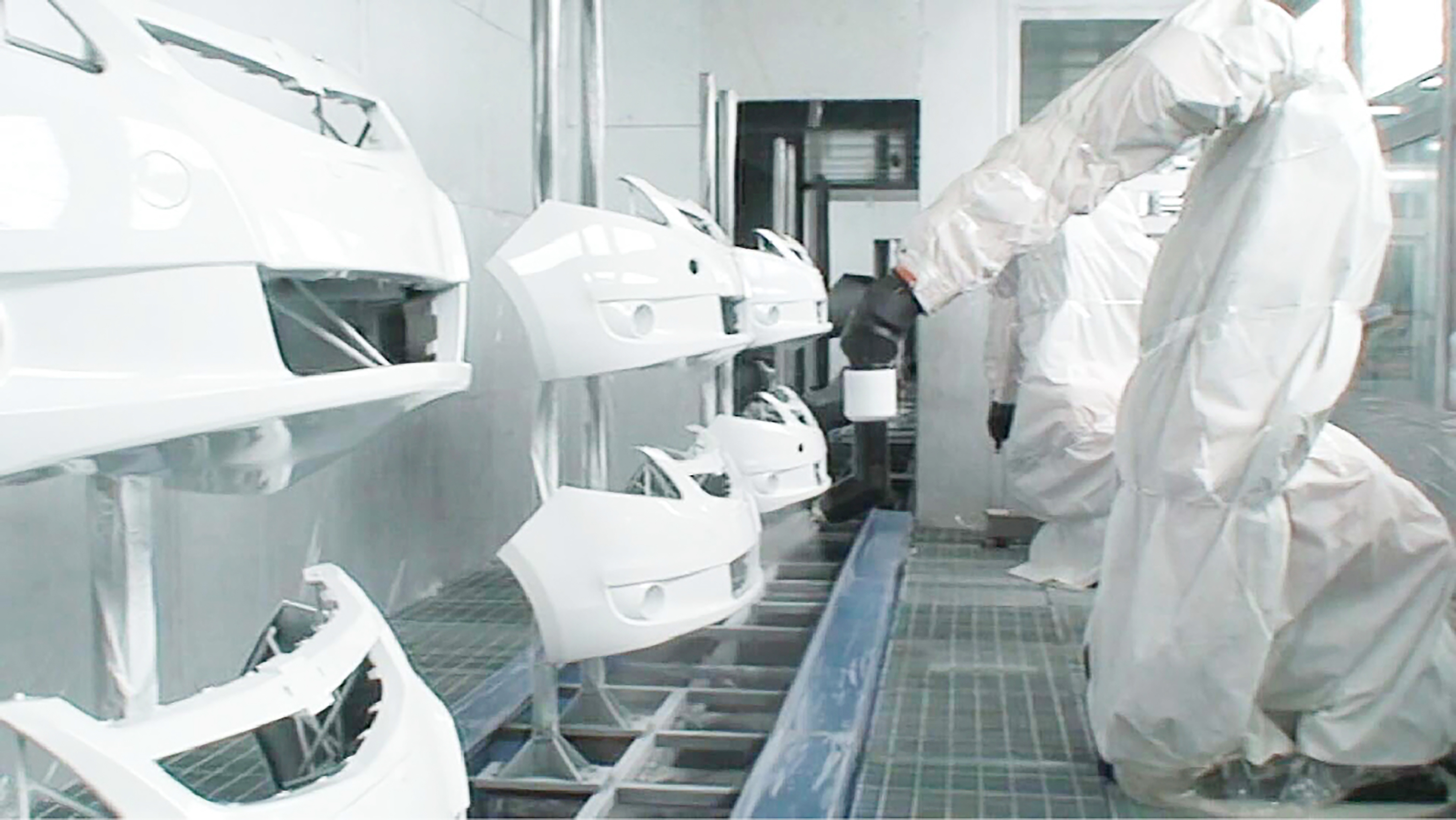
For the buyer, this means that when making a request, it is necessary to provide the specific product range, rather than an averaged concept of "auto parts." Bumpers should be calculated separately from fuel tanks, frames, and decorative elements, since their geometry, material, and adhesion requirements differ.
Cookware and household appliances
A cookware coating line is usually designed for frying pans, pots, rice cooker liners, and baking molds. The technical description of the line specifies a standard product size of Φ220×160 mm and a maximum of Φ300×160 mm. Productivity reaches 800–1000 pieces per hour. One hanger holds four inner containers or 20 lids. The anodizing line speed is 1200 mm/min, and the curing oven linear speed is 1000 mm/min with adjustment from 0.5 to 1.5 m/min. Natural gas and electricity are typically used as energy sources.
This configuration is convenient for factories producing non-stick cookware and for manufacturers of household appliances that include water heater housings or inner containers in their product range.
Metal, sheet metal, and lighting fixtures
For metal products – doors, windows, steel cabinets, furniture components, lighting fixtures, and aluminum sheets – the design parameters are related to large workpieces. In the reference configuration of a metal coating line, the maximum workpiece size is 7000×2000×2200 mm, with one part per hanger. Maximum productivity reaches 5000 m² per day. Conveyor speed is 3000 mm/min with adjustment from 2000 to 4000 mm/min.
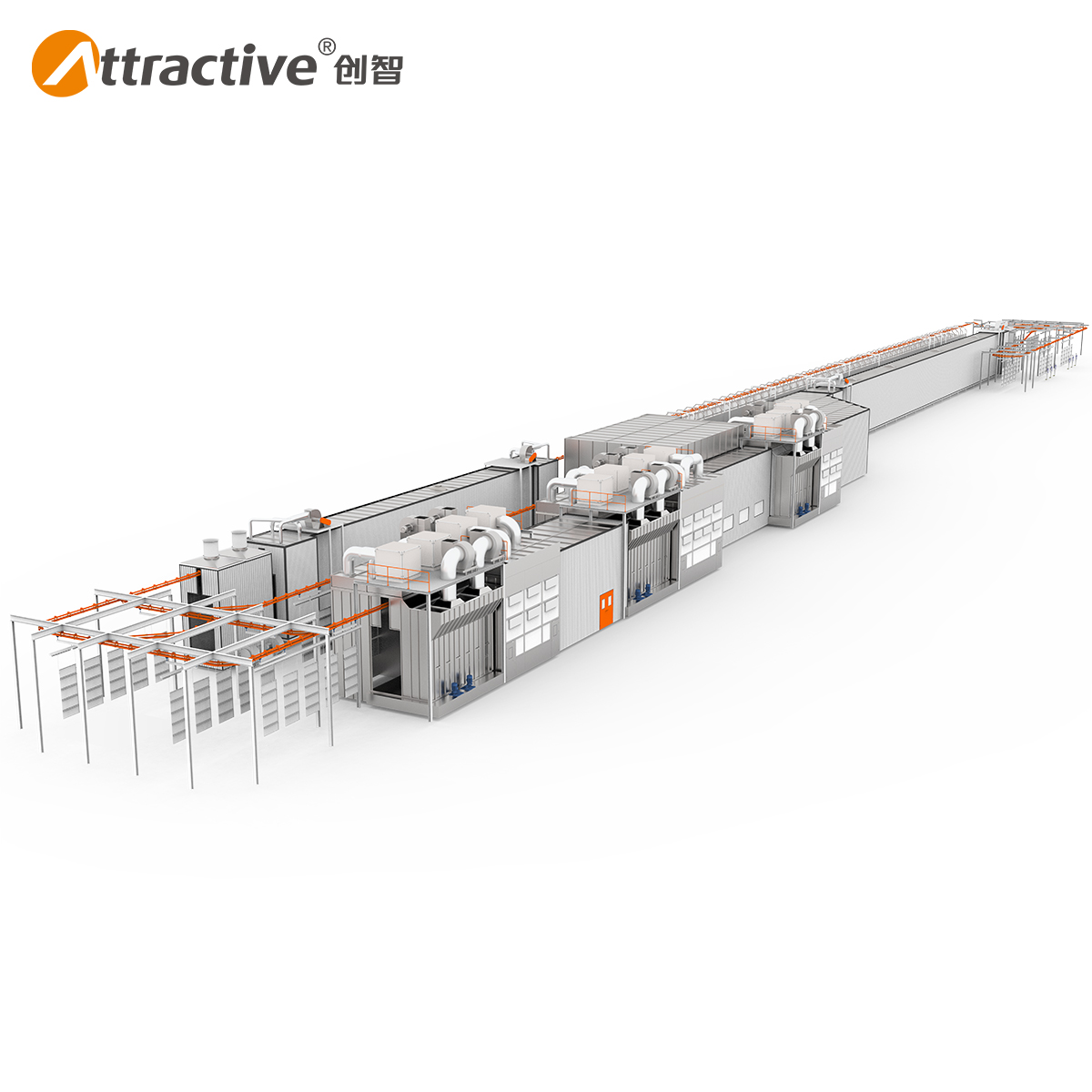
For the production of lighting fixtures and sheet metal parts, it is not so much the total productivity by area that matters, but the ability to quickly change over for different sizes. Therefore, when evaluating a line, it is necessary to clarify not only the maximum dimensions but also the minimum batch size at which economic efficiency is maintained.
Wood, furniture, and musical instruments
For wooden furniture and musical instruments, a wood coating line is used. In the reference configuration, the output for an 8-hour shift is 1422 pieces. The standard workpiece size is 100×50×1400 mm, and the maximum is 610×710×1400 mm. The hanger pitch is 300 mm, and the design line speed is 4000 mm/min with adjustment from 2000 to 6000 mm/min. Energy consumption is electric.
The particular feature of this segment is high requirements for surface cleanliness and gloss. Dust defects are critical for guitars, pianos, and expensive case furniture, so dust removal zones and air environment control must be included in the project.
Industrial equipment and large machinery
For large products such as wagons, platforms, tanks, buses, side frames, and bogies, a coating line for industrial equipment is used. The main application methods are manual and robotic spraying, and transport is carried out by a floor conveyor. The production program may include 20 gondola cars, platforms, or tanks, 7 special SQ6 wagons, 10 boxcars or grain cars, or 5–10 export wagons per 7.5-hour shift.
For such projects, what matters most is not the productivity in pieces per hour, but the line's throughput in terms of the number of large products per shift and the ability for an operator or robot to access all surfaces.
What the customer should prepare before requesting a commercial proposal
A mistake at the research stage usually leads to the supplier offering an excessive or insufficient package. To avoid this, the customer should prepare a project passport for the future line. The minimum set of data looks like this:
| Data | Why it is needed |
|---|---|
| Product range and overall dimensions | Determine the size of the working area, type of hanger, conveyor pitch, width of the booth and oven |
| Product material and surface condition | Affect the choice of pre-treatment and temperature conditions |
| Required productivity | Allows calculation of conveyor speed and the number of parallel lines |
| Enterprise operating mode | Determines the annual time fund and equipment power reserve |
| Type of coating and application method | Affects the configuration of the spray booth and cleaning system |
| Available energy sources | Determine the type of ovens: electric, gas, using steam or chilled water |
| Workshop dimensions and cleanliness class | Affects line layout and the need for a clean room |
| Certification and environmental requirements | Considered when choosing EAC, GOST R, ISO 9001, ISO 14001, ISO 45001 standards |
If the enterprise plans to modernize an existing line, it is also necessary to provide data on the current layout, conveyor, ventilation systems, and electrical capacity of the site.
Automatic line vs. traditional painting area
Comparing an automated line with a traditional manual area is important not to prove the superiority of one option over the other, but to determine the boundaries of applicability of the technology.
| Criterion | Traditional manual area | Automatic line |
|---|---|---|
| Initial investment threshold | Lower, easier to launch | Higher, requires a design cycle |
| Flexibility for small batches | High, can quickly change products | Limited by changeover and parameter adjustment |
| Coating thickness consistency | Depends on operator skill | Higher with consistent process parameters |
| Productivity | Limited by the number of workstations | Calculated for a given production rate |
| Paint consumption | Generally higher | Reduced through robotic or automatic spraying |
| Maintenance requirements | Simpler, but quality control is manual | Requires trained personnel and diagnostic systems |
From this comparison, a practical limitation is clear: a fully automated line becomes economically justified with sufficiently stable utilization and serial production. For single large items such as railway cars or special equipment, a reasonable solution may be a line with a floor conveyor and a combination of manual and robotic spraying. For small enterprises coating small batches of heterogeneous parts, a traditional painting area may remain more adequate, as it does not require a long payback period.
Limitations that cannot be ignored when choosing
Any automated coating line is designed for specific conditions. If the line's load is unstable, the product range constantly changes, and coating requirements are poorly formalized, some of the advantages of automation are lost. The most typical limitations include:
- High initial capital costs compared to a manual area.
- The need for a prepared production facility, including the requirement to operate in a clean room class 10,000 with clean, ventilated air.
- The need for personnel capable of servicing PLCs, robots, ovens, and air purification systems.
- The need to confirm equipment certification for a specific market, including EAC and GOST R for the EAEU.
- The difficulty of quickly switching to fundamentally new types of products without changing line modules.
These limitations do not mean that automation is impractical. They mean that the decision must be made based on project data, not just on the price of the line.
Project data from practice: what operation shows
When evaluating a supplier, it is useful to analyze not only technical characteristics but also long-term project data. In open reference materials from Attractivechina, the following supply examples are given, based on the company's internal statistics:
| Segment | Scale of supplies | Reported results according to the manufacturer |
|---|---|---|
| Auto parts | 20 complete automated lines | Coating yield up to 98%, paint consumption reduced by 25%, energy consumption reduced by 20%, no major downtime over 5 years |
| Cookware | 20 complete automatic lines | Coating uniformity up to 98%, paint loss reduced by 30%, production efficiency increased by 35% |
| Metal | 15 fully automated lines | Pass rate up to 97%, paint and powder consumption reduced by 30%, energy consumption reduced by 22%, efficiency increased by 40% |
| Industrial equipment | 10 complete lines | Adhesion and salt spray resistance meet industry standards; salt spray test at least 1000 hours; yield up to 98% |
| Wood and musical instruments | 10 complete lines | Paint consumption reduced by 30%, dust defects reduced by 90%, production efficiency increased by 40%, stable operation without major complaints |
The reported results reflect aggregate data from projects included in the manufacturer's reference materials. They do not guarantee identical indicators at any new site, but help understand what metrics should be included in the technical specification and verified after commissioning.
How to evaluate a line manufacturer
When choosing a supplier, it is important to distinguish between the equipment manufacturer and a company that only assembles from purchased components. For a complex coating line, the ability to carry out the full cycle is important: pre-sales design, own R&D, production, installation, commissioning, and after-sales service.
One of the active manufacturers in this segment is Guangdong Chuangzhi Intelligent Equipment Co., Ltd., operating on the international market under the brand Attractivechina. The production site is located in the National High-tech Industrial Development Zone of Zhaoqing City, Guangdong Province. The company was founded in 2005, has its own production area of approximately 35,548 m², and a staff of about 280 people, including 54 engineers. In the field of coating and environmental equipment, the company holds 79 invention patents; the total number of patents exceeds 300.
For the buyer, the following delivery conditions have practical significance:
- Custom design: size, level of automation, voltage, power, and productivity of the equipment can be adjusted to the task.
- Minimum order – 2 units, allowing to start with a limited volume.
- Quality control: 100% pre-sale equipment testing.
- Service: remote technical support, 1-year warranty, quick response within 4 hours, regular tracking, and free staff training.
At the same time, it is important for the customer to independently verify which certificates and standards apply to a specific delivery. For the EAEU market, this is particularly relevant due to EAC and GOST R requirements.
Trends that will affect design decisions
Several sustained market trends will determine the choice of coating lines in the coming years.
The first trend is the growing share of automated and robotic solutions. According to Future Market Insights, the global automotive bumper market, which requires bumper coating lines, is expected to grow at a CAGR of 4.2% from 2025 to 2035. This creates steady demand for coating lines with high quality repeatability.
The second trend is the development of powder coating technologies. Market Research Future forecasts that global powder coating equipment will grow at a CAGR of 6.73% until 2035. For projects, this means the need to consider the possibility of switching from liquid to powder materials without a complete line replacement.
The third trend is environmental requirements and energy efficiency. The role of VOC treatment systems, MES management, and ISO 14001 standards is growing. A planned line must be ready not only for the current product but also for stricter environmental regulations.
Frequently asked questions about choosing a coating line
What products does an automatic coating line typically cover?
Industrial lines are manufactured for auto parts, kitchenware, metal products, wooden furniture, musical instruments, household appliances, building materials, and industrial equipment. Within each category, narrower configurations are distinguished: for example, lines for bumpers, wheel hubs, frying pans, aluminum panels, or wagons.
What data is needed to calculate a line for a specific project?
For the calculation, the product range, dimensions, material, required productivity, operating mode, coating type, available energy sources, workshop dimensions, and certification requirements are necessary. Without this data, the manufacturer can only offer a standard package that does not guarantee the desired result.
Is it possible to manufacture a line according to an individual project?
Yes, custom manufacturing of lines is standard practice. Within customization, equipment dimensions, level of automation, voltage, power, and productivity can be changed. The minimum order in Attractivechina's reference conditions is 2 units.
Can an existing coating line be modernized?
Modernization is a common type of project along with the creation of new lines and turnkey projects. The feasibility of modernization is determined by the current layout, conveyor condition, ventilation systems, and power supply, so it requires a preliminary site survey.
What requirements are imposed on the production facility?
Attractivechina's reference materials state that the equipment operates in a clean room class 10,000 with clean, well-ventilated air. At the selection stage, this requirement should be compared with the actual condition of the workshop, its height, and available engineering systems.
What limitations should be considered when choosing an automated line?
A fully automated line is justified with stable utilization and serial production. For small heterogeneous batches or frequent product changes, a traditional area may be more flexible. It is also necessary to consider the high level of initial investment, personnel qualification requirements, and design lead times.
The PDF version of the overview of production lines and capacities is available in the Attractivechina corporate brochure: download brochure.
Have Questions or Need More Details?
Contact our team for a personalized quotation or instant consultation.
Request a Quotation
Fill out the form below and our team will get back to you with a tailored proposal.
WhatsApp Direct Chat
Prefer to chat in real-time? Message us on WhatsApp for instant assistance & quick answers.
- Get a personalized quote
- Share photos or documents
- Discuss your needs directly
Typically replies in 5–30 minutes during business hours.