
Coating Line: Manufacturer Comparisons and Trends 2026
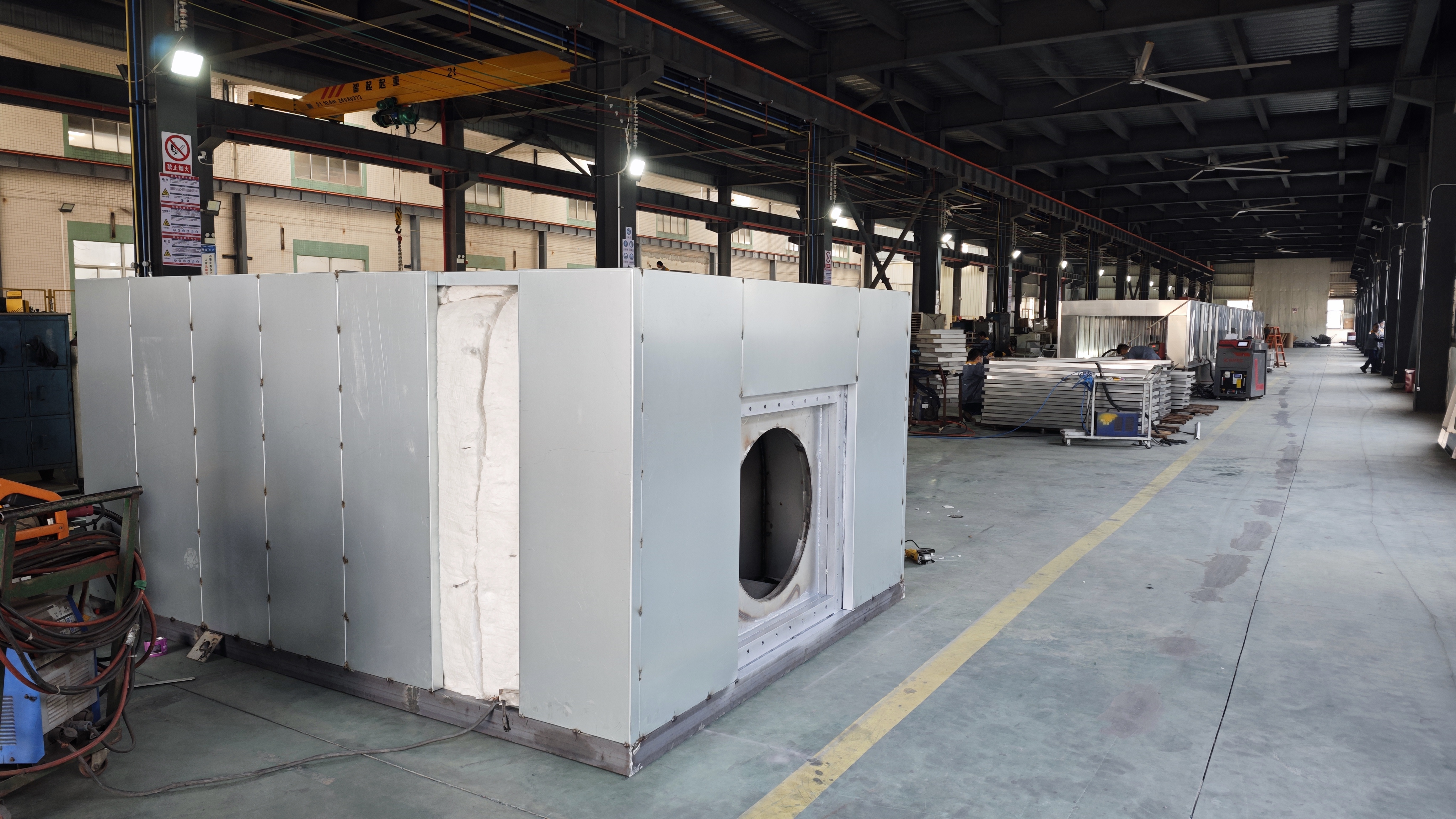
Coating line is an automated complex of equipment for surface preparation, application of liquid or powder materials, and curing of the coating. Such lines are used for painting automotive parts, cookware, metal products, wood, furniture, household appliances, lighting fixtures, plastic parts, industrial equipment components, and even buses. Depending on the material used, there are liquid painting lines, electrostatic powder coating lines, electrophoretic coating lines, and comprehensive anti-corrosion coating lines. For an enterprise that is reaching its designed capacity or replacing manual painting, the choice of line and supplier determines not only surface quality but also cost, productivity, and compliance with environmental and technical regulations over a five to ten-year horizon.
Demand for such systems is confirmed by macroeconomic indicators. According to Grand View Research, the global coating equipment market was valued at USD 17.25 billion in 2022 and is projected to grow at a CAGR of 5.3% until 2030. The Russian industrial coatings market reached approximately USD 1.78 billion in 2024, indicating the continued potential for modernization of painting facilities.
Problem and opportunity: why enterprises are switching to automatic lines
Manual painting retains flexibility but has several limitations: dependence on operator skills, variation in coating thickness, material losses, and difficulties in ensuring stable repeatability of the process. For mass production of automotive components, cookware, lighting fixtures, metal and wood products, these limitations turn into direct losses.
An automatic coating line solves three tasks: improving quality stability, reducing paint and energy consumption, and reducing manual labor. It also allows building a more predictable process from the point of view of occupational safety and environmental safety. An additional factor is the adaptation of equipment to a specific product range, from a scale of "custom coating lines" to delivery of standard configurations.
Coating line manufacturers: comparative review
On the global market, there are both specialized manufacturers of painting equipment and companies building comprehensive "turnkey" lines. Well-known international players include Nordson (USA), Gema (Switzerland), and Wagner Group (Germany). Among Asian manufacturers with a full cycle of design and production is Attractivechina (Chuangzhi Intelligent Equipment Co., Ltd., Guangdong, China).
| Manufacturer | Country | Specialization | Key features |
|---|---|---|---|
| Attractivechina | China | Automated coating lines on order: liquid, powder, electrophoretic | Own production of about 35,548 m², over 30 years of experience, 79 invention patents, full cycle: design, production, installation, commissioning, service. MOQ — 2 units. |
| Nordson | USA | Systems for liquid and powder coating, dosing and spraying equipment | Global service network, broad portfolio of standardized equipment. |
| Gema | Switzerland | Powder coating systems and electrostatic equipment | Strong positions in the powder coating segment. |
| Wagner Group | Germany | Powder and liquid coating technologies | Known for coating systems and spray technology. |
The above list is not an exhaustive rating of "best". The choice depends on the type of product, the degree of customization, and the preferred purchasing model. If an enterprise needs a standard powder coating station, it makes sense to consider global component manufacturers. If the task is to build an automated line taking into account a specific product range, workshop layout, and performance requirements, the engineering potential of the supplier and the ability to implement the project from planning to commissioning come to the fore. It is precisely in the segment of comprehensive turnkey solutions that Attractivechina works.
Technological structure of a coating line
Regardless of the type of materials, an automated line usually includes a surface preparation area, a painting booth, a system for feeding and transporting parts, a curing oven, and air purification units. Robots, reciprocators, electrostatic or electrophoretic systems can be added. The set of these modules determines whether the line can apply coatings to specific parts with the required thickness and productivity.
The parameters are calculated based on the geometry of the parts, the material, and the operating mode of the plant. To illustrate, typical design parameters can be considered.
Coating line for automotive parts
For painting front bumpers, door panels, wheel hubs, fuel tanks, and interior parts made of ABS+PC, control of the painting booth temperature at 25±2°C and humidity of 65±10% relative humidity is required. The production cycle can be 45 seconds per tray (up to 1760 trays per day), and the equipment utilization rate is 85%. To place such a line, an area of about 100×38×5.4 m is required.
Metal coating line
For aluminum panels and profiles, reciprocator and manual loading are used; operating mode — 300 days per year, 20 hours per day. Maximum workpiece size is 7000×2000×2200 mm, one workpiece per hanger. Transportation is carried out by mechanized and free-moving conveyor at a speed of 3000 mm/min (adjustable from 2000 to 4000 mm/min). Productivity reaches 5000 m² per day.
Wood coating line
For wooden furniture, chairs, tables, and musical instruments (guitars, pianos), the typical calculation is for solid wood and MDF workpieces. Productivity is 1422 parts per 8-hour shift with a hanger pitch of 300 mm. The estimated line speed is 4000 mm/min (adjustable from 2000 to 6000 mm/min).
Cookware coating line
For non-stick frying pans, rice cooker inserts, and baking molds, aluminum alloy and composite materials are used. The productivity of such lines is 800–1000 parts per hour, with a workpiece pitch of 450–900 mm. Cookware lines often use natural gas and electricity for anodizing and curing ovens.
Industry applications and results of Attractivechina projects
The experience of implementing automatic coating lines covers several industries. The projects below show measurable results: reduction of material and energy consumption, increased productivity, and stable operation without major shutdowns.
| Industry | Number of lines | Geography | Key results |
|---|---|---|---|
| Automotive parts | 20 | Germany, Russia, Thailand, Indonesia, Mexico, China | Coating yield up to 98%, paint consumption −25%, energy consumption −20%, no major downtime for 5 years. |
| Metal products | 15 | Mexico, USA, China, Singapore | Quality coating share 97%, paint/powder consumption −30%, energy consumption −22%, efficiency +40%. |
| Cookware | 20 | China, Russia, Iran, India, Bangladesh, Vietnam, Thailand | Coating uniformity up to 98%, compliance with international food standards, paint consumption −30%, efficiency +35%. |
| Industrial equipment | 10 | China | Salt spray ≥1000 hours, successfully painted parts share 98%, paint consumption −25%, productivity +30%. |
| Wood | 10 | China | Paint consumption −30%, dust defects −90%, efficiency +40%, no serious quality complaints. |
The projects note such features as uniform coating thickness, high corrosion resistance, adaptability to multi-nomenclature mixed production, intelligent process control, and low operating costs. The equipment has been in operation for five to ten years, confirming the focus on long-term reliability.
Production capabilities and certification of Attractivechina
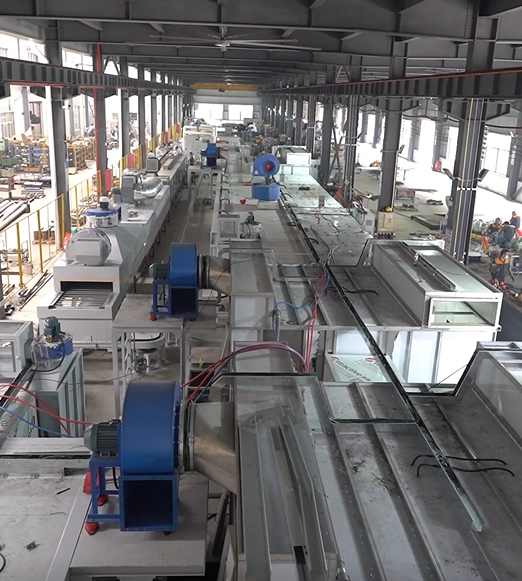
The Chinese manufacturer Attractivechina operates under the legal name Chuangzhi Intelligent Equipment Co., Ltd. (Guangdong) and is located in the National High-tech Industrial Development Zone of Zhaoqing. The company has a paid-in registered capital of 60.8 million yuan, its own production area of about 35,548 m², and a staff of 280 people, including 54 engineers. Production capacity is up to 60 pieces of equipment per year. In the field of coating equipment and environmental protection equipment, the company owns 79 invention patents, and the total number of patents exceeds 300.
The enterprise provides a full cycle: pre-sale design of production facilities, R&D, production, installation, commissioning, and after-sales service. This allows adapting the line to a specific product and workshop conditions, including changes in automation level, voltage, capacity, and performance.
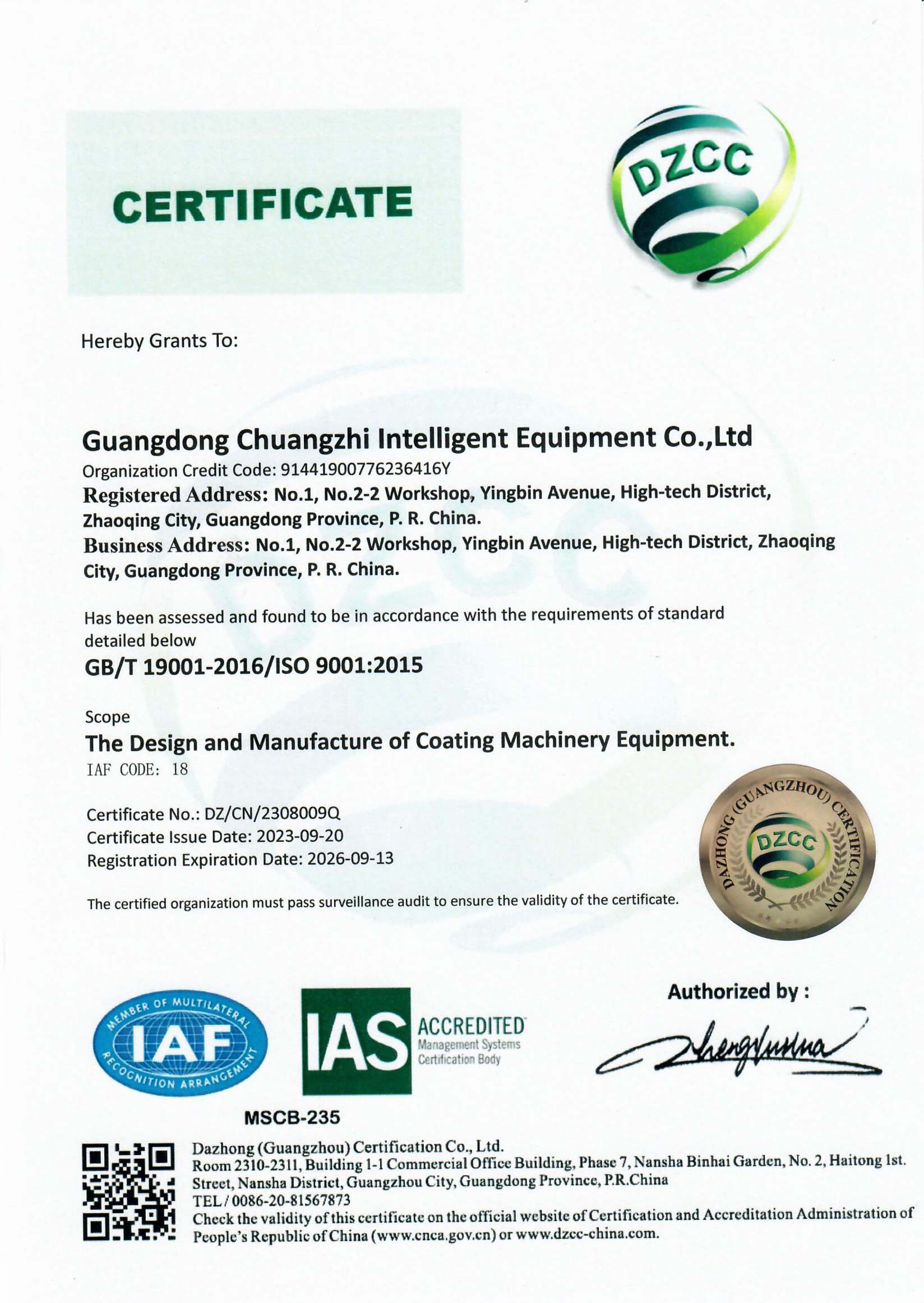
The quality management system is confirmed by ISO 9001:2015, ISO 14001:2015, and ISO 45001:2018 certificates, which is important for enterprises that evaluate suppliers according to quality, environmental, and occupational safety management standards.
For the Eurasian Economic Union market, conformity assessment of equipment is also required. When supplying to Russia, Belarus, and Kazakhstan, an EAC declaration is usually issued in accordance with technical regulations TR CU 004/2011 (safety of low-voltage equipment), TR CU 020/2011 (electromagnetic compatibility), and TR CU 010/2011 (machinery safety). The supplier's experience in processing such documents reduces project timelines and risks.
Automation versus traditional painting
Comparison of an automatic line with manual painting should be carried out according to a set of indicators: quality, material intensity, energy efficiency, productivity, and cost of ownership. According to design implementations, automated lines can increase coating yield to 97–98%, reduce paint consumption by 25–30%, reduce energy consumption by 20–22%, and increase production efficiency by 30–40%. Traditional manual painting usually provides more flexibility with frequent product changes, but requires more manual labor and gives greater variation in coating thickness.
Boundary of applicability: an automated coating line is advisable to consider with a sufficiently stable product range and volumes ensuring equipment loading at about 85%. For frequent changeovers, small batches, and low loading, manual painting may remain a more flexible and economically justified solution. Automation also requires staff training and a developed maintenance system.
Market trends and their impact on procurement
Several long-term trends are shaping demand for coating lines. First, the growth of the global coating equipment market with a projected CAGR of 5.3% until 2030 is supported by the increase in electric vehicle production and automation of industrial processes. Second, powder coating is shifting toward "smart" automation: according to Market Research Future, the global powder coating equipment market is expected to grow at a CAGR of 6.73% until 2035.
In the automotive segment, the bumper market, for which specialized lines are used, is projected at USD 17.5 billion in 2025 and USD 26.4 billion by 2035 with a CAGR of 4.2%. For companies operating in the Russian market, it is also important to consider the capacity of the industrial coatings market: USD 1.78 billion in 2024 with a projected growth of 1.3% until 2035. An additional factor is the requirement for EAC declarations when supplying to the EAEU.
From a procurement perspective, this means that the line should be selected not only for current products but also with consideration of potential growth — for example, expanding the range of automotive parts, transitioning to powder technologies, or increasing export supplies to EAEU countries.
How to evaluate a coating line supplier: a checklist
To bring a project to a specific proposal, it is useful to check several mandatory points.
1. Type of coating: liquid, powder, electrophoretic. 2. Product parameters: dimensions, weight, material, required thickness and color. 3. Production modes: number of working days and hours per day, target output volume. 4. Engineering conditions: workshop area, available energy resources (electricity, natural gas, steam, chilled water). 5. Certification: ISO 9001, ISO 14001, ISO 45001; for EAEU — EAC and TR CU. 6. Service: warranty, remote support, response time, staff training. 7. Supplier's production capabilities: own factory, number of engineers, patents and experience. 8. Geography of projects and references in a similar industry. 9. Customization capability: automation level, voltage, capacity, performance. 10. Commercial terms: MOQ, delivery times, 100% pre-sale verification.
Frequently asked questions
What is a coating line?
It is a complex of automated equipment for surface preparation, application of paint and varnish or powder materials, and curing of the coating. The line may include painting booths, conveyor systems, curing ovens, air filtration, and control systems.
What types of coating lines are used in industry?
The main types are liquid painting, powder coating, and electrophoretic coating. The selection depends on the material of the product, required thickness, operational loads, and environmental requirements.
What industries use automatic coating lines?
Automotive industry (bumpers, wheel hubs, fuel tanks, interiors), metalworking (doors, windows, sheet metal, lighting fixtures), production of cookware and household appliances, furniture and musical instruments, as well as industrial equipment and special machinery.
What parameters are critical when choosing a line for automotive parts?
Material of the part (e.g., ABS+PC), geometry, maximum tray size, temperature and humidity in the booth, production cycle, type of application (manual, robot), and equipment utilization rate. For example, for bumpers and interior panels, the production cycle can be 45 seconds per tray.
What certificates are required for supplying a coating line to the EAEU?
For the Eurasian Economic Union, it is necessary to issue an EAC declaration of conformity. The equipment must comply with technical regulations TR CU 004/2011 (safety of low-voltage equipment), TR CU 020/2011 (electromagnetic compatibility), and TR CU 010/2011 (machinery safety). Also useful are ISO 9001, ISO 14001, and ISO 45001 certificates.
What after-sales service conditions are important when purchasing a line?
The standard for manufacturers is warranty on equipment, remote technical support, service support, and staff training. For example, Attractivechina offers a one-year warranty, remote support, response time of 4 hours, regular check-up calls, and free training.
Conclusion
Choosing a coating line is an engineering and economic task in which technological parameters, supplier experience, certification, and after-sales service conditions are equally important. The data presented show that automation provides measurable results: increased coating yield, savings in materials and energy, and increased productivity. At the same time, the decision should take into account the specific product range, production volumes, and available space.
For a detailed study of technical parameters and industry solutions, you can refer to the official brochure of the manufacturer: Attractivechina brochure.
Have Questions or Need More Details?
Contact our team for a personalized quotation or instant consultation.
Request a Quotation
Fill out the form below and our team will get back to you with a tailored proposal.
WhatsApp Direct Chat
Prefer to chat in real-time? Message us on WhatsApp for instant assistance & quick answers.
- Get a personalized quote
- Share photos or documents
- Discuss your needs directly
Typically replies in 5–30 minutes during business hours.