
A Buyer's Decision Framework: Matching Core Material Densities and Thickness to Application Loads
Core material is rarely the most expensive line in a composite bill of materials, and it is usually the line that decides whether a sandwich panel meets its stiffness target, its weight target and its cost target at the same time. Two panels built with identical skins, identical resin and an identical infusion schedule can behave completely differently in service, because the core between the skins changes how the panel carries load. Density and thickness are the two variables that carry most of that decision — and they are the two variables buyers most often settle by habit.
This article sets out a practical decision framework for buyers at the research stage: how to read a density ladder, how to translate an application load into a density band, how thickness changes the answer, and where the framework has to stop and hand over to engineering calculation.
Why Density and Thickness Outrank Unit Price
Core density governs how a sandwich behaves in shear and in local compression — under a deck fitting, a jack point, a stanchion base, a rail seat or a fastener insert. Core thickness governs how far apart the two skins are held, and that separation is what produces bending stiffness. Increasing thickness raises panel stiffness steeply rather than proportionally; increasing density raises local load capacity but adds weight everywhere, including in areas that will never see a point load.
That asymmetry is why a price-per-sheet comparison misleads. A lower-density core can be lighter and cheaper and still meet a stiffness target, provided the thickness is right and the local load path is reinforced. A higher-density core can be the correct answer in one region of a part and an unnecessary weight penalty a metre away. The practical purchasing question is therefore not “which core is best”, but “which density–thickness pair matches this load case and this process”.
Step 1: Read the Density Range Before the Datasheet
Published density ranges differ widely between core families, and the width of the range is itself a signal of where a material is designed to sit. In the range reviewed for this article, PMI foam core is offered from 40 kg/m³ to 130 kg/m³ — a deliberately narrow, weight-critical band. PET foam core spans 80 kg/m³ to 320 kg/m³, from light structural grades up to high bearing grades. PVC foam core spans 45 kg/m³ to 300 kg/m³, at thicknesses from 1 mm to 80 mm. PP honeycomb sheet is offered at 70 kg/m³ and 80 kg/m³, in thicknesses from 5 mm to 100 mm. Aramid honeycomb is offered from 32 kg/m³ to 128 kg/m³, with cell sizes from 1.83 mm to 5.5 mm and a stated working temperature range of −60 °C to 180 °C.
| Core family | Density range | Documented thickness | Stated application emphasis |
|---|---|---|---|
| PMI foam core | 40–130 kg/m³ | Not stated in this dataset | Aerospace structures, UAV wings, drone components, motorsport, high-performance marine |
| PET foam core | 80–320 kg/m³ | Not stated in this dataset | Marine and yacht building, wind energy, transportation, rail vehicles, RV and caravan, construction panels, renewable energy |
| PVC foam core | 45–300 kg/m³ | 1–80 mm | Marine and yacht building, wind energy, transportation, rail, RV, industrial composites, construction panels, defense |
| PP honeycomb sheet | 70 kg/m³, 80 kg/m³ | 5–100 mm | Transportation, RV and caravan, marine, construction, industrial composites |
| Aramid honeycomb core | 32–128 kg/m³ | Sheet 2440 × 1220 mm | Aerospace interiors, helicopter panels, UAV structures, motorsport, defense, marine racing yachts |
Read the low end of each range carefully. A 40 kg/m³ PMI grade and an 80 kg/m³ PET grade can sit at similar panel weights, but they are designed for different load regimes and different process routes. Equally, the top of the PET range at 320 kg/m³ exists because some panels need bearing capacity and fastener pull-out resistance that a light structural grade cannot provide — not because heavier is inherently better.
Step 2: Map the Application Load to a Density Band
The most useful filter at the research stage is not the industry name but the dominant load on the part. Five load classes recur across the applications documented for this material range, and each points toward a different starting band. The bands below are an editorial starting point for evaluation, not a design approval: the buyer still has to confirm shear and compressive data at the specific density with the supplier.
| Load class | Typical parts | Dominant load | Density band to evaluate first | Thickness note |
|---|---|---|---|---|
| Stiffness-driven, low local load | RV panels, caravan walls, floors and roofs, truck body panels, bus panels, rail interiors | Distributed pressure, vibration, thermal cycling, humidity | PET 80–120 kg/m³; PP honeycomb 70–80 kg/m³ | PP honeycomb starts at 5 mm; PVC series can go down to 1 mm |
| Marine and wind structural, fatigue-driven | Boat hulls, decks, bulkheads, superstructures, wind turbine blades, nacelle structures | Dynamic loading, salt water and humidity, long-term static and dynamic load | PET 150–250 kg/m³; PVC 80–200 kg/m³ | PVC 1–80 mm allows thickness to be graded across one part |
| High local bearing and fixing | Bulkhead edges, transom and engine-bed regions, rail floor inserts, hardware zones | Point load, fastener pull-out, impact | PVC 200–300 kg/m³; PET 250–320 kg/m³ | Local reinforcement is usually more efficient than raising density across the whole panel |
| Weight-critical, high stiffness | UAV wings, drone structures, aircraft panels, motorsport body panels, racing yacht structures | High g-force, vibration and fatigue, stiffness-to-weight ratio, thermal stress | PMI 40–130 kg/m³; aramid honeycomb 32–128 kg/m³ | Thickness is set by the structural and aerodynamic design, not by catalogue convenience |
| Tooling and laminate build-up | RTM molds, vacuum infusion molds, FRP panels, industrial covers | Vacuum pressure, thermal cycling, corrosive exposure | Structural foam grades for dimensional stability; core mat for build-up | CM core mat 1.5–6 mm; CT, CS and CX cores 1.5–3 mm |
The class that most often goes wrong in procurement is the third one. Buyers sometimes specify a high-density core across an entire part when only a small fixing zone needs it, which adds weight and cost without adding stiffness where the panel is actually loaded. The reverse error — a light grade extended into a hardware zone — shows up later as crushed core around a fastener.
Step 3: Use Thickness for Stiffness, Density for Load
Once the load class is fixed, thickness becomes the stronger lever. Moving from a thin core to a thick one raises panel stiffness far more than a modest density increase does, and it usually costs less weight than jumping two density steps. This is why a PVC range spanning 1 mm to 80 mm is commercially valuable: the same material family can serve a thin cosmetic panel and a deeply separated structural panel without changing supplier or resin system.
The practical sequence is therefore: set the thickness needed for the stiffness target, then choose the lowest density within that thickness that satisfies local bearing and fatigue requirements. Where the two conflict, reinforce locally rather than thickening globally. Two secondary effects constrain the answer — a thicker core consumes more resin in infusion unless flow is controlled, and a thicker panel changes the geometry of the assembly around it, including frames, inserts and adjoining parts.
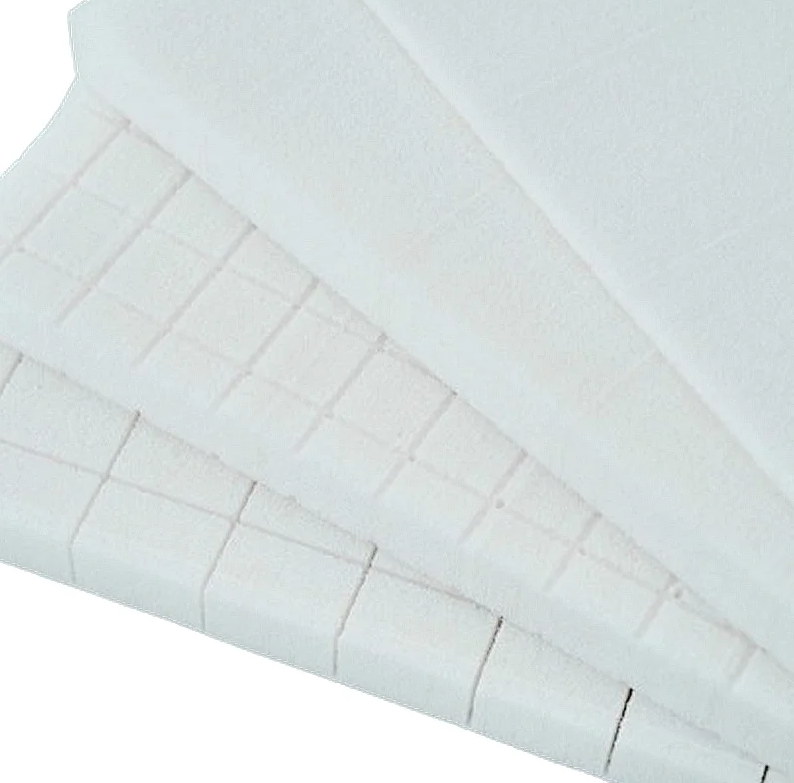
Core selection balances weight reduction, stiffness improvement and vacuum infusion compatibility — the three outcomes buyers usually try to optimise at once.
Step 4: Apply the Process Filter
A density–thickness pair is only usable if the process accepts it. Vacuum infusion, resin infusion, RTM, VARTM, hand lay-up and prepreg each impose different limits on flow, drape and temperature. Surface format is part of that filter: PVC foam core is offered plain, grooved, perforated or scrim-backed, and the choice between them changes how resin travels across the core and how well the skin bonds.
Thin flow cores are the other half of this filter. They are not structural foams; they create resin flow channels inside the laminate, add thickness and stiffness at minimal weight, and reduce print-through. Their numbers explain the difference in role clearly:
| Product | Thickness | Dry weight | Max process temperature | Width / roll length |
|---|---|---|---|---|
| CM core mat | 1.5 / 2 / 3 / 4 / 5 / 6 mm | 125, 150, 190, 260, 340, 360 g/m² | 175 °C | 1.27 m / 25–80 m |
| CX core material | 1.5 / 2 / 3 mm | 120, 150, 220 g/m² | 180 °C | 1.27 m / 70, 60, 40 m |
| CS core material | 2 / 3 mm | 130, 170 g/m² | 170 °C | 1.27 m / 80, 50 m |
| CT core material | 1.5 / 2 / 3 mm | 90, 120, 160 g/m² | 180 °C | 1.27 m / 120, 80, 50 m |
A useful rule for buyers: if the required core thickness is under about 1.5 mm, the question has moved from “which foam” to “which flow core”, because at that thickness the core is doing a laminate and flow job rather than a structural separation job.
Where This Framework Stops
Three boundaries matter, and buyers should test any supplier against them before shortlisting.
Density is not a strength value. A density number tells you what the core weighs, not what it carries. Shear and compressive performance have to be read at the specific density from a datasheet — the aramid honeycomb range in this dataset illustrates the point, quoting mechanical properties from 0.43 MPa to 5.52 MPa across its density ladder. A foam family quoted as “80–320 kg/m³” says nothing about which of those grades suits a given load until the corresponding mechanical values are supplied.
A published range is not a published data point. In the material data reviewed for this article, PMI and PET foam density ladders are documented, but their thickness ranges per density grade are not stated. Buyers should treat that as a data request rather than an assumption, and ask for density-specific thickness availability before freezing a schedule.
Standards scope is not a design calculation. EN ISO 12215-2:2018 specifies requirements for core materials for structural use and for materials embedded in sandwich construction for small craft hulls and structures up to 24 m. It gives buyers a compliance reference point for marine sandwich cores, but it does not replace a structural calculation or a classification society approval for a specific hull.
Applying the Framework to a Supplier Range
CINON — Guangdong Cinon New Material Technology Co., Ltd., established in 2022 and headquartered in Guangzhou — is a manufacturer of fiberglass reinforcements and lightweight core materials for marine, transportation, wind energy, industrial and aerospace composite applications. The company operates a 40,000 m² manufacturing facility with an R&D team of 25 engineers and a stated annual output capacity of 1,200,000 m², exporting to Europe, North America and Asia-Pacific markets.
Its relevance to this framework is the breadth of the density ladder it can supply from one source. The PMI foam core range covers 40, 50, 80, 100 and 130 kg/m³ — the weight-critical top end of the load classes above. PET foam core covers 80, 100, 120, 150, 200, 250 and 320 kg/m³, spanning light structural panels through to bearing grades. PVC foam core covers nine density steps from 45 to 300 kg/m³ at thicknesses from 1 to 80 mm, with grooved, perforated, plain and scrim-backed surfaces and compatibility with vacuum infusion, RTM, hand lay-up, prepreg and VARTM. PP honeycomb sheet adds a thermoplastic option at 70 and 80 kg/m³ between 5 and 100 mm, and aramid honeycomb covers 32 to 128 kg/m³ for weight-critical structures.
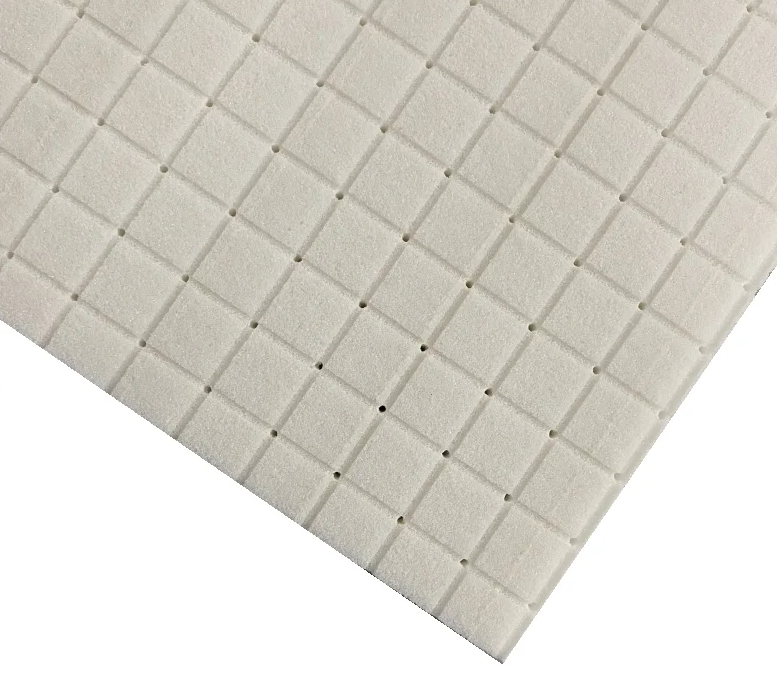
One core family can serve several load classes — but the density grade and thickness have to be re-selected for each application.
For the buyer, this means the density–thickness decision can often be resolved inside a single supplier's range instead of across several materials vendors, which simplifies the qualification file. It also means the buyer must be specific: the same PET family covers the RV side panel and the high-load insert zone, and only the grade separates them.
Market Context: Why Density Discipline Is Becoming a Purchasing Topic
Three market signals support tighter density specification rather than looser substitution.
First, core material choice in wind energy is already a multi-family decision. Industry reporting identifies end-grain balsa, SAN foam, PVC foam and PET foam as the core families most widely used in wind energy applications, which means blade buyers are routinely comparing density ladders across different material chemistries rather than within one.
Second, the marine structural core segment is a defined market in its own right — one research estimate puts global marine structural core materials at USD 114 million in 2026 — and marine buyers are the group most exposed to density errors, because over-specification shows up as weight and under-specification shows up as water ingress and fitting failure.
Third, supply is concentrated. Asia-Pacific held a reported 39% share of the core materials market in 2025, and PET foam core is described as recyclable and widely used for wind blades and transportation panels at lower cost than PVC. For buyers, that combination pushes the decision toward a supplier who can offer both a recyclable light grade and a heavy bearing grade within one qualified range, rather than toward a single-density purchase.
How This Compares with Traditional Panel Solutions
Traditional alternatives to a foam or honeycomb sandwich are solid laminate, plywood-cored panels, and balsa-cored sandwich. Each has a legitimate place, and the density framework explains where the boundary sits.
Solid laminate is the simplest to specify but the heaviest; it wins where thickness is constrained and weight is not, and it loses wherever a lightweight target is written into the brief. Plywood-cored panels are widely used in transport and RV construction and remain a valid baseline for stiffness per unit cost, but they introduce a moisture and rot variable that a closed-cell foam core does not have. Balsa-cored sandwich remains a mainstream wind blade solution alongside SAN, PVC and PET foams, and its natural fibre structure gives it a distinct property profile; where a project requires a fully synthetic, recyclable core with a documented density ladder, PET is the family typically considered.
The honest limitation of the foam and honeycomb side is local load handling. Low-density cores require designed reinforcement at fasteners, inserts, hinges and jack points, and that reinforcement has to be specified rather than assumed. Foam cores are also not a substitute for engineering calculation: density and thickness narrow the candidate set quickly, but the final approval still depends on density-specific mechanical data and, in marine applications, on standards scope such as EN ISO 12215-2:2018.
Future Outlook
Two pressures are likely to keep pushing density decisions upward in importance rather than downward. Lightweighting targets in transport, RV and wind continue to reward buyers who can hold a stiffness target with a lower density grade and a smarter thickness choice. Sustainability requirements simultaneously reward recyclable core chemistry, which is why PET's position across wind, transport and construction panels is commercially relevant rather than merely technical.
The practical expectation for the next procurement cycle is not a new material family but better data: density-specific thickness availability, density-specific shear and compressive values, and clearer standards mapping. Buyers who build the density–thickness framework into their RFQ templates now will be able to compare supplier responses on technical grounds rather than on the width of a quoted range.
FAQ
What density of core material should a buyer start with for a yacht deck?
A yacht deck is a dynamic, humidity-exposed structure, so buyers typically start in the mid-range of the PET ladder (150–250 kg/m³) or the PVC ladder (80–200 kg/m³), then adjust for local fittings. PVC foam core is available from 1 mm to 80 mm thick, which allows the thickness to be graded across a single deck. Final selection depends on the density-specific mechanical values supplied for the chosen grade.
Does a higher core density always produce a better sandwich panel?
No. Density raises local shear and bearing capacity but adds weight across the entire panel, including areas that carry no point load. In many panels the stiffness target is met more efficiently by increasing thickness at a lower density and reinforcing only the fixing zones.
How do PMI foam core and PET foam core differ by density range?
PMI foam core is offered from 40 kg/m³ to 130 kg/m³, a narrow band aimed at weight-critical structures such as UAV wings, aircraft panels and motorsport parts. PET foam core is offered from 80 kg/m³ to 320 kg/m³, a much wider band that runs from light structural panels to bearing grades, and it is a recyclable core used across marine, wind, rail and transport applications.
What is the difference between a structural foam core and an infusion flow core?
A structural foam core separates the skins and carries shear; thicknesses in this range start at 1 mm (PVC) and run to 80 mm. An infusion flow core such as CM core mat, or the CX, CS and CT materials, is a thin polyester nonwoven that creates resin flow channels, adds thickness and stiffness at minimal weight, and reduces print-through; these are supplied from 1.5 mm to 6 mm with dry weights from 90 g/m² to 360 g/m².
Can density alone qualify a core material for marine use?
No. Density indicates weight, not strength. Marine sandwich cores for small craft hulls and structures up to 24 m are addressed by EN ISO 12215-2:2018, which specifies requirements for core materials for structural use and embedded materials in sandwich construction; density-specific mechanical data and project-specific calculation remain necessary alongside it.
A downloadable CINON product catalogue covering the reinforcement and core material ranges referenced above is available here: CINON Composite Materials Catalogue (PDF).
Have Questions or Need More Details?
Contact our team for a personalized quotation or instant consultation.
Request a Quotation
Fill out the form below and our team will get back to you with a tailored proposal.
WhatsApp Direct Chat
Prefer to chat in real-time? Message us on WhatsApp for instant assistance & quick answers.
- Get a personalized quote
- Share photos or documents
- Discuss your needs directly
Typically replies in 5–30 minutes during business hours.