
A Buyer's Decision Framework for Long-Battery Smartphones
Long-battery life smartphones have shifted from a niche specification to a mainstream buying category, and that shift has made the purchase decision harder rather than easier. Counterpoint Research reports that smartphones with battery capacities of 6000mAh or higher captured 29% of global sales in January 2026, up from 10% in early 2025. More capacity is now available at more price points — which means capacity alone no longer separates a good device from a weak one.
For buyers in the research and evaluation stages, the practical question is not "which phone has the biggest battery" but "which combination of capacity, efficiency, charging behaviour, expected lifespan, compliance and cost survives contact with real usage." This article sets out a five-criterion decision framework, shows how it is applied in practice using the UMIDIGI G100 5G as a worked example, and explains where long-battery designs still carry unavoidable trade-offs.
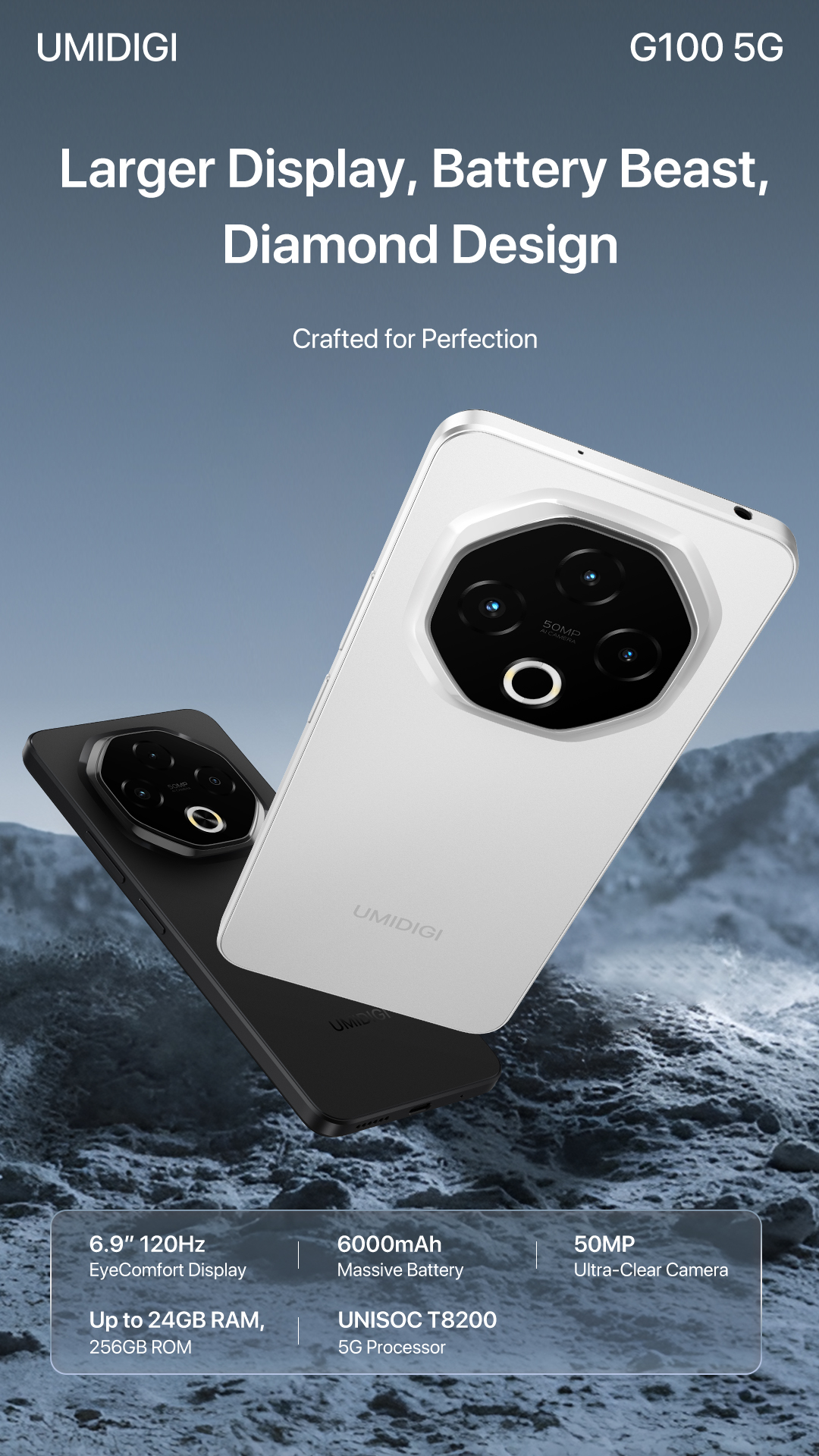
UMIDIGI G100 5G: a 6000mAh long-endurance model used throughout this article as a worked example of the framework.
Why Rated Capacity Alone Misleads Buyers
Battery capacity measured in milliamp-hours (mAh) describes how much charge a cell can hold, not how long a phone will run or how long the battery itself will last. Three variables sit between the number on the specification sheet and the experience in a buyer's hand.
The first is energy density. Silicon-carbon (Si-C) cells are increasingly replacing standard graphite anodes and can offer 20–50% higher energy density, according to Fortune Business Insights. That matters to buyers because two phones advertising the same capacity can differ substantially in physical thickness and weight — or, at the same thickness, in usable energy.
The second is consumption. A 6.9-inch 120Hz display and a 5G modem draw more power than a smaller, lower-refresh panel, so identical mAh figures do not translate into identical runtime. The third is ageing. A battery's rated capacity describes day one; the specification that determines whether a device is still usable in year three is cycle endurance, and that figure is rarely printed on a product page.
The Five-Criterion Decision Framework
The framework below is designed to be applied to any long-battery life smartphone, regardless of brand or price band. Each criterion includes what to measure, the common evaluation error, and the evidence a buyer should request before approving a model.
| Criterion | What to Measure | Common Error | Evidence to Request |
|---|---|---|---|
| 1. Rated capacity and cell technology | mAh, cell chemistry, physical thickness and weight of the finished device | Comparing mAh across devices of very different size, weight and panel class | Datasheet with dimensions and weight, plus cell type confirmation |
| 2. Charging architecture | Charging standard and wattage, thermal behaviour during charging | Assuming a higher wattage number always means a better ownership experience | Charging specification, charger compatibility, thermal design description |
| 3. Expected lifespan | Charge-cycle endurance, retention of capacity over time, warranty terms | Accepting a percentage improvement claim without the test method behind it | Cycle-test methodology, warranty documentation, replacement policy |
| 4. Power consumption profile | Chipset tier, display size and refresh rate, operating system efficiency | Evaluating the battery in isolation from the components that drain it | Screen-on time reference data, chipset documentation, OS version |
| 5. Total cost of ownership | Unit price, compliance cost, replacement cycle, after-sales support | Optimising purchase price while ignoring replacement frequency | Certification documents, support terms, projected replacement interval |
Reading the framework in the right order
Criteria should be applied sequentially, not in parallel. Capacity and charging define what the device can do; consumption determines whether that capacity is sufficient; lifespan determines how long the answer stays true; cost determines whether the whole package is rational. A model that fails an early criterion should not be rescued by strength in a later one — the most common sourcing mistake is accepting a weak compliance position because the capacity figure looked attractive.
Weighting the criteria by use case
Weighting is where the framework becomes specific. For a daily-use device, consumption and charging convenience usually dominate. For fleet or field deployment, lifespan, compliance and total cost of ownership dominate, because the cost of replacing a device in the field includes logistics and downtime rather than just hardware. Buyers should set weights before reviewing specifications, otherwise the specification that arrives first tends to set the standard.
How Capacity, Efficiency and Charging Interact
Long-battery design is a balancing exercise rather than a single engineering decision. Increasing cell capacity raises weight and thickness; increasing display size and refresh rate raises consumption; increasing charging wattage raises thermal load. Buyers evaluating long-battery life smartphones are therefore comparing different compromises, not different amounts of the same thing.
A 6000mAh cell paired with 20W PD fast charging, for example, sits in the middle of the market: enough capacity for extended daily use, with a charging standard that is widely compatible and relatively conservative in thermal terms. Twenty watts is not the highest charging tier available on the market, and buyers who prioritise charge speed over cycle endurance should treat that as a deliberate trade-off rather than a deficiency.
Efficiency is equally important. A 5G chipset, an operating system with a lighter baseline load, and display refresh management together determine how much of the rated capacity is actually usable. This is why specification-by-specification comparison produces misleading results: the criteria interact, and the device that wins on one axis often loses on another.
Worked Example: Applying the Framework to the UMIDIGI G100 5G
UMIDIGI is the smartphone brand operated by Shenzhen Keysmart Technology Co., Ltd. (Keysmart), a Shenzhen-based communications technology company founded in 2012 that combines own-brand device manufacturing with ODM and OEM services. Applying the five criteria to one of its current models shows how the framework behaves in practice rather than in theory.
| Criterion | UMIDIGI G100 5G — Documented Specification |
|---|---|
| Capacity and cell | 6000mAh long-lasting battery |
| Charging | 20W PD fast charging |
| Power consumption drivers | UNISOC T8200 5G processor; 6.9-inch 120Hz Eye-Care large display; Android 15; up to 8+16GB extended RAM with 256GB ROM, expandable to 1TB |
| Physical profile | 171mm height, 77.6mm width, 8.1mm thickness, 210g; plastic and metal construction |
| Protection and features | IP53 dustproof and waterproof; NFC; side fingerprint sensor and AI face unlock; 50MP ultra-clear triple camera with 16MP front camera |
The device illustrates two points that the framework is designed to surface. First, 6000mAh is achieved in an 8.1mm, 210g body — a slim large-capacity configuration rather than a rugged build. Second, the 120Hz 6.9-inch display is a meaningful consumption factor, and buyers should weigh display size against runtime expectations rather than assuming capacity alone settles the question.
How to treat performance claims as benchmarks
UMIDIGI positions the G100 5G with a claimed 20% longer lifespan and a stated 10–15% cost advantage relative to typical alternatives in its class. These are vendor-stated benchmarks. They are useful as comparison anchors — they tell a buyer what the manufacturer believes is differentiated about the product — but they are not independently verified test results, and the article does not treat them as such.
The correct buyer response to any lifespan or cost advantage claim is procedural: request the test methodology, the cycle conditions, the reference baseline, and the warranty terms that back the claim. If a supplier cannot describe how a 20% lifespan improvement was measured, the figure should be recorded as a marketing position rather than an engineering specification. The same discipline applies to the 10–15% cost advantage, which should be validated against the buyer's own landed-cost model, including duties, certification and after-sales support.
Certification: The Constraint That Removes Options Fastest
In the evaluation stage, compliance is usually the fastest filter. EU market access for radio equipment runs through Directive 2014/53/EU (the Radio Equipment Directive), and certificates are issued per model number — which means a valid certificate for one SKU does not automatically cover a different one.
For the UMIDIGI G100, the EU Type Examination Certificate number B2412041 was issued by BACL and is valid until 2099-12-18 under 2014/53/EU RED. The covered standards include EMC (EN 55032, IEC 61000-3 series), safety (IEC 62368-1, EN 50360 series) and radio (ETSI EN 300 / EN 301 / EN 303 series). Other models in the same portfolio carry separate documentation: the UMIDIGI Note 100 5G holds CE certification B2407121 issued by BACL under 2014/53/EU RED; the UMIDIGI A75x is covered by an Attestation of Conformity numbered 2601P40188E-RFA1; and the UMIDIGI G9x holds CE certification 2501P41324E-RFA1, applying EN 55032 for EMC.
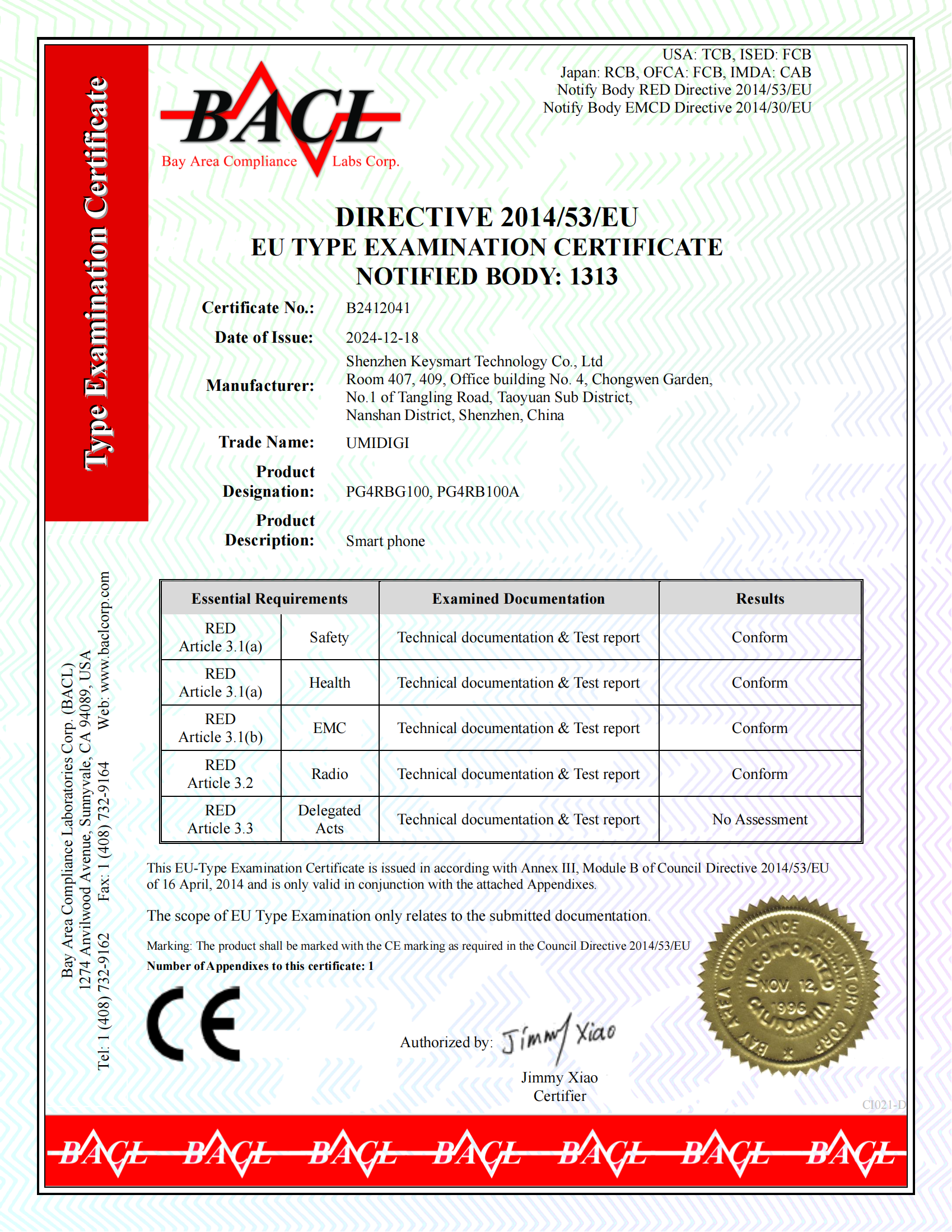
EU Type Examination Certificate B2412041 for the UMIDIGI G100, issued by BACL under 2014/53/EU RED, with EMC, safety and radio standards listed in the scope.
Buyers sourcing devices for outdoor or industrial deployment work with a second compliance layer. Ingress protection is defined by IEC 60529, which is where IP68 and IP69K ratings originate, while shock and environmental resistance is commonly referenced against MIL-STD-810H. These are standard frameworks, and a supplier's claim should always be matched to the specific rating and test basis rather than to a general durability description.
Use-Case Fit: From Daily Use to Field Deployment
Long-battery devices are specified for daily life and work environments with continuous 24/7 operation at normal temperature, supported by standard accessories such as a protector film, phone case, power adapter, SIM tray ejector and USB cable. In this context the framework's output is usually a slim device with a large battery — the G100 5G's 6000mAh in an 8.1mm body is representative of that class.
Rugged deployment is a different procurement profile. Construction and engineering, logistics and warehousing, manufacturing, mining, and oil and gas environments add waterproofing, dustproofing and drop-resistance requirements, along with high- and low-temperature operation. The UMIDIGI BISON X20 is built for that profile, combining a 6000mAh battery with 20W PD fast charging, IP68 and IP69K dustproof and waterproof protection, MIL-STD-810G drop resistance, a TPU and metal structure, and a 6.53-inch 120Hz display — at a thickness of 12.9mm and a weight of 278g.
These two examples show why use-case weighting matters more than brand-level comparison. A device that is ideal for commuters is not necessarily the right choice for a mining site, even when both carry the same battery capacity.
Market Signals Shaping the Long-Battery Segment
Three signals are worth tracking for buyers planning purchases across 2026 and beyond. The first is capacity migration: 6000mAh-class devices moved from 10% of global sales in early 2025 to 29% in January 2026, according to Counterpoint Research, which suggests the segment is becoming a mainstream default rather than a premium feature.
The second is concentration within rugged categories. The Insight Partners reports that the 5000mAh to 6000mAh battery segment accounted for 42.9% of the rugged phone market share in 2025, indicating that durability-focused buyers are converging on a relatively narrow capacity band. Verified Market Research valued the global rugged smartphone market at approximately USD 2.98 billion in 2023, projected to reach USD 5.24 billion by 2030.
The third is technology substitution. Silicon-carbon cells, with the 20–50% energy density advantage noted by Fortune Business Insights, are the main mechanism by which slim long-battery devices are becoming possible. For buyers, this is a specification to verify rather than a term to accept on trust.
Where Long-Battery Designs Still Have Limits
Long-battery smartphones solve a real problem, but they do not solve every problem, and honest evaluation requires naming the boundaries.
- Protection level is not implied by capacity. The UMIDIGI G100 5G carries IP53 dustproof and waterproof protection — a daily-use rating appropriate for light dust and spray, not for immersion. Buyers who need submersion resistance must select a device with an IP68 or IP69K rating rather than assuming a large battery implies a rugged build.
- Weight and thickness trade against protection. A rugged 6000mAh device such as the BISON X20 measures 12.9mm thick and weighs 278g, compared with 8.1mm and 210g for the G100 5G. Durability is purchased with portability, and buyers who prioritise slim handling should expect a lower ingress-protection class.
- Charging wattage is a compromise, not a ranking. 20W PD fast charging is widely compatible and thermally conservative, but it is not the fastest charging available on the market. Buyers who value minimum charge time above all else will find higher-wattage alternatives elsewhere.
- Lifespan and cost claims need external validation. Vendor benchmarks such as a 20% lifespan improvement or a 10–15% cost advantage are directional. Without disclosed test methodology they should not be entered into a decision model as measured facts.
- Customisation has scale requirements. For buyers sourcing a customised long-battery model, OEM production involves a minimum order quantity of 3000 units and a lead time of 60–70 working days, with monthly capacity of 300,000 units and 100% pre-shipment testing. Buyers whose volumes or timelines fall below those thresholds should plan around standard models instead.
- Comparative claims are not available in most cases. This framework deliberately avoids naming competing brands, because verified, attributable competitor specifications are rarely available at the point of evaluation. Buyers should interpret any absolute superiority claim in this category with caution.
Future Outlook
The direction of travel is reasonably clear. As silicon-carbon cells scale, the gap between slim mainstream devices and high-capacity rugged devices should narrow, and 6000mAh-class capacity is likely to become a baseline expectation rather than a differentiator. In parallel, certification scope is becoming a more prominent procurement criterion: as buyers in the EU and other regulated markets standardise their approval processes, model-specific certificate numbers and standards coverage are increasingly requested alongside specification sheets.
For buyers, the strategic implication is a longer replacement cycle. If a device's usable lifespan extends and its compliance position is documented, the relevant comparison shifts from purchase price to cost per year of service. That shift is exactly what the five-criterion framework is designed to measure — and it is why the framework should be applied at the evaluation stage, before a shortlist is fixed.
Frequently Asked Questions
Is a 6000mAh battery enough for a full day of use?
Capacity alone does not determine runtime. A 6000mAh battery is generally sufficient for extended daily use, but actual endurance depends on the chipset, display size and refresh rate, and operating system efficiency. The UMIDIGI G100 5G pairs 6000mAh with a 6.9-inch 120Hz display and a UNISOC T8200 5G processor, which are significant consumption factors. Buyers should treat 6000mAh as a strong baseline and confirm runtime expectations against the full configuration.
What should I verify in a CE certificate before approving a long-battery phone for the EU market?
Verify four things: that the certificate is valid for the exact model number being purchased; that it references Directive 2014/53/EU (RED); that it lists the applicable EMC, safety and radio standards; and that the issuing body and certificate number are identifiable. The UMIDIGI G100, for example, is covered by EU Type Examination Certificate B2412041 issued by BACL, valid until 2099-12-18, listing EMC standards (EN 55032, IEC 61000-3 series), safety standards (IEC 62368-1, EN 50360 series) and radio standards (ETSI EN 300 / EN 301 / EN 303 series). Certificates are model-specific: the Note 100 5G, A75x and G9x each hold separate documentation.
How do I evaluate a claim that a battery lasts longer than alternatives?
Ask for the measurement method rather than the number. A credible lifespan claim should be supported by a described cycle-test procedure, defined conditions, a stated baseline, and warranty terms that reflect the claim. Vendor benchmarks — including UMIDIGI's stated 20% longer lifespan and 10–15% cost advantage for the G100 5G — function as positioning statements until that supporting evidence is provided. If the methodology cannot be described, record the claim as unverified.
Does fast charging reduce battery lifespan?
Charging rate and thermal behaviour influence battery ageing, and higher charge rates generally place more stress on cells than slower charging. This is why charging wattage should be evaluated together with thermal design and cycle endurance rather than as an isolated performance figure. A moderate standard such as 20W PD fast charging represents a balance between charge time and conservative thermal load, but buyers should still treat cycle life as a separate specification to verify.
What belongs in a total cost of ownership calculation for a long-battery smartphone?
Four components: unit or landed cost; compliance and documentation cost for the target market; the expected replacement interval, which depends on cycle endurance rather than on purchase price; and after-sales support, including repair or replacement terms and remote technical support where applicable. Buyers comparing two devices with different prices but different expected lifespans should convert both to a cost-per-year-of-service figure before deciding. Vendor cost-advantage claims should be re-tested against that model rather than adopted directly.
What is the practical difference between IP53, IP54, IP68, IP69K and MIL-STD-810H?
IP ratings follow IEC 60529 and describe ingress protection against dust and water: IP53 and IP54 indicate limited dust protection with spray or splash resistance, while IP68 and IP69K indicate protection suitable for submersion and high-pressure water exposure respectively. MIL-STD-810H addresses shock and environmental resistance rather than water ingress, and is a separate standard framework. Devices should be matched to the required rating for the actual deployment environment — a slim daily-use device with IP53 protection such as the G100 5G serves a different environment than a rugged model with IP68 and IP69K ratings.
For readers who need the underlying manufacturing and portfolio context — including capacity ranges, protection levels and certification coverage across the current model line — the company profile document is available here: Shenzhen Keysmart Technology Co., Ltd. — Company Profile.
Have Questions or Need More Details?
Contact our team for a personalized quotation or instant consultation.
Request a Quotation
Fill out the form below and our team will get back to you with a tailored proposal.
WhatsApp Direct Chat
Prefer to chat in real-time? Message us on WhatsApp for instant assistance & quick answers.
- Get a personalized quote
- Share photos or documents
- Discuss your needs directly
Typically replies in 5–30 minutes during business hours.