
A Buyer's Framework for RFH Formwork: Load, Size, and Splicing
Concrete formwork decisions rarely fail on price alone. They fail on fit — a panel module that does not match the wall grid, a tie and clamp interface that cannot accept the accessories already sitting in the yard, or a load rating that satisfies the drawing but not the pour rate the site actually runs. The global concrete formwork market was valued at USD 8.9 billion in 2024 (Verified Market Research), and Asia-Pacific accounted for 54.7% of that market in 2025 (Fortune Business Insights). With steel still the dominant material — 44% of formwork units installed worldwide in 2024 were steel systems, against 37% timber and 19% aluminum (Cognitive Market Research) — the operative question for procurement teams is no longer “steel or timber,” but which load class, which panel geometry, and which splicing interface.
This article sets out a buyer's framework for evaluating the FW00A, FW00B, FW00C and FW00D formwork models from Rizhao Fenghua Scaffoldings Co., Ltd. (RFH), built around three technical variables: rated load capacity, available panel dimensions, and compatibility with European trio accessories.

Formwork production at RFH's Rizhao facility, where steel heavy-duty and light-duty systems are manufactured from cold bending through welding and surface treatment.
Why the Quotation Stage Hides the Real Formwork Decision
A formwork package is priced per square metre but consumed per pour. Three cost drivers sit outside the quotation sheet: the permissible pour rate allowed by the load rating, the number of joints and ties created by panel geometry, and accessory replacement plus plywood facing wear over the reuse cycle. Two suppliers can quote a similar figure per square metre and still deliver very different cost-per-pour outcomes, because only one of them is sizing the system to the pour schedule.
Market structure matters here. The top five formwork manufacturers, including PERI and Doka, hold approximately 44% of global market share (Cognitive Market Research), which means the majority of installed units come from regional and specialist manufacturers rather than global brands. For most contractors, the real comparison is therefore between specialist manufacturers — and it has to be settled on technical merit rather than brand familiarity.
Third-party price benchmarks provide a useful starting frame, though they are market-level references rather than supplier quotations. Steel formwork for large projects typically ranges between USD 25 and USD 60 per square metre; aluminum systems between USD 40 and USD 75 per square metre; plastic and modular systems between USD 20 and USD 50 per square metre; and timber formwork rental is estimated at USD 10 to USD 25 per square metre (Formwork System Market Analysis, 2024). Overlapping bands are the point: the same apparent price can buy a 60 kN/m² panel or an 80 kN/m² panel, and that difference only shows up on site.
Variable One: Rated Load Capacity and Pour Discipline
Load rating is the first filter because it determines how fast concrete can be placed and how high a lift can be poured without bulging. RFH model data lists the FW00A panel at a rated load capacity of 80 kN/m². Set against light-duty, non-galvanized, manually welded steel panels commonly rated around 60 kN/m², that is approximately 33% higher concrete pressure resistance.
For a procurement team, the practical translation is straightforward. A higher rated capacity allows the site to place concrete at a higher rate and to sequence lifts with more flexibility before formwork deformation becomes a risk. It also reduces the probability of wall bulging and the concrete rework that follows, and it supports fair-faced concrete finishes being achieved directly out of the form rather than being corrected afterwards.
The framework rule is simple: confirm that the rated capacity is stated in the same terms as the engineering drawing — fresh concrete pressure in kN/m² — and that the rating is tied to a defined tie spacing and clamp arrangement. RFH's steel heavy-duty range uses standard PERI-compatible BFD clamps, which also reduces component loss and wear across reuse cycles.
Variable Two: Panel Geometry — 3.3 m Height, 2.4 m Width, 3000 mm Length
Geometry drives labour hours more than any other single variable, because every additional joint costs ties, clamps, alignment time and patching. RFH's heavy-duty wall panels are built around large modules: FW00A is a 3.3 m high, 2.4 m wide panel, and FW00B is a 2.4 m wide panel supplied with a plywood finish. FW00C is a 3000 mm length panel, giving buyers a standard length module for extended wall runs, and FW00D is a dual-component system used for slab forming.
Three geometry checks should be applied before a model is selected:
- Grid match: does the panel module divide cleanly into the wall length and height, or does it generate in-fill panels and extra joints?
- Joint count per square metre: fewer, larger panels reduce tie density, labour and the number of potential leak paths, but they change lifting requirements.
- Lifting plan: large modules such as a 3.3 m × 2.4 m panel assume crane or lifting-device access; the panel schedule and the site's lifting capacity must be checked together.
RFH manufactures ten formwork types with more than 80 specifications, which gives procurement teams room to match modules to drawings rather than accepting a fixed catalogue grid.
Variable Three: Splicing and European Accessory Compatibility
Splicing is where a formwork system either fits the site's existing habit or forces a parallel accessory stock. RFH steel heavy-duty formwork can be used in compatible with PERI TRIO, HUNNEBEACK RASTO, DOKA FRAMI and TOPEC HARSCO products. In practice, that means clamps, ties and alignment hardware from those accessory families already held in the yard can be reused with RFH panels, lowering switching cost and reducing the risk of a mixed, incompatible component inventory.
Dimensional accuracy supports this. RFH keeps dimensional tolerance under 1.0 mm through CNC machining, against an industry average above 3.0 mm. At a spliced joint, that difference is visible: panels line up more predictably, grout loss falls, and surface correction work on fair-faced concrete is reduced.
The Supplier Behind the System: RFH
Rizhao Fenghua Scaffoldings Co., Ltd. (RFH) is a manufacturer and supplier of formwork and scaffolding equipment based in Rizhao, Shandong Province, China, established in 1953. The company's focused products are construction temporary works equipment, including formwork and scaffolding parts and assemblies. Its facility covers 80,000 square metres, with a building area of 40,000 square metres and 260 employees, and operates more than ten production workshops for cold bending, punching, welding, steel casting, electrostatic spraying and forging. Current equipment includes 4 cold bending forming machines, 12 welding robots, 6 automatic welding assembly lines, 1 formwork profile forming assembly line and 5 semi-automatic forging assembly lines, with annual production capacity reaching 200 million tons. Current sales exceed 1,200 containers. Products are exported entirely — 100% of output — and currently sell to 126 countries and regions, with main markets in the EU, USA, Australia and South America.
On quality control, product quality is managed in accordance with the ISO9001 quality management system, and welding is controlled in accordance with European standard EN1090. The company operates a mechanical test laboratory and a chemistry test laboratory and holds 22 relevant certificates, including EN 1065, EN74 and CE. For buyers evaluating long-term supply, these are the verifiable checkpoints: material testing capability, welding standard, certification set and production continuity.
Model Selection Framework: FW00A, FW00B, FW00C, FW00D
The table below summarises the model data available for this framework. It is a screening tool, not a substitute for project-specific validation against drawings, pour sequence and tie layout.
| Model | Design focus | Key dimensions and ratings | Buyer consideration |
|---|---|---|---|
| FW00A | Heavy-duty steel wall and column panel | Rated load capacity 80 kN/m²; 3.3 m height; 2.4 m width | High-velocity pours, thick foundation walls and large wall areas where rework or bulging would be costly |
| FW00B | Panel with plywood finish | 2.4 m width, plywood-faced | Specifications requiring a plywood-faced finish within a standard 2.4 m width module |
| FW00C | Length-module panel | 3000 mm length | Defining wall runs around a standard length module to control joint count and in-fill |
| FW00D | Dual-component slab system | Dual-component assembly for slab forming | Horizontal work — slab forming packages rather than vertical wall and column pours |
Read together, the four models cover the two dominant pour types on a concrete frame: vertical work (walls and columns) and horizontal work (slabs). The framework logic is to fix the pour type first, then fix load class, then confirm geometry against the grid — not to begin with a price comparison across all four.
Technical Detail: Galvanizing, Plywood Facing and Watertight Joints
Long-term cost behaviour in heavy-duty steel formwork is decided by two degradation mechanisms: rusting of the steel frame and delamination or moisture absorption in the plywood facing. Both lead to a poor concrete finish and a reduced formwork lifespan, so both should be specified explicitly in a purchase contract.
RFH addresses the steel side with a heavy-duty hot-dip galvanized coating of at least 60–80 µm thickness for corrosion resistance in harsh weather, which also eliminates routine rust treatment during normal service. On the facing side, panels use 18 mm high-grade birch plywood coated with 220 g/m² phenolic film, or a composite PP plastic facing, to prevent moisture absorption. Automated robot welding is applied to keep joints between the steel profile and the panel sheet seamless and watertight. The combined effect is described in RFH's own risk-control documentation as extending formwork lifespan and reducing replacement frequency — the mechanism behind the two-fold longer service lifespan claimed for the galvanized system compared with non-galvanized, manually welded light-duty panels.
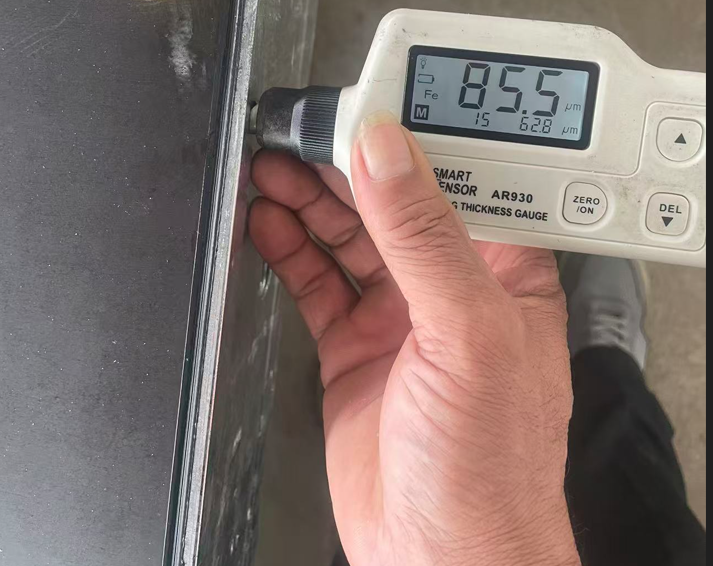
Risk control focus: hot-dip galvanized steel frames and phenolic-film or PP-faced plywood are specified to prevent rusting and delamination over repeated pours.
Application Fit: Where Each Variable Earns Its Place
- Mega-infrastructure and thick foundation walls: the 80 kN/m² rating of FW00A supports high-velocity concrete placement where a wall bulge would trigger rework at scale.
- Wall and column formwork packages: FW00A, FW00B and FW00C are sized for vertical elements, with the 3.3 m height and 2.4 m width modules reducing joint count per square metre.
- Slab forming: FW00D's dual-component system addresses horizontally formed slabs, which have different load paths and pressures from wall pours.
- Fair-faced concrete: CNC tolerance under 1.0 mm, watertight robot-welded joints and phenolic-film plywood together support surface quality directly out of the form.
- Reusable fleet programmes: where panels are bought rather than rented, the durability specification — galvanizing thickness and facing quality — becomes the main determinant of cost per pour.
- Sites already running European accessory fleets: compatibility with the listed trio and panel-formwork accessory families matters most where existing clamps and hardware must be reused.
Market Trends Shaping Heavy-Duty Formwork Procurement
Several verifiable trends are shifting how buyers frame this decision. First, material mix remains firmly steel-led despite aluminum's growth: aluminum formwork systems are expected to reach USD 2.48 billion by 2032, growing at a CAGR of 9.9% (Intel Market Research), yet aluminum accounted for 19% of global installations in 2024 against 44% for steel (Cognitive Market Research). Steel's installed base advantage means accessory ecosystems and reuse economics continue to anchor most procurement decisions.
Second, automation in formwork remains concentrated at the high end rather than the mainstream. Automated climbing formwork systems accounted for 28% of all installations in 2024, mainly in buildings over 50 stories (Industry Analysis Report) — a specialised segment, not a default specification for general building work.
Third, instrumentation is entering the category. Doka introduced DokaXact sensors in 2024 for real-time monitoring of concrete pressure on formwork (Doka GmbH), an early signal that load management may shift from paper ratings toward monitored pours. Fourth, consolidation continues at the top of the market: PERI acquired Implenia Schalungsbau in 2023 to expand its modular formwork services (PERI SE), which reinforces the role of specialist manufacturers as the volume supply base.
Finally, supply-side capacity remains substantial. China's steel products export, which includes structural components for formwork, reached 110.7 million tons in 2024 (China Customs). For buyers, the practical implication of these trends is that differentiation is moving toward documented load ratings, accessory compatibility and durability specification — the three variables in this framework — rather than toward new system categories.
How Heavy-Duty Galvanized Systems Compare with Traditional Light-Duty Panels
Compared with low-cost, non-galvanized or manually welded light-duty steel panels, the galvanized heavy-duty approach used in RFH's steel range differs on four measurable points. It carries a rated concrete pressure resistance of 80 kN/m² against roughly 60 kN/m², approximately 33% higher. It holds dimensional tolerance under 1.0 mm through CNC machining against an industry average above 3.0 mm. It uses hot-dip galvanization that removes routine rust treatment needs and, with standard PERI-compatible BFD clamps, reduces component loss and wear. And it eliminates wall bulging risks and associated rework, supporting a seamless fair-faced finish directly out of the form.
The cost picture is a trade-off rather than a straight advantage. The initial purchase price carries an estimated 15–20% premium, which is only recovered through a reported two-fold longer service lifespan and the resulting lower cost per pour. Buyers running a small number of pours, or working on projects with limited reuse opportunity, will not automatically recover that premium.
Where the framework says no
A usable framework has to state boundaries, and there are four for this one:
- Premium and handling: the 15–20% purchase premium and the lifting demand of large steel modules are hard to justify on small, fragmented or low-rise pours where crane access is limited; lighter aluminum or timber systems can be the more economical choice for those scopes even though they wear faster.
- Facing as a consumable: the plywood facing is a wear layer. Phenolic film and PP plastic facing reduce moisture absorption and delamination, but the facing still degrades over reuse cycles and must eventually be replaced — it should be budgeted as a consumable, not treated as a permanent surface.
- Defined accessory families: compatibility is specified against PERI TRIO, HUNNEBEACK RASTO, DOKA FRAMI and TOPEC HARSCO products. A site standardised on a different proprietary tie system may need adapters or separate accessory stock, which changes both cost and logistics.
- Standard modules versus non-standard geometry: a 2.4 m width module and 3000 mm or 3.3 m lengths do not resolve every architectural geometry, so in-fill or purpose-made panels may still be required, adding planning time.
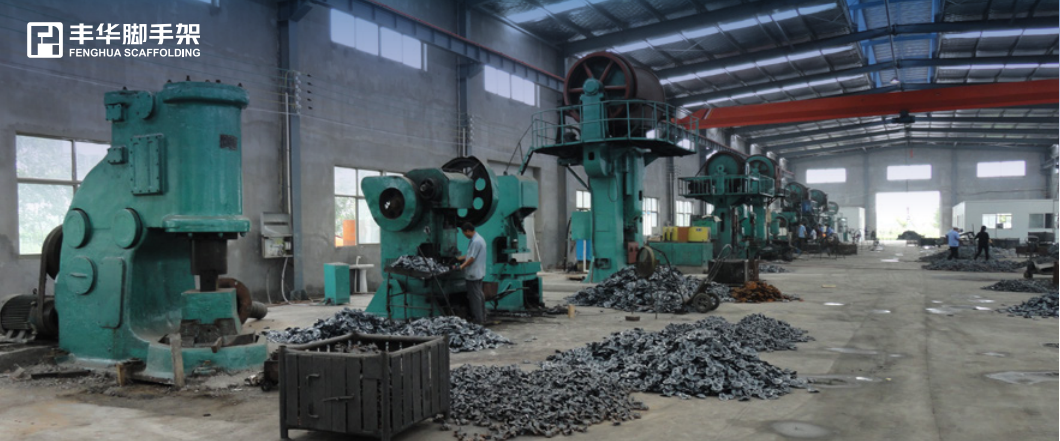
Production continuity behind the framework: multi-line manufacturing supports replacement panels and accessories over a multi-year reuse programme.
From Decision to Execution: Commercial and Inspection Terms
Once the model is fixed, execution terms determine whether the schedule holds. The minimum order quantity (MOQ) for concrete formwork is 50 units. Delivery terms are FOB Qingdao, CIF and CFR. Acceptance criteria are a pre-shipment test and third-party inspection by SGS. Payment terms are 30% T/T in advance and 70% T/T before shipment.
Procurement teams should align these terms before the first production slot is booked, particularly the inspection scope: pre-shipment testing plus third-party inspection is the mechanism that converts a catalogue specification — galvanizing thickness, facing material, dimensional tolerance — into a documented result at handover.
Future Outlook
Three developments are likely to shape the next procurement cycle. Load verification is moving toward instrumentation, following the introduction of real-time concrete pressure monitoring in 2024, though rated capacity will remain the contractual baseline for the foreseeable future. Consolidation among global manufacturers is likely to continue, keeping specialist producers as the practical volume supply base, particularly in Asia-Pacific where the region already accounts for the majority of concrete formwork demand. And as reuse economics become the central evaluation criterion, the specification items in this framework — rated load in kN/m², panel module dimensions, accessory family compatibility, galvanizing thickness and facing type — are more likely to appear as explicit contract line items rather than catalogue footnotes.
For teams currently shortlisting systems, the sequence that holds up is: fix the pour type, fix the required load class, check the panel module against the drawing grid, confirm the accessory interface, and only then compare commercial terms. Load, size and splicing are not three separate questions; they are one decision made in three passes.
FAQ
What load capacity does the FW00A panel carry, and when is that capacity justified?
RFH model data lists the FW00A panel at a rated load capacity of 80 kN/m², which is approximately 33% above the roughly 60 kN/m² rating typical of light-duty, non-galvanized, manually welded steel panels. That capacity is most clearly justified on mega-infrastructure projects, thick foundation walls and high-velocity concrete pours, where wall bulging, rework and surface repair would cost more than the panel premium. On small, low-rise pours with restricted lifting capacity, the same rating may be more than the scope requires.
How do I choose between the FW00A, FW00B, FW00C and FW00D models?
Start with the pour type, then confirm geometry. FW00A is a 3.3 m high, 2.4 m wide steel panel rated at 80 kN/m². FW00B is a 2.4 m wide panel with a plywood finish. FW00C is a 3000 mm length panel. FW00D is a dual-component system used for slab forming. The working test is whether the module divides cleanly into the project grid and reduces joints per square metre without exceeding the lifting capacity available on site.
Are RFH panels compatible with European trio accessories?
RFH steel heavy-duty formwork can be used in compatible with PERI TRIO, HUNNEBEACK RASTO, DOKA FRAMI and TOPEC HARSCO products, so clamps, ties and alignment hardware from those families can be reused rather than replaced. Standard PERI-compatible BFD clamps are part of the system and reduce component loss and wear. Compatibility is defined against those families; a site standardised on a different proprietary tie system may need adapters or a separate accessory stock.
How is dimensional accuracy controlled, and why does it matter for splicing?
RFH panels are CNC machined to keep dimensional tolerance under 1.0 mm, compared with an industry average above 3.0 mm. At spliced joints, tighter tolerance means panels line up more predictably, which reduces grout leakage, misalignment and the surface correction work needed on fair-faced concrete finishes.
What are the commercial and inspection terms for RFH concrete formwork?
The MOQ for concrete formwork is 50 units. Delivery terms are FOB Qingdao, CIF and CFR. Acceptance criteria are a pre-shipment test and third-party inspection by SGS. Payment terms are 30% T/T in advance and 70% T/T before shipment.
What maintenance and wear items should be budgeted over a long reuse cycle?
The two main degradation risks are rusting of the steel frame and delamination or moisture absorption in the plywood facing, both of which affect concrete finish and formwork lifespan. RFH applies a heavy-duty hot-dip galvanized coating of at least 60–80 µm to steel frames and uses 18 mm high-grade birch plywood coated with 220 g/m² phenolic film or composite PP plastic facing, with automated robot welding to keep steel-to-panel joints watertight. Galvanized frames remove routine rust treatment needs; the plywood facing remains a consumable wear layer that will eventually require replacement, which is why corrosion-resistant frames and moisture-resistant facing are specified to extend lifespan and reduce replacement frequency.
How is quality controlled before shipment?
Product quality is controlled in accordance with the ISO9001 quality management system, and welding is controlled in accordance with European standard EN1090. RFH operates a mechanical test laboratory and a chemistry test laboratory for raw material and in-process testing, and holds 22 relevant certificates, including EN 1065, EN74 and CE. Shipment acceptance combines a pre-shipment test with third-party inspection by SGS.
Reference document: the RFH product catalogue is available for download at RFH New Catalogue (PDF).
Have Questions or Need More Details?
Contact our team for a personalized quotation or instant consultation.
Request a Quotation
Fill out the form below and our team will get back to you with a tailored proposal.
WhatsApp Direct Chat
Prefer to chat in real-time? Message us on WhatsApp for instant assistance & quick answers.
- Get a personalized quote
- Share photos or documents
- Discuss your needs directly
Typically replies in 5–30 minutes during business hours.