
A Buyer's Guide to Precision CNC Machining Service Selection: Industry-Specific Requirements, Supplier Evaluation Criteria, and Partnering Strategies for 2026
1. Introduction
Selecting the right CNC machining service provider is critical for industrial buyers who demand high precision, fast turnaround, and compliance with industry-specific standards. Unlike standard prototyping, production-grade CNC machining for sectors such as automotive, medical, aerospace, and robotics requires tightly controlled tolerances, specialized material handling, and robust quality management systems. This guide outlines the unique demands of these industries, the essential capabilities that suppliers must possess, and practical steps for forming a successful partnership, with insights drawn from the operational practices of Unionfab, a leading global on-demand digital manufacturing platform.
2. Industry-Specific Requirements for CNC Machining
Different sectors impose distinct constraints on CNC machined components. Understanding these requirements helps buyers filter suppliers that can deliver fit-for-purpose parts.
- Automotive & Industrial Equipment: High-volume consistency, tight geometric tolerances (e.g., ±0.0002"), and resistance to vibration and thermal cycling. Many applications demand 24/7 continuous operation under factory ambient conditions with Class 8 cleanliness.
- Medical Devices: Compliance with ISO 13485 quality management systems for medical accessories, full material traceability, and surface finishes that meet biocompatibility standards. Suppliers like Unionfab hold an ISO 13485:2016 certificate (cert. no. 381230229R0S), covering the sales of 3D printed medical metal and plastic accessories for export.
- Robotics & Aerospace: Lightweight yet rigid components, often machined from Aluminum 7075-T6 or Titanium. Multi-axis hole true positions must be held within ±0.0005" (±0.0127 mm). Thin-wall milling without deformation is a common challenge requiring advanced CAM programming and vacuum fixturing.
- General Precision Engineering: Fast prototyping with no minimum order quantity (MOQ), flexible material options (engineering plastics, stainless steel, brass, copper), and rapid lead times as short as 1–5 days.
Unionfab addresses these needs with a material library spanning aluminum alloys (6061-T6, 7075), tool steels (A2, D2, H13, P20), and engineering plastics (POM, nylon, PC, PMMA, ABS, PEEK), as well as proprietary reverse dimension compensation for post-plating processes.
3. Three Essential Capabilities for Selecting a CNC Machining Supplier
3.1 Industry Experience and Customization
A capable supplier should demonstrate deep domain knowledge and the ability to customize dimensions, materials, tolerances, finishes, and markings. Unionfab operates 10 self-owned factories with 400+ CNC machines and a dedicated R&D team of over 100 engineers. Their monthly capacity exceeds 150,000 units, and they have served 80,000+ customers across 170+ countries, offering design-for-manufacturability (DFM) consultation and 24/7 automated quoting.
3.2 Compliance and Certifications
Certifications are non-negotiable for medical, automotive, and aerospace buyers. Unionfab holds multiple globally recognized certificates:
- ISO 9001:2015 (cert. no. 11326Q00568R201, valid through 2029)
- ISO 13485:2016 (cert. no. 381230229R0S)
- ISO 14001 and IATF 16949
- ISO/IEC 27001:2022 for information security management
These certifications ensure consistent quality, risk management, and regulatory compliance across export markets like the USA, Canada, Germany, and the UK.
3.3 Ability to Handle Challenging Environments
Real-world manufacturing involves tight deadlines, thin-wall machining, post-plating dimensional changes, and assembly misalignment risks. Unionfab mitigates these through modular quick-change tooling, CAM programming templates, multi-stage rough/fine milling with vacuum fixtures, and in-house pre/post-plating inspection. Their quality control includes 100% dimensional and surface inspection, form tolerances, burr removal, Go/No-Go thread gauging, and optional CMM or 3D scanning. The reported quality complaint rate is less than 0.5%, with on-time delivery exceeding 95%.
4. Case Study: CNC Machining for a Lightweight Collaborative Robot Arm
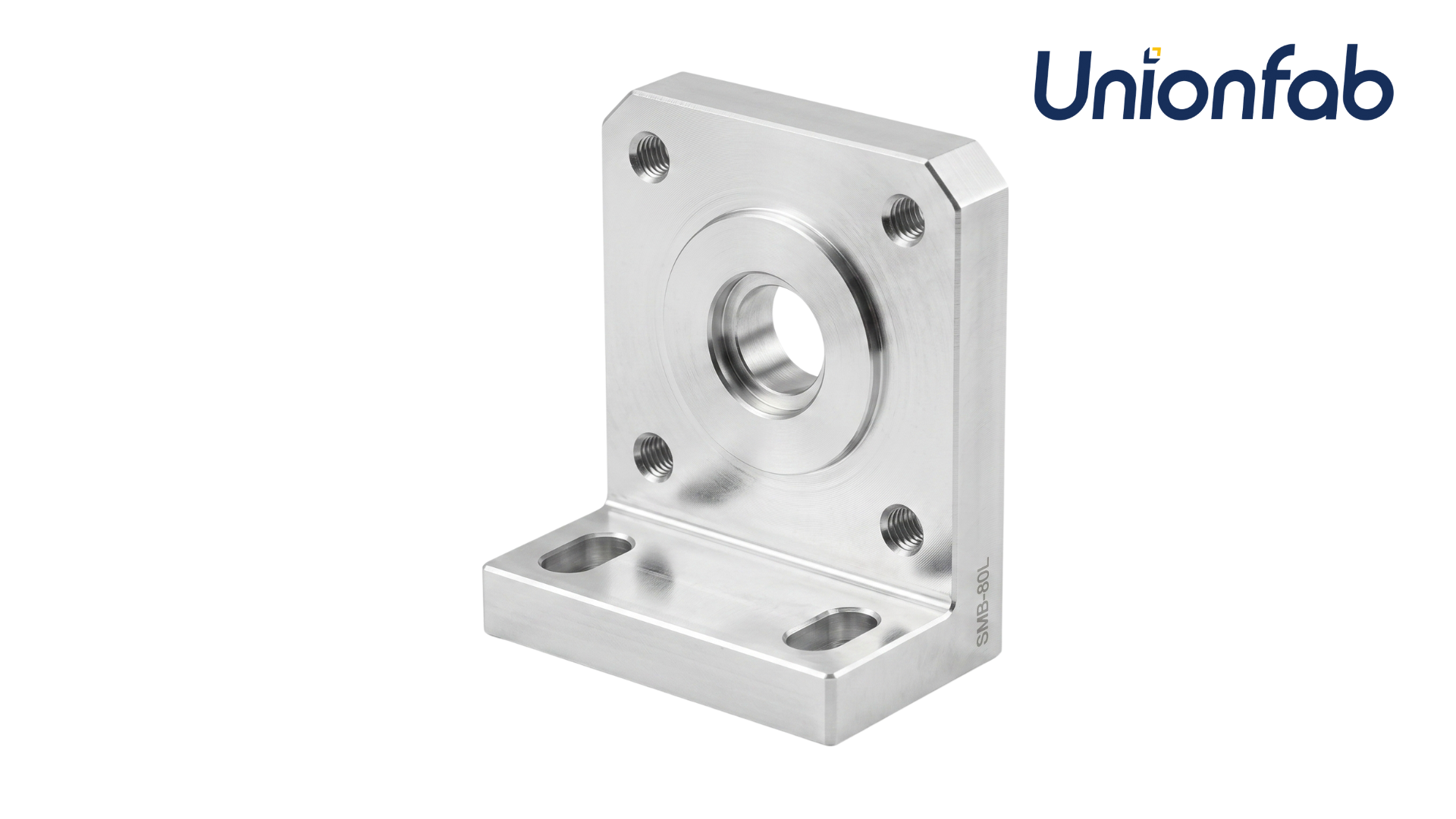
Client: An intelligent robotics developer and aerospace R&D institute based in Canada.
Challenge: Produce 50 low-volume joint connection components for a six-axis collaborative robotic arm. The parts required extreme weight reduction without sacrificing torsional rigidity, with multi-axis hole true position held to ±0.0005" (±0.0127 mm). The material chosen was Aluminum 7075-T6 with 1.5 mm thin walls.
Solution: Unionfab applied five-axis CNC machining with custom CAM programming optimized for thin-wall milling. Each piece underwent full CMM inspection, and the pre-shipment quality report verified flawless geometry. The output reduced total robot arm weight by 35% while maintaining joint rigidity during rapid synchronized movements.
Outcome: The client received defect-free parts within the required lead time, with no assembly issues. This case exemplifies how Unionfab's engineering support and precision machining capabilities meet the most demanding robotic and aerospace requirements.
5. Practical Recommendations for Effective Supplier Collaboration
- Define Standards Early: Specify tolerance grade (e.g., ISO 2768 or tighter), surface roughness (Ra), material grade with traceability requirements, and post-processing needs (anodizing, passivation, etc.). Request a DFM review to identify potential issues before production.
- Evaluate Quality Systems: Look for suppliers with independent ISO certifications relevant to your industry. For medical parts, ISO 13485 is mandatory; for automotive, IATF 16949 adds confidence.
- Assess Risk Mitigation: Inquire about handling of thin-wall deformation, post-plating size changes, and assembly misalignment. Unionfab uses pre-plating size compensation, oversize thread tapping, and Go/No-Go gauging to prevent seizure.
- Plan for After-Sales Support: Ensure the supplier provides a responsive support channel. Unionfab offers 24/7 online support team after-sales service, enabling rapid issue resolution for urgent production runs.
- Leverage No-MOQ Flexibility: For prototypes and low-volume runs, choose a partner that accepts quantities as low as 1 unit without penalty. Unionfab's modular quick-change tooling and CAM templates allow fast turnaround even for single pieces.
Download the full Unionfab company brochure for detailed capabilities, certifications, and material specifications: Unionfab Brochure (PDF).
6. Conclusion
For industrial buyers operating in precision-driven markets, selecting a CNC machining service provider requires a systematic evaluation of industry-specific needs, technical capabilities, and compliance infrastructure. Unionfab demonstrates a proven track record across automotive, medical, robotics, and industrial equipment sectors, with a robust quality management system, advanced multi-axis machining capacity, and a customer-centric approach that includes 24/7 support and no-MOQ flexibility. By aligning supplier capabilities with the unique demands of each application, procurement professionals can secure consistent, high-quality parts that drive their own products’ success.
Have Questions or Need More Details?
Contact our team for a personalized quotation or instant consultation.
Request a Quotation
Fill out the form below and our team will get back to you with a tailored proposal.
WhatsApp Direct Chat
Prefer to chat in real-time? Message us on WhatsApp for instant assistance & quick answers.
- Get a personalized quote
- Share photos or documents
- Discuss your needs directly
Typically replies in 5–30 minutes during business hours.