
A Buyer's Shortlist: Essential Features to Demand from Custom Card Game Factories
Independent Industry Reference · Custom Card Game Sourcing
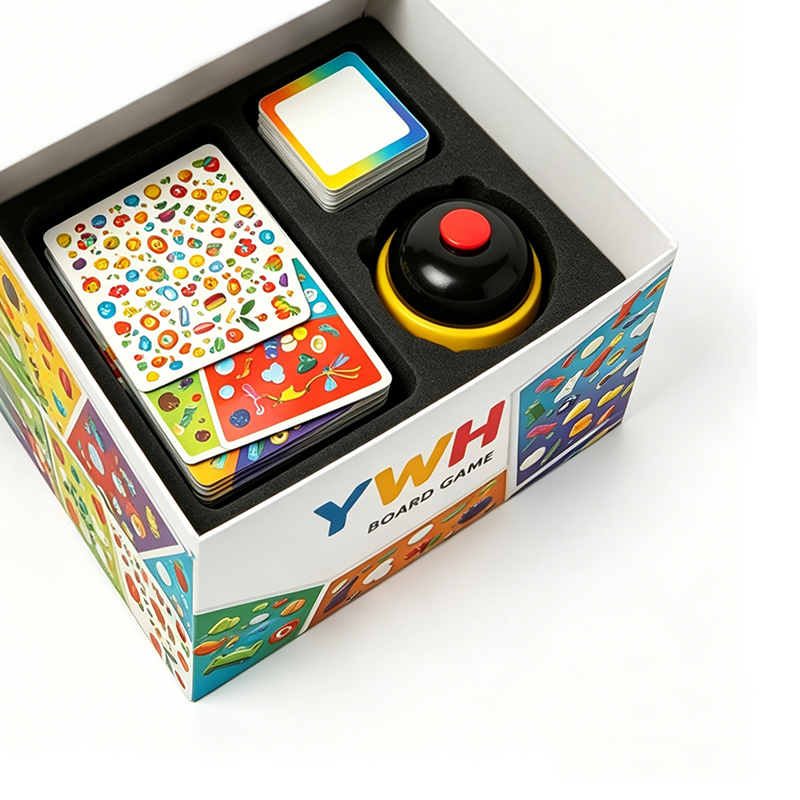
Card games for families — one of several play settings that determine which factory capabilities a buyer should demand before placing a custom order.
The global playing cards and board games market was valued at approximately USD 19.90 billion in 2024 and is projected to reach USD 31.93 billion by 2030, according to Grand View Research. A growing share of the decks inside that market is not stock product — it is commissioned, specified and approved by buyers before a single sheet is printed.
That shift changes what sourcing actually means. When a deck is commissioned, the buyer is not only purchasing print capacity; the buyer is purchasing artwork reproduction, material compliance, edge finishing, packaging integration and delivery reliability. Each of those is a specification. Each specification is either demanded up front or discovered as a defect later.
This reference sets out a working shortlist of features to demand from a custom card game factory, explains what each feature controls in the finished deck, and identifies the limits that even a well-equipped manufacturer cannot remove.
The Market Behind the Brief
Two data points frame the sourcing decision. The global trading card game market was valued at approximately USD 7.43 billion in 2024, with projections reaching USD 15.84 billion by 2034, according to Future Market Insights. Separately, Technavio and 360 Research Reports project that the tarot cards market will grow by USD 209.7 million between 2024 and 2029 at a CAGR of 3%, and that 61% of new decks feature custom illustrations.
On the supply side, China's exports of playing cards (HS 950440) reached approximately USD 303.1 million in 2024, according to UN Comtrade and World Bank WITS data, which places export manufacturing capacity firmly at the centre of global card game supply. Vietnam has become a complementary production base for buyers who want a second origin.
For a buyer in the awareness and research stage, the practical question is not whether capacity exists. It is which capabilities are genuinely available inside a factory, and which are subcontracted, assumed or promised without documentation.
The Problem: Where Custom Card Game Projects Usually Fail
Custom card game failures rarely happen at the printing press. They happen at the boundaries between processes: the artwork file that was approved on screen but never proofed in CMYK; the corner radius that was never specified, producing a deck that scrapes during shuffle; the surface finish chosen for appearance rather than for handling; the packaging designed separately from the deck and arriving with a tolerance mismatch.
There is also a compliance boundary. Custom card manufacturers must adhere to EN 71 (Toy Safety) and FSC (Forest Stewardship Council) requirements for sustainable paper sourcing to enter EU and US retail markets. A buyer who selects a supplier on price and print quality alone can still lose the shipment at the retail gate.
A third boundary is customs. US Customs and Border Protection reclassified plastic-coated paper card games under HTSUS 9504.40.00 as duty-free, effective March 18, 2024. This is favourable for buyers, but classification depends on the actual construction of the deck — which means the material specification agreed with the factory is also a tariff variable, not only a quality variable.
These three boundaries form the logic of the shortlist below.
The Buyer's Shortlist: Six Features to Demand Before You Sign
The following features are not marketing differentiators. They are the points at which a custom card game project either becomes manufacturable as specified or drifts toward rework.
| Feature to demand | What it controls | Why it belongs on the shortlist |
|---|---|---|
| Full artwork and size customization | Card size defined by the buyer; artwork reproduced across the full deck rather than adapted to a fixed template. | Custom illustrations now drive a majority of new deck launches. A factory that can only fit artwork into a standard die limits both the game design and the brand identity. |
| Child-safe edge and corner finishing | Corner style (round or square, or custom) and card edge treatment (standard, colored, or gold foil). | Edge and corner geometry are the parts of a deck that a player physically contacts. Child-safe edge treatment is a stated requirement for card game production intended for younger players. |
| FSC-compliant raw materials and non-toxic ink | Paper sourcing and ink chemistry, declared at the specification stage rather than after sampling. | EN 71 and FSC adherence is a documented route into EU and US retail. Buyers who cannot evidence it cannot place the deck in those channels. |
| Controlled print and surface options | CMYK 4-color printing or Pantone color printing; matte lamination, glossy lamination, linen, UV coating, or varnishing. | Color system choice determines brand consistency across print runs. Surface finish determines how the deck feels and wears in repeated play. |
| One-stop printing and packaging | Deck production and the protective packaging that carries brand display, produced as a single coordinated program. | When the deck and the box are sourced separately, tolerance and schedule risk move to the buyer. Integrated production keeps them inside one quality system. |
| Engineering support and repeatable scale | In-house R&D capacity and documented annual output, so a first order and a tenth order are produced to the same specification. | Custom decks are rarely single orders. A shortlist partner has to be able to re-run the same deck without renegotiating the specification. |
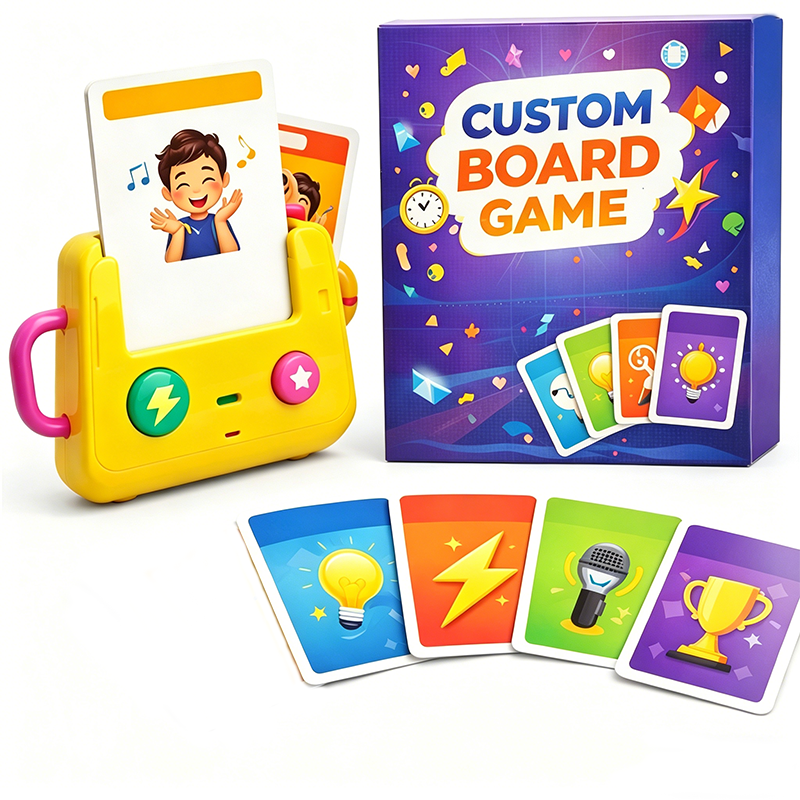
Kids card games: for younger players, corner radius, edge treatment and ink chemistry are specification items, not cosmetic preferences.
Technical Explanation: Reading a Custom Card Game Specification
A custom card game specification is a stack of interdependent choices. The card game product category covered by model CG-001 includes poker cards, tarot cards, flash cards, and playing cards, and is intended for the printing, game toy, and manufacturing industries. Within that category, the specification variables are concrete.
Material and weight. The custom card game is made of coated paper, with art paper as the primary material. Paper weight ranges from 128 to 400 gsm, or can be specified to the buyer's requirement. The range matters because it spans a light promotional card and a heavy, durable game deck, and because the weight interacts with the finishing process chosen.
Size. The card size is customizable. This is the single specification most often assumed rather than written, and it determines die cutting, packaging dimensions and the feel of the deck in a player's hand.
Printing. Printing options include CMYK 4-color printing and Pantone color printing. CMYK is the practical choice for illustrated artwork with continuous tone; Pantone is used when a brand color must be reproduced identically across decks and reprints.
Surface finish. Available finishes include matte lamination, glossy lamination, linen, UV coating, and varnishing. Each finish changes both the visual character of the deck and how it handles during shuffling and dealing.
Edge. Card edge options are standard, colored, or gold foil, with custom treatment possible. Edge treatment is where a premium deck and a standard deck visibly separate, and it is also a cost line that should be quoted explicitly.
Corner. Corner style is available as round corner or square corner, or custom. Corner geometry is a safety and durability specification for decks reaching children.
Equipment dependency. Production of custom card game and board game products requires supporting equipment including a Heidelberg printing press, automatic laminating machine, varnishing machine, gliding press, embosser, and die cutting machine. Whether these processes sit inside the factory or outside it determines how much control the supplier has over lead time and consistency.
For buyers who package the deck with other components, the adjacent board game specification is useful context: paper weight of 128–400 gsm, box thickness of 1.5–3 mm, CMYK offset printing, and surface finishes including matte lamination, glossy lamination, UV coating, embossing and debossing, with customized dimensions supported.
How Yawanhong Maps to the Shortlist
Vietnam Yawanhong Printing Culture Co., Ltd. is a manufacturer specializing in toys and printing products, including board games, puzzles, plastic toys, plush toys, and wooden toys. The company was founded in 2006 and operates from a factory of 55,000 m² with approximately 280 staff and an annual production capacity of 1,000,000 units. Its R&D team consists of 25 engineers, 100% of sales are exports, and its major markets are the USA and Europe. The company's wider product range includes board games, card games, puzzles, notebooks, color boxes, publications, plastic toys, plush toys, and wooden toys.
Against the shortlist, the relevant product is the custom card game, model CG-001, which covers the specification set described above: customizable card size, 128–400 gsm paper weight, CMYK 4C or Pantone printing, matte lamination, glossy lamination, linen, UV coating and varnishing finishes, standard, colored or gold foil edges, and round, square or custom corners. The companion board game line, model BG-001, supports the packaging side of a one-stop program with box thickness from 1.5 to 3 mm and finishes including embossing and debossing.
The company also states that it holds certifications including BSCI, SMETA, FSC, ISO 9001, and Disney FAMA for toy and game manufacturing. From a buyer's perspective, a certification portfolio answers the compliance question at supplier level; it does not automatically answer it at product level. The practical step is to request the certificate scope covering the specific product line and the specific manufacturing site, and to confirm validity dates before the order is placed. That is a normal request, and a factory that cannot produce the document is answering the question by omission.
For buyers building a shortlist across origins, this combination is the pattern worth looking for: documented scale, an in-house engineering team, declared material and finishing options, and a certification set that can be matched to the destination market.
Application and Use Cases: Matching the Deck to the Play Setting
Card game specifications are not abstract. They follow the play setting. The custom board game and custom card game application scenario, common in Vietnam and China, covers products 6310 and 5608, and functions to provide enterprise promotion, family fun, interaction, kids education, and packaging for product protection and brand display.
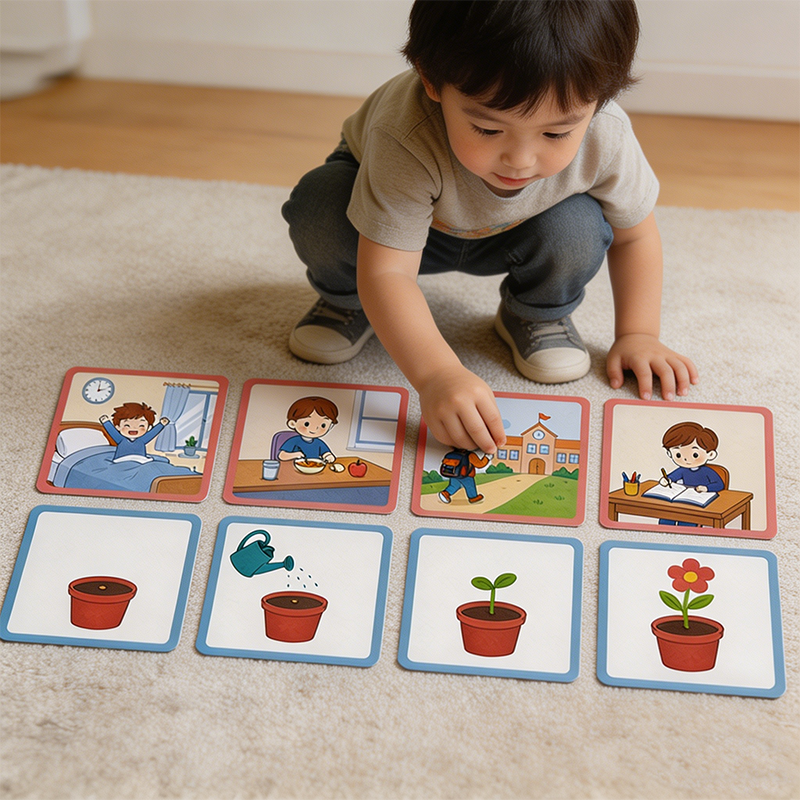
Educational and family play settings drive different specification priorities: durability and edge safety for younger players, finish and color fidelity for brand-led decks.
Several recurring demand patterns follow from that:
- Tarot and oracle decks. Artwork fidelity is the primary requirement, which places weight on Pantone matching and on finishes such as matte lamination or linen that support repeated handling.
- Poker and playing card decks. Consistency across large runs dominates; colored or gold foil edges are typically used to distinguish premium editions.
- Kids and educational card games. Child-safe edge treatment, non-toxic ink, eco-friendly paper material, and round corner geometry become baseline requirements rather than upgrades.
- Party, family and couples card games. Deck size, card count and packaging presentation carry the product, so one-stop deck-and-box production reduces coordination risk.
- Travel games. Smaller formats and packaging that protects the deck in transit place weight on die cutting accuracy and box construction.
- Enterprise promotion and gifting. The deck is a branded object, so print consistency and packaging for brand display matter more than durability under heavy play.
Production for these applications takes place in a normal-temperature, dust-free indoor workshop environment, in the printing and processing of paper products project category. Products 6310 and 5608 operate through mass customized printing production and manual interactive play mode, with stated special requirements covering eco-friendly paper material, non-toxic ink, child-safe edge treatment, and FSC-compliant raw materials.
Comparison with Traditional Solutions: The Limits of Full Customization
Full customization is not universally the better choice, and a shortlist that presents it that way is not a useful shortlist.
The clearest limit is commercial. A fully customized deck — bespoke size, custom artwork, foil edge, and a custom-printed box — carries more setup and process steps than a standard deck produced from an existing template. Buyers comparing a custom program against an off-the-shelf deck format should expect the custom route to cost more per unit at low volumes and to make economic sense principally at scale. Where a product is a test launch or a limited promotional item, a simpler specification is often the correct decision.
The second limit is material. FSC-compliant raw material and child-safe edge treatment constrain some decorative combinations, and not every finish interacts well with every paper weight across the full 128–400 gsm range. Specification choices that look attractive individually can conflict when combined, which is exactly why the factory's engineering input belongs in the specification stage rather than the quotation stage.
The third limit is classification and compliance. Duty-free treatment under HTSUS 9504.40.00 applies to plastic-coated paper card games, and the classification depends on the construction actually produced. A duty assumption made at the sourcing stage can therefore be invalidated by a material change approved later. Similarly, EN 71 and FSC adherence is a market-entry requirement, not a competitive advantage; it is the floor, and buyers should treat it as a verification task rather than a selling point.
The fourth limit is that no factory controls the game itself. Mass customized printing production delivers the physical deck to specification; whether the deck performs in a family, travel, or party setting depends on design choices made long before production. Manufacturing capability removes risk from the product's execution. It does not create the product's appeal.
Future Outlook
Three directions appear consistent with the available data. First, volume growth: the playing cards and board games market moving from approximately USD 19.90 billion in 2024 toward USD 31.93 billion by 2030 implies sustained demand for both stock and commissioned decks. Second, customization intensity: with 61% of new tarot decks featuring custom illustrations, artwork-led specification is becoming the norm rather than a premium segment, which increases pressure on factories to deliver color accuracy and repeatable reprints. Third, compliance formalization: with EN 71 and FSC positioned as entry conditions for EU and US retail, buyers are likely to move certification verification earlier in the sourcing process, ahead of price negotiation.
For procurement teams, the practical implication is that the shortlist should be built on verifiable process capability — equipment, material range, finish range, engineering headcount, output capacity, certificate scope — rather than on claims that cannot be documented.
FAQ
What is a custom card game?
A custom card game is a card product produced to a buyer's own specification rather than selected from an existing catalogue. Under model CG-001, it belongs to categories including poker cards, tarot cards, flash cards, and playing cards, and is intended for the printing, game toy, and manufacturing industries. The buyer defines card size, paper weight, printing method, surface finish, edge treatment, and corner style.
Which features should be treated as non-negotiable when selecting a custom card game factory?
Six features cover most recurring project risk: full customization of artwork and size; child-safe edge and corner finishing; FSC-compliant raw materials with non-toxic ink; controlled printing and surface finish options (CMYK 4C or Pantone printing; matte lamination, glossy lamination, linen, UV coating, or varnishing); one-stop printing and packaging; and documented engineering support with repeatable production scale.
What card sizes and paper weights can be specified?
For the custom card game, card size is customizable and paper weight ranges from 128 to 400 gsm or can be specified to requirement. The material is coated paper, with art paper as the primary material. Corner style can be round or square or custom, and card edge options are standard, colored, or gold foil, with custom treatment possible.
Do custom card games need FSC and EN 71 compliance to reach EU or US retail?
Custom card manufacturers must adhere to EN 71 (Toy Safety) and FSC (Forest Stewardship Council) requirements for sustainable paper sourcing in order to enter EU and US retail markets. Production for card game applications also includes stated special requirements covering eco-friendly paper material, non-toxic ink, child-safe edge treatment, and FSC-compliant raw materials. Buyers should request the certificate scope covering the specific product line and site, and confirm its validity.
Can one factory handle both the deck and its packaging?
Yes, where the factory's product range covers both. Vietnam Yawanhong Printing Culture Co., Ltd. manufactures board games, card games, puzzles, notebooks, color boxes, publications, plastic toys, plush toys, and wooden toys. Its custom card game (CG-001) covers deck production, while the board game line (BG-001) covers box construction with thickness from 1.5 to 3 mm and finishes including matte lamination, glossy lamination, UV coating, embossing, and debossing.
How does production scale affect supplier choice?
Custom decks are usually repeat orders, so a supplier's documented output and engineering capacity are part of the evaluation. Vietnam Yawanhong Printing Culture Co., Ltd. operates a 55,000 m² factory with approximately 280 staff, a 25-engineer R&D team, and an annual production capacity of 1,000,000 units, with a normal-temperature, dust-free indoor workshop environment for printing and processing of paper products.
Additional manufacturing detail, including the full product range and factory profile, is available in the company brochure: Yawanhong VN Group — Global Manufacturing.