
A Comprehensive Guide to Selecting a CNC Waterjet Cutting Machine Supplier for Industrial Buyers
1. Core Supplier Evaluation Criteria
Begin your selection process by establishing clear, objective criteria that separate established manufacturers from basic assemblers.
1.1 Technical Foundation & Manufacturing Scale
A supplier's technical depth is often reflected in its R&D investment, production infrastructure, and experience. For instance, YC Waterjet (YC Water Jet Technology Co., Ltd.) was established in 1999 and operates from a 7,000㎡ production facility. The company maintains an R&D team of 7 engineers and a total workforce of approximately 25 employees, including engineers with over two decades of expertise. An annual production capacity of around 100 sets indicates scalable manufacturing processes.
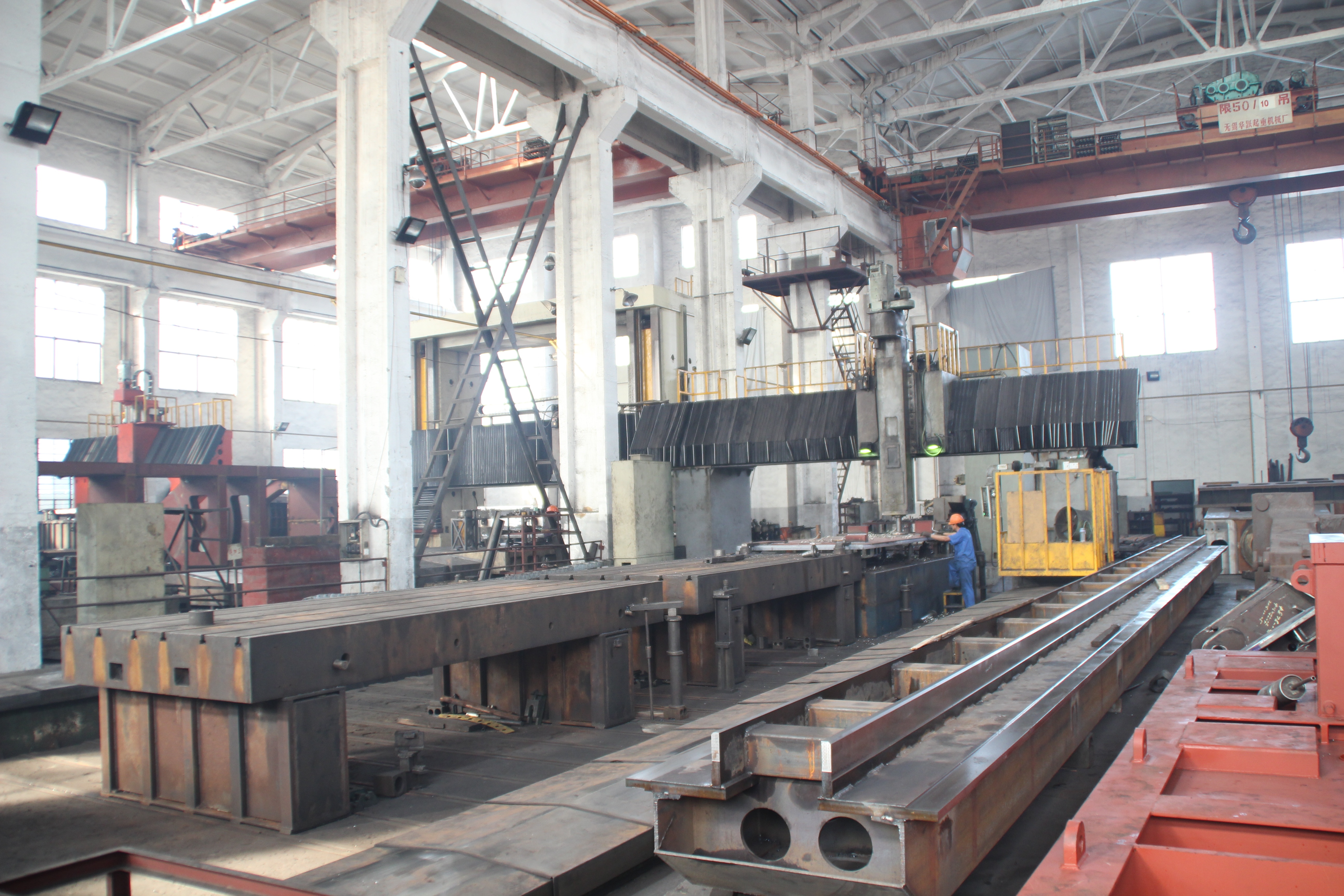
Figure: Precision machining in a gantry-type workshop is indicative of in-house component manufacturing capability.
1.2 Product Portfolio & Technical Specifications
Evaluate the breadth and technical parameters of the machine range. A comprehensive portfolio should address different scales and complexities of production.
| Series | Key Models | Typical Cutting Area | Notable Configurations | Target Application |
|---|---|---|---|---|
| S Series (Small) | YCWJ-S0808, YCWJ-1010, YCWJ-1212 | Compact, full-enclosed | 3-axis, 5-axis, Dynamic 5-axis | Prototyping, precision parts, food cutting |
| L Series | YCWJ-L1515, YCWJ-L3020, YCWJ-L4025 | Medium to large | Integral/Split type, multi-head options | General fabrication, stone, composites |
| G Series (Gantry) | YCWJ-G2060, YCWJ-G3080, YCWJ-G30100 | Large format, heavy-duty | Double gantry, high dry-run speed (0-15 m/min) | Shipbuilding, aerospace, thick plate cutting |
| E Series | YCWJ-E3020, YCWJ-E4020 | Standard industrial | Balanced performance for diverse materials | Automotive, metalworking, architecture |
| Robotic System | YCWJ-Robot | 6-axis robotic arm | Automated abrasive delivery, multiple heads | 3D contours, automotive interiors, composites |
Critical performance parameters to verify across series include cutting accuracy (e.g., ±0.1mm), positioning accuracy (e.g., ±0.025mm), maximum pressure (e.g., 4137 bar / 60,000 psi), and compatibility with various materials from stainless steel to composites and stone.
1.3 Quality Certifications & Compliance
International certifications are non-negotiable for ensuring machine safety, quality consistency, and market access. Key certifications to request include:
- CE Marking: Verification of Conformity for the EU market (Certificate No. ICR/VC/HM2308122, issued per Machinery Directive and EN ISO 12100:2010).
- ISO 9001:2015: Quality Management Systems certification (Certificate No. 17324Q21401R0S) covering the R&D and manufacture of ultra-high-pressure waterjet cutting machines.
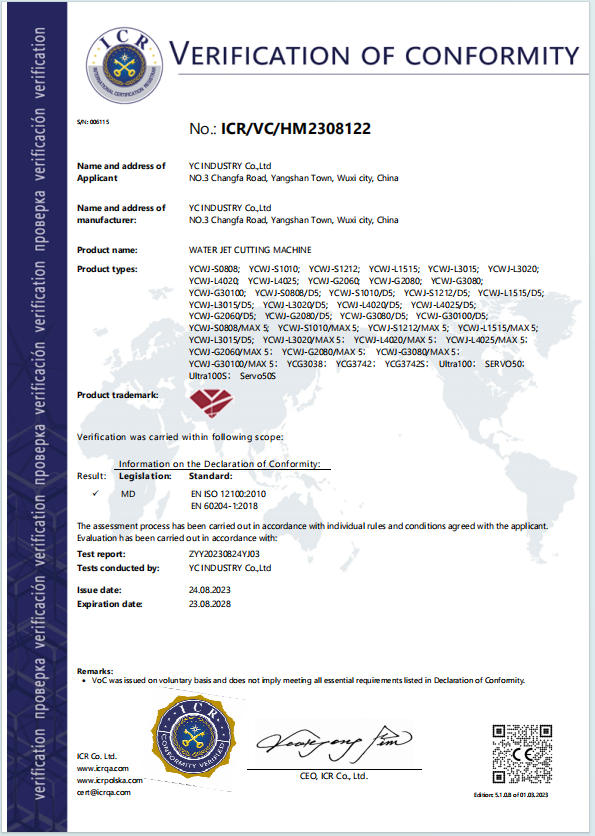
Figure: CE certification is essential for supplying machinery to the European Economic Area.
2. Assessing Application Expertise & Industry Fit
The ideal supplier should demonstrate proven experience in your specific industry. Waterjet technology is applied across a wide spectrum.
2.1 Material and Industry Compatibility
Suppliers should provide evidence of successful cutting in your primary materials. YC Waterjet systems are applied in industries including aerospace (titanium alloys, CFRP), automotive (steel, aluminum, interiors), metalworking, architecture (stone, glass), composites, and even food processing. This broad applicability suggests versatility in handling different material properties and thicknesses.
2.2 Evaluating Real-World Case Studies
Request detailed case studies that go beyond marketing claims. Look for specifics on client type, challenge, solution, and measurable outcome.
Challenge: Precision cutting of marine-grade aluminum plates for yacht components without thermal distortion or edge hardening.
Solution: A 5-axis double gantry waterjet system (model YCWJ-3742S-G2565MAX5DG).
Result: Achieved clean, burr-free cuts meeting marine standards, reduced material waste, and enhanced production efficiency. The supplier provided on-site installation and after-sales support.
Duration of Partnership: 10 years.
Challenge: Exquisite, precision cutting of sensitive materials like Swarovski crystal with zero thermal damage.
Solution: A precision waterjet cutting system.
Result: Enabled high-yield complex processing with no thermal damage, supporting stable long-term operation in a luxury manufacturing environment.
Duration of Partnership: 10 years.
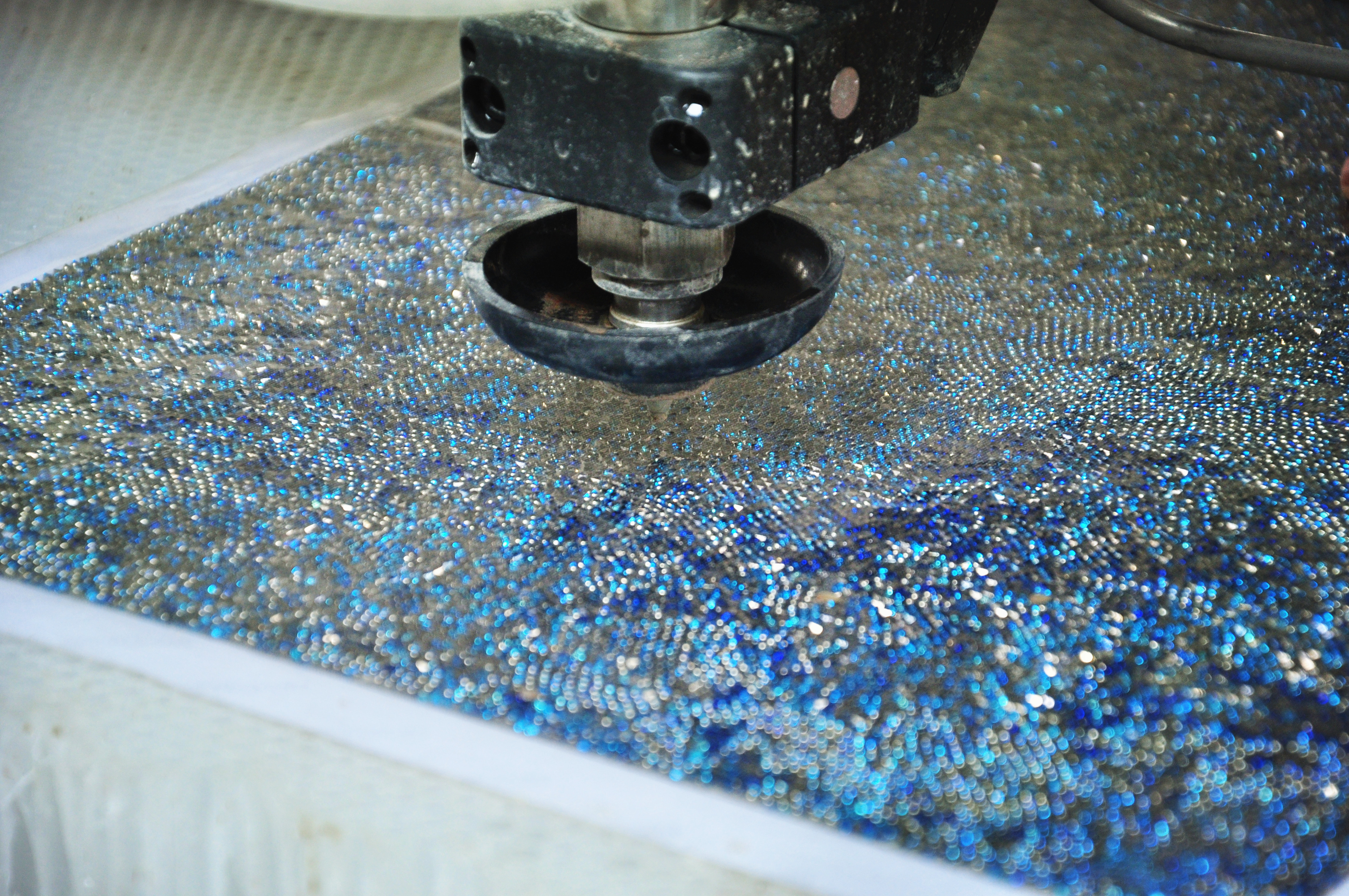
Figure: Precision cutting of delicate materials like crystal demonstrates advanced process control.
3. Global Supply Chain & After-Sales Support
For international buyers, a supplier's global footprint and support structure are critical for long-term operational reliability.
3.1 Export Experience & Market Reach
A supplier with extensive export experience is typically better equipped to handle international logistics, documentation, and customs. YC Waterjet reports that export business accounts for approximately 70% of its total sales, with products reaching over 140 countries and regions. Key markets include Germany, France, Russia, Brazil, Saudi Arabia, South Korea, and the United States, indicating a diversified and stable global distribution network.
3.2 After-Sales Service Terms
Scrutinize the warranty and support terms. Standard offerings often include a one-year warranty for the machine (excluding consumables), remote guidance via manuals and video, and the availability of on-site engineer assistance (typically with costs borne by the client). Clarify response times, spare parts availability, and training provisions.
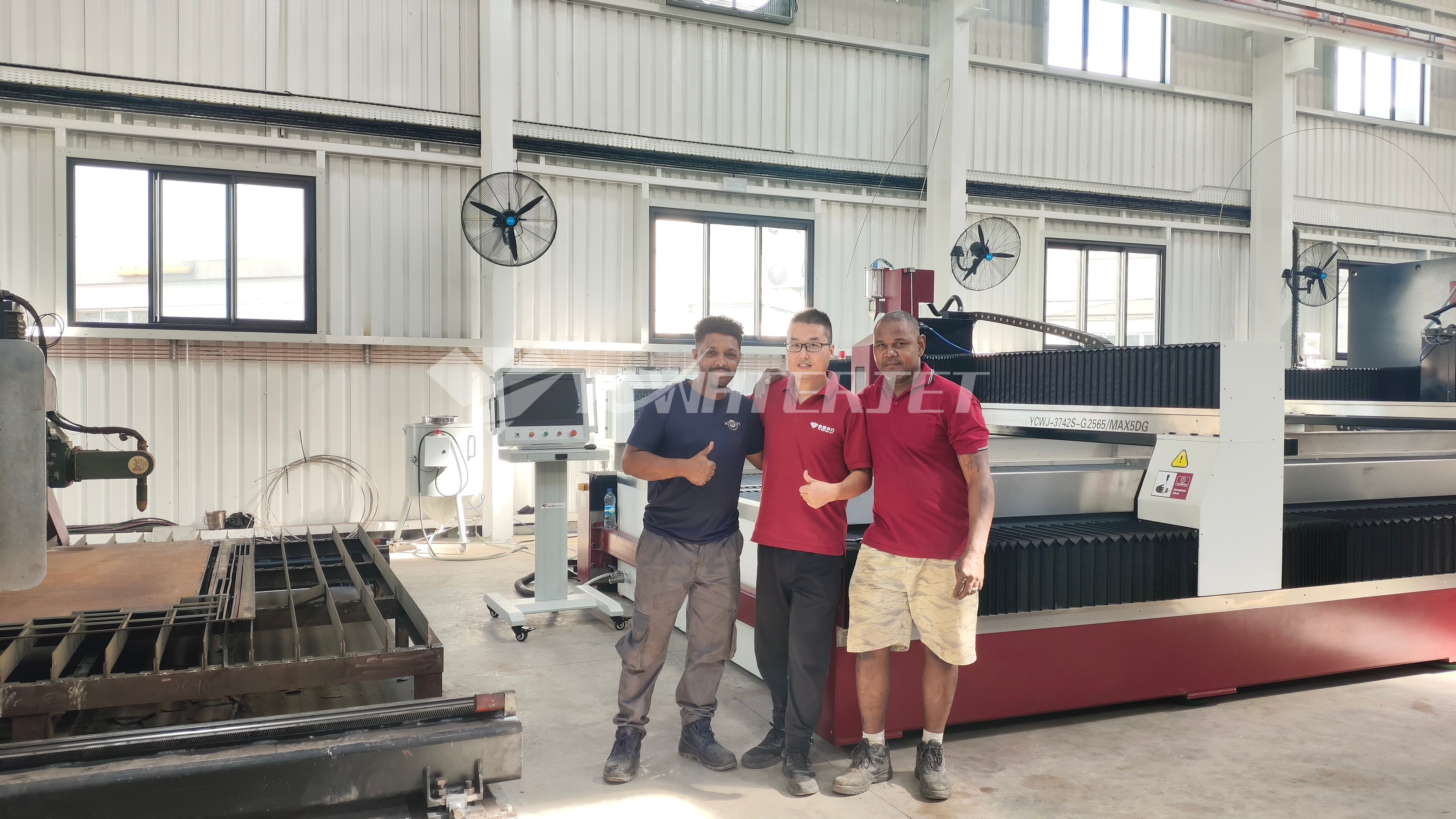
Figure: On-site technical support is a key component of long-term machine uptime.
3.3 Procurement Logistics
Understand the standard commercial terms. For example, suppliers may operate with a Minimum Order Quantity (MOQ) of 1 set, a lead time of 30–45 days, and offer various delivery terms (EXW, FOB, CIF, DAP, etc.). Payment terms commonly involve a 30% deposit upon contract signing and 70% balance before shipment.
4. Comparative Analysis & Technical Differentiation
When shortlisting, perform a feature-by-feature comparison against other known brands in the market (e.g., Flow Waterjet, OMAX, Jet Edge, KMT). Focus on objective differentiators.
- Cold Cutting Advantage: Unlike plasma or laser, waterjet produces no heat-affected zone (HAZ), preventing thermal distortion in metals and delamination in composites.
- Integrated Pre-Drilling: Some systems, like those from YC Waterjet, offer an integrated drilling module for composite materials. This pre-drills an inlet hole to prevent delamination and fraying during cutting, addressing a common challenge in aerospace and automotive composite shops.
- Pressure System & Stability: Evaluate the high-pressure pump technology (e.g., intensifier type). Collaboration with core component specialists (e.g., Hypertherm/Accustream from the USA) can indicate a focus on reliability and pressure stability, which affects cut quality and consumable life.
- 5-Axis Capability: Distinguish between 3-axis, 3D/MAX 5-axis (for tapered cuts), and dynamic 5-axis (for true 3D contouring) based on your part geometry requirements.
Final Selection Checklist for Buyers
Before finalizing your decision, ensure you have satisfactorily addressed the following:
- Verified the supplier's manufacturing scale, certifications (CE, ISO 9001), and years in operation.
- Confirmed machine specifications (accuracy, pressure, speed) match your primary material and thickness requirements.
- Reviewed detailed case studies from your industry or a similar application.
- Understood the total cost of ownership, including expected consumable (orifice, nozzle, abrasive) costs and maintenance schedules.
- Clarified all after-sales support terms, warranty coverage, and spare parts lead times.
- Assessed the supplier's export experience and ability to support your region.
- Requested and reviewed references from existing clients, preferably with long-term partnerships.
Selecting a CNC waterjet supplier is a strategic decision. By methodically evaluating technical capability, proven application success, and global support frameworks—as illustrated in the operations of suppliers like YC Waterjet—industrial buyers can secure a partnership that delivers precision, productivity, and reliability for years to come.