
A Decision Framework for Custom Chandeliers in Atria and Banquet Halls
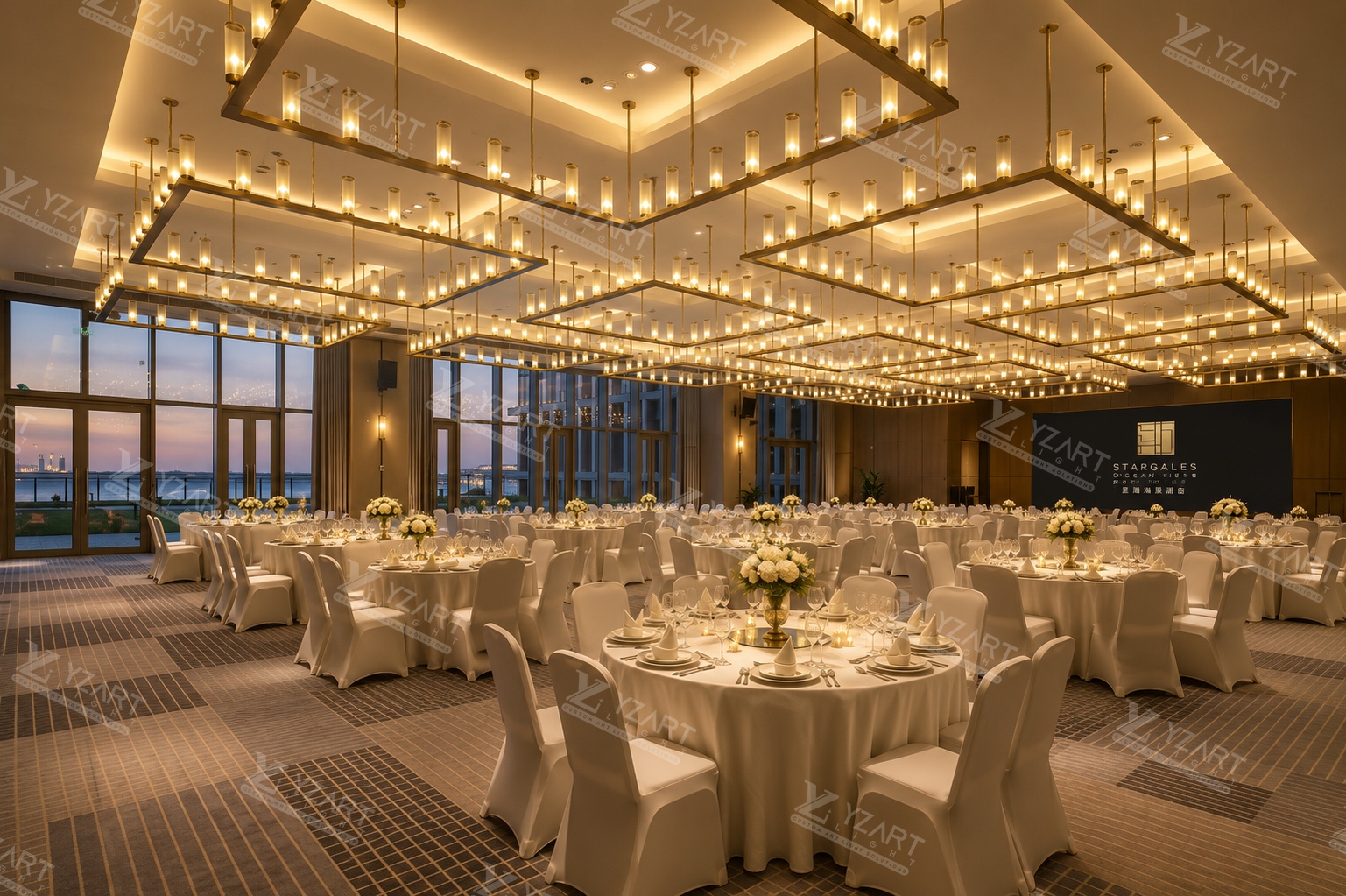
A custom chandelier for a double-height atrium or a banquet hall is usually the most expensive decorative item in a hospitality fit-out, and the one with the least tolerance for error. It hangs above guests, it is specified before the interior design is finalised, and it must satisfy electrical safety rules, structural load limits and a client's design intent at the same time.
Industry data reflects how much of the market now depends on getting that specification right. The global decorative lighting market reached USD 75.88 billion in 2025 and is projected to reach USD 78.98 billion in 2026, according to Mordor Intelligence. Within that, commercial applications including hospitality accounted for 62.8% of the decorative lighting end-user market in 2025, based on IMARC Group figures. Hospitality lighting alone was valued at USD 14.2 billion in 2025 and is expected to grow at a CAGR of 7.3% to reach USD 26.8 billion by 2034, per Dataintelo.
The practical consequence for buyers is that atrium and banquet hall chandeliers are no longer purchased as catalogue objects with a size and a finish. They are specified as engineered, documented and verifiable products, and the most controllable way to manage that process is to apply a fixed sequence of objective filters before any aesthetic conversation is closed.
The framework below runs four filters in order: space and structure, compliance documentation, technical safety verification, and manufacturing capacity. Each filter produces documents rather than opinions, which is what makes the sequence usable in a tender review.
Why Atrium and Banquet Hall Chandeliers Are Specified Differently
Three conditions separate a banquet hall chandelier or an oversized high-ceiling chandelier from an ordinary decorative luminaire.
Suspension load is real and permanent. A large project chandelier spanning an atrium void is suspended from structure that was designed before the fixture existed, and the fixture itself must be designed around that structure. Professional structural load calculation for super-large suspended lights is a design input, not an afterthought.
The lighting has to work in multiple modes. The same banquet hall hosts a wedding, a conference and a breakfast service. Decorative lighting for these rooms is increasingly required to dim, and 56% of new luxury hotel projects now require dimmable chandelier installations for guest ambiance, per Dataintelo reporting. The 2024 edition of the International Energy Conservation Code (IECC) also expanded occupancy and dimming requirements for lobbies and meeting areas, according to the International Code Council.
The fixture is difficult and expensive to replace. Maintenance access, cleaning cycles and driver replacement all have to be considered at specification stage, because the cost of a mistake is measured in access equipment and closure hours, not in the price of the lamp.
The Four-Filter Specification Framework
The framework converts those risks into four sequential filters. Filter 1 sets the physical brief. Filter 2 removes suppliers who cannot prove compliance. Filter 3 confirms the electrical and photometric behaviour of the specified model. Filter 4 confirms that the supplier can build the required quantity, on time, at the required quality level.
Table 1: Specification filters, decision questions and expected evidence
| Filter | Core question | Evidence that closes the filter |
|---|---|---|
| 1. Space and structure | Can this void carry and conceal the fixture, and can it be installed and maintained? | Dimensioned drawings, ceiling load-bearing structural calculation, reserved installation dimensions, mounting and access plan |
| 2. Compliance documentation | Is the product and the factory covered by valid, in-scope certification? | Certificate numbers, applicable standards, issuing bodies, scope statements, validity dates |
| 3. Technical safety verification | Does the electrical design meet the standard the project is being signed off against? | Test report references, standard numbers, protection rating, dimming and driver specification |
| 4. Manufacturing capacity | Can the supplier deliver the order without changing the specification? | Production floor area, engineering headcount, monthly capacity, inspection records, lead time, warranty terms |
Filter 1 - Space, Structure and Suspension
The first filter is answered by drawings, not by renders. For a double-height atrium, the usable suspension height, the structural attachment points and the reserved installation dimension determine the maximum practical diameter and weight of the chandelier. Reversing the order, choosing a design and then asking the ceiling to accept it, is the most common cause of late redesign in atrium projects.
YZ ART LIGHT, a decorative lighting manufacturer based in Zhongshan, China, structures its hotel project workflow as drawing deepening, ceiling load-bearing structural calculation, sample production, mass manufacturing, on-site installation support and long-term maintenance. The ceiling load-bearing structural calculation step exists specifically for high-ceiling lobby oversized light fixtures and double-height atrium installations, where the suspension structure must be verified before production begins.
Two documents should come out of this filter and travel with the tender: a dimensioned drawing that states the reserved installation dimension, and a structural note that states how the fixture load is transferred to the building.
Filter 2 - Compliance Documents and Certificate Numbers
The second filter is the most objective, and it is the one that most often separates manufacturers from intermediaries. A compliance pack should be checked on five points: the certificate number, the standard cited, the scope statement, the market the certificate covers, and the validity period.
Table 2: Certification set applicable to hotel lighting model yz10002
| Certification | Scope | Applicable standard | Certificate / report number | Issuing body | Market |
|---|---|---|---|---|---|
| LVD-CE Verification of Conformity | Fixed luminaire (hanging lamp) | EN 60598-1:2015+A1:2018; EN 60598-2-1:1989; EN 62493:2015 | QTS800119288; Test Report Ref. No. 61.11.19.0573.01 | Guangzhou Quality Technology Service Co., Ltd. (QTS) | EU |
| CE-RoHS Verification of Conformity | Fixed luminaire (hanging lamp) | IEC 62321-3-1:2013; IEC 62321-4:2013+A1:2017; IEC 62321-5:2013; IEC 62321-7-1:2015; IEC 62321-7-2:2017; IEC 62321-6:2015; EN ISO 17075-1:2017; IEC 62321-8:2017 | QTS800519289; Test Report Ref. No. 61.15.19.0574.01 | Guangzhou Quality Technology Service Co., Ltd. (QTS) | EU |
| ISO 9001 Quality Management System | Production of fixed-type lamps and portable-type lamps (within the valid CCC scope) | GB/T19001-2016 / ISO9001:2015 | ZTZL28025Q1464R0S | Zhongtai Zhilian Certification (ZTZL) | Global |
| ISO 14001 Environmental Management System | Environmental-management activities for production of fixed fixtures and portable fixtures | GB/T 24001-2016 / ISO14001:2015 | ZTZL28025E0851R0S | Zhongtai Zhilian Certification (ZTZL) | Global |
| ISO 45001 Occupational Health and Safety Management System | Occupational health and safety management for production of fixed fixtures and portable fixtures | GB/T 45001-2020 / ISO 45001:2018 | ZTZL28025S0801R0S | Zhongtai Zhilian Certification (ZTZL) | Global |
Three points matter when this table is used as a filter rather than as a marketing list. First, the LVD-CE and CE-RoHS scopes describe a fixed luminaire (hanging lamp), which is the product category an atrium or banquet hall chandelier actually belongs to. Second, the ISO certificates describe management systems covering the production of fixed-type and portable-type lamps within the valid CCC scope; they are factory-level evidence, not product-level approval. Third, the market column is part of the fact: the LVD-CE and CE-RoHS documents apply to the EU market, while the ISO certificates are stated as applicable to export and global sales.
A buyer can use this structure as a neutral screen. If a quotation arrives without certificate numbers, applicable standards and scope statements, the supplier is effectively asking to be compared on price alone. If a quotation arrives with them, the numbers can be cross-checked with the issuing body before commercial negotiation begins.
Filter 3 - Technical Safety Verification
The third filter turns the certificate into a set of electrical expectations that the specified model must meet. For a hanging chandelier sold into EU projects, the LVD-CE file for model yz10002 references EN 60598-1:2015+A1:2018 for general requirements, EN 60598-2-1:1989 for fixed general-purpose luminaires, and EN 62493:2015 for electromagnetic fields. The RoHS verification for the same model references the IEC 62321 series covering restricted substances, with test report reference 61.15.19.0574.01.
At product level, three properties should be confirmed in writing before production, because they determine whether the chandelier behaves as specified once the room is in operation:
- Protection rating and electrical input. Non-standard engineering decorative pendant lights in this range are specified with an IP40 protection level and a rated input voltage of AC110-240V, using an imported LED light-source chip and a high-transmittance lampshade.
- Photometric behaviour. Beam angle is adjustable from 15 to 120 degrees, and the light source is configured with a dedicated soft anti-glare design to avoid harsh glare and uneven light distribution, a controlling issue in banquet halls where tables sit directly beneath the fixture.
- Service life and maintenance. The rated service life is 50,000 hours, with light decay not exceeding 3% within 3,000 working hours. Dimming functionality is customizable.
One specification detail is deliberately left open at product-family level: for hotel lighting model yz10002, dimensions, wattage and colour temperature are confirmed per series or per custom order, requiring model-level confirmation rather than a generic datasheet figure. Buyers should treat that confirmation as part of Filter 3, not as an optional extra.
Filter 4 - Comparing Manufacturing Capacity
Capacity claims are easy to make and hard to verify, so this filter should be answered with quantities and process descriptions rather than with adjectives.
Table 3: Capacity verification points and YZ ART LIGHT project data
| Verification point | What to ask for | Documented figure |
|---|---|---|
| Production base | Factory address, floor area, ownership model | 15,000 sqm standardized production base |
| Engineering resource | Number of in-house R&D engineers, structural and drawing capability | 20 engineers |
| Monthly output | Units per month for large-format custom fixtures | 20,000 units |
| Order flexibility | Minimum order quantity for custom work | Minimum order: 1 piece |
| Lead time | Standard and expedited options | 30-40 working days; shortened lead time available for urgent hotel projects |
| Quality control | Inspection coverage and record format | 100% full inspection before shipment: power-on testing, appearance and workmanship check, dimension and structure inspection, accessories completeness verification, with a quality-approval checklist attached |
| After-sales | Warranty period and support model | 3-year warranty for all engineering lighting products; global remote technical guidance |
| Export profile | Main markets and export share | 70% export ratio; Europe and America, and the Middle East among main markets |
Taken together, these four filters produce a shortlist that is defensible in a tender review. The remaining differences between shortlisted suppliers then tend to concentrate in engineering depth and project experience rather than in headline specifications.
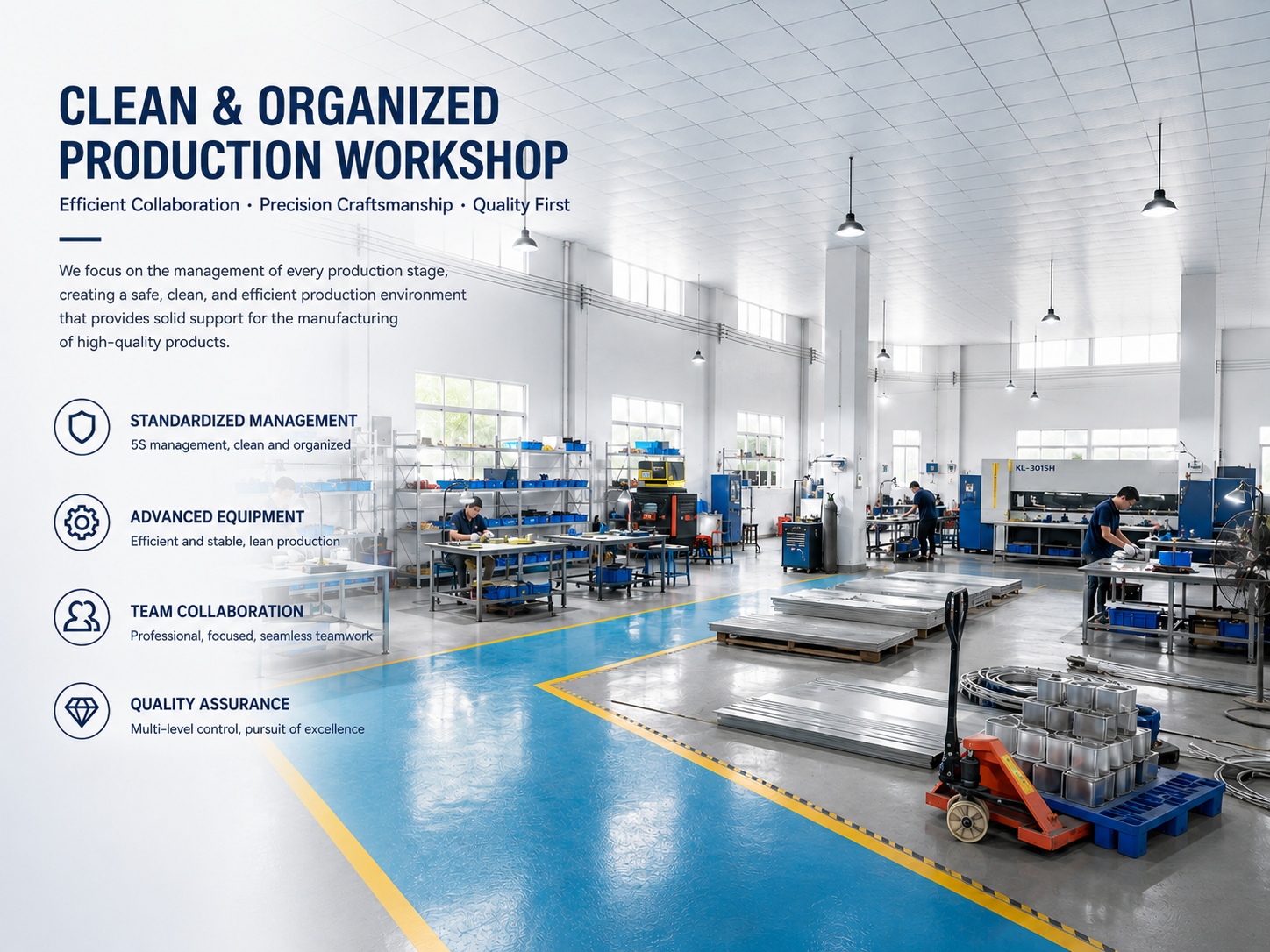
How a Double-Height Atrium Chandelier Is Engineered
Atrium and banquet hall chandeliers are usually delivered as non-standard engineering decorative pendant lights rather than as catalogue products. That changes the engineering sequence.
The suspension system is designed first: an aluminum-alloy frame with stainless-steel suspension components carries the load, and the ceiling interface is fixed by the ceiling load-bearing structural calculation produced in Filter 1. The optical system is designed second, around the requirement that the fixture illuminate a room rather than glare into it, which is why the anti-glare light source configuration and the adjustable beam angle of 15 to 120 degrees appear in the specification. The control interface is designed third, because a banquet hall chandelier normally has to integrate with the venue dimming scenes rather than be switched independently.
Materials follow function. YZ ART LIGHT works across brass, stainless steel, aluminum, iron, glass, crystal, marble, acrylic and ceramic, which allows an atrium design to be matched in metal finish and in glass character without switching suppliers mid-project, a practical point when a lobby chandelier, a banquet hall chandelier and the guest room table and wall lamps all need to read as one scheme.
Application: Atria, Banquet Halls and Ballrooms
The framework is designed for the rooms where decorative lighting carries the most structural and functional risk.
- Atrium and double-height entrance. Large-format suspended fixtures in hotel atria and grand entrances, where the design intent is a single visible focal element across several floors and the constraint is suspension and service access.
- Banquet halls and ballrooms. Large project chandeliers and ring or cluster fixtures above seating, where glare control, dimming range and event flexibility determine the specification more than the silhouette.
- Lobbies and public areas. Oversized chandeliers and sculptural installations in main lobbies and club lounges, where the fixture must reconcile with the interior design language of the property.
- Guest rooms, restaurants and lounges. Table lamps, wall lamps and floor lamps that carry the same material and finish language into guest-facing areas.
Project evidence matters in this filter because atrium and banquet hall work is rarely a first-time exercise. YZ ART LIGHT states that it has completed over 1,000 commercial engineering projects and is a long-term supplier for hotel brands including Hilton, Pullman and InterContinental. Its published project references include the InterContinental Hotel in Israel, the Four Seasons Hotel in the UAE, the Marriott Hotel in Costa Rica, the Waldorf Astoria Hotel in Malaysia and the InterContinental Hotel in Taiwan.
Market Signals Behind the Framework
Three market-level movements explain why this specification discipline is spreading rather than staying confined to flagship projects.
The decorative lighting market is expanding, not fragmenting. The global decorative lighting market grew from USD 75.88 billion in 2025 to a projected USD 78.98 billion in 2026, according to Mordor Intelligence, and hospitality lighting is forecast to grow at a 7.3% CAGR to USD 26.8 billion by 2034, per Dataintelo. Volume of this scale is specified rather than simply bought, which raises the value of documented compliance.
Light source decisions have already converged. LED is the dominant light source in decorative lighting with a 39.8% share in 2025, based on IMARC Group data, and LED-integrated chandeliers capture over 54% of market volume annually, according to Market Research Hub and Horizon Databook. For atrium and banquet applications, that convergence is what makes dimming, light decay control and driver replacement predictable enough to write into a specification.
Regional demand is concentrating in projects with strict documentation requirements. Asia Pacific holds a 44.6% revenue share of the high-end lighting market, per Grand View Research for 2024, and is described as the fastest-growing hospitality lighting region at a 5.98% CAGR by Mordor Intelligence. Saudi Arabia Vision 2030 targets 150 million annual tourist visits and requires over USD 500 billion in hospitality infrastructure investment, per Dataintelo, and programmes of that type typically specify luminaires against documented standards rather than catalogue images.
Comparison with Traditional Specification Practice, and Where This Framework Stops
The traditional alternative is a catalogue-led process: select a chandelier from a range, request a quotation, negotiate, then resolve structural and electrical questions during installation. It is faster at the design stage and cheaper to administer, and on small, low-risk installations it can work.
The framework described here trades that speed for fewer late-stage changes. It front-loads document checks that would otherwise surface during site inspection, and it makes supplier comparison possible on verifiable criteria rather than on claims. The difference is most visible in projects with a fixed opening date, where a late-stage structural redesign is not recoverable.
The framework also has boundaries that buyers should recognise before relying on it.
- It verifies compliance, not design quality. A valid LVD-CE or CE-RoHS file confirms that a defined product scope meets specified standards. It says nothing about whether a particular chandelier suits a particular interior.
- Certification scope and market are limited by definition. The LVD-CE and CE-RoHS documentation for model yz10002 applies to the EU market and describes a fixed luminaire (hanging lamp). Projects outside that market or outside that product scope require separate confirmation. North American projects, for example, are typically specified against UL 1598 and UL 8750 from UL Solutions, which is a different certification route that these documents do not replace.
- Certificates have validity periods. The set shown here runs to 2028-09-02 for LVD-CE, 2028-09-27 for CE-RoHS and 2028-09-02 for ISO 9001, ISO 14001 and ISO 45001. Buyers should re-verify currency at the time of order rather than assume a static document set.
- Capacity figures are averages, not guarantees. A stated monthly capacity of 20,000 units and a standard lead time of 30-40 working days describe normal operating conditions. A fast-track hotel programme with a fixed installation window still requires the shortened lead-time option to be confirmed for the specific order.
Future Outlook
Two directions are likely to shape how atrium and banquet hall chandeliers are specified over the next several years.
The first is control integration. As dimming requirements expand through codes such as the 2024 IECC and through project-level expectations, with 56% of new luxury hotel projects already requiring dimmable chandelier installations according to Dataintelo, the chandelier becomes part of the building lighting control scheme rather than a standalone fixture. That pushes dimming capability, driver specification and control compatibility earlier into the specification document.
The second is documentation depth. As hospitality lighting volumes grow in regions with large infrastructure programmes, the practical differentiator between suppliers is less likely to be the silhouette of a fixture and more likely to be the completeness of the compliance and engineering pack that arrives with it. Buyers who build their specification around certificate numbers, standards and structural documentation typically find that comparison becomes faster, not slower.
FAQ
What is the first document a buyer should request for a custom atrium chandelier?
A dimensioned drawing that states the reserved installation dimension, supported by a ceiling load-bearing structural calculation for the suspended fixture. For projects procured through tender, the same request should include the supplier qualification certificates, complete bidding documents and project case portfolios.
Which certificates apply to hotel lighting model yz10002, and what are their certificate numbers?
Five documents are stated for this model. LVD-CE Verification of Conformity, certificate number QTS800119288, test report reference 61.11.19.0573.01. CE-RoHS Verification of Conformity, certificate number QTS800519289, test report reference 61.15.19.0574.01. ISO 9001 Quality Management System, certificate number ZTZL28025Q1464R0S. ISO 14001 Environmental Management System, certificate number ZTZL28025E0851R0S. ISO 45001 Occupational Health and Safety Management System, certificate number ZTZL28025S0801R0S. The LVD-CE and CE-RoHS documents were issued by Guangzhou Quality Technology Service Co., Ltd. (QTS); the three ISO certificates were issued by Zhongtai Zhilian Certification (ZTZL).
How should a buyer verify that a certificate actually covers a hanging chandelier?
By reading the scope statement rather than the certificate title. The LVD-CE and CE-RoHS documents for model yz10002 state their scope as a fixed luminaire (hanging lamp), which corresponds to chandelier products in the hotel lighting range. The ISO 9001, ISO 14001 and ISO 45001 certificates cover management systems for the production of fixed-type lamps and portable-type lamps within the valid CCC scope. The market column should also be checked, because LVD-CE and CE-RoHS apply to the EU market while the ISO certificates are stated as applicable to export and global sales.
What technical parameters should be confirmed before a banquet hall chandelier is manufactured?
Dimensions, wattage and colour temperature require model-level confirmation for hotel lighting model yz10002, and are provided per series or per custom order. Engineering decorative pendant lights in this range are specified with a rated input voltage of AC110-240V, a protection level of IP40, an adjustable beam angle of 15 to 120 degrees, customizable dimming, a rated service life of 50,000 hours and light decay not exceeding 3% within 3,000 working hours.
How can manufacturing capacity be verified for a large project chandelier order?
By requesting verifiable figures rather than general statements. For YZ ART LIGHT these are a 15,000 sqm standardized production base, 20 in-house engineers, a monthly capacity of 20,000 units, a minimum order of 1 piece, and a standard lead time of 30-40 working days with a shortened option for urgent hotel projects. Quality control is stated as 100% full inspection before shipment, covering power-on testing, appearance workmanship, dimension and structure inspection and accessories completeness, with a quality-approval checklist attached.
Do EU certificates such as LVD-CE and CE-RoHS cover projects in North America?
No. The LVD-CE and CE-RoHS documentation described here applies to the EU market and to a fixed luminaire (hanging lamp) scope. North American luminaire projects are typically specified against UL 1598, the Standard for Luminaires, and UL 8750 for LED equipment, published by UL Solutions. Buyers specifying for that market should confirm the applicable certification route separately at tender stage.
What lead time, warranty and minimum order apply to custom hotel chandelier projects?
The standard lead time is 30-40 working days, with a shortened lead time available for urgent hotel projects. The minimum order is 1 piece, which allows sampling before a batch commitment. Engineering lighting products carry a 3-year warranty, with free replacement of faulty light sources within the warranty period, and global remote technical guidance is provided for overseas clients.
Documentation for Review
A consolidated company and product brochure covering the production base, product ranges and certification set described in this article is available for download: Zhongshan YZ ART LIGHT Co., Ltd. company brochure.
Have Questions or Need More Details?
Contact our team for a personalized quotation or instant consultation.
Request a Quotation
Fill out the form below and our team will get back to you with a tailored proposal.
WhatsApp Direct Chat
Prefer to chat in real-time? Message us on WhatsApp for instant assistance & quick answers.
- Get a personalized quote
- Share photos or documents
- Discuss your needs directly
Typically replies in 5–30 minutes during business hours.