
A Four-Layer Comparison Framework for Orthodontic Supplies Buyers
HTNXT · Independent Industry Reference · Procurement Analysis
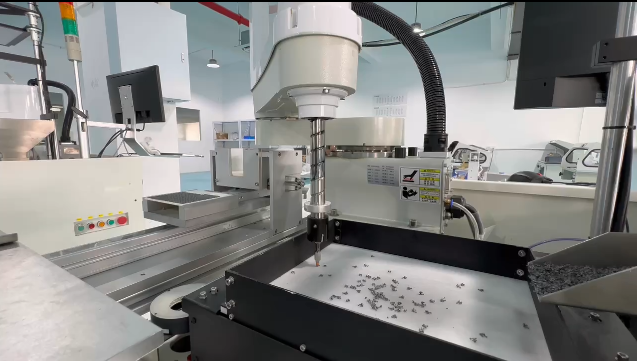
Bracket positioning and finishing line — an example of how orthodontic components move through a controlled manufacturing sequence before final packaging.
Most orthodontic supplies catalogs are organized by product family. Brackets sit on one page, pliers on another, elastics on a third. That structure serves the supplier well because it mirrors how inventory is stored. It does not serve the buyer, because clinical use never happens in product-family order. A clinician does not order ‘all brackets’ and separately ‘all springs’. They move through a sequential treatment process, and each stage pulls a different combination of components off the shelf.
This article proposes a four-layer comparison framework for buyers evaluating orthodontic supplies. The four layers are: clinical purpose, treatment-stage sequence, chairside instrumentation, and finishing and retention. The framework is designed for importers, distributors, clinic procurement managers, and private-label brand owners who need to compare categories that do not share a single specification sheet — for example, a Niti closed spring with eyelets versus a Niti open coil spring, or a Mathieu needle holder versus a pair of bracket tweezers.
Comparison at this level is not about which product is better. It is about which product belongs to which decision layer, and what constraints each layer imposes on sourcing.
A buyer who compares orthodontic supplies by unit price alone tends to under-specify the middle of the case and over-specify the beginning. Early-stage products such as separators, bands, and initial archwires are typically well understood because they repeat on every case. Finishing products such as power chains, rotation wedges, and chewies are often treated as commodity add-ons. In practice, finishing failure — not bracket failure — is what drives retreatment in many clinics.
The four-layer framework forces the buyer to ask four separate questions about any item before it enters a purchase order:
- Layer 1 — Clinical purpose: What mechanical or clinical function does this item perform?
- Layer 2 — Treatment-stage sequence: At which point in the treatment timeline is it consumed?
- Layer 3 — Chairside instrumentation: What handling tools does the clinician need to place, adjust, or remove it?
- Layer 4 — Finishing and retention: What keeps the result stable after the active phase ends?
A supplier that can answer all four layers for a given category is telling the buyer something more useful than a price list: it is confirming that the category has been thought about clinically, not just commercially.
Clinical purpose is the first filter because it separates items that look similar on a specification sheet but behave differently in the mouth. Two Niti springs illustrate this clearly.
Niti Closed Spring With Eyelets versus Niti Open Spring
A Niti closed spring with eyelets is supplied in diameters of 0.008", 0.010", 0.012", and 0.014", with lengths of 3 mm, 6 mm, 9 mm, and 12 mm. It is available with identical eyelets or with different eyelets, so the spring can be anchored between various bracket hooks and anchorage posts. The closed coil design delivers constant, gentle, continuous traction, and the polished coil surface is intended to reduce friction against soft tissue.
A Niti open spring is supplied in the same diameter range but in continuous lengths of 180 mm and 914 mm, in an open coil configuration. Because it is open-coil and supplied in long lengths, it is cut to the required span chairside rather than selected in fixed millimetre increments.
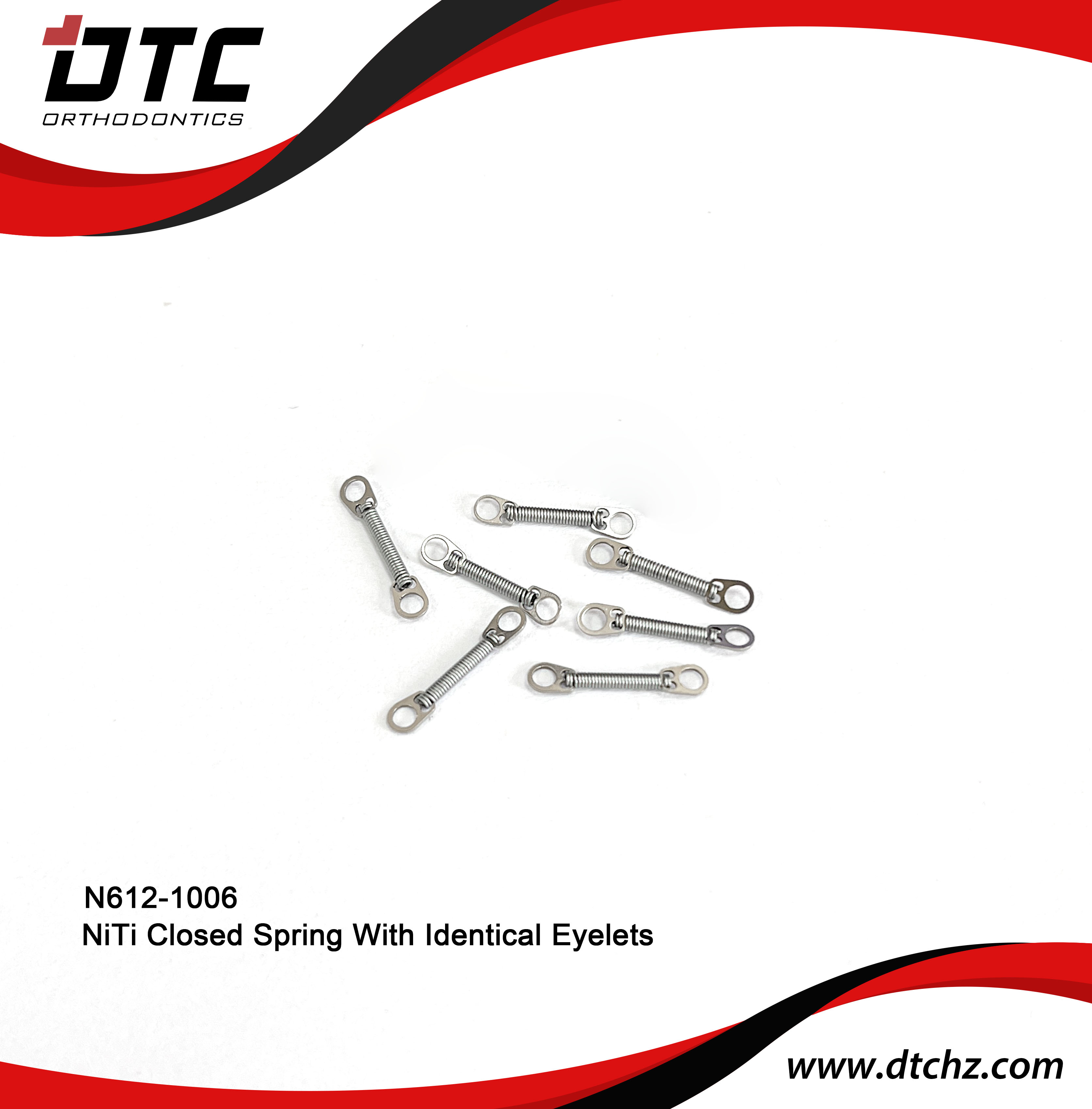
Niti closed spring with identical eyelets — fixed-length design with integrated attachment points.
From a Layer 1 perspective, the comparison is not ‘closed versus open’. It is fixed-length anchored traction versus cut-to-length continuous traction. Both are legitimate. The buyer’s question is whether the clinic prefers pre-measured application or chairside length control. That question has nothing to do with unit price and everything to do with chairside workflow.
| Comparison dimension | Niti Closed Spring With Eyelets | Niti Open Spring |
|---|---|---|
| Configuration | Closed coil, integrated eyelets | Open coil, cut-to-length |
| Diameter range | 0.008", 0.010", 0.012", 0.014" | 0.008", 0.010", 0.012", 0.014" |
| Supplied length | 3 mm, 6 mm, 9 mm, 12 mm | 180 mm, 914 mm |
| Attachment | Identical or different eyelets | Clinician-formed anchorage |
| Material | Super-elastic nickel-titanium alloy | Super-elastic nickel-titanium alloy |
When two products share material and diameter range but differ in delivery format, the sourcing decision is a workflow decision. Buyers evaluating either item should verify that the supplier can supply the full diameter and length matrix, not just the most commonly ordered size.
Once clinical purpose is clear, the next comparison layer is sequence. Orthodontic treatment is not a single purchase event. It is a timeline, and inventory planning has to follow it.
A functional fixed-appliance sequence commonly divides into four phases: preparation, alignment and levelling, working-wire mechanics, and finishing. Fixed-appliance items map across these phases as follows.
| Treatment phase | Typical fixed-appliance items | Sourcing constraint to verify |
|---|---|---|
| Preparation | Separators, Dental Orthodontic Bands | Size system and band material consistency |
| Alignment and levelling | Dental Brackets, Dental Buccal Tubes, Dental Wires | Slot size (18 / 22), prescription (Roth, MBT, Edge-wise), torque variant |
| Working-wire mechanics | Niti springs, Power Chains, Ligature Rings, Orthodontic O Rings | Diameter range, force consistency, elasticity material |
| Finishing and detailing | Rotation Wedges, Power Chains, Orthodontic Chewies | Colour or stiffness options, patient compliance profile |
The sequencing constraint is compatibility across phases. A bracket purchased in phase two must accept the archwire purchased in the same phase, which must in turn accept the ligation mechanism used in phase three. If the bracket uses a 0.022" slot and the wire set is specified for 0.018", the case stalls regardless of product quality.
Because of this, experienced buyers usually do not compare individual SKUs in isolation. They compare slot-size-consistent kits. A supplier offering brackets in both 18 and 22 slot sizes, buccal tubes in the same two sizes, and wires across round and rectangular cross-sections is offering a sequence-complete platform rather than a catalog.
Instrumentation is the layer most often treated as an afterthought in supplier catalogs, and yet it is the layer where quality failure produces the most immediate clinical disruption. A bracket that bends slightly is a nuisance. A plier that loses its edge mid-case is a chairside emergency.
For buyers, the comparison criteria at Layer 3 are narrower and more mechanical than at Layers 1 and 2.
Dental Pliers and cutting instruments
Dental Pliers in the DTC range carry hardness specifications of HRC 55-60 for loop-bending pliers such as Light Wire Pliers, HRC 58-63 for cutting pliers such as Light Wire Cutter Pliers and Band Crimping Pliers, and HRC 50-55 for Bracket Removing Pliers. Maximum sterilization temperature is stated as 180 °C across the range. Distal End Cutter Pliers are specified for arch wires up to 0.021" × 0.025" with mini tips of 0.018" × 0.022".
These numbers matter more than they appear. HRC range tells the buyer what wire and band stock the plier is designed to cut or form. Sterilization temperature tells the buyer whether the instrument survives the clinic’s autoclave cycle without losing temper. A buyer comparing two plier suppliers should compare the same three values, not the same product photo.
Dental Tweezers, Needle Holder, and Dental Retractor
Dental Tweezers in this range include Brackets Tweezers, Tube Tweezers with long tip and short tip, and Lingual Brackets Tweezers — each form factor matched to a specific placement scenario. The Mathieu Needle Holder is supplied with a hard tip, without a hard tip, or without a hard tip in Type C configuration. Dental Retractors are offered as Cheek Retractor and Lip Retractor variants.
The chairside logic is straightforward: tweezers place small components; the needle holder manages sutures and ligature wire; the retractor provides access. Each is a tool that only exists to support the fixed-appliance sequence, which is why comparing them as standalone products rarely produces a useful purchasing decision.
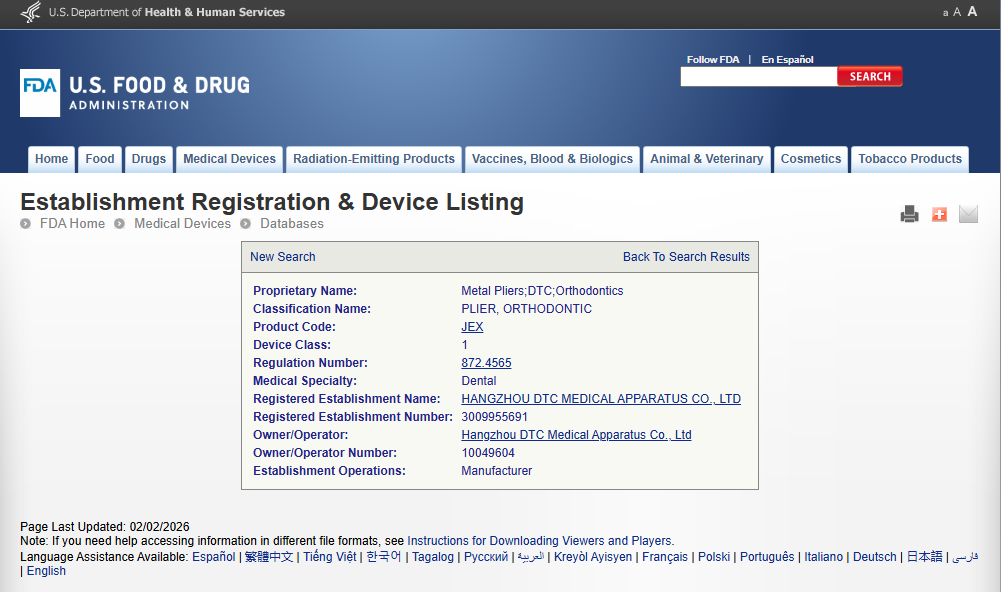
Orthodontic pliers fall under dedicated regulatory registration — a Layer 3 compliance signal buyers can verify.
A practical Layer 3 rule for buyers: require the supplier to state hardness range, maximum sterilization temperature, and the specific wire or band sizes the instrument is intended to handle. If those three values are missing from a quotation, the instrument is being sold on appearance rather than specification.
Finishing components are consumed in the last third of treatment, and their material behavior directly affects case outcome. This is the layer where buyers most often accept vague specifications.
Power Chains are supplied in open long, closed continuous, and open short configurations, made from TPU. Ligature Rings are supplied in a normal type from medical-grade, latex-free TPU. Separators are supplied in blue TPU. Orthodontic Rotation Wedges are available in transparent and grey. Orthodontic O Rings are available in latex and silicone. Orthodontic Chewies are supplied in TPR and offered in original, orange, mint, mango, strawberry, and grape options.
Two Layer 4 constraints deserve closer attention than they usually receive.
The first is material consistency. Power chains, ligature rings, separators, and rotation wedges may all be TPU, but the elasticity profile and stain resistance are what determine whether the material holds force across a multi-week interval. A supplier quoting ‘TPU’ without force-retention data is quoting a material, not a performance specification.
The second is patient-facing variability. Orthodontic Chewies are supplied in six colour variants and Orthodontic O Rings in two material variants. For distributors, this is a stocking complexity decision. For clinic buyers, it is a compliance and patient-preference decision. Neither group benefits from a supplier that lists the colour range but not the material specification of each variant.
Once the four layers are separated, two cross-layer criteria govern the entire purchase decision: compatibility and workflow coverage.
Compatibility is a cross-layer property. It exists only when Layer 2 (brackets, tubes, wires) and Layer 3 (pliers, cutters) agree on the same dimensional assumptions. A bracket system specified in 18 and 22 slot sizes with low-torque and high-torque variants can only be compared meaningfully against a wire set specified in the matching cross-sections, cut by instruments rated for those wire dimensions.
Workflow coverage is the buyer’s measure of how many treatment stages a single supplier can support without introducing a second source. A supplier that covers separators, bands, brackets, buccal tubes, wires, ligation, springs, instrumentation, and finishing consumables reduces the number of separate qualification projects a distributor or clinic has to run.
This is where catalog breadth stops being a marketing claim and becomes an operational fact. Breadth only reduces procurement overhead if the products inside that breadth are dimensionally compatible across layers.
The four-layer framework is a decision structure, not a universal ranking method. It has at least three boundaries that buyers should recognize.
First, it does not replace clinical judgment. Layer 1 assumes that the clinic has already made a treatment-protocol decision. The framework helps compare suppliers of the same clinical concept, not choose between clinical philosophies.
Second, a Layer 2–complete supplier is not automatically a Layer 3– or Layer 4–complete supplier. A manufacturer may produce brackets and buccal tubes at high volume while sourcing pliers and elastic consumables through third parties. Buyers who assume that catalog breadth equals in-house manufacturing across all four layers may find that only part of the range is directly controlled.
Third, the framework is weakest when applied to raw-material-sensitive categories. Nickel-titanium archwires, for example, depend on NiTi raw material supply chains that are geopolitically concentrated. A framework that assumes uniform availability across all four layers can understate exposure to a single-material bottleneck.
Buyers should treat the four layers as a checklist for questions to ask, not as a scorecard that a supplier either passes or fails.
Hangzhou DTC Medical Apparatus Co., Ltd. — trading as DTC Orthodontics — is a Chinese orthodontic supplies manufacturer founded in 2004 and based in Hangzhou, Zhejiang Province. The company operates a 5,000 m² facility with approximately 150 employees, an annual output stated at 1,000,000 units, and a 30-engineer R&D team. Its portfolio spans orthodontics, pediatric dentistry, and dental laboratory products, with export activity covering the EU, USA, Middle East, South America, Asia, Africa, and Australia.
Read against the four-layer framework, DTC’s portfolio maps as follows.
| Layer | Representative DTC categories | Specification anchors |
|---|---|---|
| Layer 1 — Clinical purpose | Niti Closed Spring With Eyelets, Niti Open Spring, Lingual Chain, Crimpable Hook, Lingual Button | Spring diameters 0.008"–0.014"; closed spring lengths 3–12 mm; open spring lengths 180 mm and 914 mm |
| Layer 2 — Treatment-stage sequence | Dental Brackets, Dental Self-ligating Brackets, Dental Buccal Tubes, Dental Orthodontic Bands, Dental Wires | Slot size 18 / 22; Roth, MBT, Edge-wise; low and high torque; round and rectangular wires |
| Layer 3 — Chairside instrumentation | Dental Pliers, Dental Tweezers, Needle Holder, Dental Retractor, Dental Mirrors | HRC 50–63 by plier type; 180 °C sterilization; Mathieu needle holder variants |
| Layer 4 — Finishing and retention | Power Chains, Ligature Rings, Orthodontic O Rings, Separators, Rotation Wedges, Orthodontic Chewies | TPU, TPR, latex and silicone variants; latex-free TPU ranges |
The company holds an EN ISO 13485:2016 certificate (certificate number SX 2184523-1) issued by TÜV Rheinland LGA Products GmbH, covering design and development, manufacture, and distribution of orthodontic brackets, bands, tubes, wires, lingual buttons, crimpable hooks, orthodontic pliers, dental mirrors, and related products. It also holds a Notified Body confirmation letter (number 244557490) under Regulation (EU) 2017/745 for Class IIa orthodontic devices, and an FDA registration under registration number 3009955691 referencing 21 CFR Part 807.
Two additional facts are relevant to Layer 2 buyers. First, DTC holds a patent for an ‘Orthodontic Buccal Tube Convenient for Archwire Insertion’ (CN 224292022 U), which is directly relevant to the wire-and-tube compatibility question in Layer 2. Second, the company has been identified in third-party industry reporting as one of the larger manufacturers of standard mandibular orthodontic brackets in certain US niche reporting — a claim sourced from a low-reliability industry listing and best treated as a directional signal rather than a verified ranking.
Export certification covering brackets, buccal tubes, pliers, tweezers, oral mirrors, force gauges, bracket positioning gauges, arch turrets, implant spanners, and bonding trays is held under Zhe-Hang Food & Drug Medical Device Export No.20260027, issued by the Zhejiang Medical Products Administration.
For buyers running supplier qualification across all four layers, this combination of certifications and category coverage is the substantive piece of the picture. Product photos are not.
The global orthodontic supplies market was valued at USD 14.8 billion in 2024 and is expected to grow at a CAGR of 20.1% through 2034, according to Global Market Insights. Within that figure, North America held the largest regional share in 2024 at an estimated 30.6% by revenue, according to Grand View Research. China’s own orthodontic supplies market was estimated at approximately USD 713.25 million in 2024 by Market Research Future.
Two structural shifts are reshaping how buyers compare suppliers across the four layers.
The first is supply-chain concentration. Nickel-titanium archwires face supply-chain exposure because NiTi raw material sourcing is heavily concentrated, according to Mordor Intelligence. That concentration affects Layer 2 sourcing directly: a buyer who has qualified a supplier for brackets but sources wires separately now has to model raw-material availability as a distinct risk, not as a sub-item of supplier quality.
The second is export maturity. China exported USD 13.5 billion in medical instruments, including dental tools, in 2024, according to the Observatory of Economic Complexity. The dental equipment and accessories segment recorded export growth of 13.93% in the period leading to late 2024, according to CMEF reporting — a medium-reliability figure that nonetheless signals the direction of supply-side capacity.
For buyers, the implication is that Layer 3 and Layer 4 categories are no longer automatically sourced from a different, lower-tier supplier base than Layer 1 and Layer 2. The distinction between ‘core clinical’ and ‘peripheral consumable’ is narrowing. Four-layer comparison is how a buyer detects that shift before it appears in a quotation.
Three developments are likely to influence how the four-layer framework is applied over the next several years.
First, self-ligating systems continue to expand. Self-ligating brackets were projected to reach a global market value of USD 403.9 million by 2025, according to Future Market Insights — a medium-reliability projection, but consistent with the broader shift toward bracket designs that reduce or eliminate separate ligation steps. If self-ligating adoption rises, Layer 3 instrumentation requirements change: fewer ligature-placement tools, more emphasis on bracket positioning and debonding instruments.
Second, adult orthodontic demand is reshaping Layer 4. The adult orthodontics segment is growing on aesthetic demand, with clear aligners growing at a 14.25% CAGR, per Mordor Intelligence. Aesthetic-driven demand changes the finishing layer toward lower-visibility elastics, ceramic or clear components, and patient-facing comfort consumables.
Third, regulatory complexity is unlikely to decrease. Brackets and tubes are classified as Class I or II devices in the US under 21 CFR 872.5410, with ISO 27020:2019 as the recognized standard, while EU MDR 2017/745 requires CE marking and classifies most orthodontic products as Class I or IIa. Cross-border suppliers will continue to be evaluated on documentation depth, which reinforces the case for validating certification coverage per layer rather than per company.
The four-layer framework does not replace clinical experience or supplier audit procedures. It replaces the habit of comparing orthodontic supplies by unit price and product photo with a comparison that follows the treatment timeline. A buyer who can state, for any product, which layer it belongs to and which cross-layer compatibility constraint it must satisfy, has already filtered out most of the noise in a catalog.
For readers who want the underlying product specifications in one place, the DTC Orthodontics catalog is available as a downloadable reference: English product catalog (PDF).
Which specifications matter most when comparing orthodontic brackets and buccal tubes in a fixed-appliance kit?
Slot size and prescription are the two controlling specifications. Dental Brackets are supplied in slot sizes 18 and 22, with low-torque and high-torque variants, across Roth, MBT, and Edge-wise systems for maxillary and mandibular arches. Dental Buccal Tubes follow the same slot sizes and system options, so an archwire specified for a 0.022" slot will not seat correctly in a 0.018" bracket set. Compatibility should be verified at the slot-size and torque level before price.
What is the functional difference between a Niti closed spring with eyelets and a Niti open spring?
Niti Closed Spring With Eyelets is a closed-coil design supplied in fixed lengths of 3 mm, 6 mm, 9 mm, and 12 mm, with identical or different eyelets for direct attachment to bracket hooks and anchorage posts. Niti Open Spring is an open-coil design supplied in continuous lengths of 180 mm and 914 mm, cut to the required span at chairside. Both use super-elastic nickel-titanium alloy and both are available in 0.008", 0.010", 0.012", and 0.014" diameters. The choice is between pre-measured anchored traction and cut-to-length continuous traction.
Which chairside instruments should be paired with which treatment stages?
Instrument selection follows the task rather than the product line. Dental Tweezers in the range include Brackets Tweezers, Tube Tweezers with long tip and short tip, and Lingual Brackets Tweezers, each matched to a placement scenario. Cutting tasks are handled by Light Wire Cutter Pliers (ligature wires up to 0.30 mm) and Distal End Cutter Pliers (arch wires up to 0.021" × 0.025"). Band and crown fitting uses Band Crimping Pliers and Crown And Band Contouring Pliers. The Mathieu Needle Holder is available with a hard tip, without a hard tip, and without a hard tip in Type C.
What sterilization parameters should buyers verify for reusable orthodontic instruments?
Sterilization tolerance is specified per product family. Dental Pliers in the DTC range state a maximum sterilization temperature of 180 °C, with hardness values of HRC 55-60 for loop-bending pliers such as Light Wire Pliers, HRC 58-63 for cutting and contouring pliers, and HRC 50-55 for Bracket Removing Pliers. Stainless Steel Dental Mirrors and Glass Dental Mirrors state autoclavability up to 130 °C. Buyers comparing reusable instruments should require these values in writing rather than assume them from material descriptions.
Which certifications indicate that orthodontic supplies are suitable for EU or US markets?
DTC Orthodontics holds an EN ISO 13485:2016 certificate (number SX 2184523-1) issued by TÜV Rheinland LGA Products GmbH, covering design, development, manufacture, and distribution of orthodontic brackets, bands, tubes, wires, lingual buttons, crimpable hooks, orthodontic pliers, dental mirrors, and related products. A Notified Body confirmation letter (number 244557490) applies under Regulation (EU) 2017/745 for Class IIa orthodontic devices. FDA registration under number 3009955691 references 21 CFR Part 807. In the US, brackets and tubes are classified under 21 CFR 872.5410 with ISO 27020:2019 as a recognized standard. Export documentation covering brackets, buccal tubes, pliers, tweezers, oral mirrors, and related instruments is held under Zhe-Hang Food & Drug Medical Device Export No.20260027.
How should finishing and retention consumables be compared across suppliers?
Finishing consumables should be compared on material specification and variant range rather than appearance. Power Chains are supplied in open long, closed continuous, and open short types from TPU. Ligature Rings use medical-grade, latex-free TPU. Orthodontic O Rings are available in latex and silicone. Separators are supplied in blue TPU. Orthodontic Rotation Wedges are available in transparent and grey, designed to deliver continuous rotational force. Orthodontic Chewies are made from TPR and offered in original, orange, mint, mango, strawberry, and grape. Buyers should confirm the material behind each variant, since colour or flavour options can obscure differences in elasticity and force retention.
This article is an independent industry reference prepared for buyers evaluating orthodontic supplies. Product specifications, certification numbers, and market figures are cited from the sources indicated. Market projections attributed to third-party research firms are directional and should be verified against current data before procurement decisions.
Have Questions or Need More Details?
Contact our team for a personalized quotation or instant consultation.
Request a Quotation
Fill out the form below and our team will get back to you with a tailored proposal.
WhatsApp Direct Chat
Prefer to chat in real-time? Message us on WhatsApp for instant assistance & quick answers.
- Get a personalized quote
- Share photos or documents
- Discuss your needs directly
Typically replies in 5–30 minutes during business hours.