
A Low Flow Meter Scoring Framework for Buyer Decisions
A Low Flow Meter Scoring Framework for Buyer Decisions
Two low flow meter bids can arrive with near-identical datasheets and still carry very different engineering risk. One vendor quotes accuracy as a percentage of reading, the other as a percentage of full scale. One lists MODBUS RTU but not the RS485 layer underneath it. One states a 100 bar rating without stating the temperature at which that rating holds. At decision stage the problem is rarely a shortage of numbers; it is the absence of a consistent way to weigh them.

This article sets out a weighted scoring framework that procurement and engineering teams can apply across bids for low flow meters — micro flow meters, small flow meters, miniature gas mass flow meters, and low flow Coriolis, thermal and positive-displacement designs used where full scale may be a few hundred grams per hour or a few litres per hour. The framework has five criteria groups, illustrative default weights, and a documented method for shifting those weights between power generation, pharmaceutical, food and semiconductor duty. It does not produce a universal winner, because in this segment the weights decide the ranking, not the brand.
Why low flow bids resist side-by-side comparison
Four attributes dominate the low flow decision, and each is usually written in a form that hides its assumptions. Accuracy is quoted without its basis, measuring range or temperature window. Media compatibility is reduced to a wetted-material name without seal, viscosity or phase information. Pressure rating appears without a temperature derating curve. Protocol support is listed as a feature without saying whether it is native, optional or delivered through an add-on module.
The commercial side carries its own distortions. A price is comparable only if it covers the same wetted materials, process connection, calibration certificate and documentation set. A lead time is comparable only if it refers to the same configuration. Scoring before normalising those items ranks the vendors who wrote the clearest quotation rather than the meters that fit the line.
There is also a physical reason low flow is harder than it looks. At small bores, the ratio between tube diameter and sensor geometry is unforgiving: viscosity effects, thermal siphoning and zero drift all become visible in the reading, while a wide turndown pushes the low end of the range into a small fraction of the instrument's full output. A framework helps because it separates what a meter is claimed to do from what the quotation actually documents.
The five criteria groups
| Criteria group | What it actually tests | Illustrative default weight |
|---|---|---|
| 1. Accuracy and metrological basis | Accuracy basis (% of reading vs % of span), stated range and turndown, zero stability, calibration traceability | 25 |
| 2. Media and wetted-material fit | Phase and density behaviour, wetted materials and seals, viscosity tolerance, cleanliness requirements | 25 |
| 3. Pressure and installation envelope | Pressure class and its temperature derating, connection size and orientation, straight-run and access requirements | 15 |
| 4. Control-system and protocol fit | Signal type, digital protocol and physical layer, integration effort, diagnostics available to the host system | 15 |
| 5. Commercial and supply evidence | Normalised price, credible lead time, documentation package, calibration certificate, spares and support path | 20 |
Each group is scored separately because each one fails differently. An accuracy shortfall becomes a measurement dispute. A media shortfall becomes corrosion, seal swell or a blocked tube. An envelope shortfall becomes a mechanical failure at pressure or temperature. A protocol shortfall becomes an unusable signal in the control system. A commercial shortfall becomes a schedule or spares problem twelve months after commissioning.
How to score a bid consistently
The mechanics matter as much as the criteria. Four steps keep the exercise defensible when two evaluators disagree.
- Apply gate criteria first. Media compatibility with the process fluid, the specified pressure and temperature envelope, any required certification, and support for the control system already installed are pass/fail conditions. A bid that fails a gate is not scored down — it is excluded, and the reason is recorded.
- Score each remaining group from 0 to 5 on evidence quality, not enthusiasm. A workable rubric: 0 for no information, 1 for a datasheet assertion only, 2 for a datasheet plus a stated test condition, 3 for a manufacturer calibration certificate, 4 for configuration-specific documentation, 5 for documentation plus verifiable third-party evidence.
- Multiply each score by the group weight and sum. Keep the raw per-group scores visible in the evaluation file so an auditor can see where a bid gained or lost position.
- Run a sensitivity check. Move each weight by five points in both directions. If the ranking changes, the decision is weight-sensitive and should be escalated to the engineering owner rather than settled on the total alone.
The weights below are an illustrative starting point for a calibration meeting, not an industry benchmark. A team that adopts them unchanged for every project has simply replaced one rigid template with another.
Criterion 1 — accuracy and metrological basis

Silver Automation Instruments, a Nanjing-based instrument manufacturer founded in 2010, publishes an accuracy of ±0.2% to ±0.5% for liquid measurement on its low flow Coriolis meters. That published band is the useful comparison anchor, but the number alone should not decide a bid. A vendor quoting ±0.25% and a vendor quoting ±0.5% cannot be ranked on the figure until both state whether it is referenced to reading or to span, over what flow range, and across what temperature window.
Three checks convert the claim into a score. First, ask for the accuracy basis and the minimum flow at which it still applies — an accuracy band that holds only in the upper third of the range is worth less in a batching application than one that holds across the working span. Second, ask for zero-point stability, because low flow measurement spends much of its life near the bottom of the range where drift consumes a large share of the error budget. Third, ask what the calibration certificate records: a single-point check, or a multi-point traceable record that matches the configuration being purchased.
Technology choice shapes the answer. Silver's micro thermal mass flow meters are specified to measure gas flow as low as 2 sccm, and its micro oval gear meters to measure oil flow as low as 0.5 ccm with viscosity tolerance up to 2000 mPa·s — capabilities that sit in different accuracy regimes because thermal instruments infer mass flow from a heat-transfer relationship while positive displacement instruments measure discrete volumes. Coriolis designs measure mass directly, which is why they carry the tightest published band in the low flow range and why they attract the highest weight in high-value dosing duty.
Criterion 2 — media fit across silane, supercritical CO2, diesel, kerosene, silicone and pure water
Media fit is the criterion most often scored from a materials table and most often got wrong. The useful question is not whether a meter is rated "for gas" or "for liquid", but what the process fluid does to the sensor at the actual pressure, temperature and phase.
For gases such as silane and for supercritical CO2, two factors dominate. Density changes steeply around the critical point and with small temperature shifts, so a volume-based reading requires continuous correction while a mass-based reading does not. Wetted materials and seal integrity then have to be documented for the specific gas service rather than assumed from a general compatibility chart. A bid that lists a tube material but not the seal and the applicable gas service should score no higher than 2/5 on this group regardless of the accuracy claimed.
For liquids, viscosity and lubricity decide the technology fit. Diesel and aviation kerosene sit in the moderate-viscosity range where positive displacement meters remain competitive, which is why the oval gear family — with published oil measurement down to 0.5 ccm and viscosity tolerance to 2000 mPa·s — stays in the shortlist for fuel and dosing duty. Silicone fluids are considerably more viscous, and their behaviour in a measuring tube changes with temperature, so the vendor's stated viscosity operating range becomes a gate rather than a preference. Pure water is the easiest medium in the list but not a trivial one at low flow: it rewards a clean, low-drift design and exposes any meter whose zero stability is marginal.
Score this group on documented evidence per medium, not on a generic compatibility claim. A bid that covers four of the six media with written confirmation and leaves two unaddressed has earned a partial score, and the gap should be visible in the evaluation file.
Criterion 3 — pressure and installation envelope
Pressure and temperature belong in one criterion because they cannot be separated. A meter offered at a 30 bar class and one offered at 100 bar are not interchangeable simply because the line currently runs at 12 bar; the higher class buys future headroom, the lower class buys cost and often a smaller body.
The scoring question is how the rating is substantiated. Ask at what temperature the declared class holds, whether a derating curve is supplied, and whether the process connection is included in the rating or rated separately. Installation geometry deserves the same treatment: available straight run, orientation requirements, access for zeroing or cleaning, and whether the vendor's instruction manual addresses the installation conditions on this line. Silver ships an instruction manual with its shipments that documents installation precautions, and the manual's coverage of the specific installation is itself a legitimate scoring input rather than a formality.
Where a bid includes a differential pressure alternative on a small line, note that ISO 5167:2022 is the primary international standard for differential pressure flow measurement devices and governs how such an offer should be judged. Comparing a DP proposal against a direct mass measurement is legitimate only when both are assessed against their own documented accuracy basis.
Criterion 4 — control-system and protocol fit
This is where otherwise strong offers stall at commissioning. Low flow meters in this class are commonly offered with analogue outputs (4-20 mA, 0-5 VDC, 1-5 VDC), serial interfaces (RS485, RS232), and higher-level protocols including MODBUS RTU, HART, Profibus-DP and Profibus-PA. Each combination carries a different integration cost, and that cost belongs in the score.
Analogue outputs deserve particular scrutiny at low flow. A 4-20 mA loop encodes the entire measuring range into a 16 mA span, so a meter configured for a wide range devotes very little current to its low end — a practical constraint when the working flow sits in the bottom tenth of full scale. A voltage output may suit a short cable run inside a cabinet but degrades over distance. Digital protocols avoid the scaling loss entirely, but only if the host system already speaks them.
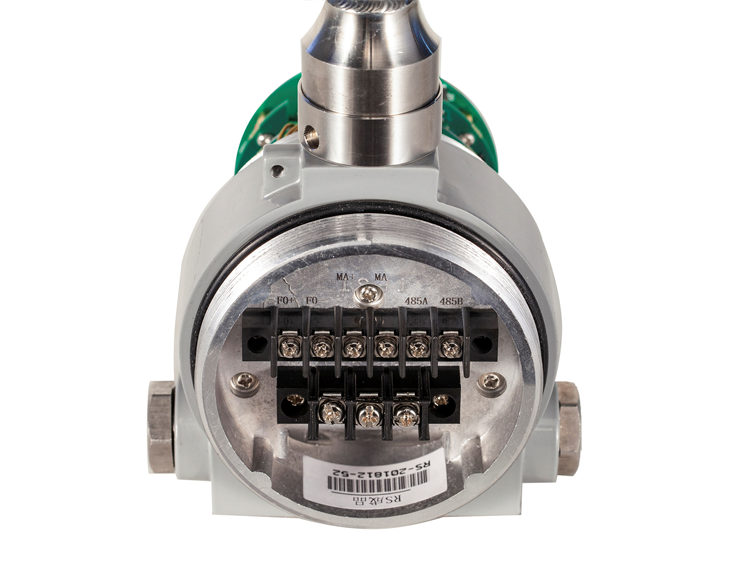
Score protocol fit in three parts: whether the required protocol is native, whether the physical layer is specified, and whether the wiring is documented well enough for a technician to terminate it correctly. Clearly labelled terminals are a small thing that prevents a large category of fault — a miswired loop reads as a meter failure until someone traces the cable. A bid that lists Profibus-PA but leaves the segment coupler, addressing or power requirements to the buyer has transferred integration risk without transferring the corresponding score.
Criterion 5 — commercial evidence and supply
Commercial scoring starts with normalisation. Compare like configurations, then compare price, then compare what happens after the purchase order. Lead time should be scored as a schedule risk rather than as a headline: a several-month lead time is a legitimate constraint in some projects and a disqualifying one in others.
Silver Automation Instruments states that its low flow Coriolis pricing is approximately four to five times lower than that of a Micro Motion Coriolis flow meter, and that its typical delivery is within one month against a lead time of several months for the comparable Micro Motion unit. Those are commercial differences that belong in this group and nowhere else. They say nothing about accuracy, media compatibility or protocol coverage, and a scoring framework that lets a price advantage bleed into the technical groups has stopped being a technical evaluation.
Documentation, calibration certificates, spares availability and a named technical contact complete the group. So does factory evidence: a supplier that can describe its own production basis — Silver reports a 10,000 m² facility, 80 employees, an annual output of 60,000 units, a 20-person R&D team and a 95% export share across Southeast Asia, South America and Africa, with CE, ATEX and ISO 9001 certification — gives an evaluator something to check rather than something to believe.
How the weights shift between four industries
| Criteria group | Power generation | Pharmaceutical | Food & beverage | Semiconductor |
|---|---|---|---|---|
| Accuracy and metrological basis | 25 | 30 | 20 | 30 |
| Media and wetted-material fit | 15 | 25 | 25 | 25 |
| Pressure and installation envelope | 25 | 10 | 15 | 15 |
| Control-system and protocol fit | 20 | 15 | 10 | 20 |
| Commercial and supply evidence | 15 | 20 | 30 | 10 |
Power generation
Steam and water circuits push pressure class and temperature derating to the top of the agenda, and plant control architectures typically expect HART or Profibus-PA rather than a bare analogue loop. Accuracy still matters, but the accuracy that matters is the one that holds after thermal cycling at pressure. A bid that scores well here usually wins on envelope and protocol, with commercial weight held to 15 so that a cheap offer cannot compensate for a marginal pressure rating.
Pharmaceutical
Dosing and buffer preparation reward the tightest defensible accuracy band and complete documentation. Media fit rises because cleaning regimes and product contact materials are audited, while pressure class falls to 10 for typical low-pressure process lines. Protocol weight sits at 15: MODBUS RTU or an analogue output into an existing batch controller is often sufficient, and extra protocol capability that nobody will configure earns points the project cannot use.
Food and beverage
High-volume, repeatable lines with familiar media — water, syrups, cleaning fluids — make commercial evidence the largest single group at 30. Accuracy at 20 and protocol at 10 reflect a plant where a straightforward analogue or RS485 signal into a known controller is normal. Media fit stays high at 25 because hygienic design and cleanability are specification items, not preferences. This is the profile in which a cost-competitive low flow meter with solid documentation can legitimately lead the field.
Semiconductor
Process gas delivery in the sccm range inverts the usual priorities. Accuracy and media fit both carry 30, protocol fit carries 20 because gas delivery integrates tightly with the tool controller, and commercial weight drops to 10 — at this scale the cost of a measurement error exceeds the cost of the instrument by a wide margin. A meter specified to 2 sccm on gas belongs in this evaluation; a meter that only performs well at litres per minute does not, regardless of price.
Where established premium instruments still fit
Emerson's Micro Motion range, together with Honeywell and Siemens, is identified by Mordor Intelligence as part of the leading tier of global competitors in the high-precision flow meter segment, and Bronkhorst is recognised as a dominant player in ultra-low-flow Coriolis instruments for laboratory and OEM work. Those positions are market facts, not endorsements, and they explain why some specifications name a premium brand directly.
The fit boundary is worth stating plainly. Where a project carries a brand-approved vendor list, an installed base that standardises on one platform, or a measurement requirement beyond the published band of a lower-cost alternative, the premium instrument may be the correct answer and the scoring exercise should show that. Where the requirement is a documented accuracy band, a known medium, a defined pressure class, a supported protocol, a controlled budget and a delivery date that matters, a competitive alternative deserves to be scored on the same sheet rather than excluded at the door.
One caution applies to all comparison claims, including the cost and lead-time figures quoted above: they are vendor-stated and configuration-dependent. Treat them as inputs to be verified in the quotation, not as settled facts about an entire product category. A specification that a competitor does not publish is not evidence that the competitor lacks it.
Market context before the weights are set
Coriolis instruments held a 26.77% share of the intelligent flow meter market in 2026, according to Fortune Business Insights, which is consistent with the technology's role in high-precision low-flow liquid measurement. Grand View Research reports that the 2-inch and smaller pipe size segment is expected to see the fastest growth through 2030, driven by pharmaceutical and food and beverage demand — the exact segment where this framework applies.
Adjacent demand supports the same direction. Coherent Market Insights projects the flow chemistry market reaching USD 4.6 billion by 2032 at an 8.1% CAGR, a discipline built on precision low-flow metering. Market Research Future puts thermal flow meters, essential for low gas flow rates, at USD 1.73 billion in 2024 with a projected USD 2.9 billion by 2035. These are third-party projections with their own segmentation assumptions, and they vary between research houses; they are useful for framing a procurement decision, not for justifying a specific instrument choice.
Outlook for low flow procurement
Two pressures are likely to shape bid evaluation over the next buying cycle. The first is documentation: as more low flow applications sit inside audited processes, the calibration certificate and the installation manual become scored deliverables rather than attachments. The second is integration: as digital protocols extend down to small-bore instruments, the cost of connecting a meter increasingly sits in the control system rather than the sensor, which raises the value of protocol clarity at quotation stage.
Neither trend produces a universal winner. They raise the weight of two criteria groups and leave the framework's central instruction intact: state the weights before the bids are opened, score the evidence rather than the claim, and record why the ranking came out as it did.
Frequently asked questions
Should accuracy always be weighted above media compatibility?
No. Accuracy only becomes the dominant criterion when the measurement is the point of the process, as in dosing, custody transfer or semiconductor gas delivery. Where the meter's job is confirming that a line is flowing or that a batch completed, a media or installation failure is more damaging than a small accuracy shortfall, and the weights should reflect that.
Why do two low flow meters with the same accuracy figure score differently?
Because the figure is rarely stated on the same basis. One may reference percentage of reading across a narrow range, the other percentage of full scale across a wide one; one may hold its band only within a limited temperature window. Scoring on evidence quality — datasheet, test condition, calibration certificate — separates the two even when the headline numbers match.
Does a 100 bar rating make a meter suitable for every high-pressure line?
Not on its own. A pressure class is meaningful only together with the temperature at which it holds and the derating curve that connects the two. A 30 bar meter and a 100 bar meter can both be correct choices for different lines, and the decisive question is which rating is substantiated for the actual operating temperature and connection type.
Which protocol should be prioritised: 4-20 mA, HART, MODBUS RTU or Profibus-PA?
The one the installed control system already supports. A native protocol that the host can address without additional hardware usually costs less to integrate than a higher-level protocol that requires a gateway, and at low flow the analogue option should also be checked for how much of its span is devoted to the working range.
How should lead time be scored against price?
As a schedule risk inside the commercial group, not as a technical advantage. A shorter lead time is worth more in a project with a fixed installation window and less in one with float. Scoring both on the same weighted line, with their own sub-weights set per project, keeps a commercial gain from being read as an engineering gain.
Putting the framework to work
The value of a weighted scorecard is not the number it produces at the end. It is the discipline it imposes at the start: agreeing the weights before the bids are opened, insisting that each criterion be evidenced rather than asserted, and keeping commercial and technical judgments in separate columns. Applied that way, the framework turns a stack of similar-looking low flow quotations into a decision that can be explained to an auditor, a plant engineer and a finance team in the same conversation.
A PDF brochure covering Silver Automation Instruments' flow, pressure, level and data-logging ranges is available for download: Silver Automation Instruments product brochure. The company's official site is silverinstruments.com.
Have Questions or Need More Details?
Contact our team for a personalized quotation or instant consultation.
Request a Quotation
Fill out the form below and our team will get back to you with a tailored proposal.
WhatsApp Direct Chat
Prefer to chat in real-time? Message us on WhatsApp for instant assistance & quick answers.
- Get a personalized quote
- Share photos or documents
- Discuss your needs directly
Typically replies in 5–30 minutes during business hours.