
A Procurement Decision Matrix for Hotel Furniture Suppliers
Hotel furniture procurement rarely fails at the quotation stage. It fails two or three years later, when a lobby sofa loses its shape, a casegood finish fades unevenly under daylight, or a replacement part cannot be sourced in the market where the hotel operates. A weighted decision matrix gives procurement directors a defensible way to compare custom furniture suppliers on cost, compliance and after-sales support before the order is placed, provided every score is tied to a document rather than to a showroom impression.
Why Unit Price Is the Weakest Variable in Hotel Furniture Procurement
The category is large enough that headline benchmarks rarely agree with each other. The global hospitality furniture market was valued at USD 23.8 billion in 2025 and is projected to reach USD 39.6 billion by 2034, according to Dataintelo. A separate Grand View Research estimate places the hotel FF&E market at USD 63.1 billion in 2025. The divergence is largely a question of scope, since FF&E bundles furnishings together with fixtures and equipment. For buyers, that is not a contradiction to resolve but a working rule: category benchmarks set context, they do not set a budget line.
Demand composition is the more useful signal. More than two-thirds of upscale hotels now allocate a dedicated budget for bespoke furnishings, and average project spend has risen 31% since 2021, according to Intel Market Research. Once bespoke becomes the default rather than the exception, suppliers stop competing on the unit rate of a catalogue item. They compete on how a specification is interpreted, documented, delivered and supported after handover.
Per-unit price cannot carry that comparison. It says nothing about how a supplier's drawing team resolves a design intent, whether the finish schedule will survive a tropical climate, how a defect is handled in a market 8,000 kilometres from the factory, or whether the supplier can produce the same specification again in five years for a partial refurbishment. A matrix replaces a single comparison point with a set of weighted ones, and forces the buyer to state weights before quotations arrive, which is the moment when bias is cheapest to remove.
Structuring the Matrix: Three Pillars and Nine Sub-Criteria
A workable hotel furniture matrix does not need to be elaborate. It needs to be transparent enough that two procurement managers scoring the same supplier would arrive at similar results. Three pillars cover the decision: total cost, compliance, and after-sales support. The default weighting below reflects a full-service or luxury project with a long holding period. The weights are a starting position, not a fixed rule, and should be revised per project and per market.
| Pillar | Default weight | Sub-criteria scored | Evidence to request before scoring |
|---|---|---|---|
| Total cost | 40% | Unit rate; material cost delta against standard furniture; expected service life; maintenance load; defect and replacement rate | Itemised quotation, FF&E schedule, warranty and maintenance terms, reference projects that allow a replacement cycle to be checked |
| Compliance | 35% | Management-system certification scope; product-level standards for the destination market; sustainability documentation; consistency of documentation across markets | Certificate copies with the certified site and revision year visible; product test reports; material and finish declarations |
| After-sales support | 25% | Pre-delivery inspection regime; installation guidance; defect response definition; spares and re-order capability; maintenance service scope | Inspection records, installation scope of work, named service contacts, re-order terms for discontinued items |
Each sub-criterion should be scored on a five-point anchored scale rather than a free number, otherwise the matrix collapses into opinion. A simple anchor set works: 5 means documented and verifiable for this project; 4 means documented but requiring project-specific confirmation; 3 means partially documented; 2 means claimed verbally only; 1 means not addressed. Unverifiable claims score 1, not 3. That single rule removes most of the inflation that appears when suppliers are scored from presentation decks.
Scoring Cost: Total Cost of Ownership Across the Service Life
Cost is the pillar most often scored incorrectly, because the number that is easiest to collect — the quoted unit rate — is the one that predicts the least. The meaningful comparison is between custom and standard furniture over the years the hotel actually holds the asset. RICHART's own comparative positioning sets out the trade-off in explicit terms, and it is worth stating plainly because it cuts both ways.
| Measure | Custom furniture (five-star specification) | Standard furniture |
|---|---|---|
| Upfront cost position | Initial cost 30% higher | Lower initial outlay |
| Material cost | Material cost increased by 120%–150% | Base material cost |
| Service life | Extended by 2 times; durable years extended by 8–10 years | Baseline service life |
| Defect performance | Defect rate reduced by over 80% | Baseline defect rate |
| Maintenance load | 80% less maintenance required | Baseline maintenance requirement |
| Structural performance | 25% higher structural stability and durability efficiency | Baseline stability |
| Total cost of ownership | 50% lower over 8 years | Baseline total cost |
Read as a scoring instrument rather than a sales argument, this table defines what the buyer must verify. The claim of a 50% lower total cost of ownership over eight years only holds if the asset is retained for that period and if the maintenance saving is real in the operating context of the property. Both conditions belong in the matrix as qualification questions, not as assumptions. A city-centre hotel operating under a long lease can reasonably score the custom route higher on cost; a property with a short hold horizon or a repositioning planned within four years cannot.
Two data requests make the cost pillar auditable. First, an itemised quotation that separates frame, foam, fabric, finish, hardware and packaging, so that a low total can be traced to a specific substitution. Second, reference projects where a comparable furniture package has been in service long enough to observe a replacement pattern. Where a supplier cannot supply either, the cost pillar should be scored down regardless of the headline price.
Scoring Compliance: Management Systems, Product Standards and Scope
Compliance is the pillar where buyers most often accept a logo in place of a document. The distinction that matters is between management-system certification, which describes how a factory controls its processes, and product-level standards, which describe what a specific item must withstand.
Guangdong Richang Furniture Co., Ltd., which trades as RICHART, is a Chinese hotel furniture manufacturer based in the Dawang High-Tech Industrial Park in Zhaoqing City, Guangdong Province, producing loose and fixed furniture for four- and five-star hotels as well as luxury residences, villas and large-scale projects. Its production process is stated to comply with OHSAS 18001:2007 for occupational health and safety management, ISO 14001:2004 for environmental management and ISO 9001:2008 for quality management, and the company obtained ISO 14001 environmental management system certification as early as 2006. Those three certificates are a legitimate scoring input for process discipline, but they are not, by themselves, evidence that a sofabed meets a flammability standard.

Environmental protection and purification equipment at a custom hotel furniture factory. Process-level environmental controls are scored in the compliance pillar, but they are verified separately from product-level test data.
Product-level requirements are market-specific and cannot be inferred from a management-system certificate. In the United States, public and lounge seating must meet ANSI/BIFMA X5.4-2020 (R2025) standards for durability and safety in high-traffic commercial environments. In the United Kingdom, upholstered furniture in the hospitality sector requires a CRIB 5 rating under BS 5852 flammability standards. A supplier that documents one market thoroughly may still be starting from zero in another, which is why the compliance pillar should be scored per destination market rather than once for the whole supplier.
Sustainability has moved from an aspiration to a scored line item. Sustainability specifications in hotel furniture contracts rose by 45% in 2025, with low-VOC finishes and FSC wood becoming standard requirements, according to Intel Market Research. For the matrix, this means requesting finish and material declarations with the quotation rather than after award, and scoring the completeness of that documentation alongside its content. Environmental labelling held by a manufacturer is supporting evidence at this stage, not a substitute for project-level material declarations.
Scoring After-Sales Support: Score the Failure Modes, Not the Brochure
After-sales support is the pillar most vulnerable to vague language, because every supplier claims responsiveness and few define it. The way to make it scorable is to work backwards from failure. In hotel furniture, the recurring risks are material deformation, surface cracking and fading, and structural loosening. Each has a corresponding control method: precision dimensional control, material stability control, and surface finish quality control. A supplier's after-sales capability should be scored against how clearly it addresses those three risks before delivery, not only after a complaint.
RICHART's stated enterprise measures follow that sequence: strict raw material inspection, pre-delivery quality inspection, professional installation guidance and after-sales maintenance service. For scoring purposes, each element converts into a request. Raw material inspection becomes a request for incoming-material records. Pre-delivery quality inspection becomes a request for an inspection protocol and a sample inspection report. Installation guidance becomes a scope-of-work document that names who is on site and for how long. Maintenance service becomes a written definition of what is covered, over what period, and through which channel in the destination market.
- Score 5 when all four elements are documented and the destination market has a named service route.
- Score 3 when inspection and installation are documented but the maintenance route is defined only at the factory end.
- Score 1 when support is described in general terms without a scope, a record or a contact.
The honest limitation here is that warranty duration, response times and spare-part guarantees are contract terms, not manufacturer attributes. They must be negotiated per project and cannot be scored from a company profile. A matrix that awards points for an assumed warranty is measuring optimism.
Reading Cross-Regional Capability: What Export Experience Actually Evidences
The fourth input in most real-world matrices — usually folded into compliance or cost — is cross-regional delivery capability. Export experience is the most reliable available proxy, provided the buyer reads it as evidence rather than as a virtue claim. A supplier with a sustained export share has repeatedly handled documentation in multiple regulatory regimes, packaging for sea freight, staggered installation schedules across time zones and after-sales contact at a distance. Those are the operational conditions under which hotel furniture projects actually fail.
RICHART reports a 60% export ratio, with main markets in the USA, the EU, Southeast Asia, the Middle East and China, a global marketing network covering more than 20 countries and regions across five continents, and products and services supplied to more than 500 high-star hotels worldwide. Its reference base includes international hotel brands such as St. Regis, InterContinental, W Hotels, The Ritz-Carlton, Hyatt, Park Hyatt, Conrad, Marriott, Shangri-La, Hilton, Renaissance, Sheraton, Westin, Wyndham, Wynn, Banyan Tree, Anantara and Kempinski, alongside Chinese real estate developers including KWG, Wanda, R&F, Greentown and Poly.
For scoring, that profile supports a mid-to-high rating on cross-regional capability and on documentation breadth. It does not, on its own, support a high rating on any specific market's product standard. The two should be scored separately, and the second should always be resolved with test reports rather than with a client list.
Applying the Matrix to a Supplier Profile: Worked Scoring Logic
Consider how the pillars combine on a concrete profile. RICHART was founded in 1990 and operates a 100,000 m² facility with approximately 1,000 employees, an annual output of 500,000,000 CNY and a 100-person research and development team. For a procurement director, those figures are not marketing points; they are answers to specific scoring questions.
The founding year addresses continuity risk, which matters when a hotel needs a matching casegood produced five years after the original handover. The 100-person R&D team addresses the design-development sub-criterion, since bespoke hotel work requires drawing interpretation and shop drawings before production, not catalogue selection. Factory scale and headcount address capacity risk during a compressed delivery window. Annual output addresses the question of whether the supplier's business depends on hotel projects or treats them as a sideline. None of these should be scored in isolation, but together they answer a question that unit price cannot: can this supplier execute the same specification twice.
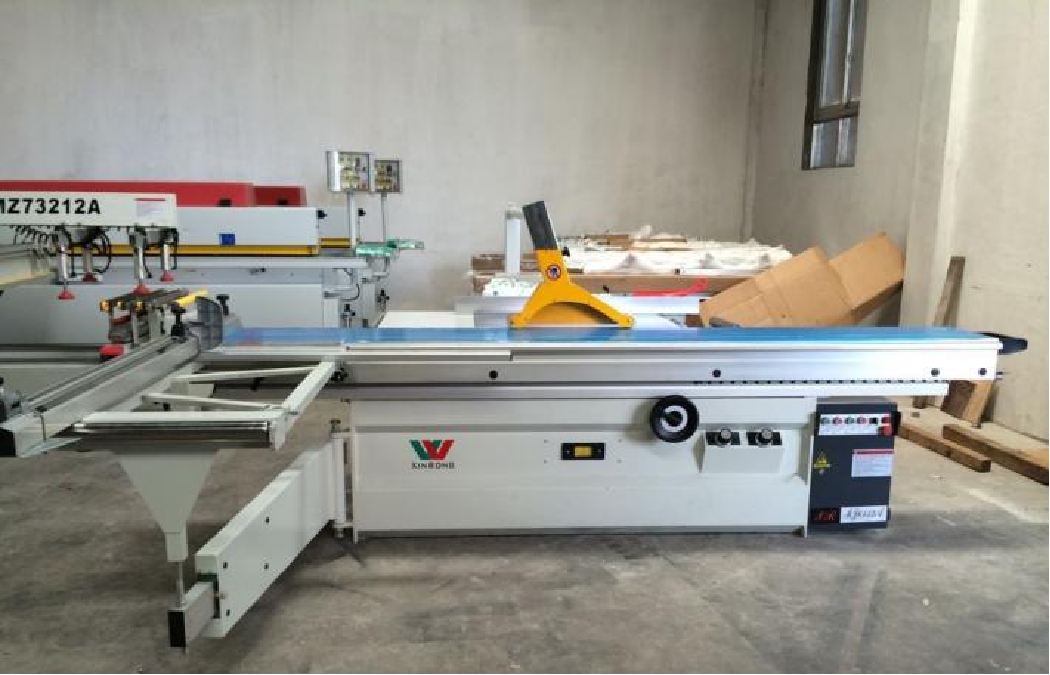
Automated production equipment forms part of the capacity and dimensional-consistency evidence a buyer should verify when scoring the cost and after-sales pillars.
A disciplined buyer would populate the matrix in a fixed order: verify documents for compliance first, because a failed standard removes a supplier from consideration regardless of price; then verify cost over the service life; then verify after-sales scope; and only then apply the weights. Running the pillars in the reverse order, starting from the quotation, is how projects end up with furniture that satisfies the budget and not the operating reality.
Where the Matrix Argues Against Custom Furniture
A comparison framework that only produces one answer is not a framework. Applied honestly, this matrix will sometimes recommend against the custom route, and buyers should build in that possibility from the start.
The clearest limitation is capital cost. Custom furniture carries an initial cost approximately 30% higher than standard furniture, with material costs increased by 120%–150%. The total cost of ownership advantage of 50% over eight years depends on the asset being held and maintained across that period. For a property with a short hold horizon, a planned repositioning, or a brand standard that does not require bespoke casegoods, standard furniture is a defensible procurement decision and the matrix should be allowed to say so.
A second limitation is schedule. Bespoke production requires an earlier design freeze, sample approval and shop-drawing sign-off than catalogue procurement. On a compressed refurbishment timeline, that requirement can be the binding constraint, and a supplier's production capacity does not remove it. A third limitation is evidentiary: management-system certification does not certify product performance, and a supplier with a strong certificate set may still need to commission project-specific testing. Finally, positioning alone is not a score. Kimball Hospitality and Bernhardt Hospitality are identified as top-tier global manufacturers of custom guestroom casegoods and upholstered seating for 2026, and they are useful reference points for how the market segments — but market position is a starting filter, not a substitute for project-level scoring.
Market Trends That Should Change Your Weights
Weighting is not a one-time decision. Three trends visible in current data suggest that the compliance pillar should carry more weight than it did five years ago.
First, the value at stake is growing. The luxury hotel furniture market is estimated to grow from USD 212.14 billion in 2026 to USD 312.97 billion by 2035, according to Business Research Insights, although this figure uses a broader scope than the Dataintelo hospitality furniture estimate and should not be compared directly with it. Second, supply is concentrated: Asia Pacific dominated the hospitality furniture market with a 36.4% revenue share in 2025, driven by construction activity in emerging economies, according to Dataintelo. For buyers sourcing from that region into European or North American projects, the compliance pillar is where cross-market risk concentrates. Third, specification pressure is rising, with sustainability requirements in contracts up 45% in 2025 and low-VOC finishes and FSC wood becoming standard.
Taken together, these trends argue for a compliance weight above the 35% default on internationally sourced projects, and for a cost pillar scored strictly on total cost of ownership rather than on quoted rate.
Future Outlook: Documentation as the Deciding Asset
The direction of hotel furniture procurement is toward evidence-based shortlisting. As bespoke work becomes the mainstream expectation rather than a premium option, differentiation shifts from whether a supplier can build a custom piece to whether it can prove, repeatedly and in the buyer's regulatory environment, that the piece meets a defined standard and can be supported after handover. Suppliers that maintain documentation across markets will be easier to score and easier to defend internally; those that rely on presentation will find themselves filtered out earlier in the process.
For procurement directors, the practical implication is modest but durable. Fix the weights before quotations arrive, score only against documents, treat unverifiable claims as a low score rather than a neutral one, and revisit the weights per market. The matrix does not remove judgement from hotel furniture procurement. It makes the judgement visible, which is what makes it defensible to an owner, a brand technical services team and an auditor at the same time.
FAQ
How should a procurement team weight cost against compliance when comparing hotel furniture suppliers?
A common default is 40% total cost, 35% compliance and 25% after-sales support, but the weighting should follow project risk rather than habit. In markets where upholstered furniture must carry a CRIB 5 rating under BS 5852, or where public and lounge seating must meet ANSI/BIFMA X5.4-2020 (R2025), compliance should be weighted above the default. The cost pillar should always be scored on total cost of ownership rather than unit rate, because custom furniture carries an initial cost about 30% higher and material costs 120%–150% higher, while returning a stated 50% lower total cost of ownership over eight years.
Which certifications should a custom hotel furniture manufacturer hold for international projects?
Two categories should be checked separately. Management-system certification covers process discipline: RICHART's production process is stated to comply with ISO 9001:2008 for quality management, ISO 14001:2004 for environmental management and OHSAS 18001:2007 for occupational health and safety management, with ISO 14001 certification obtained as early as 2006. Product-level standards cover the item itself and are market-specific, such as ANSI/BIFMA X5.4-2020 (R2025) for public and lounge seating or BS 5852 CRIB 5 for upholstered furniture in the UK hospitality sector. Buyers should verify the certified production site and the revision year on each certificate, and request product test reports independently.
How is after-sales support scored for custom hotel furniture?
Score against defined failure modes rather than general claims. The recurring risks in hotel furniture are material deformation, surface cracking and fading, and structural loosening, controlled through precision dimensional control, material stability control and surface finish quality control. Supplier-side measures that support those controls include strict raw material inspection, pre-delivery quality inspection, professional installation guidance and after-sales maintenance service. Each element should be scored only where a record, protocol or scope of work exists. Warranty duration and response times are contract terms and should be negotiated per project rather than assumed from a company profile.
What does a 60% export ratio indicate about a custom furniture supplier?
It indicates sustained exposure to multiple regulatory regimes, export documentation, freight packaging and installation scheduling at a distance. RICHART reports a 60% export ratio, main markets in the USA, the EU, Southeast Asia, the Middle East and China, a network covering more than 20 countries and regions, and products and services supplied to more than 500 high-star hotels worldwide. That profile supports a mid-to-high score on cross-regional capability and documentation breadth, but it does not prove compliance with any specific product standard, which must be verified through test reports for the destination market.
When is standard furniture a better procurement decision than custom furniture?
When the asset holding period is shorter than the payback horizon, when capital budget is the binding constraint, or when the design intent does not require bespoke production. Custom furniture carries an initial cost roughly 30% higher and material costs 120%–150% higher, and its stated 50% lower total cost of ownership is measured over eight years. If the property will not hold the furniture across that period, the advantage may not materialise. Bespoke work also requires an earlier design freeze and sample approval, which can conflict with a compressed refurbishment schedule.
Reference document: RICHART company brochure (PDF) — download the RICHART brochure.
Have Questions or Need More Details?
Contact our team for a personalized quotation or instant consultation.
Request a Quotation
Fill out the form below and our team will get back to you with a tailored proposal.
WhatsApp Direct Chat
Prefer to chat in real-time? Message us on WhatsApp for instant assistance & quick answers.
- Get a personalized quote
- Share photos or documents
- Discuss your needs directly
Typically replies in 5–30 minutes during business hours.