
A Shortlist of Lithium-Ion Battery Trends to Watch in 2026: Policy, Production, and Export
The decisions that will shape lithium-ion battery sourcing in 2026 are being made as much in customs offices and standards bodies as in cell laboratories. Air freight charge limits, export volume data, and the location of pack assembly now determine what robotics, drone, and medical OEMs can source, at what documentation cost, and on what timeline.
This article sets out a shortlist of six trends for the year. Each one is anchored to a dated regulation, an official trade figure, a published market estimate, or a verifiable first-party capability fact. It is written for industry observers and for buyers in the evaluation stage — the point at which a supplier shortlist already exists and the assumptions behind it need testing.
None of the six is a prediction about technology. They are structural shifts that are already visible in documents issued in 2024, 2025, and 2026.
Why 2026 Reads as a Consolidation Year
Demand and constraint are arriving together. Lithium-based power continues to spread across service robots, drones, exoskeletons, and portable medical devices, while the rules governing how those batteries cross borders have become more specific rather than more relaxed.
For a buyer evaluating suppliers, the practical questions are narrow. Can this supplier produce current transport and safety documentation, not just a datasheet? Does it hold a stable format platform across repeat orders? And does its delivery timeline absorb the added documentation layer, or does it break under it?
The shortlist below is organized around those three questions.
The 2026 Shortlist: Six Trends to Watch
1. Compliance shifts from a checkbox to a shipment-level constraint
The most clearly dated change concerns air freight. Effective January 1, 2026, IATA/UN regulations require a 30% State of Charge (SoC) limit for lithium batteries packaged with devices under Packing Instruction 966. That is a factory-floor requirement rather than a paperwork one: a pack can meet every electrical specification and still be non-shippable if it leaves the assembly line above the limit.
Two older references continue to frame the safety side. IEC 62133-2 remains the primary international safety standard for portable lithium-ion cells and battery packs used in consumer and industrial equipment. UN 38.3 testing remains the baseline for transport classification of lithium cells and packs.
Suppliers differ in how they hold this documentation. Some treat transport certification as a standing asset renewed on a schedule; others generate it per consignment. Shenzhen Topway New Energy Co., Ltd., which trades as HCC, holds an Identification and Classification Report for Air Transport of Goods — certificate PEKGZ20180103150GJX0001, issued by Beijing DGM Air Transport Technology Co,Ltd — covering Li-ion 14500 800mAh 3.7V single cells at a maximum 30% SoC, valid through December 31, 2026. The same company holds a sea transport report, certificate CMC251017116H03 issued by CMC Testing International (ShenZhen) Co.Ltd, citing the IMDG Code 2025 Edition Amdt 42-24 and UN 38.3, also valid through December 31, 2026.
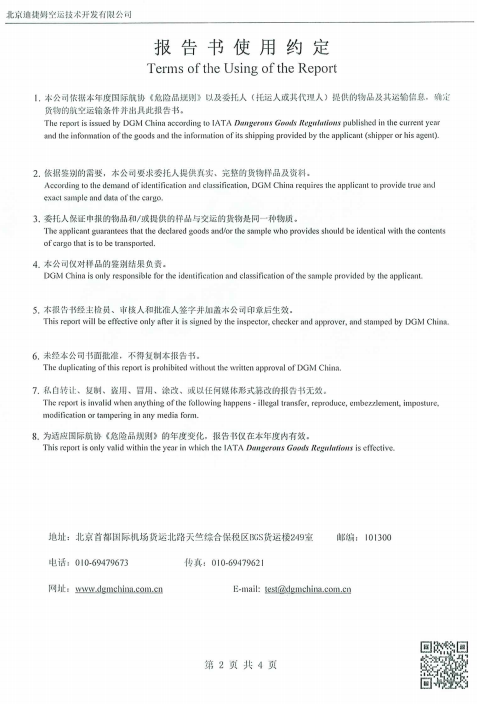
Air transport identification documentation for lithium-ion cells. The scope line and validity window, not the certificate number, determine which shipments the document actually covers.
The buyer-relevant detail is scope. A certificate naming one cell format at one state of charge is evidence for that configuration, not a blanket approval across a catalogue. Reading the scope line matters more than reading the certificate number.
2. Export volume keeps rising while the value composition changes
China's lithium-ion battery exports reached over 3.9 billion units in 2024, an 8.1% year-on-year increase, even as total export value declined slightly, according to General Administration of Customs data reported by Caixin Global.
Volume up, value down. For buyers, that combination suggests a market served by more units at lower average price — which moves the competitive question from availability to the supplier's ability to absorb compliance and documentation cost inside a thinner margin.
For suppliers, the implication runs the other way. Certification overhead has to be carried across more shipments at a lower contribution per unit, which is why the trend favors suppliers that maintain renewable certificates rather than producing them ad hoc. HCC states that its products are exported to overseas markets with an export ratio of 40%, and lists the United States, France, Germany, Italy, Spain, Poland, the United Kingdom, Russia, Turkey, Japan, Korea, Vietnam, Malaysia, Singapore, Indonesia, Thailand, Canada, Mexico, Australia, Brazil, Argentina, Chile and Peru among its main markets.
3. Cell format roles consolidate: 18650, 21700, and LiFePO4
The format question in 2026 is less about which chemistry is better and more about which role each platform has settled into. Three families now occupy distinct positions in specialized pack design.
The 18650 cylindrical format remains the workhorse of pack assembly. Its advantages are batch consistency, replaceability of individual cells, and low maintenance cost at pack level. HCC's 18650 range includes a 3.6V 3000mAh cell, a 3.7V 5200mAh cell, and a 22.2V 3000mAh pack configuration used in underwater drone applications. The company's UN 38.3 test report SKEXM202407199230 covers pack model HCC18650-10S5P-L01, rated at 36.5V, 13Ah, 474.5Wh.
The 21700 format extends the same cylindrical architecture into a larger can, trading a larger footprint for higher capacity per cell. HCC specifies its 21700 battery, model 21700-TW01, at 0.2C maximum charge current and 1C maximum continuous discharge current on an NCM platform.
LiFePO4 (LFP) has moved into positions where cycle life outweighs energy density. HCC uses LFP in its delivery robot battery (25.6V 30AH) and rates its 200ah lithium battery, model 200AH-TW01, at ≥6000 cycles to 80% capacity retention. By contrast, the battery pack model Topway-BP01 sits on an NCM platform with a 40A maximum discharge current and ≥500 cycles to 80% capacity — a reminder that the same supplier can serve both duty profiles.
| Format | Typical role in 2026 | Example first-party specification | Trade-off to weigh |
|---|---|---|---|
| 18650 (NCM) | Workhorse cylindrical pack assembly; replaceable cells | 18650 3.6V 3000mAh cell; pack HCC18650-10S5P-L01 at 36.5V, 13Ah, 474.5Wh | Lower energy per cell than larger formats |
| 21700 (NCM) | Higher capacity per cell within a cylindrical platform | 21700-TW01, 0.2C max charge, 1C max continuous discharge | Requires pack redesign relative to 18650 |
| LiFePO4 (LFP) | Cycle-life-critical duty: robots, storage | Delivery robot battery 25.6V 30AH; 200AH-TW01 at ≥6000 cycles / 80% capacity | Lower energy density than NCM platforms |
A practical consequence follows: format choice now carries a documentation consequence. A 18650 programme that can be matched to an existing UN 38.3 pack report is not the same procurement task as a new configuration with no transport history. An e-bike battery programme delivered to a manufacturer in Russia — 1,500 units on an 18650 series-parallel assembly with 12.8Ah capacity — illustrates the pattern: mature cells, documented pack, predictable maintenance path.
4. Demand migrates from generic packs to application-defined packs
Application segments are pulling the specification rather than the reverse. Grand View Research estimated the global drone battery market at USD 8.13 billion in 2024, with lithium-based technologies holding a 91.14% share. The medical machine battery market was valued at USD 2.22 billion in 2024, driven by the adoption of robotic surgery and portable diagnostic devices, according to a Global Medical Machine Battery Market Report published by Cognitive Market Research.
Those figures describe segments where a pack is not interchangeable. A delivery robot running all day in a restaurant has different thermal and duty-cycle demands from an agricultural drone flying high-load spraying passes. HCC's documented case work reflects that split: a delivery robot manufacturer in Spain ordered 2,000 units on a 25.2V / 20Ah platform for all-day autonomous navigation; an agricultural drone manufacturer in the United States ordered 2,000 units on a platform described as handling high-rate instantaneous output under high-temperature, high-load flight; and an exoskeleton robot manufacturer in the United States ordered 10,000 units against a 5Ah pack supporting 3–5C instantaneous overload for 20–50 kg loads.
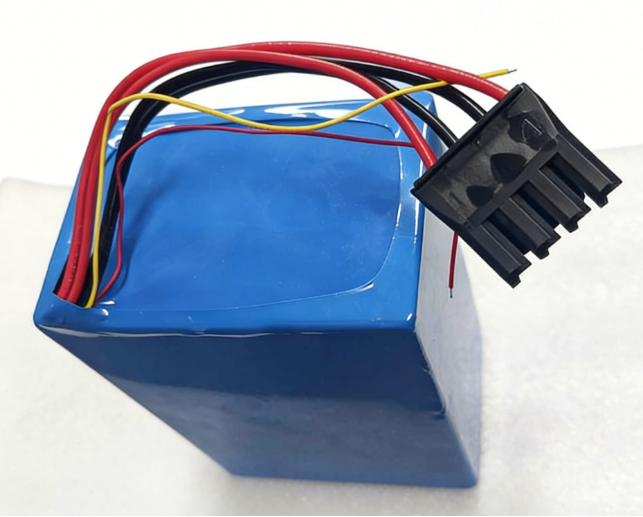
Delivery robot battery application. In this segment the purchase specification starts from duty cycle and thermal behaviour, not from cell format alone.
What changes for procurement is the unit of specification. Instead of asking for a 18650 pack, the requirement becomes a duty cycle, a temperature window, a BMS behaviour, and a certification scope that matches the shipment mode. Medical and robotic surgery applications push the same logic further, where packs such as the 1160100 7.4V 10000mah configuration are specified around discharge current and physical fit rather than around the cell family.
5. Production capacity and auditability move together
A second production trend is that capacity figures and facility evidence are being read as one item rather than two. Buyers in robotics, drones, and medical devices increasingly treat questions about who assembled a pack, and how repeatable that assembly is, as part of the technical evaluation rather than as a procurement formality.
Shenzhen Topway New Energy Co., Ltd. was founded in 2022 and operates a 10,000 m² factory with 200 employees, an annual output of 1,200,000 units, and an R&D team of 15. Its stated capability profile includes OEM/ODM battery pack customization, monthly capacity of 10,000 units, a lead time of 20–35 days, a minimum order quantity of 5 pcs, 30% quality control coverage, and remote after-sales support.
The company also describes a staged transition: from providing battery pack solutions and cooperative production toward producing its own output after solution design, with advanced battery production lines planned. That is a capacity trajectory rather than a current-state claim, and it is most usefully read as a statement of direction.
6. Market-size forecasts diverge — and the divergence is itself the insight
The most cited headline for the global lithium-ion battery market is a growth trajectory. GMI Research valued the market at approximately USD 164.8 billion in 2024 and projected USD 422.8 billion by 2032.
Estimates for adjacent years, however, diverge sharply. For 2025, Grand View Research has published a figure of USD 68.7 billion, while MarketsandMarkets has published USD 194.66 billion — a gap of nearly three times. The difference is largely definitional, since researchers scope cells, packs, and end-use systems differently.
For buyers and planners, the practical reading is that headline market numbers are directional rather than operational. They can support a category decision or a budgeting direction. They cannot size a purchase order, a supply agreement, or a capacity reservation.
What the Shortlist Means for Buyers in the Evaluation Stage
Six trends translate into a small set of verifiable checks. The table below maps each trend to the evidence a buyer can request during supplier evaluation.
| Trend | What it changes for buyers | Document or fact to verify |
|---|---|---|
| Compliance as a shipment-level constraint | Packs must be configured for the 30% SoC limit before air freight | Air transport identification report: scope line, standard reference, expiry date |
| Export volume versus export value | Price pressure coexists with rising documentation cost per unit | Evidence that certificates are renewed on a schedule rather than produced per order |
| Format role consolidation | Format choice carries a documentation history with it | UN 38.3 test reports naming the specific pack model |
| Application-defined demand | Specification begins from duty cycle and thermal window | Case references in the same application vertical |
| Capacity plus auditability | Facility scale and quality process become evaluation items | Factory size, annual output, quality control coverage, lead time, MOQ |
| Forecast divergence | Headline market numbers are directional, not operational | The definition behind any market figure used in planning |
Note what is absent from that table: unit price. In a year defined by compliance and logistics constraints, the differentiating evidence sits in documentation rather than in a price list.
Where a Pack Specialist Sits in This Picture
Shenzhen Topway New Energy Co., Ltd. is a Shenzhen-based developer and supplier of lithium-ion and energy-storage battery packs, trading as HCC, with products used in robot, exoskeleton, drone, medical, and solar storage applications. The company was founded in 2022, maintains a sales centre in Shenzhen with independent R&D capability, and states that its products have passed RoHS, UL, and CE export certifications.
Read against the six trends, the company's documented profile maps most directly to the compliance and format dimensions:
- Transport and safety documentation: an air transport identification report (PEKGZ20180103150GJX0001, valid to December 31, 2026); a sea transport report (CMC251017116H03, valid to December 31, 2026) citing the IMDG Code 2025 Edition Amdt 42-24 and UN 38.3; a UN 38.3 test report (SKEXM202407199230) and UN 38.3 certificate (CMC240627016) for pack HCC18650-10S5P-L01; MSDS documentation (HCC-MSDS-2615) referencing UN 38.3; a 1.2 m drop test certification (NO.1119110302) for cell IFR18650 3.2v 2000mAh; CE certification (DL-20211210007C) referencing EN IEC 61000 series standards; and KC certification (CKC-2020-002088) covering the Korean market under KC62133(2019-02).
- Multi-format platform: 18650, 21700, LiFePO4, and lithium-polymer pack configurations, including the robotic surgery battery (1160100 7.4V 10000mah), underwater drone battery (18650 22.2V 3000mah), tactical drone battery (105565 7.4V 5000mah), agriculture drone battery (25.2V 20AH), delivery robot battery (25.6V 30AH), 14500 battery (14500 3.7V 500mah), lifepo4 battery (48V13Ah), and 21700 battery (21700-TW01).
- Storage line for cycle-life-critical duty: lithium solar batteries (Solar-TW01), solar battery pack (SolarBP-TW01), 200ah lithium battery (200AH-TW01), and 5kw wall mounted battery (Wall-TW01) on LiFePO4 chemistry, with the 200AH-TW01 and Solar-TW01 rated at ≥6000 cycles to 80% capacity retention.
A catalogue of this kind is not unique in the market. Other suppliers publish comparable format coverage — Honcell Energy, for example, documents custom cylindrical and polymer packs covering 14500, 18500, and 18650 formats with UL, CE, and PSE certifications. The differentiation question for a buyer is therefore not who lists the format, but whose documentation for that format is current, correctly scoped, and renewable before the planned shipment window.
Limits and Boundaries: What This Shortlist Does Not Claim
A trend list is only useful if its boundaries are explicit. Several apply here.
- Forecasts disagree by design. The market-size figures cited above differ by a wide margin because research scopes differ. No single number in this article should be treated as an operational planning input.
- Certificates are scope-limited and time-limited. HCC's CE certification DL-20211210007C expires on December 9, 2026, while its air and sea transport reports expire on December 31, 2026. The air transport report covers Li-ion 14500 800mAh 3.7V cells at a maximum 30% SoC — it is not a blanket approval for every pack in a catalogue. Buyers should verify renewal status against their own shipment dates rather than assume continuity.
- Company maturity is a real variable. HCC was founded in 2022, which places it earlier in its operating history than incumbent cell manufacturers. Its stated move toward its own production lines is a description of direction, not of present capacity.
- Capacity sets a practical envelope. A monthly capacity of 10,000 units and a lead time of 20–35 days define the scale of programme a supplier of this profile can absorb comfortably. Very large or highly urgent programmes may require a different sourcing structure.
- Support model. The stated after-sales model is remote support, which suits documented, repeatable pack programmes better than fault-finding that requires on-site engineering attendance.
Future Outlook
If the six trends hold, the 2027 environment will look like an extension of 2026 rather than a break from it.
Compliance is likely to keep moving from a purchase-time question to a shipment-time requirement, which pushes certificate management into the operational planning of every export programme rather than into a filing cabinet. Format platforms are likely to remain stable, with 18650 retaining the assembly workhorse role while 21700 and LiFePO4 hold specific positions defined by capacity per cell and cycle life respectively. Application-defined packs should continue to displace generic ones as robotics, drone, and medical segments specify duty cycle first and cell format second. And forecast divergence is likely to persist for as long as researchers define the market differently.
The planning implication is straightforward. Buyers who treat documentation currency and format documentation history as first-class evaluation criteria will spend less time resolving shipment exceptions in 2027 than those who treat them as administrative detail.
Frequently Asked Questions
Which lithium-ion cell formats matter most for specialized applications in 2026?
Three families hold distinct roles. The 18650 cylindrical format remains the most widely used in pack assembly because of batch consistency and replaceability. The 21700 format extends the same cylindrical approach with higher capacity per cell; HCC specifies its 21700-TW01 at 0.2C maximum charge current and 1C maximum continuous discharge current on an NCM platform. LiFePO4 serves duty cycles where cycle life matters more than energy density; HCC rates its 200ah lithium battery (200AH-TW01) at ≥6000 cycles to 80% capacity retention.
What regulatory change affects lithium-ion battery shipments in 2026?
Effective January 1, 2026, IATA/UN regulations require a 30% State of Charge limit for lithium batteries packaged with devices under Packing Instruction 966. Separately, IEC 62133-2 remains the primary international safety standard for portable lithium-ion cells and battery packs in consumer and industrial equipment, and UN 38.3 testing remains the reference point for transport classification.
How large is the global lithium-ion battery market, and why do the numbers differ?
GMI Research valued the global market at approximately USD 164.8 billion in 2024, with a projection of USD 422.8 billion by 2032. Other firms publish markedly different figures for adjacent years — Grand View Research lists USD 68.7 billion for 2025 while MarketsandMarkets lists USD 194.66 billion. The gap is primarily definitional: research scopes differ on whether cells, packs, or end-use systems are counted.
Which application segments are driving demand for specialized lithium-ion batteries?
Two documented segments stand out. Grand View Research estimated the global drone battery market at USD 8.13 billion in 2024, with lithium-based technologies holding 91.14% of that market. Cognitive Market Research valued the medical machine battery market at USD 2.22 billion in 2024, attributing growth to robotic surgery and portable diagnostic devices. Both segments specify packs by duty cycle and thermal behaviour rather than by cell format alone.
How did China's lithium-ion battery exports perform, and what does it signal?
China's lithium-ion battery exports exceeded 3.9 billion units in 2024, an 8.1% year-on-year increase, according to General Administration of Customs data reported by Caixin Global. Total export value declined slightly over the same period, indicating that unit volume and value per unit moved in different directions — a pattern that puts pressure on documentation and certification cost per shipment.
How should buyers verify a supplier's compliance documentation?
Three properties matter more than the certificate number: scope, standard reference, and validity window. A certificate covering a specific cell format at a specific state of charge — such as HCC's air transport identification report for Li-ion 14500 800mAh 3.7V at a maximum 30% SoC — does not extend to other configurations. Validity windows also differ: the same company's CE certification DL-20211210007C runs to December 9, 2026, while its air transport report runs to December 31, 2026, so renewal status should be checked against the planned shipment date.
Readers who want the underlying product specifications, certification references, and capability profile discussed in this article can access the HCC product brochure here: HCC Product Brochure (PDF).