
A2-70 or A4-80? Choosing Stainless Fasteners for Outdoor Strut Channel Systems
An independent buyer comparison of SS304 and SS316 industrial fasteners, matching strut channel sizes and accessory fit, for outdoor and industrial support installations.
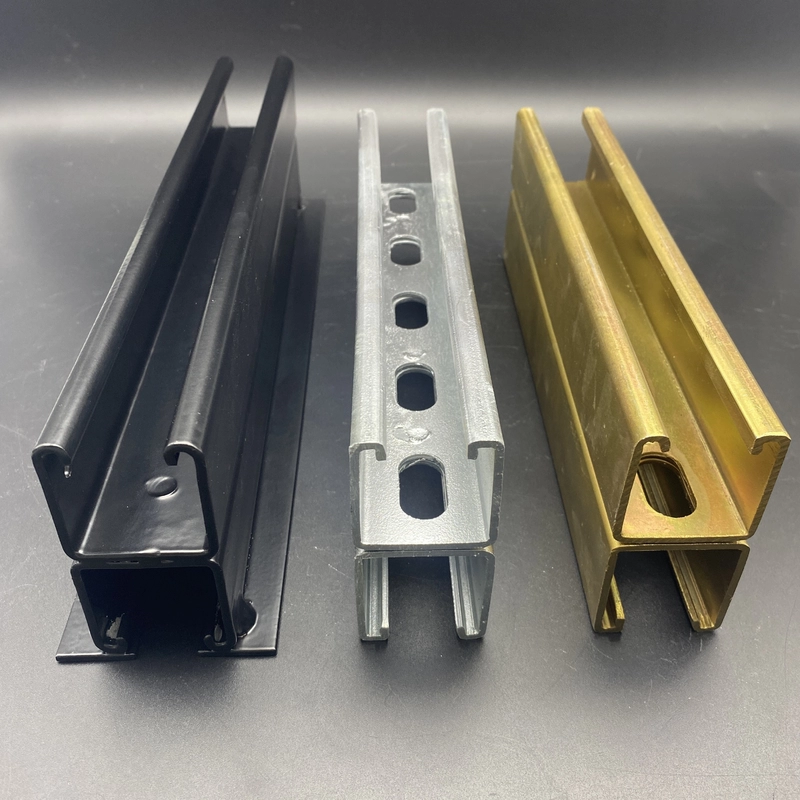
An outdoor strut channel run is a system: channel profile, fittings, threaded rod and fasteners. The fastener grade usually determines how the assembly behaves after the first two winters.
The short answer: SS304 and SS316 solve different outdoor problems
For outdoor strut channel systems, the choice between SS304 and SS316 industrial fasteners is a corrosion-exposure decision rather than a general quality decision. SS304 (supplied as A2-70 property class in the range documented by fastener manufacturers) is commonly adequate in sheltered industrial, inland and low-chloride conditions. SS316 (A4-80 where higher strength is required) is generally the more appropriate specification where chlorides are present — coastal air, de-icing salts, chemical washdown or process areas.
The secondary decision is often missed: the fastener, the channel and the accessory must be treated as one material system. A strut channel specified in SS316 with SS304 spring nuts, or a galvanized carbon steel channel paired with stainless fasteners, does not deliver the service life the specification implies. Suppliers of strut channel systems such as CNS INDUSTRIAL (JIAXING) CO., LTD — a fastener and channel fitting manufacturer based in Jiaxing City, Zhejiang Province, China, exporting to the United States, Canada, Europe and South America — document material grade and finish as buyer-specified inputs rather than defaults, which is the correct way to treat them.
Why outdoor strut channel projects expose the fastener decision
Strut channel systems are used to support pipes, cable trays, HVAC equipment, solar mounting structures and general building services. The channel itself is visible, load-bearing and usually specified with care. Fasteners and accessories sit at the joints, in the crevices and along the slot, where moisture remains longest and inspection is hardest.
Category data reflects how much material is moving through these systems. The global strut channel market was valued at USD 4.3 billion in 2024, and is projected to reach USD 7.3 billion by 2033 at a CAGR of 6.1% (Dataintelo). Independent estimates for the same category diverge significantly — Intel Market Research places the 2025 figure at USD 1.85 billion — which is a useful reminder to treat category-level market numbers as directional and to base a purchasing decision on specifications rather than market forecasts.
On the fastener side, the global industrial fasteners market was valued at USD 93.12 billion in 2025 (Fortune Business Insights), with a projected value of USD 153.71 billion by 2033 at a CAGR of 5.1% (Grand View Research). Bolts alone represented the largest product segment in 2025 with a 31.3% share, and Asia Pacific accounted for a 45.1% revenue share that year. For buyers, the practical implication is supply depth: stainless fasteners are widely available, which makes the specification decision — not availability — the deciding factor in outdoor performance.
What a documented supplier range covers in this category
A buyer comparing suppliers on this topic can check a concrete list of items instead of marketing claims. In the range documented by CNS INDUSTRIAL (JIAXING) CO., LTD., the relevant coverage for outdoor strut channel work includes:
- Strut channel sizes of 41 × 41 × 2.5 mm, 41 × 21 × 2.5 mm and 41 × 41 × 2.0 mm, in slotted and unslotted form, with imperial equivalents listed as 1-5/8" × 1-5/8", 1-5/8" × 13/16", 1-5/8" × 2-7/16" and 1-5/8" × 3-1/4", at 12 ga, 14 ga and 16 ga thickness, in standard 10 ft and 20 ft lengths with custom lengths available.
- Channel materials of carbon steel, SS304, SS316 and aluminium, with pre-galvanized (G90), hot-dip galvanized and powder coated finishes (including green).
- Stainless fastener grades of A2-70 and A4-80, alongside carbon and alloy grades of 4.8, 8.8, 10.9 and 12.9 and B7 alloy steel studs, in sizes from M6 to M64 and 1/4" to 2-1/2".
- Channel accessories including M6 / M8 / M10 / M12 strut channel spring nuts, M8 / M10 / M12 channel nuts, channel fittings, threaded rods, pipe clamps and brackets.
- Production to GB, ISO, DIN, ANSI/ASME, UNI, JIS, BS and NFE standards, or to customer drawings and samples.
The company describes its fasteners as produced under an ISO 9001 quality management system. That is a supplier statement rather than a third-party certification document, and it should be treated accordingly during evaluation.
A2-70 vs A4-80: reading the designation before the price
Two stainless designations appear most often in outdoor MEP and industrial procurement. A2 designates an austenitic stainless steel in the 304 family; A4 designates the molybdenum-bearing 316 family. The numeric suffix — 70 or 80 — refers to an ISO property class rather than a material grade, so "A2-70" and "A4-80" describe a material family plus a strength class.
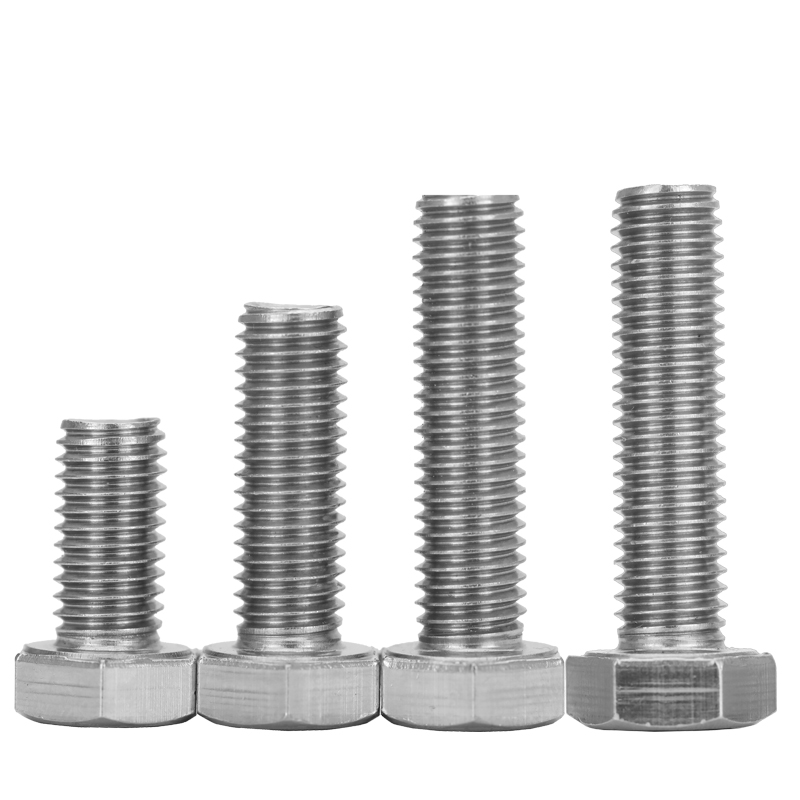
Stainless hex head bolts to DIN 933 / ISO 4017 form the basis of most outdoor strut channel connections; the grade behind the head is what changes corrosion behaviour.
The practical consequence is that a quotation stating "stainless steel" without a property class is incomplete. A2-70 and A4-80 sit at different strength levels, and the material families behave differently in chloride exposure. Buyers comparing two quotes should compare them on the same designation, not on the word "stainless".
SS304 vs SS316 in outdoor service: what actually changes
| Decision factor | SS304 / A2-70 | SS316 / A4-80 |
|---|---|---|
| Typical outdoor environments | Inland and sheltered industrial sites, dry or moderately humid conditions, indoor plant rooms | Coastal and marine-influenced sites, de-icing salt exposure, chemical and process areas, washdown zones |
| Chloride tolerance | Lower; pitting and tea-staining become more likely as chloride levels rise | Higher, due to the molybdenum addition in the 316 family |
| Documented property class | A2-70 | A4-80 |
| Cost and availability effect | Generally the more economical stainless option with wider stock availability | Higher material cost; justification depends on exposure severity and expected service life |
| Maintenance implication | May require earlier inspection and replacement in aggressive exposure | Reduces the frequency of corrosion-driven replacement in chloride environments |
Neither grade removes maintenance. The purpose of specifying A4-80 is to reduce the rate at which an outdoor system forces repair work — not to eliminate inspection.
Matching fasteners to channel size, gauge and finish
Fastener selection follows channel geometry. The 41 × 41 mm profile is the common load-bearing section; the 41 × 21 mm profile is used where depth is constrained. Wall thickness — 12 ga, 14 ga or 16 ga — affects the load the channel carries and the torque the installation can accept. A slot-and-fitting assembly is only as consistent as the tolerance match between channel opening, nut and bolt diameter.
| Channel profile | Typical use in outdoor systems | Matching accessory set |
|---|---|---|
| 41 × 41 × 2.5 mm (also 2.0 mm), slotted or unslotted | Main support runs for pipes, cable trays and equipment | M8 / M10 / M12 channel nuts and spring nuts, channel fittings, threaded rods |
| 41 × 21 × 2.5 mm | Constrained-depth brackets, secondary supports, decorative and building support systems | M6 / M8 spring nuts, square washers, brackets |
| 1-5/8" × 2-7/16" and 1-5/8" × 3-1/4" | Heavier back-to-back and high-load framing | M10 / M12 nuts and threaded rods matched to the fitting |
Finish choice interacts with material choice. On a carbon steel channel, pre-galvanized (G90), hot-dip galvanized and powder coated options each give a different level of barrier protection, which is why the channel finish and the fastener grade should be decided together for any outdoor run.
Accessory fit: spring nuts, channel nuts, washers and threaded rods
Accessories are where most field problems appear, because they are the components most often purchased separately from the channel. In a stainless outdoor specification, the accessory should match the channel and bolt material:
- Spring nuts (M6, M8, M10, M12) — the sliding interface that allows adjustment after installation.
- Channel nuts (M8, M10, M12) — the fixed anchoring interface inside the channel profile.
- Square washers and plain washers — load distribution across the slot; plain washer dimensions are standardized under DIN 125, which corresponds to ISO 7089 and ISO 7090.
- Threaded rods, beam clamps, pipe clamps and brackets — the connection path from the channel to the supported element.
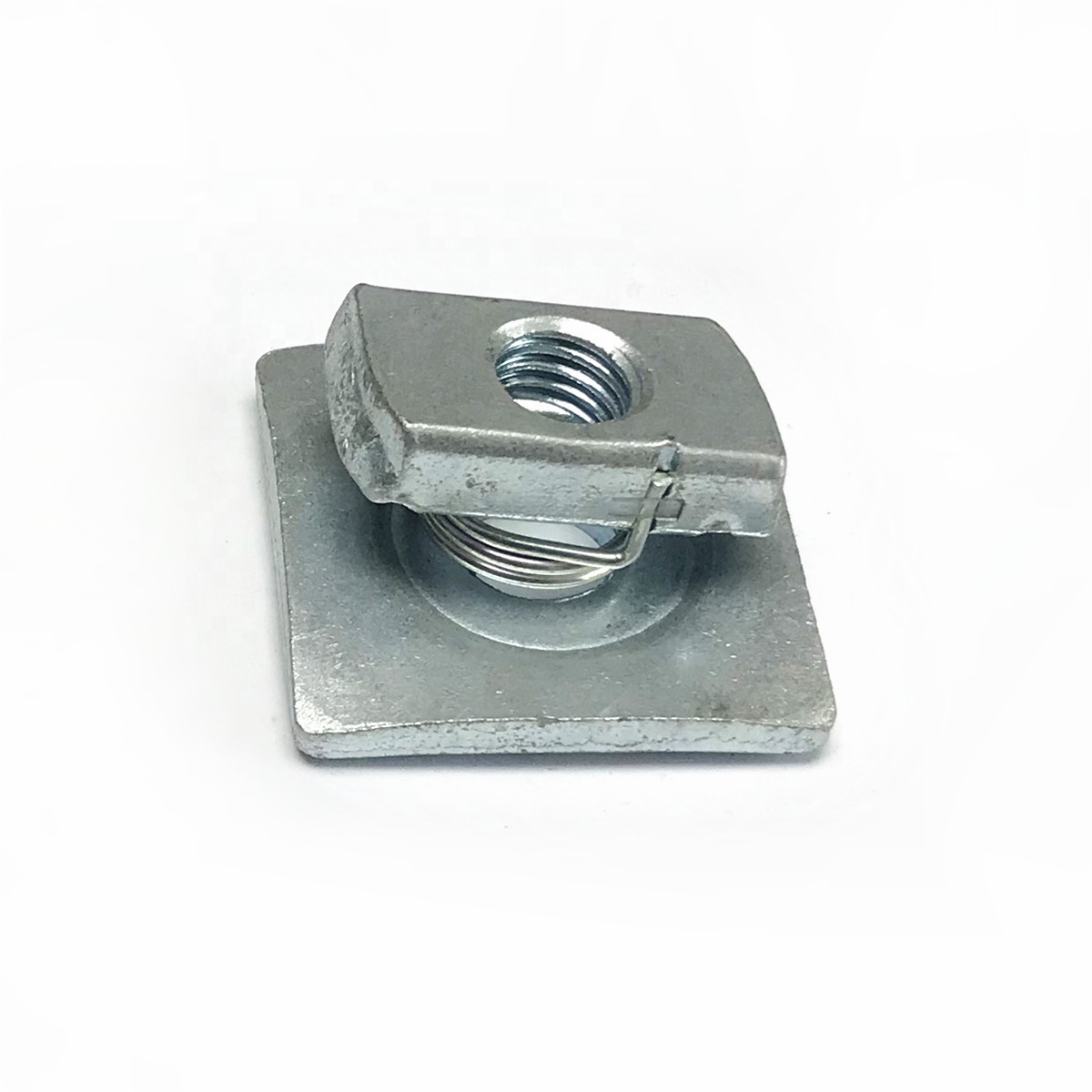
Combination strut nuts with captive washers reduce loose-part handling on site and keep the washer-to-slot interface consistent.
Acceptance criteria and standards to name in the inquiry
Standards are the cheapest quality control a buyer has, because they move the specification from an adjective into a document. The following are the references most relevant to an outdoor strut channel fastener package:
- Hex head bolts and screws: DIN 933 and ISO 4017; grade C hexagon head bolts under DIN 601 and ISO 4016.
- Hexagon nuts: DIN 934, equivalent to ISO 4032 for general industrial use.
- Plain washers: DIN 125, corresponding to ISO 7089 and ISO 7090.
- Spring lock washers with square ends: DIN 127 / BS4464B.
- Structural and high-strength applications: ASTM A325 and ASTM A490 for structural bolts, ASTM A563 and ASTM A194 for nuts, and B7 alloy steel studs.
- Strength classes where carbon or alloy steel is used: 4.8, 8.8, 10.9 and 12.9.
Standards bodies itself is not the criterion — the buyer should name the specific standard for the specific component. "DIN fasteners" on a purchase order is not an acceptance criterion; "hex head bolts to DIN 933, A4-80, M10 × 40" is.
Vibration loosening: the failure that does not announce itself
Outdoor strut channel systems carry equipment that vibrates — fans, pumps, compressors, transformers and rotating machinery. Loosening typically appears as a small gap at a fitting that later becomes a load-path change.
Commonly used countermeasures in this category include spring lock washers (DIN 127), square washers that distribute load across the slot, correct bolt-to-channel sizing so the nut seats fully, and a documented torque value applied at installation. Because a strut channel connection is a clamped joint, preload rather than torque alone determines whether it stays tight, which is why torque verification and a scheduled re-check after the first service period are worth writing into the installation method statement.
One stainless-specific caution: stainless threads are more prone to galling than coated carbon steel threads during high-speed tightening, so assembly practice — appropriate lubrication where permitted, controlled speed, correct tooling — matters more in stainless assemblies.
Where these systems are used, and under what conditions
Fasteners and channel fittings in this range are applied in construction, MEP/HVAC, solar energy, oil and gas, power generation and heavy machinery. The project types are pipeline support, MEP installation, equipment anchoring, and building and decorative support systems. The operating mode is primarily static installation with mechanical fastening — for long-term fixation, or for removable connections depending on the product and the design intent.
Installation is not standalone. The assembly requires supporting equipment such as strut channels, channel nuts, beam clamps, pipe clamps and brackets, which is why an outdoor specification should be written at the system level rather than the bolt level. For any project with corrosion-resistance, strength-grade or dimensional-tolerance requirements, the material grade and finish need to be defined in advance rather than confirmed on delivery.
Documented project experience in this category covers engineering contractors, machinery manufacturers, and electrical and general industrial customers in the United States, Canada, Mexico, Argentina, Australia, Belgium, Costa Rica, Germany, Denmark, France and the United Kingdom. The reported outcomes are strong and durable connections for pipeline support and equipment anchoring, improved installation efficiency, and reduced long-term maintenance needs — outcomes that depend as much on the material specification as on the component itself.
Market trend: material specification is moving earlier in the project
Two category trends are pushing the SS304/SS316 decision earlier in the procurement timeline.
First, metal fasteners held 91.0% of the industrial fasteners market in 2025, and Asia Pacific accounted for a 45.1% revenue share (Grand View Research). China's own industrial fasteners market was valued at USD 12.23 billion in 2024 (Credence Research), which means buyers in Europe and North America are increasingly comparing a domestic stainless option against an imported one on specification, not on availability.
Second, outdoor infrastructure — solar mounting, MEP and utility support — is increasingly specified for longer service life, which raises the cost of corrosion-driven replacement. The strut channel category is projected to grow at a 6.1% CAGR to 2033 (Dataintelo), and the growth is concentrated in exactly the applications where the fastener sees weather. Specifying grade and finish at the design stage is cheaper than replacing it after commissioning.
Comparison with traditional coated solutions — and the honest limits
The conventional alternative to stainless is carbon or alloy steel with a coating system: electro-zinc plating, hot-dip galvanizing (HDG), Dacromet, Magni, Geomet or pre-galvanizing. These remain the right answer in many projects, because they deliver high strength classes — 8.8, 10.9, 12.9 and B7 alloy steel studs — at a lower material cost than stainless.
That strength difference is the first real limit of a stainless specification. The documented stainless options in this range sit at A2-70 and A4-80 property classes, while the carbon and alloy options reach 12.9 and B7. Where a connection requires those higher property classes, stainless is not a direct substitute and the corrosion problem must be managed through the coating system instead.
Three further limits are worth stating plainly:
- Stainless is not corrosion-proof. In crevices, stagnant moisture or high-chloride conditions, even 316-family material can suffer localized attack. Grade selection supports good design; it does not replace drainage, gap control and inspection.
- Mixed material pairs need review. Pairing stainless fasteners with a galvanized carbon steel channel in a wet environment creates a dissimilar-metal condition that can accelerate consumption of the zinc coating. Specifying one material family across channel, nut and bolt avoids the question entirely.
- Purchasing terms are a real constraint. In the range reviewed here, the minimum order quantity is 500 kg per item and the stated lead time is 30–45 days, with monthly capacity of 800 tons. Small or one-off outdoor projects may find that a stainless-only package is harder to schedule than a mixed one.
Future outlook
The direction of travel is toward specification discipline. As outdoor support systems are designed for longer service intervals, buyers are increasingly asked to defend the material grade in a submittal, not just the load rating. That favours suppliers who can state grade, finish, standard and dimensional tolerance as separate, verifiable fields on a datasheet — and it penalises quotations that answer "stainless steel" to every corrosion question.
For the near term, the practical expectation for buyers is that the SS304 versus SS316 decision will continue to be made on environment, not on brand. Coastal and chemically exposed sites will keep moving to A4-80; sheltered industrial and inland sites will keep SS304 as the economical default. The differentiator between suppliers will be whether they can document both consistently across channel, nut, bolt and washer.
FAQ
What is the difference between SS304 and SS316 fasteners for outdoor strut channel systems?
SS304 is an austenitic stainless steel in the A2 family, and SS316 is the molybdenum-bearing A4 family. SS304 is commonly adequate in sheltered, inland or low-chloride conditions, while SS316 is generally preferred where chlorides, coastal air, de-icing salts or chemical exposure are present.
Which stainless grade should a buyer specify for coastal strut channel installations?
Coastal installations are chloride-exposed, so the 316 family — specified as A4-80 where a higher property class is needed — is the more appropriate choice. Design factors such as drainage, crevice avoidance and inspection access still apply, because no stainless grade is immune to localized corrosion in severe conditions.
What do A2-70 and A4-80 mean on a fastener?
A2 and A4 identify the stainless material family — approximately 304-type and 316-type respectively — while the numeric suffix denotes an ISO property class rather than a material grade. A quotation that says only "stainless steel" therefore omits essential information for an outdoor specification.
Which strut channel sizes and accessories match M6–M12 spring nuts and M8–M12 channel nuts?
The 41 × 41 mm profile in 2.5 mm or 2.0 mm wall, and the 41 × 21 mm profile in 2.5 mm wall, are the standard profiles used with M6 to M12 spring nuts. Channel nuts are documented in M8, M10 and M12, with square washers and threaded rods completing the joint assembly.
What standards and acceptance criteria should be named in a purchase order?
Name the standard per component: DIN 933 or ISO 4017 for hex head bolts, DIN 934 or ISO 4032 for hexagon nuts, DIN 125 or ISO 7089 / ISO 7090 for plain washers, DIN 127 for spring lock washers, and ASTM A325 / A490 with ASTM A563 or A194 for structural applications. Include material grade, property class, size and finish in the same line item.
How is vibration loosening handled in outdoor strut channel systems?
Common measures include spring lock washers to DIN 127, square washers to spread load across the slot, correct nut-to-channel fit so the nut seats fully, and a documented torque value. Because the connection is a clamped joint, preload control and a scheduled re-check after the first service period are central to keeping it tight.
What are typical purchasing terms for stainless industrial fasteners in this category?
In the range reviewed here, the stated minimum order quantity is 500 kg per item, lead time is 30–45 days, monthly capacity is 800 tons, and production follows GB, ISO, DIN, ANSI/ASME, UNI, JIS, BS or NFE standards, or customer drawings and samples.
What limitations should buyers accept when moving from coated carbon steel to stainless fasteners?
Stainless options in this range are documented at A2-70 and A4-80 property classes, below the 8.8, 10.9, 12.9 and B7 classes available in carbon and alloy steel. Stainless also remains susceptible to localized corrosion in severe chloride or crevice conditions, and can form a dissimilar-metal pair with galvanized channel in wet service.
Supplier reference: CNS INDUSTRIAL (JIAXING) CO., LTD., Jiaxing City, Zhejiang Province, China — www.cnsindustrial.com. Product and capability information for this manufacturer is available in the CNS Industrial brochure.