
AASHTO M247 vs EN 1423 vs AS/NZS: A Glass Bead Gradation Map
Road marking glass bead standards are usually compared as if they were three competing opinions about a single product. They are better understood as three indexing systems stacked on top of one another. AASHTO M 247, EN 1423 and AS/NZS each combine an application method, a designation type and a particle size window — and in most sourcing disputes it is the size window, not the name of the standard, that decides whether a bead behaves the way a marking specification expects.
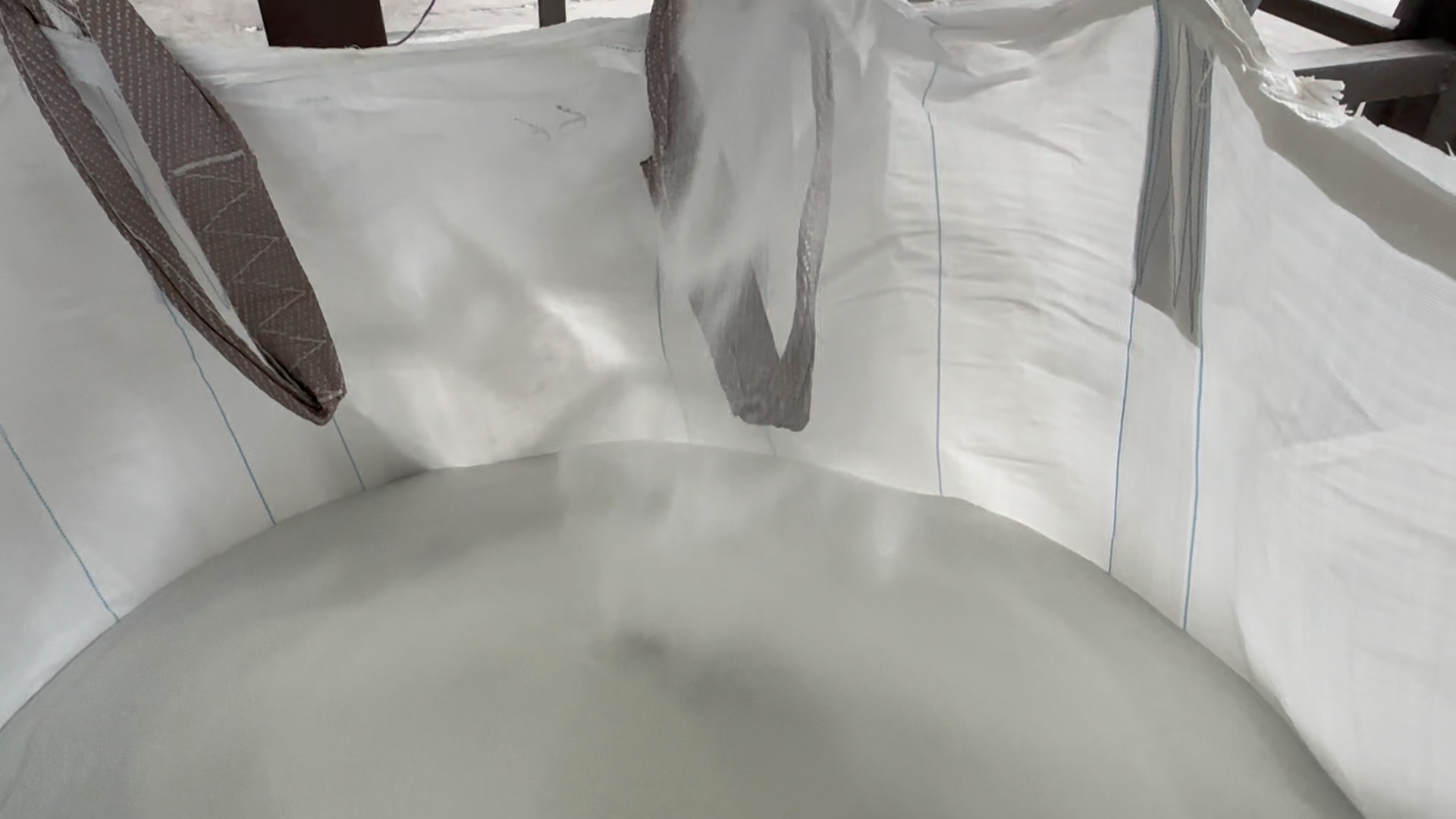
LangFang Dylan Technology Co., Ltd., which trades as Dylantech, is a glass bead manufacturer founded in 2004 and based in LangFang, China. The company produces road marking and industrial glass beads through four production bases in Liaoning, Shanxi, Hebei and Henan provinces, and its catalogue is organised around precisely the designations that generate confusion in tenders: AASHTO M247 Type 1 through Type 4, EN 1423 and EN 1424, BS 6088A and BS 6088B, AS/NZS Type B, C and D, and the Type IA/IB/IIA/IIB/IIC family.
This article builds a buyer-side comparison framework for those designations. It maps each type to its particle size window, separates optical criteria from gradation criteria, states where the framework stops being reliable, and closes with the purchasing terms and acceptance criteria that should be confirmed before a purchase order is issued.
Why the same bead can be 'wrong' on two projects
A bead designation on its own is not a specification. It is one coordinate in a three-part system, and all three coordinates have to agree before a grade can be quoted confidently.
- Layer 1 — Application mode. Drop-on, pre-mixed or interlayer application determines which standard family governs the product.
- Layer 2 — Standard family and jurisdiction. AASHTO M 247 in the United States; EN 1423 and EN 1424 in Europe and in markets that adopt the European framework; BS 6088; AS/NZS in Australia and New Zealand; plus national and state overlays.
- Layer 3 — Designation type and particle size window. Type 1, Type 2, Type C, Type D and similar labels each resolve to a specific sieved size range.
Two enquiries can both say “glass beads to standard” and still describe products that cannot be swapped, because they diverge at layer 1 or layer 3. The practical rule for procurement teams is to write all three layers into the enquiry: application mode, governing standard, and the numerical size window.
Layer 1: application mode is decided before the bead is
The first filter is not size but how the beads reach the road surface. EN 1423 specifies the requirements applicable to glass beads, anti-skid aggregates and the mixture of the two that are applied as drop-on materials on road marking products. EN 1424 addresses pre-mixed beads instead. Official road marking guidance in Hong Kong applies the same split: drop-on glass beads are required to comply with BS EN 1423 and pre-mixed glass beads with BS EN 1424, with the refractive index of the beads required to conform to at least Class A (n ≥ 1.5).
For buyers this produces a screening question that should be answered before any size discussion. If beads are broadcast onto the wet marking, the drop-on family applies. If they are blended into the marking material before application, the pre-mix family applies. A supplier can hold stock in both families, but an individual grade is normally qualified for one application mode. Asking about size before settling the application mode is the most common source of mismatch in tender evaluations.
Layer 2: the designation families you will actually be asked to quote
AASHTO M 247 — United States
AASHTO M 247 is the US standard for glass beads used in pavement markings. The current AASHTO M 247-26 edition carries a revised set of gradations running from Type 0 to Type 5 and became effective on 1 July 2026. Dylantech's AASHTO M247 range covers Type 1 through Type 4, which means a project calling for a type outside that set requires a custom size request rather than a catalogue substitution.
EN 1423 and EN 1424 — Europe and adopting markets
EN 1423 governs drop-on materials; EN 1424 governs beads used pre-mixed into the marking product. Both are frequently referenced in tenders well outside Europe wherever the European specification has been adopted into local road authority practice.
BS 6088A and BS 6088B
The BS 6088 designation is quoted as two gradations. In the Dylantech range, BS 6088A is listed with a 1180–425 μm window and BS 6088B with an 850–180 μm window.
AS/NZS Type B, Type C and Type D
The Australia and New Zealand family is quoted by letter: Type B (850–75 μm), Type C (1300–425 μm) and Type D (1700–710 μm).
Type IA, IB, IIA, IIB and IIC
This family is supplied by size window — IA (850–75 μm), IB (300–63 μm), IIA (1000–180 μm), IIB (600–75 μm) and IIC (1000–300 μm). Because similar type designations appear in more than one specification context, buyers should confirm in writing which standard governs the designation on their project before the order is placed.
National and state overlays
Some markets add a further specification layer. China's national standard for glass beads for road markings is GB/T 24722-2020, published on 14 December 2020 and effective from 1 July 2021. The Texas Department of Transportation requires road marking beads to conform to DMS-8290 and specifies three bead gradations tested using Tex-831-B. In both cases the local requirement is the one that must be satisfied at acceptance, even when the product also meets an international standard.
Layer 3: particle size windows side by side
Once the application mode and the governing standard are fixed, the comparison reduces to numbers. The table below lists the size windows attached to the designations in the Dylantech catalogue.
| Designation as listed | Standard family | Particle size window |
|---|---|---|
| AASHTO M247 Type 1 | AASHTO M247 | 1180–150 μm |
| AASHTO M247 Type 2 | AASHTO M247 | 1180–180 μm |
| AASHTO M247 Type 3 | AASHTO M247 | 1700–710 μm |
| AASHTO M247 Type 4 | AASHTO M247 | 2000–850 μm |
| EN 1423 | EN 1423 | 850–180 μm |
| EN 1423 | EN 1423 | 710–125 μm |
| EN 1424 | EN 1424 | 1400–355 μm |
| BS6088A | BS 6088 | 1180–425 μm |
| BS6088B | BS 6088 | 850–180 μm |
| AS/NZS Type B | AS/NZS | 850–75 μm |
| AS/NZS Type C | AS/NZS | 1300–425 μm |
| AS/NZS Type D | AS/NZS | 1700–710 μm |
| Type IA | Type I/II family | 850–75 μm |
| Type IB | Type I/II family | 300–63 μm |
| Type IIA | Type I/II family | 1000–180 μm |
| Type IIB | Type I/II family | 600–75 μm |
| Type IIC | Type I/II family | 1000–300 μm |
| RI 1.6 | Optical variant | 1000–180 μm |
| RI 1.7 | Optical variant | 1180–180 μm |
Three observations matter more than the individual rows.
Windows overlap across standards. AASHTO M247 Type 3 and AS/NZS Type D are listed with the same 1700–710 μm window. AS/NZS Type B, BS6088B and one EN 1423 listing share an 850–180 μm range, while AS/NZS Type B extends further to 75 μm at the fine end. Overlap means dual qualification is realistic — one production grade can satisfy two or three designations — but it does not make two designations interchangeable, because the acceptance test method and the exact cut points can still differ.
Neighbouring types usually differ at one end only. AASHTO M247 Type 1 (1180–150 μm) and Type 2 (1180–180 μm) share a coarse screen; only the fine cut moves. Type 3 and Type 4 shift both ends upward. That is why a clause written as “Type 1 or equivalent” is risky: equivalence has to be argued at the sieve, not at the type label.
The finest grades are not road marking grades. Type IB (300–63 μm) sits well below the rest of the table. Narrow or very fine windows belong to specific application and processing contexts and should not be substituted into a road marking specification. Additional grades in the range include OPSS1750 (850–150 μm) and GB05 (800–80 μm). The catalogue's overall listed size span is 0.5 mm–20 mm.
The optical layer: what RI 1.6 and RI 1.7 change
Gradation controls where a bead sits in the coating; refractive index controls how much light returns to the driver. Two optical variants sit alongside the standard grades in this range: GLASS BEADS RI 1.6 (1000–180 μm) and GLASS BEADS RI 1.7 (1180–180 μm).
Market context frames the choice. Cognitive Market Research values the global road marking glass beads market at USD 1.18 billion in 2025 across a forecast period running to 2033, and reports that beads with a 1.5 refractive index — the conventional grade written into most road marking specifications — accounted for 54.0% of global market value in 2026. Higher-index material is the smaller, more specialised part of the market: Potters Industries, for example, lists standard 1.5 and high-reflective 1.9 refractive index variants.
For a buyer, the decision rule is not that higher is automatically better. It runs in three steps:
- Confirm the minimum class in the project specification. The Hong Kong sample specification, for instance, sets a floor of Class A (n ≥ 1.5).
- Move to a higher refractive index where the marking is expected to hold up in wet-night conditions, since higher-index beads generally return more light under those conditions.
- Check which size window the optical grade is available in. RI 1.6 is listed at 1000–180 μm and RI 1.7 at 1180–180 μm, which are narrower selections than the full standard range — so an RI upgrade can also change which gradations a project can use.
Surface finish and colour: the two fields buyers forget to specify
Two fields sit outside the gradation and optical layers but appear on every technical data sheet for this range: surface finish and colour.
Surface finish is listed as smooth or matte. Finish affects handling, interaction with the binder and compatibility with coating systems, and it should be stated explicitly whenever a supplier is expected to match a product that has already been qualified on site.
Colour is listed as transparent, opaque or mixed colour. Transparent beads are the default for retroreflective road marking; opaque and mixed colour options serve decorative and specification-driven applications where appearance matters alongside optical behaviour. The catalogue states that custom colour and size are available on request, which is the practical route for a project whose designation is not covered by a standard catalogue grade.
Recycled glass is the recorded base material for the designated road marking grades in this range — the AASHTO M247, EN 1423/1424, BS 6088, AS/NZS and Type I/II models. That matters for tenders carrying recycled-content or sustainability criteria, where a supplier has to be able to state the base material of the grade being offered rather than the material used somewhere in the plant.
A six-step sequence for turning a specification into an order
- Confirm the governing standard and jurisdiction. Use the standard named in the tender or national specification, not the one the commercial team knows best.
- Confirm the application mode. Drop-on and pre-mix sit under different standard families, with EN 1423 and EN 1424 as the clearest example.
- Convert the designated type into its numerical size window and write both cut points into the enquiry. Type labels alone are ambiguous across standards.
- Check overlap against the approved product list. If a grade already approved under one standard falls inside the new window, dual qualification may avoid a second qualification cycle.
- Confirm the optical requirement — the minimum refractive index class, and whether the required size window exists in that optical grade.
- Fix finish, colour, packaging and branding, then lock acceptance testing, delivery terms and payment terms into the order.
How the Dylantech range maps to this framework
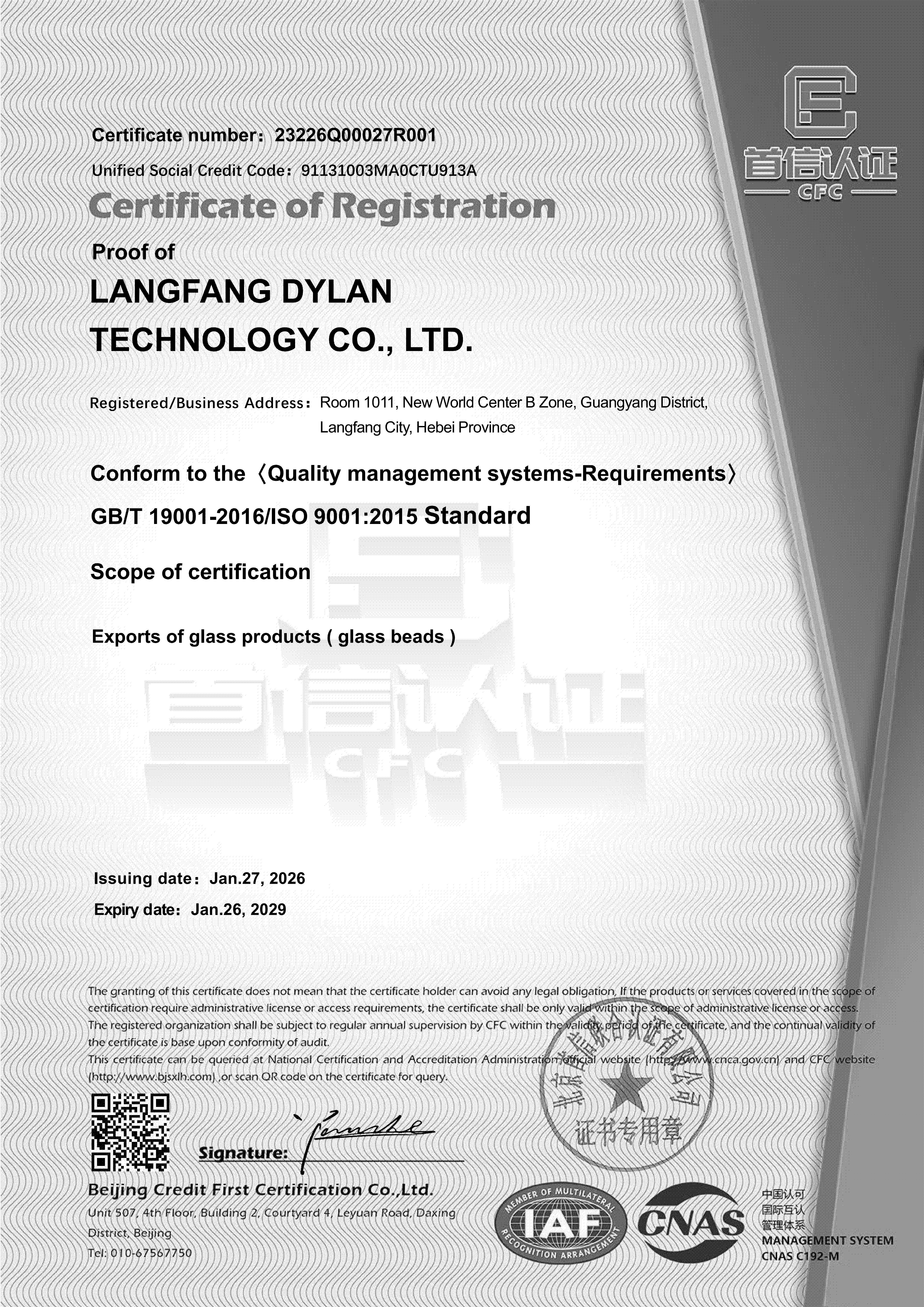
LangFang Dylan Technology Co., Ltd. (Dylantech) is a Chinese glass bead manufacturer founded in 2004, with a stated annual output of 100,000 tons, more than 15 production lines and four production bases in Liaoning, Shanxi, Hebei and Henan provinces. Its laboratory is equipped with instruments including CAMSIZER and X-2600 for particle size, reflectivity and wear testing. The company holds ISO 9001 certification — certificate 23226Q00027R001, issued by CFC against GB/T 19001-2016 / ISO 9001:2015, valid from 27 June 2026 to 26 June 2029, with a scope covering exports of glass products (glass beads) — and its company profile also records CE, JIS and KIS certifications. Export accounts for 95% of output, with main markets in the EU, the USA, Southeast Asia and the Middle East.
For a comparison framework, the relevant capability facts are the ones that touch ordering decisions: OEM production services are offered; monthly capacity is recorded at 10,000 tons; lead time is 45–60 days; minimum order quantity is 1 ton; quality control is described as 100% testing; after-sales support is delivered remotely. Partners listed in the company profile include road safety companies such as ENNIS, Geveko and Swarco, alongside local construction firms and road safety product manufacturers. Further product detail is published at dylantech.com.
Field evidence from the same range maps back onto three of the designations in the table above. An EN 1423 grade was supplied in a 72-ton road marking project running three years, with stable performance and low wear. An RI 1.7 grade was supplied in a 198-ton project, also stable over three years with low wear. A BS 6088A grade was supplied in a 108-ton project with the same three-year stability and low-wear result. In each case the customer type is a road marking engineering company or traffic safety manufacturer, and the application is increasing the retroreflective performance of road markings. These are supplier-side project records rather than independent third-party test reports, which is how they should be weighted in an evaluation.

Where the framework stops
- It does not replace the official standard text. Published descriptions of EN 1423 and EN 1424 are often republished summaries rather than the full standard. Buyers writing compliance clauses should obtain the official text and the applicable national adoption.
- Overlapping windows are not equivalence. The same numerical window under two standards can still be tested and accepted differently.
- The current AASHTO edition is broader than the catalogue. AASHTO M 247-26 lists Type 0 through Type 5; the range described here covers Type 1 to Type 4, so a Type 0 or Type 5 requirement needs a custom size request rather than a catalogue match.
- Type IA/IB/IIA/IIB/IIC designations are supplied by window. Confirm the governing standard for those designations in your jurisdiction before ordering.
- Local specifications can be stricter than the base standard. Texas DMS-8290, with three gradations tested using Tex-831-B, sits on top of the national framework.
- Longevity figures in this article are supplier records. Three-year stability and low wear are reported by the supplier, not by an independent laboratory.
Purchasing terms and acceptance criteria to fix before the PO
Dylantech's recorded commercial terms are: minimum order quantity 1 ton; delivery terms FOB, CIF, DDP or EXW; acceptance criteria based on pre-shipment test. Payment terms are quoted as alternatives rather than a single standard — TT 100% against BL copy; TT 30% in advance with 70% against copy B/L; L/C 90 days after BL date; TT 100% 30 days from BL date; TT 100% after receipt of the cargo; and T/T 100% 90 days after BL date.
Before the order is placed, a buyer should have all of the following in writing:
- The designation and the numerical size window, stated as both cut points.
- The governing standard and jurisdiction that acceptance will be measured against.
- The refractive index class required.
- Surface finish and colour.
- The test method, and whether pre-shipment test results accompany each batch.
- Packaging and OEM branding requirements, since OEM production services are offered.
- Lead time and capacity planning — 45–60 days against a monthly capacity of 10,000 tons.
What is changing into 2027
Three movements are visible in the data. The market itself remains substantial: USD 1.18 billion in 2025, with the forecast period running to 2033. Within it, the conventional 1.5 refractive index grade still carried 54.0% of market value in 2026, so high-index material remains the differentiating minority rather than the default. Meanwhile the standards are fragmenting at the type level: AASHTO M 247-26, effective 1 July 2026, describes gradations from Type 0 to Type 5, and state-level specifications such as Texas DMS-8290 add their own gradation sets on top.
The likely consequence for procurement is that the standard name stops being sufficient as a specification shorthand. Where three standards each expand their type lists, the numerical size window becomes the common language between AASHTO, EN and AS/NZS quotations — and the supplier who can state type, window, refractive index and test method on one line is easier to qualify than the one who states a standard name and leaves the rest to the buyer. Sustainability requirements are moving in the same direction: recycled glass is the recorded base material for the designated road marking grades in this range, and Dylantech's waste heat recovery system has been recognised as a scientific and technological achievement by the China Energy Conservation Association, which suggests recycled-content and energy questions will migrate from marketing material into tender documents.
FAQ
How do I decide between EN 1423 and EN 1424 glass beads?
By application mode. EN 1423 specifies the requirements applicable to glass beads, anti-skid aggregates and the mixture of the two applied as drop-on materials on road markings. EN 1424 applies to pre-mixed beads. Official road marking guidance in Hong Kong, for example, requires drop-on beads to comply with BS EN 1423 and pre-mixed beads with BS EN 1424, with the refractive index of the beads at least Class A (n ≥ 1.5).
Are AASHTO M247 Type 2 and EN 1423 the same bead?
No. Their listed windows overlap but are not identical. AASHTO M247 Type 2 is listed at 1180–180 μm, while EN 1423 grades are listed at 850–180 μm and 710–125 μm. The shared range is 850–180 μm, but the AASHTO type extends coarser and one EN 1423 listing extends finer. The numerical window and the acceptance test, not the label, determine whether one can substitute for the other.
Which refractive index should a project specify?
Start from the minimum class in the governing specification; the Hong Kong sample specification, for instance, sets Class A at n ≥ 1.5. Market data is a useful sanity check: beads with a 1.5 refractive index accounted for 54.0% of global market value in 2026, so that grade remains the volume standard. Where wet-night performance is the priority, higher-index options are available — the Dylantech range lists RI 1.6 (1000–180 μm) and RI 1.7 (1180–180 μm).
Can glass bead size and colour be customized?
Yes. The range is listed with a 0.5 mm–20 mm size span; colour options are transparent, opaque or mixed colour; surface finish is smooth or matte; and the catalogue states that custom colour and size are available on request. OEM production services are offered, with a minimum order quantity of 1 ton.
What are the standard purchasing terms and acceptance criteria?
The recorded terms are a minimum order quantity of 1 ton; delivery terms FOB, CIF, DDP or EXW; and acceptance criteria based on pre-shipment test. Payment terms are quoted as alternatives, including TT 100% against BL copy, TT 30% in advance with 70% against copy B/L, L/C 90 days after BL date, TT 100% 30 days from BL date, TT 100% after receipt of the cargo, and T/T 100% 90 days after BL date.
How long should delivery be planned for?
The recorded lead time is 45–60 days, against a monthly capacity of 10,000 tons and a stated annual output of 100,000 tons across four production bases in Liaoning, Shanxi, Hebei and Henan provinces.
Do state specifications add requirements beyond the national standard?
Yes. The Texas Department of Transportation requires road marking beads to conform to DMS-8290 and specifies three bead gradations tested using Tex-831-B. Where a state or national overlay exists, that requirement governs acceptance even if the product also meets an international standard.