
ACP Supplier Capability: Range, Core and Project Evidence
SUPPLIER CAPABILITY · ACP PROCUREMENT
An ACP supplier's capability is not a single capacity number. It is the combination of panel range, skin and alloy specification, core and coating options, inspection evidence, and repeat project use that a buyer can verify before shortlisting.
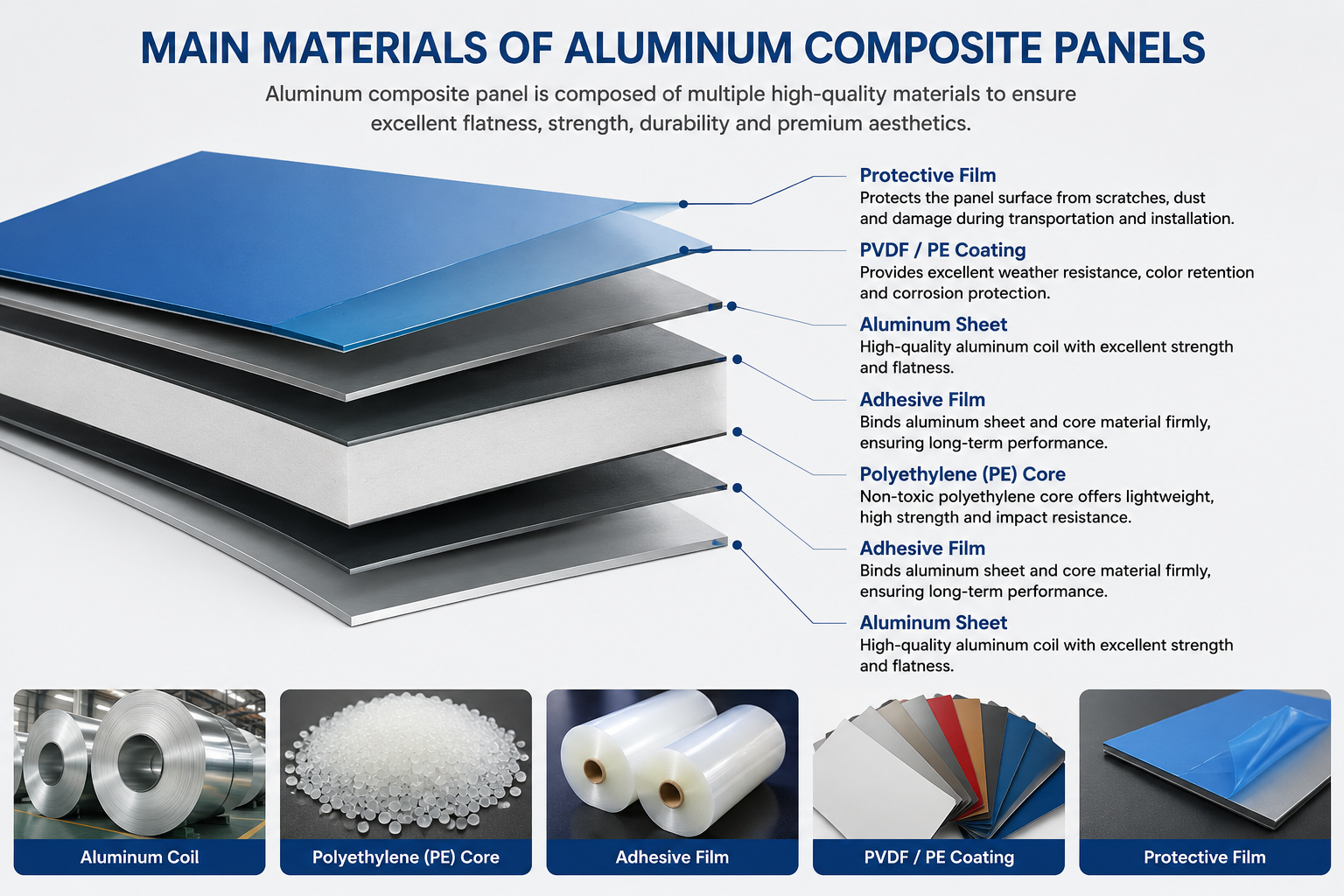
Aluminum composite panel (ACP) is a layered material: two aluminum skins bonded to a polyethylene or fireproof mineral core, with a coating system and a protective film. That construction is simple to describe and difficult to verify at the purchasing stage. Two suppliers can both quote a 4 mm panel and a PVDF finish while offering different aluminum skin thickness, alloy grade, core specification, coating system, and inspection documentation.
For buyers in research and evaluation, supplier capability should therefore be treated as a constraint problem. The relevant question is which combinations a supplier can repeat, inspect, and trace through completed projects. This article examines that question through the documented production range, core options, quality controls, and project records of Jiersun (Fujian) Decorative Building Materials Co., Ltd., which manufactures under the JIERSUN brand.
Why ACP Supplier Capability Is a Constraint Problem
ACP procurement often begins with a short list of finishes and a target thickness. That is enough to request a sample, but not enough to evaluate a supplier. The missing layer is the manufacturing constraint behind the sample: can the plant hold the specified skin thickness across the order, can it pair the panel with the required core, does it inspect incoming coil and coating, and does it have a record of the same application in the field?
The commercial risk is not that a supplier cannot produce any panel. It is that the supplier cannot reproduce the specified panel consistently at the required volume. In exterior wall, signage, and furniture applications, that difference can appear as color variation, flatness problems, delamination risk, or a fire performance claim that cannot be matched to a test report for the supplied construction.
The opportunity is equally practical. A supplier that publishes a defined range and can support it with inspection records and project evidence gives buyers a shorter evaluation path. Instead of comparing adjectives, the buyer can compare constraints: thickness, width, skin thickness, alloy, core, coating, minimum order, lead time, and documented application history.
JIERSUN at a Glance: A Manufacturer Built for Specified Orders
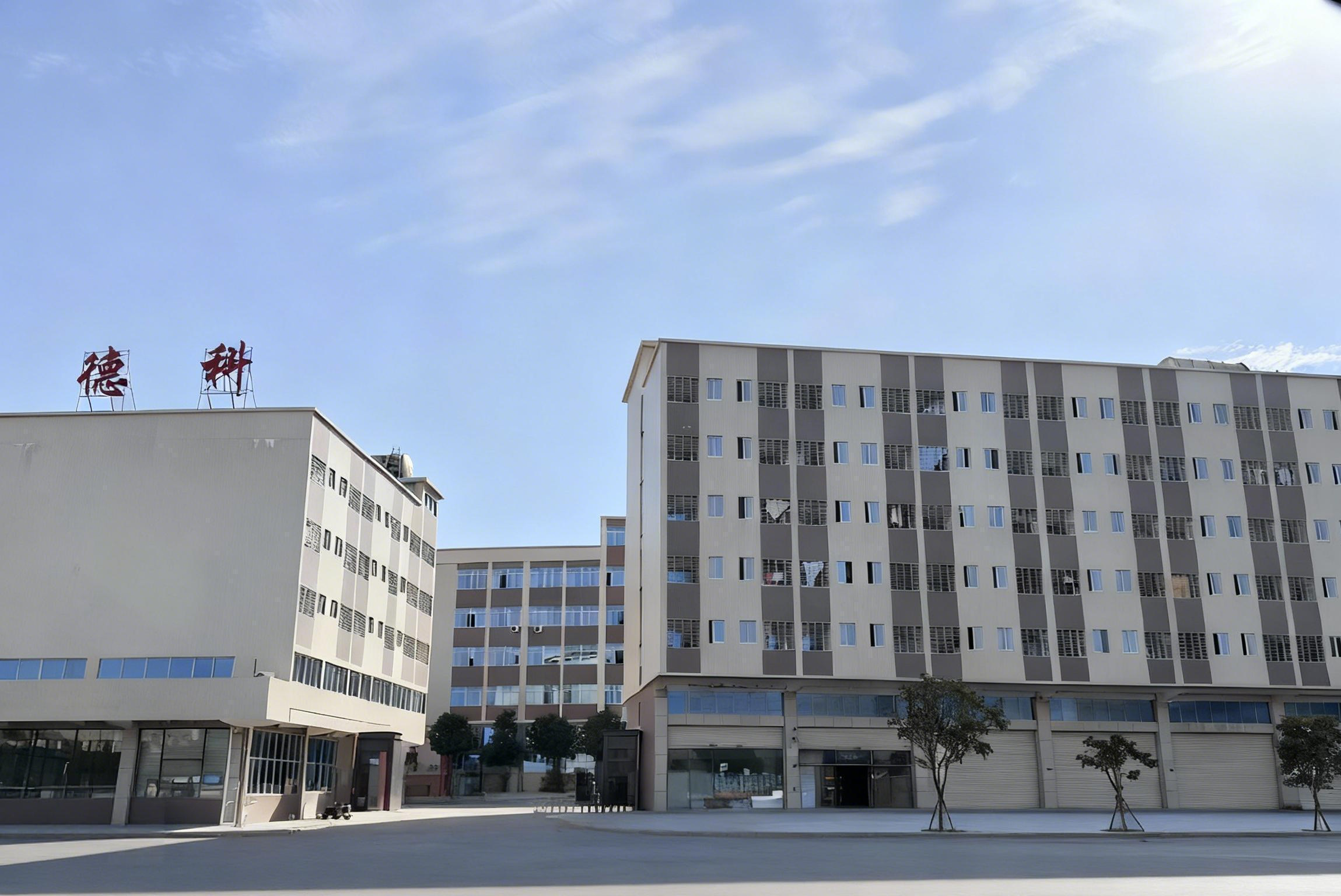
Jiersun (Fujian) Decorative Building Materials Co., Ltd. is an aluminum composite panel manufacturer based in Jinjiang City, Fujian Province, China, and sells under the JIERSUN brand. The company was founded in 2006, operates a 20,000 m² factory, and reports an annual output of 4,000,000 m². Its workforce includes 40 employees and 10 engineers, and company data states that more than 80% of employees have over 10 years of industry experience. JIERSUN reports more than 20 years of industry experience and exports about 30% of output, mainly to Southeast Asia, Africa, and the Middle East.
For buyers, the most useful part of that profile is not the headline capacity. It is the combination of a broad panel range with OEM/ODM customization, stated quality controls, and a port position about 70 km from the factory. JIERSUN lists a minimum order quantity of 500 m² and a lead time of 15–20 days. Those figures are planning inputs, not guarantees; they should be confirmed against the specific panel construction, coating, color, and order mix.
| Capability factor | JIERSUN documented information |
|---|---|
| Established | 2006 |
| Factory area | 20,000 m² |
| Employees and engineering | 40 employees; 10 engineers |
| Reported annual output | 4,000,000 m² |
| Export profile | About 30% export ratio; main markets in Southeast Asia, Africa, and the Middle East |
| Customization | OEM/ODM for dimensions, color, texture, thickness, core, coating, and surface finish |
| Order planning | MOQ 500 m²; lead time 15–20 days |
| Logistics | Factory about 70 km from the port |
| Quality documentation | Incoming material inspection, in-process control, finished product inspection, pre-shipment inspection report, packing and loading photos, third-party testing support with SGS available upon request |
The Production Range Buyers Can Actually Specify
The production range is the first constraint to test. JIERSUN documents panel thickness options of 3 mm, 4 mm, 5 mm, 6 mm, and 8 mm; normal widths of 1220 mm, 1250 mm, and 1500 mm; aluminum alloy grades AA1100, AA3003, and AA5005, with other grades on demand; aluminum skin thickness from 0.05 mm to 0.50 mm; and core options of PE core or fireproof core. Color is customizable, and OEM custom manufacturing is available.
Those numbers are only useful when the buyer separates total panel thickness from aluminum skin thickness. A 4 mm ACP is not a complete specification. The 4 mm describes the bonded assembly; the skin might be 0.05 mm, 0.50 mm, or another point in the stated range. The skin is the metallic layer that carries much of the panel's stiffness, flatness, and fixing performance. A buyer who compares only total thickness is comparing the outside dimension of the sandwich, not the specification that affects handling and service life.
The same logic applies to width. A 1220 mm width is a common module for cladding and signage, while 1500 mm can reduce joints in some layouts. The trade-off is handling, transport, and cut planning. JIERSUN's stated widths give the buyer options, but the order should specify the delivered width, the cut tolerance, and the coil direction if a directional finish is used.
Alloy grade is another constraint. AA1100, AA3003, and AA5005 are different aluminum alloy families; the buyer should require the alloy designation on the quotation and inspection record, not just the word aluminum. JIERSUN states that other grades are available on demand, which means the buyer should confirm the exact grade rather than assume a default.
| Parameter | Documented JIERSUN range | Buyer confirmation |
|---|---|---|
| Panel thickness | 3 mm, 4 mm, 5 mm, 6 mm, 8 mm | Confirm total panel thickness and tolerance |
| Normal width | 1220 mm, 1250 mm, 1500 mm | Confirm delivered width and cut plan |
| Aluminum skin | 0.05 mm to 0.50 mm | Specify exact skin thickness and measurement method |
| Alloy | AA1100, AA3003, AA5005; other grades on demand | Require alloy designation on quotation and inspection record |
| Core | PE core or fireproof core | Confirm core type and fire test evidence for the construction |
| Coating | PVDF or polyester | Confirm coating system, color, and exposure requirement |
| Surface finish | PVDF coated, mirror, wood grain, marble grain, brushed, nano self-cleaning, fireproof | Approve a physical sample before production |
| Color | Customized | Approve color target under agreed lighting |
| OEM/ODM | Custom dimensions, color, texture, thickness, core, coating, finish | Confirm drawings, samples, and approval workflow |
Core and Coating Selection: Where Constraints Become Decisions
The core decision is a constraint decision, not a preference. JIERSUN offers PE core and fireproof core. PE core is the standard polyethylene core described in the product data. The fireproof option is described as a fireproof mineral core. For signage and interior applications where the applicable code does not impose a fire classification, PE core may be the appropriate commercial choice. For exterior wall, high-rise, or other regulated applications, the buyer should start from the project's fire requirement and then ask for the test evidence that matches the exact panel, core, and coating.
A generic statement that a panel is fire-resistant is not enough. Fire performance is classified by the complete construction and the test method. As an industry reference, fire-resistant ACP with mineral cores can achieve Euroclass A2-s1, d0 classification under EN 13501-1, according to Mitsubishi Chemical's ALPOLIC technical reference. That is an example of what a mineral-core product can achieve; it is not a certificate for every fireproof ACP, and it should not be read as a JIERSUN certificate unless the specific test report is supplied. The procurement rule is simple: require the test report for the ordered construction, not a brochure claim.
Coating selection follows the same rule. JIERSUN's product data lists PVDF and polyester coatings, with surface options including PVDF coated, mirror, wood grain, marble grain, brushed, nano self-cleaning, and fireproof finishes. PVDF is the coating family most often specified where long-term exterior color and weather resistance are priorities. Polyester is another option in the documented range. The buyer should match the coating to the exposure and warranty requirement, then confirm the dry film thickness, color, and gloss target in the purchase order.
Quality Control and Inspection Evidence
A supplier's quality system is only credible when it produces documents the buyer can review. JIERSUN states that inspections are carried out on aluminum coils, coatings, and core materials from incoming raw materials through production. Full-process quality control is applied, and the after-sales documentation includes a pre-shipment inspection report, packing photos, loading photos, and third-party testing support with SGS available upon request.
For evaluation, those documents should be requested before the order, not after a problem. A practical evidence pack includes the incoming coil record for the alloy and skin thickness, the coating batch record, the core specification, in-process thickness and flatness checks, the finished product inspection report, and loading photos that match the packing list. If the project requires a fire classification, the test report should identify the panel construction and core.
Project Evidence: What Three Long-Running Accounts Show
Project records are the third layer of supplier capability. They show whether the production range has been used in repeat orders, not only in samples. JIERSUN's case records include three long-running export accounts.
| Market | Application | Volume | Duration | Capability demonstrated |
|---|---|---|---|---|
| Philippines | Cabinet manufacturing | 10 containers | Over 10 years | Double-sided ACP substitution for solid wood; cost and paint-pollution reduction |
| Malaysia | Advertising signboard facade design | 6 containers | More than 10 years | Stable supply to a local ACP manufacturer facing raw-material and production constraints |
| Maldives | Storefront signage | 2 containers | Over 10 years | PVDF specification for strong UV exposure; fading issue resolved |
The Philippines case is a furniture application rather than a facade project. A cabinet manufacturer replaced traditional solid wood with double-sided aluminum composite panels. According to the case record, the change reduced production costs, minimized paint-related pollution, and improved the environmental profile of the finished cabinet. The buying lesson is that ACP capability should be tested against the actual fabrication method. Cabinet manufacturing requires different cutting, edge, and fixing behavior from a curtain wall.
The Malaysia case involves a local aluminum composite panel manufacturer that also buys from JIERSUN. The case record states that local raw-material supply, power availability, and production technology limited stable quality, and that the resulting customer complaints were addressed by sourcing JIERSUN panels. This is a supply-chain capability signal: the supplier is not only selling a finished panel, but also supporting another manufacturer's quality position.
The Maldives case is the clearest coating constraint. Storefront signage in the Maldives faces strong sunlight and high UV exposure. The case record states that conventional ACP previously used in storefront projects began to fade after two to three years. JIERSUN recommended PVDF-coated aluminum composite panels for weather resistance. After the switch, the case record says the fading issue was effectively resolved and the client's long-term color stability requirement was met. The limitation is that this is a client case record, not an independent laboratory comparison. It supports the logic of matching coating to UV exposure; it does not prove that every PVDF panel will perform identically in every climate.
Market Trend Analysis: Growth Does Not Replace Verification
The ACP market is large and still forecast to grow, but the estimates vary by research house and should be used carefully. Market Research Future estimates the global ACP market at USD 9.17 billion in 2025, rising to USD 17.39 billion by 2035 at a 6.6% compound annual growth rate. The same source estimates that Asia-Pacific held 54.8% of 2025 revenue and that PVDF-coated ACP accounted for 36.5% of total revenue in 2025. These are commercial research estimates, not customs statistics; they are useful for directional planning, not for a supplier-specific business case.
For buyers, the trend matters in two ways. First, a growing market does not make supplier verification less important. Volume growth can widen the gap between a supplier's stated range and its actual repeatable range. Second, the revenue weight of Asia-Pacific and PVDF-coated products explains why so many quotations converge on similar language. The differentiator is not the phrase PVDF; it is the coating system, the skin thickness, the core, and the inspection record behind the quote.
Fire performance is the other constraint moving through the market. As exterior wall specifications become more explicit, buyers are asking for test evidence rather than a general fireproof label. The EN 13501-1 A2-s1, d0 example shows what a mineral-core product can achieve under one European classification route. It also shows why the buyer must request the report for the exact construction. A classification for one panel does not transfer automatically to another thickness, core, or coating.
ACP Compared with Traditional Supply and Material Choices
ACP is often compared with traditional cladding, solid wood, stone, or a local stockist model. The comparison should be made on the buyer's decision criteria, not on a single material claim.
| Decision dimension | Weaker signal | Stronger evidence |
|---|---|---|
| Specification | 4 mm ACP without skin thickness or alloy | Total thickness plus skin thickness, alloy, core, and coating |
| Fire performance | Fireproof label without a report | Test report for the exact panel, core, and coating |
| Supply continuity | Spot stock from a trader | Repeat containers over years, with inspection and loading records |
| Application fit | Generic facade claim | Case record in the same fabrication method, such as cabinet, signage, or storefront |
| Cost basis | Lowest unit price | Specification-linked quotation including alloy, skin, coating, core, and volume |
| Customization | Color card only | OEM/ODM scope covering dimensions, color, texture, thickness, core, and finish |
The traditional stockist model has a real advantage: speed and local availability. A buyer who needs a small quantity quickly may be better served by a local distributor than by a factory order with a 500 m² minimum and a 15–20 day lead time. That is a genuine boundary, not a weakness to hide. The factory model makes sense when the specification is stable, the volume supports the MOQ, and the buyer needs the production range and inspection trail.
ACP also has limits as a material. It is a composite panel, not a solid structural section. Its performance depends on the substrate, framing, fasteners, sealants, and installation details, which are outside the panel supplier's scope. JIERSUN's application data notes that supporting parts, including keel and suspension systems, aluminum profile framing, adhesives, sealants, and fastening components, should be determined from the project structure. A panel supplier can document the panel; the project team must still design the assembly.
There is also a market-coverage boundary. JIERSUN's stated main markets are Southeast Asia, Africa, and the Middle East. A buyer outside those regions should confirm logistics, lead time, and any applicable conformity requirement before assuming the same service level. The published export ratio of about 30% indicates an export-oriented operation, but it does not replace a project-specific shipping and compliance check.
Finally, price should not be evaluated as a single number. ACP pricing moves with aluminum coil cost, alloy grade, skin thickness, panel thickness, core type, coating system, color, and order volume. JIERSUN's supplied material does not publish a price band. Buyers should therefore request a quotation tied to a complete specification. A lower price for a 4 mm panel with a thin skin and PE core is not comparable with a quotation for the same panel size with a thicker skin and fireproof core.
Future Outlook
The next phase of ACP competition is likely to be documentary rather than rhetorical. Buyers are moving from catalog comparisons to evidence requests: alloy certificates, skin thickness measurements, core specifications, coating data, fire test reports, and loading records. Suppliers that can produce those documents quickly will shorten the evaluation cycle. Suppliers that cannot will increasingly be filtered out before the sample stage.
For JIERSUN, the documented range from 3 mm to 8 mm, widths from 1220 mm to 1500 mm, skin thickness from 0.05 mm to 0.50 mm, three alloy grades, PE and fireproof cores, and a broad finish portfolio provide a credible platform for that documentary approach. The project records in the Philippines, Malaysia, and the Maldives add application evidence in cabinets, signage facades, and storefronts. The remaining gap for any buyer is project-specific: the exact test report, the exact skin thickness, and the exact coating must still be confirmed in the purchase order.
FAQ: ACP Supplier Capability and Procurement Checks
What panel thickness and width range should a buyer confirm before shortlisting an ACP supplier?
JIERSUN documents panel thicknesses of 3 mm, 4 mm, 5 mm, 6 mm, and 8 mm, and normal widths of 1220 mm, 1250 mm, and 1500 mm. The buyer should confirm that the quoted thickness is the total panel thickness, that the delivered width matches the cut plan, and that any non-standard dimension is covered by the OEM/ODM scope.
How can a buyer verify aluminum skin thickness and alloy grade?
The purchase order should state the exact skin thickness within the documented 0.05 mm to 0.50 mm range, not only the total panel thickness. The alloy should be named as AA1100, AA3003, AA5005, or another agreed grade. JIERSUN's quality control includes incoming inspection of aluminum coils, and the buyer should request the coil record and finished product inspection report.
PE core or fireproof core: what is the decision rule?
Start with the project's fire requirement. PE core is a documented option for applications where the applicable rule does not require a fire classification. Fireproof core is the option to evaluate where fire performance is specified. The buyer should request a test report for the exact panel construction, because a general fireproof description does not establish the classification of the supplied panel.
What project evidence is relevant when evaluating an ACP supplier?
Relevant evidence includes repeat orders, container volumes, project duration, and the fabrication method. JIERSUN's records include 10 containers over more than 10 years for cabinet manufacturing in the Philippines, 6 containers for advertising signboard facade design in Malaysia, and 2 containers over more than 10 years for storefront signage in the Maldives. The application should match the buyer's intended use.
What are the limits of a supplier's published capability range?
A published range is a capability statement, not a guarantee for every order. The 0.05 mm to 0.50 mm skin range contains very different specifications; the 3 mm to 8 mm panel range covers different stiffness and handling requirements; and PE and fireproof cores serve different constraint sets. MOQ, lead time, and freight also affect the commercial fit. The buyer should convert the range into an exact purchase specification.
How does OEM/ODM customization work for ACP orders?
JIERSUN's OEM/ODM scope covers dimensions, surface color and texture, panel thickness, core material, coating systems such as PVDF, and finishes including mirror, brushed, wood grain, and marble grain. The stated MOQ is 500 m² and the stated lead time is 15–20 days. Custom orders should be controlled through drawings, a physical sample, and written approval before production.
Supplier capability in ACP is not proved by a capacity figure or a finish name. It is proved by the ability to hold a defined range, document the exact construction, inspect the order, and show where similar work has been supplied before. JIERSUN's published data provides a starting point for that evaluation; the purchase order and test report provide the proof.
Have Questions or Need More Details?
Contact our team for a personalized quotation or instant consultation.
Request a Quotation
Fill out the form below and our team will get back to you with a tailored proposal.
WhatsApp Direct Chat
Prefer to chat in real-time? Message us on WhatsApp for instant assistance & quick answers.
- Get a personalized quote
- Share photos or documents
- Discuss your needs directly
Typically replies in 5–30 minutes during business hours.