
ACP Thickness by Scenario: Facades, Interiors & Signage
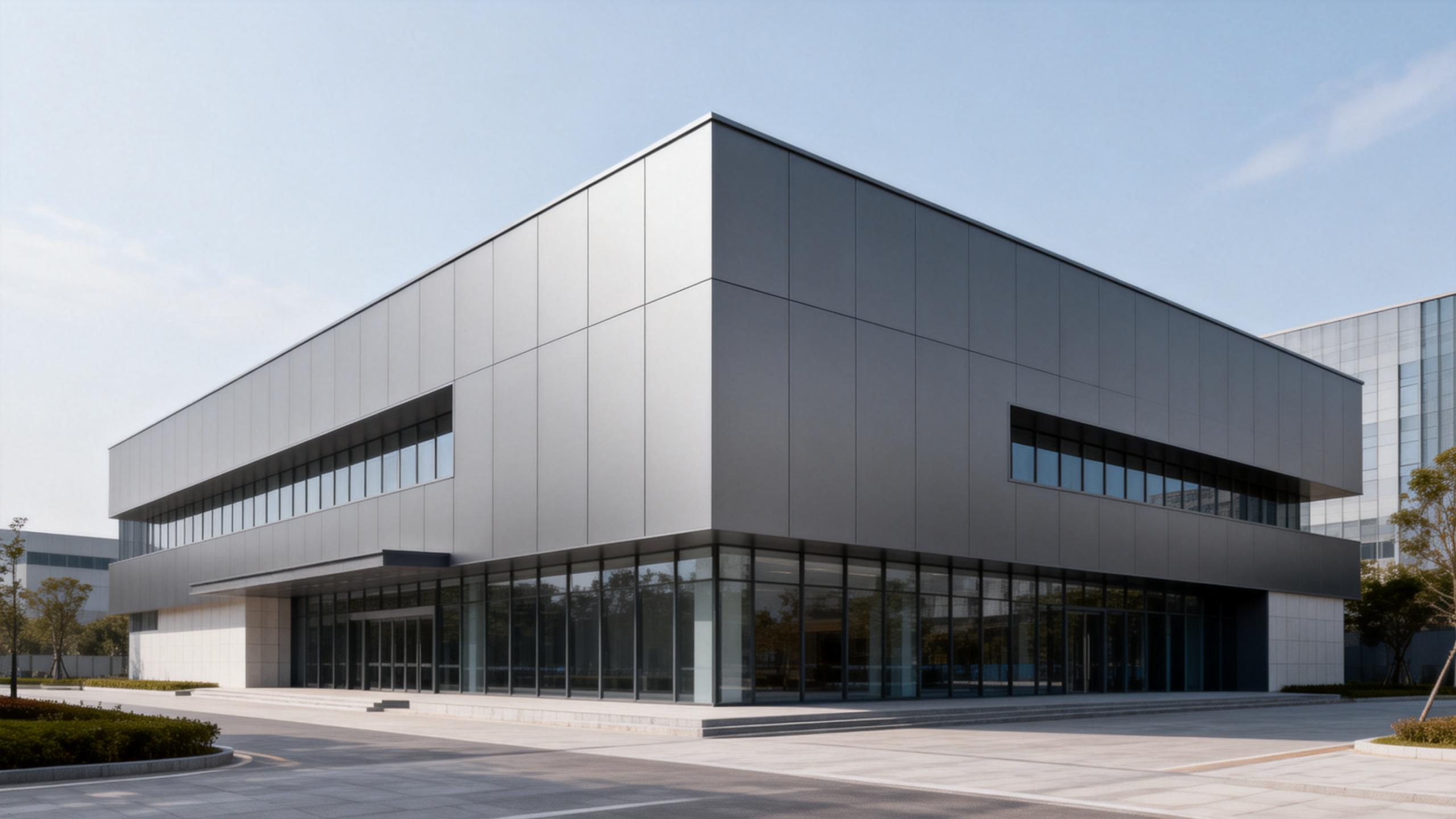
Aluminum composite panel (ACP) specification usually begins with a single number — panel thickness — yet the decision that determines whether a facade, an interior fit-out or a signage programme performs as intended is a scenario decision. A practical convention has formed around three common gauges: 3mm panels are generally aligned with building curtain walls and exterior wall decoration, 4mm panels with interior decoration, and 5mm panels with furniture factory applications and signage. This guide explains where that convention comes from, what it does not cover, and how documented long-service projects in the Philippines, Malaysia and the Maldives support it.
Why Thickness Alone Does Not Decide the Application
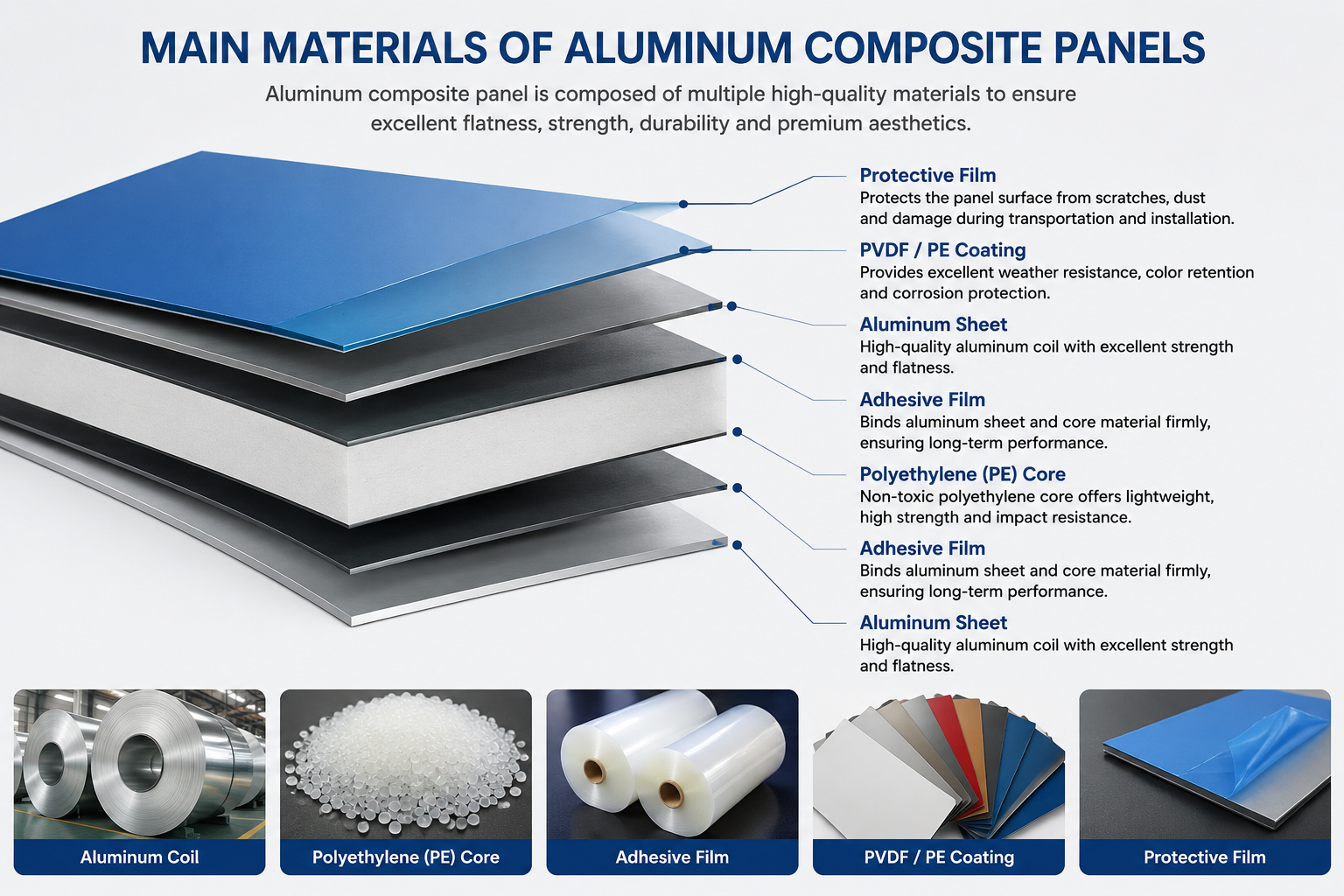
An aluminum composite panel is a layered product rather than a single sheet of metal. JIERSUN (Jiersun (Fujian) Decorative Building Materials Co., Ltd.), a manufacturer of aluminum composite panels based in Jinjiang City, Fujian Province, China, describes the structure as high-quality aluminum coils, a polyethylene (PE) or fire-resistant mineral core, high-performance adhesive films, and durable PVDF or polyester (PE) coatings, with a protective film applied to prevent scratches during transportation and installation.
That same construction is offered across the thickness range. The 3mm, 4mm and 5mm variants share the same published specification fields: normal widths of 1220mm, 1250mm and 1500mm; aluminum alloy grades AA1100, AA3003 and AA5005, with other grades available on demand; aluminum thickness from 0.05mm to 0.50mm; core options of PE core or fireproof core; and surface types including PVDF coated, mirror, wood grain, marble grain, brushed, nano self-cleaning and fireproof aluminum composite panels. Colors and OEM branding are accepted as custom work.
Because the material options overlap, thickness should not be read as a quality ranking. What changes with thickness is how the panel behaves in fabrication and in service: how much rigidity the sheet carries when it is cut, folded, routed or bonded; how flat it remains across a given support spacing; and how the installed assembly responds to the loads and exposures of a particular environment. Thickness is therefore best treated as a matching variable — a gauge selected for a scenario.
The Scenario-Matching Problem Buyers Face
Procurement teams usually receive a project brief that names an application rather than a gauge. The brief says “exterior cladding”, “ceiling and wall lining”, or “storefront signage”. Somewhere between that brief and the purchase order, someone has to convert an application into a thickness, a core type, a coating and a fixing method.
Two common errors appear at that point. The first is copying the thickness from a previous, unrelated project — a 3mm exterior specification reappearing on an interior ceiling, or the reverse. The second is assuming that a heavier panel automatically resolves a performance requirement that actually depends on the core or the coating. Neither error is visible in a quotation, and both tend to surface later, during installation or after the first seasons of service.
How ACP Thickness Maps to Facades, Interiors and Signage
The mapping below is a working convention used by specifiers and fabricators, not a formal grade classification. It reflects how the three gauges are most often applied in building curtain wall and exterior wall decoration, interior decoration, and furniture and signage work.
| Panel thickness | Primary scenario | Typical role in the assembly | What still has to be confirmed |
|---|---|---|---|
| 3mm | Building curtain wall & exterior wall decoration | Decorative and protective exterior skin carried by a curtain wall or external wall system | Wind and structural design of the supporting system; fire performance rating; weather and UV resistance grade |
| 4mm | Interior decoration | Interior wall cladding and ceiling panels in commercial, retail and project interiors | Core type required by interior fire rules; fixing or bonding method; substrate condition |
| 5mm | Furniture factory applications & signage | Cabinet and furniture panels; signboards, billboards and storefront signage faces | Fabrication and edge treatment; outdoor UV exposure if the sign faces weather; required rigidity over the sign support spacing |
3mm ACP for Curtain Walls and Exterior Wall Decoration
Exterior work is the scenario where the panel faces the widest set of simultaneous exposures: direct sunlight, ultraviolet radiation, rain, temperature cycling and, in some markets, high ambient humidity. The 3mm panel is the gauge most often aligned with building curtain wall and exterior wall decoration, where it functions as a decorative finish that also contributes to building protection.
Two specification decisions matter more than the thickness number in this scenario. The first is the coating. PVDF coating is the system associated with outdoor exposure where weather and UV resistance requirements apply, and a nano self-cleaning option is available for surfaces where dirt retention is a concern. The second is the core: PE core and fireproof core are distinct material options, and fire performance rating should be defined in the contract rather than assumed from the panel gauge.
The 3mm panel does not stand alone. Published application guidance for this scenario lists keel and suspension systems, aluminum profile framing systems, adhesives and sealants, and fastening components as supporting equipment, with the final supporting parts determined by the project structure. Installation is a passive, fixed operation intended for long-term service without continuous energy consumption; the maintenance cycle depends on the surface coating and the service environment.
4mm ACP for Interior Decoration
Interior decoration covers wall cladding, ceilings and feature surfaces in commercial and retail interiors, offices and project fit-outs. The 4mm panel is the gauge commonly aligned with this scenario. Interior panels are usually handled and installed in larger formats than exterior cassettes, and the additional body of a 4mm sheet supports a flatter installed appearance across interior framing.
Interior work is also where the finish range does most of its work. Wood grain, marble grain, brushed and mirror surfaces are all available across the same panel family, which means a single interior scheme can combine several visual treatments without changing the substrate, the fixing logic or the fabrication process. For designers, that consistency reduces the number of material interfaces they have to detail.
The decision that cannot be made by appearance is the core. Interior public spaces are frequently subject to fire requirements, and the specification should state whether a PE core or a fireproof core is required. This is a contract-level decision; it is not implied by choosing 4mm instead of 3mm.
5mm ACP for Furniture Manufacturing and Signage
The 5mm gauge is aligned with two scenarios that share a common trait: the panel is handled, machined and installed with less continuous backing than a wall lining. Furniture factory applications and signage both put the panel through cutting, routing and edge work, and both benefit from additional rigidity.
In furniture manufacturing, aluminum composite panels are used as a cabinet panel material. In a Philippine cabinet manufacturing project, a furniture manufacturer replaced traditional solid wood with double-sided aluminum composite panels after a material recommendation. According to the documented project record, the change reduced production costs, significantly minimized paint-related pollution, and strengthened the environmental position of the finished products in the Philippine market. The supply relationship has continued for more than ten years.
In signage, panels are used for signboards, billboards and storefront signage faces. A Malaysian distributor — itself a local aluminum composite panel manufacturer constrained by raw material supply, power availability and production technology — began sourcing panels for advertising signboard facade design. Per the documented record, the supplied panels helped the distributor meet the requirements of high-standard clients, reduce complaint rates and improve market competitiveness, across six containers and a relationship of more than ten years.

The JIERSUN Range Behind the Scenario Mapping
Jiersun (Fujian) Decorative Building Materials Co., Ltd. is a manufacturer of aluminum composite panels founded in 2006, operating a 20,000 m² facility in Jinjiang City, Fujian Province, China, with a research and development team of 10 engineers and an annual output of 4,000,000 m². The company reports an export ratio of 30%, with main markets in Southeast Asia, Africa and the Middle East, and a factory located 70 km from the port — a logistics position that supports its stated delivery times. More than 80% of employees have over 10 years of industry experience.
The product family covers the three scenario gauges directly:
- 3MM Aluminum Composite Panel — aligned with building curtain wall and exterior wall decoration.
- 4MM Aluminum Composite Panel — aligned with interior decoration.
- 5MM Aluminum Composite Panel — aligned with furniture factory applications and signage.
All three share the same option set: panel thicknesses of 3mm, 4mm, 5mm, 6mm and 8mm within the wider range; normal widths of 1220mm, 1250mm and 1500mm; aluminum alloy grades AA1100, AA3003 and AA5005; aluminum thickness from 0.05mm to 0.50mm; PE core or fireproof core; and PVDF coated, mirror, wood grain, marble grain, brushed, nano self-cleaning and fireproof surface types.
Customization is offered under an OEM/ODM model covering dimensions, surface color and texture options, panel thickness, core material type, coating systems such as PVDF, and surface finishes. The stated minimum order quantity is 500 m², with a lead time of 15–20 days. Quality control runs from incoming inspection of aluminum coils, coatings and core materials through full-process control to finished product inspection, and is supported by pre-shipment inspection reports, packing and loading photographs, and third-party testing on request. After-sales support covers product selection consultation, project specification recommendation, installation and fabrication guidance, and remote technical support with a 24-hour response commitment.
Technical Explanation: What Thickness Does and Does Not Decide
Three specification variables are frequently confused with one another, and separating them prevents most scenario mismatches.
Panel thickness versus aluminum skin thickness
Panel thickness is the overall dimension of the finished composite — 3mm, 4mm, 5mm, 6mm or 8mm. Aluminum thickness, by contrast, is the gauge of the individual aluminum skins, and it ranges from 0.05mm to 0.50mm as a configurable input. These are two different numbers. A thicker panel with a thin skin and a thinner panel with a heavier skin behave differently in stiffness and in fabrication, which is why a thickness label alone is not a complete specification.
Core type
The core is either a polyethylene (PE) core or a fireproof core. This choice governs fire performance far more directly than panel gauge does. Published technical documentation for fire-rated aluminum composite materials states that mineral-core panels can achieve Euroclass A2-s1, d0 classification under EN 13501-1. Where a project specification names a fire class, the core must be selected against that requirement, and the requirement should be written into the contract.
Coating system
The coating determines how the surface resists weathering, UV exposure and soiling. PVDF and polyester coatings are the two coating families in the published composition. PVDF-coated ACP accounted for 36.5% of total global ACP revenue share in 2025, according to Market Research Future — a figure that reflects how widely the coating is specified where outdoor durability matters.
What thickness does not decide: panel gauge alone does not establish wind-load capacity, fire classification, colour stability or service life. Span performance depends on the supporting system and the structural design of the project, and the panel datasheet does not replace that calculation. For international trade documentation, aluminum composite panels of aluminum alloys with a thickness greater than 0.2mm fall under HS code 76061230.
Field Evidence: Three Long-Service Projects
The strongest argument for scenario-based thickness selection is not theoretical. It is the record of installations that have already passed the point where mis-specification becomes visible.
| Market | Scenario | Documented outcome |
|---|---|---|
| Philippines | Cabinet manufacturing — furniture factory application | Solid wood replaced with double-sided aluminum composite panels; production costs reduced and paint-related pollution significantly minimized. Supply relationship over 10 years. |
| Malaysia | Advertising signboard facade design — signage | Local manufacturer sourcing panels to overcome raw material and production constraints; served high-standard clients, reduced complaint rates and improved market competitiveness. Over 10 years. |
| Maldives | Storefront signage — outdoor, high UV | Conventional ACP faded after only 2–3 years under year-round strong sunlight and high UV. Switching to PVDF-coated panels resolved exterior fading and met long-term colour-stability requirements. Over 10 years. |
The Maldives case is the clearest illustration of why coating and scenario have to be matched before thickness is discussed. The environment did not change between the two specifications — the coating did.
Market Trend: Scenario Fit Is Becoming a Procurement Criterion
Market research from Market Research Future places the global aluminum composite panels market at USD 9.17 billion in 2025, projected to reach USD 17.39 billion by 2035 at a compound annual growth rate of 6.6%. The same source reports that Asia-Pacific holds 54.8% of global revenue in 2025, making the region the primary demand engine rather than only a production base.
Those figures should be read directionally. Different commercial research providers publish different ACP market estimates — one alternative estimate places the 2025 market at USD 7.00 billion with a CAGR of 8.31% to 2034 — and the two sets are not methodologically comparable, since they differ in what ACP uses they count. The consistent signal across estimates is continued growth, not a precise valuation.
What matters for buyers is the direction of specification practice. As facade fire performance receives sustained regulatory attention and as coating durability becomes easier to verify through field evidence, the core-type and coating decisions are increasingly made before, and independently of, the thickness decision. Scenario matching is moving from an informal habit into a documented procurement step.
Comparison with Traditional Solutions
Against solid wood in furniture and cabinet manufacturing, aluminum composite panels offer a documented cost and environmental trade-off. In the Philippine project, double-sided panels replaced solid wood, reducing production cost and minimizing paint-related pollution — an outcome relevant to manufacturers facing tightening expectations on solvent emissions and indoor air quality.
Against lower-specification cladding in high-UV markets, the comparison is about coating rather than substrate. Conventional aluminum composite panels in Maldivian storefront projects began to fade after only 2–3 years, while PVDF-coated panels resolved the fading issue and met long-term colour stability requirements for outdoor durability.
The comparison is not one-sided, and the panel family has clear boundaries:
- It requires a supporting system. Panels are not self-supporting structures. Keel and suspension systems, aluminum profile framing, adhesives, sealants and fasteners are required, and the final supporting parts must be determined by the project structure.
- It is not a uniform fire solution. PE core and fireproof core are different products. A fire-rated application cannot be met by thickness selection alone.
- Outdoor appearance is coating-dependent. Service life and colour stability follow the coating system and the maintenance cycle, which depends on the surface coating and the service environment.
- Its performance envelope is project-specific. Wind-load capacity, permissible span and required rigidity over a support spacing are engineering outputs of the structural design, not values that can be inferred from the panel gauge.
Limitations and Selection Boundaries
Three boundaries are worth stating plainly, because they are where most procurement risk sits.
First, thickness is a proxy, not a guarantee. A 5mm panel is not automatically more suitable than a 4mm panel for a given job; suitability depends on the span, the framing, the exposure and the fabrication method. Second, fire performance and weather resistance must be specified explicitly in the contract, along with any nano self-cleaning coating, colour and texture requirements — published application guidance treats these as technical requirements that belong in the contract, not in a general description. Third, the supporting system is part of the specification. Two projects using identical panels can perform differently because their keel, framing and fixing details differ.
Future Outlook
Three shifts are likely to shape ACP specification over the next several years. Core selection will move earlier in the process, because fire performance requirements are increasingly stated at project level rather than left to the installer. Coating verification will become more evidence-based, as buyers ask for documented service records in high-UV and high-humidity environments rather than relying on coating names. And scenario documentation — the practice of matching a gauge to a named application with a stated rationale — will become a normal part of supplier evaluation, because it is the point at which a supplier's technical advice can be checked against real installations.
For buyers in Southeast Asia, Africa and the Middle East, where aluminum composite panel demand continues to expand, the practical implication is straightforward: ask which thickness, which core and which coating belong to the application, and ask for the project evidence behind that recommendation.
FAQ
Do 3mm, 4mm and 5mm aluminum composite panels differ in material composition?
They share the same published specification fields. All three list aluminum alloy grades AA1100, AA3003 and AA5005 with other grades on demand; aluminum thickness from 0.05mm to 0.50mm; normal widths of 1220mm, 1250mm and 1500mm; PE core or fireproof core; and the same coating and surface families, including PVDF coated, mirror, wood grain, marble grain, brushed, nano self-cleaning and fireproof types. What differs is the overall panel thickness and the resulting rigidity and fabrication behaviour.
Which ACP thickness is normally specified for curtain walls and exterior wall decoration?
3mm is the gauge commonly aligned with building curtain wall and exterior wall decoration, where the panel serves as a decorative and protective exterior skin carried by a curtain wall or external wall assembly. Final selection should be confirmed against the project's structural design, the supporting system — keel and suspension systems, aluminum profile framing systems, adhesives, sealants and fastening components — and the fire performance rating named in the specification.
Can 4mm aluminum composite panels be used for both interior walls and ceilings?
4mm is the gauge aligned with interior decoration, and the published applicable-industry fields for the panel family include interior decoration generally, covering interior wall cladding and ceiling applications. Interior use still requires the core type to be decided between PE core and fireproof core, depending on the fire requirements written into the contract, and the fixing or bonding method must suit the substrate.
Why is 5mm used for signage and furniture rather than interior wall lining?
5mm is aligned with furniture factory applications and signage. Both scenarios involve panels that are handled, machined and installed with less continuous backing than a wall lining — cabinet panels on the furniture side, and signboards, billboards and storefront signage faces on the signage side. The additional gauge provides more body for those fabrication, handling and support conditions.
Does panel thickness determine fire performance or weather resistance?
No. Fire performance is governed by the core: PE core and fireproof core are distinct material options, and published technical documentation for fire-rated aluminum composite materials states that mineral-core panels can achieve Euroclass A2-s1, d0 classification under EN 13501-1. Weather resistance is governed mainly by the coating system — PVDF coating is the system associated with outdoor exposure where weather and UV resistance requirements apply, with a nano self-cleaning option available. Fire performance rating, weather and UV resistance, and coating requirements should be stated explicitly in the contract.
How long can aluminum composite panels perform in high-UV outdoor environments?
Durability follows the coating and the service environment. The panels are described as a passive, fixed installation intended for long-term service without continuous energy consumption, with a maintenance cycle that depends on the surface coating and service environment. In a Maldives storefront project, conventional aluminum composite panels faded after only 2–3 years under year-round strong sunlight and high UV radiation, while PVDF-coated panels resolved the fading issue and met long-term colour stability and outdoor durability requirements across a relationship of more than ten years.
For readers who need the full specification and option set, the JIERSUN ACP Catalog (2026) is available for download.
Have Questions or Need More Details?
Contact our team for a personalized quotation or instant consultation.
Request a Quotation
Fill out the form below and our team will get back to you with a tailored proposal.
WhatsApp Direct Chat
Prefer to chat in real-time? Message us on WhatsApp for instant assistance & quick answers.
- Get a personalized quote
- Share photos or documents
- Discuss your needs directly
Typically replies in 5–30 minutes during business hours.