
AI Color Sorter Buyer's Guide: KEYETECH vs. Generic Options
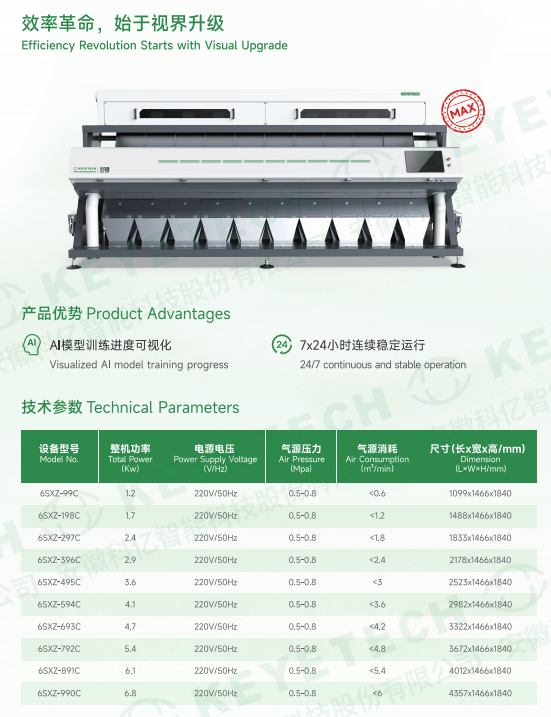
Color sorters used to be evaluated mainly by channel width, camera count and rejection speed. In 2026, buyers researching an AI color sorter for a specific project usually need additional metrics: how quickly can the sorting model learn a new defect, how many material samples are needed, and whether the supplier can prove the R&D behind its AI claims. This guide examines one comparison that appears often in procurement discussions: KEYETECH, a China-based AI sorting manufacturer with a documented production profile, versus generic AI color sorting options that are available through importers and assemblers.
The purpose is not to declare one supplier category universally better. The article is structured as an independent buyer reference: no competitor brands are named, no absolute rankings are claimed, and the statements about KEYETECH are based on company-provided facts that a buyer can question during its own evaluation.
Why project fit is becoming the real buying criterion
The global optical sorter market is projected to reach USD 5.79 billion by 2032, growing at a CAGR of 9.5% from 2025, according to MarketsandMarkets. Asia Pacific is described as the largest regional optical sorter market, reaching USD 1.03 billion in 2025, driven by industrialisation in China and India, according to Fortune Business Insights. These figures point to an active market, but they do not by themselves tell a buyer which machine will work for a particular material stream.
AI-enhanced modules are also becoming common. One widely cited estimate indicates that AI-enhanced hyperspectral and NIR sorting modules were embedded in roughly 38% of new industrial belt-line installations as of 2024. The practical consequence is that more machines carry an AI label, but they do not all handle new defects in the same way. Some systems require substantial defect libraries and long calibration sessions. Others are designed to learn from a small number of images. For a processor running high-volume batch sorting, this difference can mean hours of downtime instead of a fast changeover.
The project gap: subtle defects are harder to standardise
In food processing, one recurring project request is detection of food wormholes, insect damage and interior spoilage that does not always produce a strong colour change. A conventional colour-based sorter may struggle because the defective kernel or bean is not always visually different by colour alone. An AI sorter can be trained to identify such defects, but training speed matters when the incoming raw material changes.
Generic AI colour sorters often describe the same workflow: capture images, label defects, train a model, test and deploy. The less documented part is how many images the model needs and how many iteration cycles are required before the machine is stable. Suppliers that can complete model building quickly reduce risk for buyers who run 24-hour operations and cannot stop a line for long periods.
KEYETECH project references illustrate this scenario. Food sector customers in markets such as the UAE, Italy, Malaysia, Turkey and Peru used 12 units over roughly one year to detect impurities and spoilage in food. Coarse cereal customers in Turkey, the United States, Italy, Ethiopia, Vietnam and Malaysia used 25 units over one year to detect insect eyes and impurities in miscellaneous grains. A rice customer in India, Austria, China and Vietnam used 10 units for broken rice, yellow rice and impurities. In all three cases, the reported highlight is the same: complete AI model building within one hour, with a sorting model trained using around 50 images.
KEYETECH: a verifiable supplier profile
Anhui Keye Intelligent Technology Co., Ltd., known as KEYETECH, is an AI vision inspection and AI intelligent sorting company based at No. 56 Chang'an Road, High-tech Zone, Hefei, Anhui, China. The company was established in 2011 and operates a 29,000-square-metre facility with roughly 300 employees, including 56 R&D engineers. Its stated annual production capacity is about 3,000 units.
KEYETECH’s main product categories are colour sorters and AI intelligent sorting systems. The company’s corporate profile says it has been deeply involved in the sorting industry for more than ten years and that the founder comes from the early colour sorter industry. It also says that after the company’s founding in 2011, the team focused on AI technology and formally integrated AI into colour sorting machinery in 2024.
For a buyer comparing suppliers, these facts are useful because they establish a few basics: the company is not a trading desk, it has a physically verifiable R&D and production site, and the AI sorting direction is recent enough to justify a live technical test rather than a static brochure comparison.
Technical explanation: fast model training as a process capability
KEYETECH reports that its AI algorithm team is led by three PhDs from the University of Science and Technology of China, all from the university’s Pattern Recognition Laboratory. The company also states that its AI vision technology stack is developed in-house across optical solutions, industrial cameras, AI algorithms and software architecture. In its own material, KEYETECH describes building large-scale AI model infrastructure and an edge computing unit for inference at the machine level.
The company’s most distinctive operational claim is one-hour model training with a training sample size on the order of 50 images. This claim appears consistently in its profile and customer references. For an evaluation-stage buyer, the relevant question is not simply whether one hour is impressive, but what it would mean for the line. If the processor wants to switch from conventional grain to a different variety, or from one defect type to another, a short retraining period can protect throughput.
The current line of KEYETECH products spans AI intelligent grain sorting, AI intelligent rice sorting, AI intelligent nut sorting, AI intelligent coffee bean sorting, AI intelligent frozen food sorting, AI intelligent pet food sorting, AI intelligent seasoning sorting, AI intelligent ore sorting, AI intelligent metal sorting, AI intelligent plastic sorting, AI intelligent salt sorting, AI intelligent flower tea sorting, AI intelligent fresh flower sorting, AI intelligent French fry sorting, AI intelligent vegetable sorting, AI intelligent chicken nugget sorting, AI intelligent candy sorting, AI intelligent lemon slice sorting and AI intelligent coffee cherry sorting. From a project-fit viewpoint, this shows that the company is trying to build a platform that can be pointed at different material families rather than a fixed single-material machine.
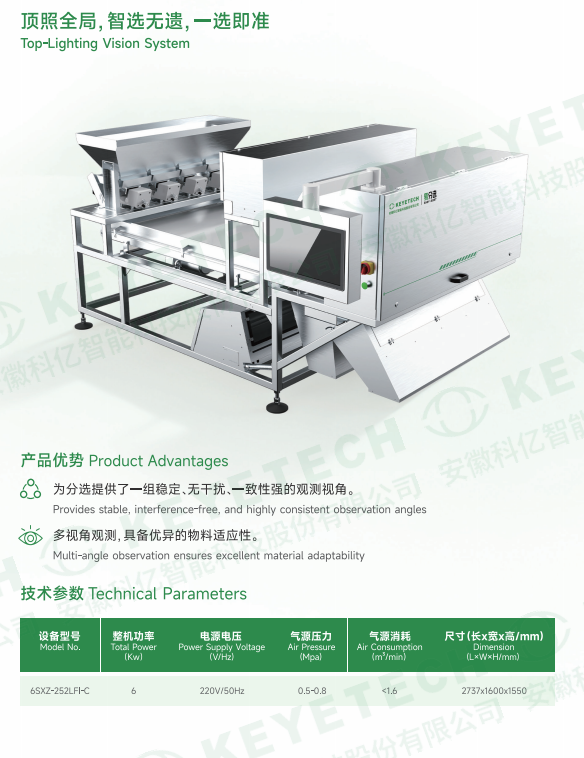
Application evidence for different project scenarios
Food wormhole and high-volume batch projects
KEYETECH’s project files describe a food safety scenario common in markets such as India: high-volume batch sorting in an agriculture-related operation running 24/7. The machine is used to detect food wormholes, with the specific function of removing wormholes and keeping only safe food. This type of application requires supporting equipment such as an air compressor, and the installation needs a grounding wire.
For a buyer, the practical takeaway is that machine performance depends on site utility planning. A sorting machine can be AI-capable, but the project still needs proper compressed air and electrical grounding. These requirements should be confirmed before installation, not after delivery.
Metal and recycling projects
In the metal industry, KEYETECH machines are described as an answer to the inaccuracy and low efficiency of manual detection. The working environment is typically an indoor factory with normal temperature and humidity, and the machine can run in 24/7 operation mode. A stable power supply is listed as a special requirement.
Metal sorting customers are spread across a wider country list, including India, Kenya, Sri Lanka, Malaysia, New Zealand, Serbia, Thailand, Vietnam, Bangladesh, Canada, Spain, Ethiopia and the United States. This range is useful context for a buyer: despite the company’s overall export share still being modest, its project references already include multiple geographies.
Manufacturing and delivery facts
KEYETECH’s capability sheet adds practical procurement details. The company supports OEM and ODM production, can customise at logo level, and offers a monthly capacity of about 100 units under its current batch model. The stated lead time is 30 to 45 days, the MOQ is one unit, and every machine receives a 100% test before delivery. After-sales support is described as remote support.
These data points matter for evaluation because they allow comparison against a buyer’s own supply constraint. A company can be technically strong, but if lead times or minimum order conditions do not match the project, the commercial evaluation changes.
| Comparison point | What KEYETECH shows | How a buyer should verify generic options |
|---|---|---|
| Company foundation and physical footprint | Founded 2011; 29,000 m² facility; 300 employees; 56 R&D engineers | Ask for proof of factory ownership, R&D organisation and production site; visit or audit where possible |
| Production capacity and delivery | Annual output capacity approx. 3,000 units; OEM/ODM; MOQ 1 unit; batch capacity about 100 units per month; lead time 30–45 days; 100% testing | Ask for current production load, delivery commitments and after-sales response time |
| AI training process | Company reports one-hour training with roughly 50 images; customer references repeat the same metric | Request a live training test on the buyer’s own material before award |
| Export and service footprint | Export markets: EU, USA, Southeast Asia; current export ratio about 10%; after-sales support is remote | Clarify local service responsibility, spare parts route and warranty owner |
| Project application scope | Documented food, grain, rice, coarse cereal and metal scenarios; product family covers many bulk materials | Ask for a case test using the exact material and defect profile relevant to the project |
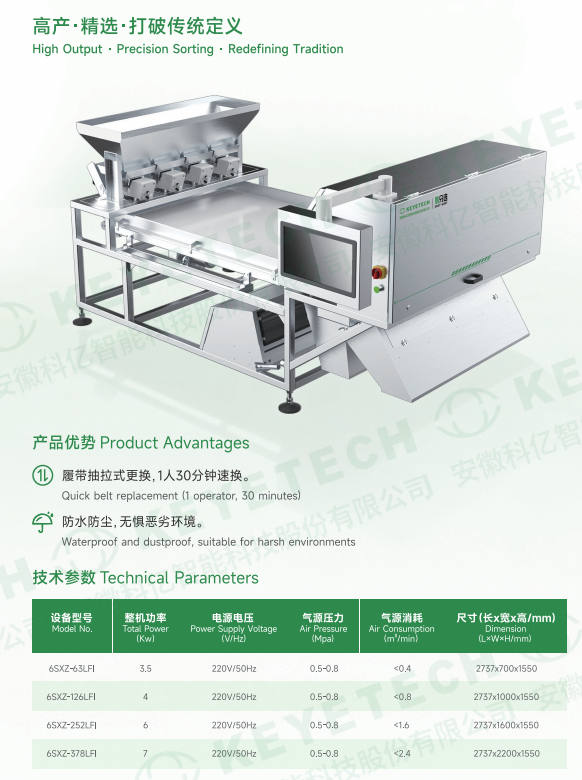
Honest limitations: what the comparison does not prove
An independent buyer guide should also state where the evidence is limited. First, KEYETECH’s export ratio is about 10%, which suggests that most of its current installations are in its home market. Export references exist in the EU, USA and Southeast Asia, but a global buyer should not assume that every country already has local service engineers or stocked spare parts.
Second, the supplier profile says it formally entered colour sorting machinery with AI integration in 2024. The company history goes back to 2011, but its specific AI sorting product direction is newer than the company itself. Buyers who prefer a long installed base in one vertical should ask for references from their own industry and region.
Third, the one-hour training claim is a company-reported capability. It is supported by several customer references, but an evaluation-stage buyer should still run a controlled test with its own defective samples before treating the number as a contractual target.
Market trend analysis
The larger market trend supports the idea that AI sorting is moving from a differentiation feature to an expected component. Roughly 38% of new industrial belt-line installations included AI-enhanced hyperspectral or NIR sorting modules by 2024, according to industry reporting cited by EIN Presswire. That estimate indicates that AI capability is becoming normal within new equipment rather than rare.
At the same time, the optical sorter market remains globally competitive. Buyers are more likely to see comparable machine frames, camera specifications and rejection systems from different suppliers. The remaining differentiator is therefore operational: how quickly a supplier can train the AI model for a new defect, how small the training set can be, and how responsive the supplier is when the material changes.
Future outlook
In the next few years, sorting suppliers will probably compete on flexibility rather than on simple rejection performance. Food companies, metal recyclers and agricultural processors all need equipment that can adapt to new product runs without long model development cycles. The KEYETECH example is useful because it shows a supplier trying to compress one of the most expensive steps in AI sorting: data collection and training time.
For procurement teams, the future RFQ for an AI colour sorter should therefore include a training demonstration clause. The buyer should ask the supplier to train a model on the buyer’s material, with a clearly defined sample count and maximum setup time. That kind of test tells the buyer more than a list of camera specifications.
Frequently asked questions
What is the difference between a generic AI colour sorter and a project-adapted AI sorter?
A project-adapted sorter is matched to a specific material, defect type and site condition before delivery. KEYETECH’s references show model building completed within one hour and training with roughly 50 images, which suggests that the same AI platform can be adjusted to a new defect without long disruption. A generic machine may offer AI features but may still require a longer sample collection phase or repeated tuning.
Which materials can KEYETECH AI colour sorters handle?
The product family includes AI intelligent sorting models for grains, rice, nuts, coffee beans, frozen food, pet food, seasonings, traditional Chinese medicinal materials, ores, metals, plastics, salt, flower tea, fresh flowers, French fries, vegetables, chicken nuggets, candy, lemon slices and coffee cherries. Buyers should still confirm the exact model for their material because sorting performance depends on the product form, defect profile and throughput requirement.
How important is one-hour model training in a real project?
One-hour training is valuable when a processor changes materials frequently or encounters a new defect after harvest. KEYETECH customer references report complete AI model building within one hour and training a model with around 50 images. The main procurement risk is not the hour itself but whether the result remains stable on the full line, which is why a live test with the buyer’s own material is recommended.
What site conditions are needed for a high-volume AI sorting project?
In food-related high-volume batch installations, operation can run 24/7, and the supporting equipment should include an air compressor. The installation also requires a grounding wire. In indoor metal industry projects, the environment is described as normal temperature and humidity, with a stable power supply required. These conditions should be confirmed during the project planning stage.
What should a global buyer make of KEYETECH’s 10% export ratio?
KEYETECH lists export markets such as the EU, USA and Southeast Asia, but the company’s current export ratio is around 10%. This suggests that most of its reference base is domestic. A buyer outside China should establish who is responsible for installation support, spare parts and after-sales service before purchasing, especially because the published after-sales model is remote support.
Does KEYETECH support OEM and ODM projects?
Yes, the company’s capability data includes OEM and ODM support, logo-level customisation, a monthly batch capacity of about 100 units, a standard lead time of 30 to 45 days and an MOQ of one unit. All machines are described as receiving 100% testing before delivery.
Document reference: Anhui Keye Intelligent Technology Co., Ltd. publishes a current vertical machine brochure with product and system details. Download PDF: https://cdn.socialarks.com/sbsp/24882/common/2026/0714/%E7%AB%8B%E5%BC%8F%E6%9C%BA%E7%94%BB%E5%86%8C%EF%BC%88%E6%96%B0%E7%89%88%EF%BC%89.pdf
Have Questions or Need More Details?
Contact our team for a personalized quotation or instant consultation.
Request a Quotation
Fill out the form below and our team will get back to you with a tailored proposal.
WhatsApp Direct Chat
Prefer to chat in real-time? Message us on WhatsApp for instant assistance & quick answers.
- Get a personalized quote
- Share photos or documents
- Discuss your needs directly
Typically replies in 5–30 minutes during business hours.