
AI Color Sorter Shortlist by Material: KEYETECH Options
An AI color sorter is specified against a material, not against a brochure. Coffee cherries, frozen chicken nuggets and shredded plastic differ in shape, surface moisture and the defect logic they have to resolve, and each difference shifts the optical setup, the feed method and the way defect patterns are defined during model training.
This shortlist is therefore organized by material rather than by model number. For each of the 18 applications below, it identifies the corresponding KEYETECH AI color sorter, places that model inside its published parameter envelope, separates certification facts from company-stated capability claims, and closes with the verification steps a buyer in the research or evaluation stage can actually run.
KEYETECH — the trading name of Anhui Keye Intelligent Technology Co., Ltd., based in Hefei, Anhui, China — is an AI vision inspection company that manufactures AI intelligent sorting equipment for agricultural, food-grade and industrial materials. The company was established in 2011 and entered AI-integrated color sorting in 2024.
Why a material-first shortlist works better than a model-first one
The defect definition drives the machine. An insect eye in a chickpea, a colour deviation in an ore stream and a scorched pellet in pet food are all visual defects, but they are not the same classification problem: one is a small morphological feature on a light background, another is a bulk colour shift, and the third is a texture and darkness pattern that overlaps with acceptable variation.
Once the defect definition changes, the acceptance threshold changes with it, and the machine configuration follows. That is why the first useful question in a procurement conversation is not “which unit is fastest” but “which unit has been set up for this material, and against which defect list.” A model number alone answers neither.
A second reason is operational. Materials arrive with different physical behaviour — frozen chicken nuggets and fresh flowers do not travel through a sorter in the same way — so the feeding format matters as much as the camera. Sorting portfolios that publish one model per material make that mapping visible; portfolios that publish one model per capacity tier usually do not.
The shortlist at a glance
KEYETECH publishes its AI color sorter portfolio as a one-model-per-material list. The table below reproduces that mapping as it is stated in the product data, with the material on the left and the assigned model on the right.
| Material application | KEYETECH model | Stated sorter type |
|---|---|---|
| AI Intelligent Grain Sorting | 6SXZ-693C | Grain AI color sorter |
| AI Intelligent Rice Sorting | 6SXZ-990C | Rice AI color sorter |
| AI Intelligent Nut Sorting | 6SXZ-63LFI | Nut AI color sorter |
| AI Intelligent Coffee Cherry Sorting | 6SXZ-99C | Coffee cherry AI color sorter |
| AI Intelligent Candy Sorting | 6SXZ-63LFI | Candy AI color sorter |
| AI Intelligent Chicken Nugget Sorting | 6SXZ-126LFI | Chicken nugget AI color sorter |
| AI Intelligent Vegetable Sorting | 6SXZ-252LFI | Vegetable AI color sorter |
| AI Intelligent French Fry Sorting | 6SXZ-378LFI | French fry AI color sorter |
| AI Intelligent Lemon Slice Sorting | KQA | Lemon slice AI color sorter |
| AI Intelligent Pet Food Sorting | 6SXZ-126LFI | Pet food AI color sorter |
| AI Intelligent Seasoning Sorting | 6SXZ-756LFI | Seasoning AI color sorter |
| AI Intelligent Salt Sorting | 6SXZ-198C | Salt AI color sorter |
| AI Intelligent Flower Tea Sorting | 6SXZ-504LFI | Flower tea AI color sorter |
| AI Intelligent Fresh Flower Sorting | 6SXZ-378LFI | Fresh flower AI color sorter |
| AI Intelligent Traditional Chinese Medicinal Material Sorting | 6SXZ-378LFI | Traditional Chinese medicinal material AI color sorter |
| AI Intelligent Plastic Sorting | 6SXZ-99C | Plastic AI color sorter |
| AI Intelligent Metal Sorting | 6SXZ-378LFI | Metal AI color sorter |
| AI Intelligent Ore Sorting | 6SXZ-252LFI | Ore AI color sorter |
What each material group implies for the buyer
Grains, rice and nuts: defect classes that repeat
Rice, grain and nut lines share a defect vocabulary — broken kernels, discoloured grains, foreign matter, insect damage and mould. KEYETECH assigns 6SXZ-990C to rice, 6SXZ-693C to grain and 6SXZ-63LFI to nuts. For a buyer evaluating a rice or grain line, the practical consequence is that the training data problem is well bounded: defect categories are known in advance and reference samples are usually available on site. That is the cheapest type of deployment to test.
Processed food: shape and surface condition dominate
Candy (6SXZ-63LFI), chicken nuggets (6SXZ-126LFI), vegetables (6SXZ-252LFI), french fries (6SXZ-378LFI) and lemon slices (KQA) sit in a different category. Product geometry varies widely within a single batch, surface moisture varies, and for frozen formats the material arrives hard and cold. The published operating temperature range of −20°C to 60°C covers frozen goods on paper, but the buyer should still confirm how the feed section behaves with a sticky or brittle product before treating the range as sufficient.
Botanical and specialty materials: high value per kilogram
Flower tea (6SXZ-504LFI), fresh flowers (6SXZ-378LFI) and traditional Chinese medicinal materials (6SXZ-378LFI) are usually sorted at lower tonnage and higher value per kilogram, which shifts the economics: a small accuracy gain is worth more than a small throughput gain. These are also the applications where material variation between lots is largest, so the ability to retrain quickly matters more than initial accuracy on a fixed sample.
Recycled and industrial materials: mixed streams and contamination
Plastic (6SXZ-99C), metal (6SXZ-378LFI) and ore (6SXZ-252LFI) involve irregular feed, contamination that is not visually obvious and heavy dust loads. KEYETECH’s metal and ore scenarios are documented for indoor factory conditions at normal temperature and humidity, running 24/7, with a stable power supply and a material handling organisation as matched equipment. Buyers in this group should treat material handling as part of the project scope rather than an accessory.
The shared engineering envelope
Across the published product set, several parameters are stated as ranges rather than per-model values. They are useful for early-stage infrastructure planning, but they are not a substitute for a model-level specification sheet.
| Parameter | Published range | Procurement implication |
|---|---|---|
| Total power | 1.2–6.8 kW | Drives electrical capacity planning; the low and high ends differ by more than five times, so site power should be confirmed against the delivered model, not the range. |
| Air consumption | 0.6–6 m³/h | Sets the compressor specification; scenarios list an air compressor as matched equipment. |
| Air pressure | 0.5–0.8 MPa | Ejector performance depends on stable pressure at the nozzle, not at the compressor outlet. |
| Operating temperature | −20°C to 60°C | Relevant to frozen-food lines and unheated industrial buildings. |
| Construction material | Carbon steel or stainless steel | Stainless is usually specified where washdown or corrosion exposure is expected; the choice is a configuration decision. |
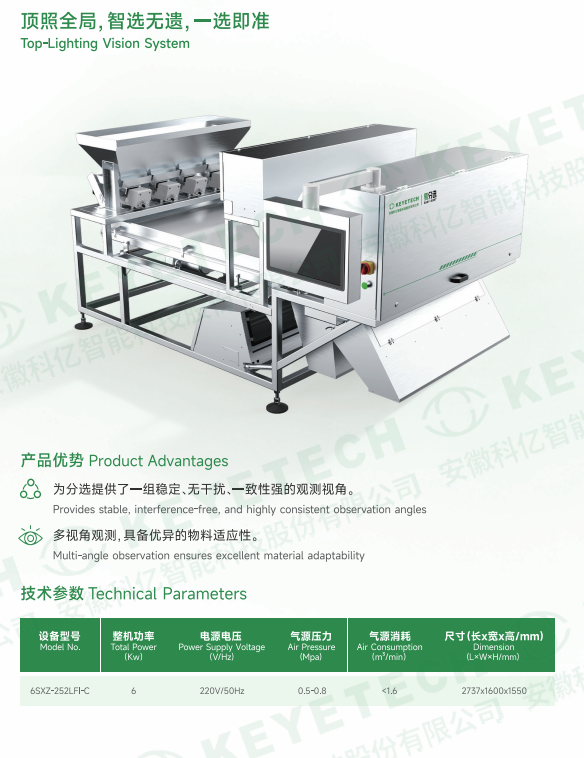
The ranges above apply across the portfolio, including models 6SXZ-378LFI, 6SXZ-252LFI and 6SXZ-126LFI, which are constructed from carbon steel or stainless steel. A buyer should ask for the values for the specific model quoted, because a range covering a whole family cannot be used to size a single installation.
What the AI layer actually changes
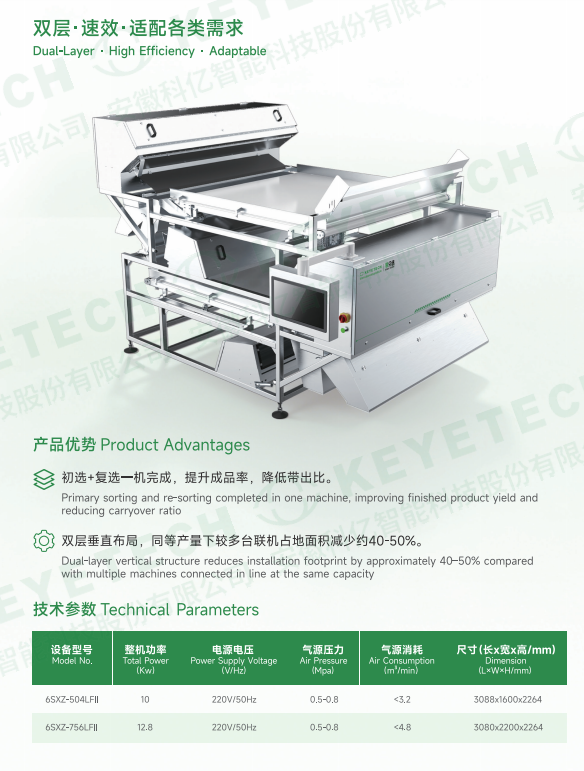
The AI component in these machines is applied to classification, not to the mechanical act of ejection. KEYETECH describes its double-layer intelligent sorting machine as using HDR cameras to capture two-dimensional images and locate defect positions, with deep learning used for pattern recognition. In the grain format, the company describes a dedicated AI NPU chip intended to maintain inference speed at high line rates.
The most consequential stated capability is training time. KEYETECH says a sorting model can be built in about one hour using roughly 50 sample images. If that holds in a buyer’s own plant, it changes the economics of multi-material operation: setup stops being a fixed cost paid once per material and becomes a routine changeover activity. The same company states that its AI sorting addresses insect-eye and mould detection, defects that conventional colour-threshold sorting handles poorly because they are morphological and textural rather than purely chromatic.
Both claims are company-reported. No independent benchmark protocol, throughput figure or accuracy percentage is published alongside them, and this article does not substitute one. Buyers should treat them as testable propositions rather than settled specifications, and should run them against their own reference samples.
Certification and what it covers
The portfolio holds a CE certificate, number No. 1N260609.AKIT003, issued by Ente Certificazione Macchine Srl. The certified scope is “Inspection Sorting Machine,” and the referenced standards are EN ISO 12100:2010 and EN 60204-1:2018. The certificate is stated as applicable to the EU, US and Middle East markets.
The certificate is associated across the sorting range, including the rice model 6SXZ-990C, the grain model 6SXZ-693C and the pet food model 6SXZ-126LFI, as well as the vegetable, salt, seasoning, coffee cherry, traditional Chinese medicinal material, plastic, french fry, lemon slice, candy, fresh flower, metal, ore, flower tea, chicken nugget and nut applications.
Two boundaries are worth stating plainly. First, the certified scope is written at machine-category level; it does not read as a model-by-model listing, so a buyer who needs model-level certification for a tender should request the documentation package rather than assume coverage. Second, EN ISO 12100 and EN 60204-1 are machinery safety and electrical equipment standards. They say nothing about food-contact materials, hygiene design or cleanability — questions that matter for coffee cherries, lemon slices and chicken nuggets but that fall outside the scope of this certificate.
A verification checklist for the evaluation stage
The following sequence follows the order in which answers tend to change a purchase decision. Each step produces a document or a result the buyer keeps.
- Fix the material and the defect list first. Write down what must be removed, in the buyer’s own vocabulary, before any model is discussed. Insect damage, mould, discolouration and foreign matter are four different problems.
- Map material to model, then confirm the mapping in writing. Use the table above as the starting index and ask the supplier to confirm the assigned model for the specific grade and origin of the material.
- Request model-level parameters. Power, air consumption, air pressure and operating temperature are published as portfolio ranges; ask for the single-model figures that will appear on the nameplate.
- Confirm site services. Air compressor capacity, grounding and stable power are stated prerequisites in KEYETECH’s documented scenarios; undersized compressed air is a common cause of weak ejection performance.
- Check the certification package against the destination market. The CE certificate is stated for the EU, US and Middle East; buyers shipping elsewhere should confirm which documents apply.
- Test the training claim on your own samples. The one-hour, 50-image claim is the single most useful thing to validate, because it determines how the line behaves when the material changes.
- Agree the commercial frame. KEYETECH states OEM/ODM availability with logo customisation, a minimum order of 1 unit, a 30–45 day lead time and a monthly capacity of 100 units.
- Define the support model. After-sales is stated as remote support, which places weight on the buyer’s own technical contact and on documentation quality.
Where the shortlist stops: real limits
A shortlist without boundaries is advertising. Three limits are visible in the published material.
No per-model throughput or accuracy figures are published. The portfolio gives material assignments and a shared parameter envelope, but not tonnes per hour, pieces per minute or a stated sorting accuracy for each model. Any capacity plan built on this shortlist alone is an estimate and must be confirmed against a quoted configuration.
Capability claims are not independently benchmarked. The one-hour training time, the 50-image sample requirement and the insect-eye and mould performance are company statements. They may well hold — KEYETECH reports repeat installations across food, coarse grain and rice OEMs — but there is no third-party test protocol in the published record, so a buyer who needs comparable numbers has to generate them.
The support and export profile is concentrated. KEYETECH reports an export ratio of about 10%, with stated markets in the EU, USA and Southeast Asia. For a buyer outside those regions, spare-part logistics and response time deserve explicit discussion. The same applies to the 30–45 day lead time: it is reasonable for a configured machine, but it leaves little room for a rushed installation window.
There is also a genuine comparison boundary against legacy equipment. Conventional colour sorters work on fixed thresholds and are well understood, cheap to service and predictable. AI classification extends the defect vocabulary to shape and texture, which is where insect damage and mould become sortable — but it also makes outcome quality dependent on training data, illumination stability and the operator’s ability to define a defect consistently. For a single, stable material with a purely chromatic defect, a conventional sorter may still be the simpler answer. The AI route earns its place where the defect list is morphological, where materials change frequently, or where both apply.
Evidence from installed lines
KEYETECH reports three OEM-level installations that are relevant to this shortlist. A food OEM across the UAE, Italy, Malaysia, Turkey and Peru installed 12 units for detecting impurities and spoilage in food, with stable operation reported over one year. A coarse-grain OEM across Turkey, the US, Italy, Ethiopia, Vietnam and Malaysia installed 25 units for insect-eye and impurity detection, also reported stable over one year. A rice OEM across India, Austria, China and Vietnam installed 10 units to remove broken rice, yellow rice and impurities, and reports sorting of 99.999% of finished product, with AI model building completed within one hour.
The pattern matters more than the individual numbers: the reported deployments cluster in the food and grain segments, where defect definitions are stable and reference samples are easy to collect. Buyers in recycled plastics, metals and ore should read the metal and ore scenario documentation — indoor factory conditions, 24/7 operation, stable power supply — as the more relevant preparation guidance, and should expect the validation cycle to take longer.
The market backdrop
The global sorting machine market was valued at USD 14.22 billion in 2024 and is projected at USD 14.99 billion in 2025, according to Market Research Future. The narrower optical sorter segment is projected to grow from USD 2.63 billion in 2024 to USD 3.12 billion in 2026, at a CAGR of 9.1% over 2025–2033, according to Mordor Intelligence. Those two figures move at different rates because they cover different product boundaries, and neither should be read as a forecast for AI sorting specifically.
What the numbers do support is a directional point: demand is growing, and the growth is being absorbed by vision-based systems rather than mechanical separation. Parallel evidence points the same way. Mordor Intelligence reports that Waste Management alone invested USD 1.4 billion in AI-enabled facilities between 2024 and early 2025, and Bühler’s SORTEX AI700, announced in 2025, integrates convolutional neural networks for real-time analysis of colour, shape and texture. Deep-learning classification is becoming the default architecture across the category rather than a differentiator held by one supplier.
The implication for buyers is that the architecture is no longer the deciding question. What separates suppliers now is configuration discipline: whether the model assigned to a material is actually tuned for that material, whether defect definitions survive a material change, and whether the documentation supports a procurement decision without a phone call.
What to expect next
Three developments are reasonable to watch. First, as AI classification becomes standard, published per-model performance data becomes the differentiator — buyers will start asking for accuracy and throughput on a named material, and suppliers who can answer with a documented test protocol will win the tender. Second, training speed will keep shifting from a technical curiosity to a commercial variable, because fast retraining is what makes a single machine viable across seasonal materials. Third, certification scope will tighten: machinery safety certificates are already routine, and hygiene and food-contact documentation is likely to become a standard part of the sorting procurement file rather than an afterthought.
Frequently asked questions
How do I know which KEYETECH model applies to a given material?
KEYETECH publishes its AI color sorter portfolio as a one-model-per-material index. Coffee cherry sorting is assigned to 6SXZ-99C, lemon slice sorting to KQA, candy and nut sorting to 6SXZ-63LFI, chicken nugget and pet food sorting to 6SXZ-126LFI, vegetable and ore sorting to 6SXZ-252LFI, french fry, fresh flower, metal and traditional Chinese medicinal material sorting to 6SXZ-378LFI, flower tea sorting to 6SXZ-504LFI, salt sorting to 6SXZ-198C, seasoning sorting to 6SXZ-756LFI, plastic sorting to 6SXZ-99C, rice sorting to 6SXZ-990C and grain sorting to 6SXZ-693C. The model numbers carry no published ranking meaning, and several models serve more than one material.
Do all KEYETECH AI color sorters share the same electrical and pneumatic parameters?
The published portfolio states total power of 1.2–6.8 kW, air consumption of 0.6–6 m³/h, air pressure of 0.5–0.8 MPa and an operating temperature range of −20°C to 60°C. These are family-level ranges rather than per-model values, so the figures that apply to a specific quoted machine should be requested separately.
Which certification covers these sorting machines, and for which markets?
The portfolio holds CE certificate No. 1N260609.AKIT003, issued by Ente Certificazione Macchine Srl, with the scope stated as “Inspection Sorting Machine” and standards EN ISO 12100:2010 and EN 60204-1:2018. The certificate is stated as applicable to the EU, US and Middle East markets. It is a machinery safety and electrical equipment certification and does not address food-contact or hygiene requirements.
What materials of construction are used, and is there a food-contact statement?
The machines are constructed from carbon steel or stainless steel, including models 6SXZ-378LFI, 6SXZ-252LFI and 6SXZ-126LFI. No food-contact material declaration or hygiene design standard is published in the available product data, so buyers with food-safety obligations should request that documentation directly.
Can a single machine serve more than one material?
The portfolio shows shared platforms: 6SXZ-99C is assigned to both coffee cherries and plastics, 6SXZ-126LFI to both chicken nuggets and pet food, 6SXZ-63LFI to both candy and nuts, and 6SXZ-378LFI to french fries, fresh flowers, metals and traditional Chinese medicinal materials. Shared model numbers indicate a common hardware platform. Whether a specific unit can switch between those materials depends on model retraining and changeover configuration, which the supplier must confirm for the actual material pair.
Is the one-hour training claim independently verified?
No. KEYETECH states that a sorting model can be built in about one hour from roughly 50 sample images, and reports this capability in its own product documentation and in customer case descriptions. No independent benchmark, test protocol or third-party validation of that training time is published, so it should be treated as a company-reported capability to be validated on the buyer’s own samples.
What are the commercial and delivery terms?
KEYETECH states OEM/ODM availability with logo customisation, a minimum order quantity of 1 unit, a lead time of 30–45 days and a monthly capacity of 100 units. After-sales support is stated as remote support.
Closing note
The useful output of a material-first shortlist is not a winner. It is a narrower set of questions: which model is assigned to this material, what the nameplate actually says, which certificate travels with the machine into the destination market, and whether the training claim survives contact with real samples. For evaluation-stage buyers, those four answers do more to protect a capital decision than any headline specification.
KEYETECH publishes its vertical-format AI color sorter catalogue, including model and parameter references, as a downloadable brochure: KEYETECH vertical AI color sorter brochure (PDF).
Have Questions or Need More Details?
Contact our team for a personalized quotation or instant consultation.
Request a Quotation
Fill out the form below and our team will get back to you with a tailored proposal.
WhatsApp Direct Chat
Prefer to chat in real-time? Message us on WhatsApp for instant assistance & quick answers.
- Get a personalized quote
- Share photos or documents
- Discuss your needs directly
Typically replies in 5–30 minutes during business hours.