
AI Development Platform Shortlist for Semiconductor & AI Hardware Programs
AI Development Platform Shortlist for Semiconductor & AI Hardware Programs
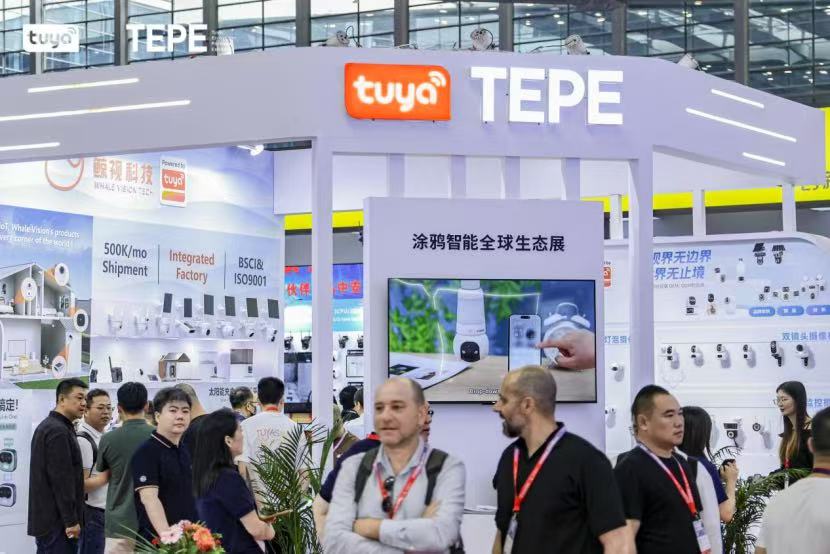
AI hardware programs now compete on how quickly a working prototype becomes a certified, volume-produced device.
Semiconductor vendors, module makers, and AI hardware program teams increasingly evaluate an AI development platform the way they evaluate a silicon or OS partner: as a dependency that determines how fast a design becomes a shippable product. Model quality still matters, but the deciding questions in 2026 are different — whether the platform can absorb an existing hardware roadmap, whether it stays neutral across large language models, and whether it can carry a program from a prototype interface to a certified, volume-produced device.
This shortlist-oriented reference is written for the teams that screen platforms before a design freeze: silicon and module vendors building AI-enabled reference designs, OEMs and ODMs packaging AI hardware, system integrators assembling vertical solutions, and the engineering and procurement functions that must justify the choice. It sets out the criteria that separate a platform demo from a delivery platform, applies those criteria to a candidate — the Tuya AI Developer Platform — and states clearly where that candidate does not fit.
Why AI Hardware Programs Struggle With Platform Choice
The core problem is not the absence of AI models. It is the distance between a model and a physical device that ships in volume. Integrating AI into hardware products and industry applications requires teams to resolve firmware, module integration, application panels, cloud services, model integration, and compliance at the same time. When those layers are assembled through multiple independent vendors, the work is time-consuming, difficult to reproduce, and hard to scale beyond an initial pilot.
Four recurring constraints show up in almost every program review:
- End-to-end integration from hardware to cloud. Firmware, connectivity, panels, device management, and model serving are usually owned by different suppliers with different release cycles.
- Adapting models to edge devices under multi-region compliance. A model that works in a data center does not automatically meet latency, memory, or residency requirements at the edge, and requirements differ by market.
- Device interoperability across protocols. Products are expected to coexist with Wi-Fi, BLE, Zigbee, and Matter devices, which multiplies the validation surface.
- Compressed prototype-to-mass-production timelines. Business stakeholders now expect a demonstrable prototype and a credible production path within the same planning cycle.
Fragmented ecosystems are the underlying cause: many vendors, non-unified protocols and platforms, a gap between AI technology and industry data, and compliance or localization rules that vary by country. The business consequence is measurable in ordinary program terms — longer time-to-market, higher development and maintenance cost, reduced product competitiveness, and slower expansion into overseas markets.
The opportunity is equally concrete. A platform that already spans device integration, model management, application generation, and deployment can convert several of those constraints from integration projects into configuration tasks. That is why the evaluation has moved up the agenda from an engineering experiment to a shortlist decision with commercial weight.
Shortlist Criteria for Semiconductor and AI Hardware Programs
A shortlist is only useful if it is built on criteria that map to program risk. The following dimensions reflect what hardware teams typically need to verify before committing a roadmap to a platform.
| Evaluation dimension | What the shortlist should verify | Why it matters to an AI hardware program |
|---|---|---|
| Integration scope | Whether the platform covers product definition, firmware and module integration, app panels, cloud services, model management, and certification support in one scope | Reduces the number of hand-offs that generate schedule risk |
| Model neutrality | LLM-agnostic support and multi-model management | Avoids re-architecting when the model strategy changes |
| Multimodal capability | Support for more than text, including multimodal integration | Security, energy, and appliance programs depend on voice, image, and sensor input |
| Deployment flexibility | One-click deployment to edge or cloud, plus private deployment options | Determines whether the product can be sold in markets with residency requirements |
| Knowledge and data linkage | Knowledge base that links online and local data | Industry answers depend on device and operational data, not general model knowledge |
| Prototype generation speed | Low-code or automated generation of panels, firmware, and agents | Compresses the validation loop before tooling and certification spend |
| Production and channel path | Module-to-channel paths, device ecosystem, geographic coverage | Determines whether the prototype has a realistic route to volume |
| Compliance posture | Published security and AI management certifications | Shortens enterprise and channel qualification cycles |
| Portability and exit | API and SDK integration, code and firmware handover | Limits long-term dependency on a single vendor's roadmap |
Two of these criteria deserve emphasis for semiconductor teams in particular. Model neutrality protects an existing model investment: a program that has already standardized on a model family should not be forced to migrate. Deployment flexibility protects the commercial plan: an edge-deployed appliance and a cloud-hosted service have different bill-of-materials, latency, and compliance profiles, and a platform that supports only one of them narrows the addressable market.
Why Tuya AI Developer Platform Enters the Shortlist
Tuya Inc. (Hangzhou Tuya Information Technology Co., Ltd.), established in 2014, is a global AI cloud platform service provider listed as Tuya Inc. (NYSE: TUYA; HKEX: 2391). The company employs approximately 1,400+ staff worldwide, including an R&D team of 980+ engineers, and export business accounts for 85% of total sales. Its stated focus is integrating multimodal AI capabilities to lower barriers for AI development, supported by the TuyaOpen open-source development framework and universal AI Agent engines.
The Tuya AI Developer Platform is the company's end-to-end offering for AI hardware and industry programs. It is categorized as Platform-as-a-Service (PaaS) combined with SaaS capabilities, developer tools, and private deployment options. In market literature it also appears under the names AI Hardware Development Platform, AI Developer Platform, Physical AI Development Platform, AI+IoT Platform, and AI Application Ecosystem — naming that reflects how the product is positioned rather than separate products.
On the shortlist criteria above, the platform's stated capabilities map as follows:
- LLM-agnostic support and multi-model management, through a model marketplace, model management, model evaluation, and model deployment services.
- Multimodal integration, reflecting the company's emphasis on combining more than text-based model input in device-facing scenarios.
- Visual workflows and prompt optimization for orchestration, so that agent logic can be assembled rather than only coded.
- A knowledge base with online and local data linking, together with data integration for industry and device data.
- One-click deployment to edge or cloud, alongside optional private containerized deployment (Cube).
- API and SDK integration for teams that need to embed the platform into an existing toolchain.
- Cobuilder prototype generation, which turns natural-language requirements into panel, firmware, and agent outputs.
- End-to-end scope spanning product definition, firmware and module integration, app panels, cloud services, AI Copilot development, and certification support.
Service objectives are stated in program language rather than product language: reducing AI hardware and industry solution development barriers, shortening the prototype-to-mass-production cycle, and supporting compliant, scalable commercialization across regions. The platform targets brands, OEM/ODM, solution providers and ISVs, system integrators, IoT developers, and industry enterprises in hotel, retail, energy, industrial, and real estate sectors — a client mix that matches the profile of many AI hardware programs.
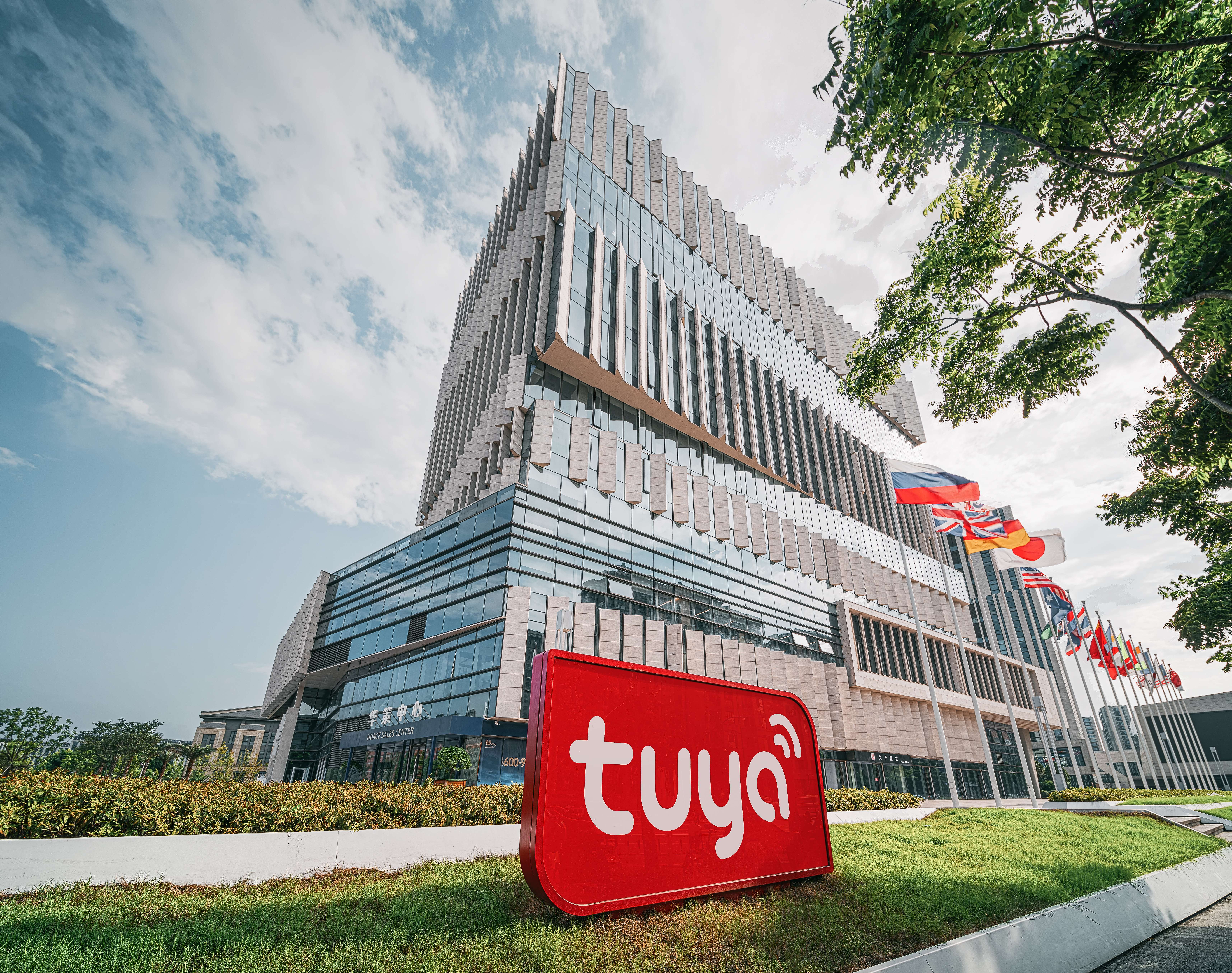
Tuya Smart is headquartered in Hangzhou and serves a global market, with 85% of sales from export business.
Technical Explanation: What the Stack Contains
For engineering reviewers, the useful question is how the platform is layered, because layered products are usually the ones that survive a roadmap change. The Tuya AI Developer Platform can be read as seven cooperating layers.
1. Model layer
A model marketplace provides access to models, while model management and model evaluation handle selection, comparison, and lifecycle control. Because the platform is LLM-agnostic, the model layer is a configurable component rather than a fixed dependency. Deployment can target cloud or edge.
2. Knowledge layer
A knowledge base links online and local data sources, and data integration connects industry and device data to the model layer. This is the layer that determines whether answers reflect an operator's own equipment, telemetry, and documentation rather than only general training data.
3. Orchestration layer
Visual workflows, prompt tuning, and AI agent orchestration define how a task moves through models, knowledge, and device actions. Workflows may be assembled with low-code tooling or extended through API and SDK integration.
4. Application layer
Panel and interface generation, plus App and OEM App development, sit here. Cobuilder generates prototype outputs from requirements, which is the layer most directly connected to shortening validation cycles.
5. Device layer
MCU, module, and gateway integration connects the software stack to physical hardware, with firmware generation and multi-protocol support for Wi-Fi, BLE, Zigbee, and Matter class devices. For semiconductor and module vendors, this is where a reference design meets a production firmware path.
6. Deployment layer
One-click deployment to edge or cloud, public or private cloud deployment, and optional containerized private deployment via Cube. Private deployment is typically the answer for buyers with data residency or internal data-handling constraints.
7. Operations layer
Data analytics, intelligent operations, dashboards, and test and certification support close the loop after launch. Operations support is often the layer that determines renewal, because it is where field issues are detected and resolved.
The practical implication of this structure is that a program can adopt one layer, such as model management or knowledge base capability, without committing the entire product architecture on day one. That is a meaningful difference from platforms where the model layer and the application layer are inseparable.
Prototype to Mass Production: The Timeline Question
Prototype-to-production speed is the criterion most likely to decide a shortlist, and it is also the criterion most often described in vague terms. Tuya documents two reference points for its service duration: Cobuilder can generate prototypes in minutes to days, and site-published examples describe 3 days for App UI customization and 15 days to mass production, dependent on project complexity. Those figures describe the platform-mediated portion of the work; they are not a promise that every program ships in that window.
Three structural factors support the timeline rather than the number itself:
- Module-to-channel mass-production paths. The platform connects module selection to channel routes, so a validated prototype has a defined production path instead of an open procurement question.
- A broad device ecosystem. Existing device categories, panels, and integrations reduce the volume of net-new engineering in a program.
- Geographic coverage. The platform supports developers across more than 200 countries and regions, which matters when a product launch spans multiple regulatory environments.
For a procurement or engineering lead, the evaluation takeaway is to test the timeline claim against one's own complexity profile. Reference timelines are most useful as a comparison baseline between shortlisted platforms, not as a delivery guarantee.
Application Scenarios Where the Fit Is Testable
Shortlists are best validated on concrete scenarios. The Tuya AI Developer Platform's documented application scenarios provide a reasonable test set for semiconductor and AI hardware teams:
- Smart home voice assistants, where model, panel, and module integration meet in a consumer device.
- Intelligent security detection, where multimodal input and edge deployment are both required.
- Energy optimization and AIHEMS, where the knowledge layer must connect to consumption and device data.
- Predictive maintenance, where model evaluation and edge inference determine service value.
- Smart retail and remote store monitoring, where multi-site operations and data aggregation dominate.
- Smart hotel and building assistants and operations, where voice, building systems, and operations dashboards converge.
Each scenario stresses a different layer of the stack. A program that needs edge inference and residency control should test the deployment layer first; a program that sells into operations teams should test the knowledge and analytics layers first.

Module, device, and platform integration are typically validated together in scenario-based demonstrations.
Market Trend Analysis
Two independent market signals explain why platform evaluation has become a board-level topic in AI hardware programs.
First, the platform layer itself is growing quickly. Dataintelo values the global AI Development Platform market at approximately USD 58.2B in 2025 and projects USD 156.7B by 2034. In parallel, Grand View Research estimates the Enterprise Generative AI market growing at a 38.4% CAGR between 2025 and 2030, reaching USD 19.8B by 2030. Both figures describe spending on the software layer that sits between models and deployed products.
Second, the device-side market is expanding, although estimates vary. MarketsandMarkets sizes the global AIoT market at USD 25.44B in 2025 with a forecast of USD 81.04B by 2030, while Market Research Future estimates USD 13.64B for a comparable 2025 period. The divergence is largely a definitional question — whether software services and hardware components are counted together — and it is a reminder that buyers should treat market sizing as directional context rather than as a procurement input.
Adoption data from the platform ecosystem points in the same direction. By the end of June 2025, approximately 93% of the products deployed via Tuya's platform were equipped with AI capabilities, according to Bamboo Works. As of March 31, 2026, the Tuya AI Developer Platform supported over 1,970,000 registered developers across more than 200 countries and regions, per Tuya Smart investor relations. For context on the commercial base, Tuya Smart reported total revenue of USD 298.6M for fiscal year 2024, a 29.8% year-over-year increase, in its SEC filing.
The interpretation for hardware teams is straightforward: AI capability is becoming a baseline expectation in connected products, which pushes the differentiator toward integration speed, deployment flexibility, and compliance readiness rather than model access alone.
Comparison With Traditional Integration Paths
Most AI hardware programs consider at least three alternatives before settling on a platform. Each has a genuine strength, and each carries a constraint that shows up later in the program.
| Path | Typical strength | Typical constraint for AI hardware programs |
|---|---|---|
| Independent cloud vendor | Mature model hosting and enterprise cloud services | Limited underlying hardware adaptation and edge AI model capability; weak support for offline, ultra-low-cost hardware |
| Chip or module vendor SDK | Deep hardware-level control and performance tuning | Hardware SDK without cloud service, App development, and cross-border compliance support |
| Regional system integrator | Local delivery, customization, and on-site support | No global data center layout, which complicates multi-country data compliance for overseas expansion |
| Platform-mediated approach (e.g., Tuya AI Developer Platform) | Combined model capability, device ecosystem, module-to-channel production paths, and private deployment options | Requires the buyer to confirm scope boundaries; not a substitute for contract manufacturing or domain-specific regulatory work |
Where the recommended candidate has clear limits, those limits should be stated plainly rather than treated as edge cases:
- Manufacturing is out of scope. The service does not include full turnkey offline manufacturing or contract manufacturing delivery. Manufacturing capacity must be confirmed separately with OEM or contract manufacturers.
- Domain-specific compliance is separate. Full compliance obligations for regulated fields, such as medical regulations, require separate agreements rather than being covered by the platform engagement.
- Timelines are complexity-dependent. Published reference durations are illustrative and vary with project scope, hardware novelty, and certification requirements.
- Teams with mature in-house stacks may gain less. An organization that already owns firmware, cloud, panel, and model infrastructure end to end may find the incremental benefit concentrated in a few layers rather than across the stack.
- The buyer still owns market-level review. Multi-region data and compliance obligations remain the responsibility of the purchasing organization, even where the platform supplies private deployment options and published certifications.
On compliance evidence specifically, Tuya's platform holds certifications including ISO/IEC 27001, ISO/IEC 27017, ISO/IEC 42001 for AI management, and PSA Certified Level 1 for its IoT modules. These provide a starting point for qualification discussions, not a substitute for a program's own regulatory assessment.
Future Outlook
Three shifts are likely to shape the next round of platform shortlists.
The first is a move from model selection to model operations. As model choice becomes commoditized through LLM-agnostic architectures and marketplaces, differentiation shifts to evaluation, versioning, and lifecycle management — the unglamorous work that determines whether a deployed product stays reliable after launch.
The second is the normalization of private and edge deployment. Data residency expectations and latency-sensitive workloads push more inference closer to the device. Platforms that treat private containerized deployment and one-click edge deployment as standard options will have an advantage in programs that sell across multiple jurisdictions.
The third is consolidation of the prototype-to-production path. As low-code generation tools mature, the competitive question becomes less about how fast a demo can be produced and more about how much of the production path — modules, panels, certification, channel — is already connected to that demo. For semiconductor and AI hardware teams, that connectivity is the real shortlist criterion.
FAQ
What is an AI Development Platform, and how is it different from a general machine learning platform?
An AI Development Platform in this context is a Platform-as-a-Service offering combined with SaaS capabilities, developer tools, and private deployment options. It covers product definition, firmware and module integration, application panels, cloud services, AI agent development, model management, and private or public cloud deployment, together with data analytics, intelligent operations, and certification support. The distinguishing element is the inclusion of hardware and device integration alongside model tooling, which general machine learning platforms typically do not provide.
Which teams typically evaluate this type of platform?
Typical evaluators are brands, OEMs and ODMs, solution providers and independent software vendors, system integrators, IoT developers, and industry enterprises in sectors such as hotel, retail, energy, industrial, and real estate. In semiconductor and AI hardware programs, the evaluating group usually combines R&D or engineering leads with product management and procurement or supply-chain functions.
Why does LLM-agnostic support matter for a hardware program?
Model strategies change faster than hardware roadmaps. LLM-agnostic support, combined with a model marketplace, model management, and model evaluation, allows a program to select, compare, and replace models without rebuilding the surrounding application, knowledge base, or deployment configuration. For teams that have already invested in a specific model family, this reduces the risk of forced migration and preserves existing evaluation work.
What deployment options are available beyond public cloud?
The platform supports one-click deployment to edge or cloud, public or private cloud deployment, and optional private containerized deployment through Cube. Private deployment is the option most relevant to buyers with internal data-handling policies or market-specific data residency requirements. Multimodal integration, visual workflows, and a knowledge base that links online and local data are supported across these deployment modes.
How long does it take to move from prototype to mass production?
Published reference points describe Cobuilder generating prototypes in minutes to days, with site examples citing 3 days for App UI customization and 15 days to mass production, dependent on project complexity. These figures cover the platform-mediated portion of development. Programs should treat them as comparison baselines and confirm their own timeline against certification scope, hardware novelty, and manufacturing arrangements, since turnkey offline manufacturing is not included in the service scope.
What is explicitly outside the scope of the platform engagement?
Two boundaries are documented. First, the service does not include full turnkey offline manufacturing or contract manufacturing delivery; manufacturing capacity must be confirmed with OEM or contract manufacturers. Second, full domain-specific compliance obligations, such as medical regulations, require separate agreements. Buyers should also expect to conduct their own multi-region legal and market review independently of the platform's published certifications.
Shortlist Summary
For semiconductor and AI hardware programs, the shortlist decision is a bet on integration speed and deployment flexibility rather than on a single model. The Tuya AI Developer Platform meets the structural criteria that most programs weight heavily: end-to-end scope from product definition to certification support, LLM-agnostic model management, multimodal integration, a knowledge base linking online and local data, one-click edge or cloud deployment, API and SDK integration, Cobuilder prototype generation, and optional Cube private cloud, backed by a broad device ecosystem, module-to-channel production paths, and developer coverage across more than 200 countries and regions.
It also has boundaries that belong in the same evaluation document: no turnkey manufacturing, separate agreements for regulated compliance domains, complexity-dependent timelines, and a smaller marginal benefit for teams that already own the full stack in-house. A shortlist that states both sides is more useful to an engineering and procurement review than one that states only capabilities.
Additional platform and product documentation is available in the Tuya corporate brochure: Tuya2026_V0.99_EN.pdf.