
AI Sorting Compliance Files: Reading Qualifications and Terms
AI Sorting Compliance Files: Reading Qualifications and Terms
In AI intelligent sorting procurement, a supplier's qualification file is not a logo or a one-line 'certified' claim. It is a document set whose scope must match the model, material, construction, destination market, and acceptance method. Buyers in the research and evaluation stages should read that set in layers: entity facts, product facts, conformity evidence, and purchase terms.
The discipline matters because broad language often mixes those layers. A factory size can look like a quality certificate. A CE record can look like approval for every model and every market. A case study can look like an acceptance test. This article uses KEYETECH's disclosed company profile and compliance record as an example of facts a buyer can request and verify, without treating undocumented certifications as existing.
Why 'certified' is not a purchase specification
A qualification file contains four different kinds of evidence, and each answers a different buyer question. Entity facts answer whether the supplier is a real, stable business. Product facts answer what the machine is and how it is configured. Conformity evidence answers which standard, market, and scope have been assessed. Acceptance terms answer how the buyer will prove that the delivered unit works on the intended material.
Problems begin when one layer is used as proof of another. A 29,000 m² factory is not a CE certificate. A CE certificate is not a factory audit. A case study is not a factory acceptance test. An export market list is not proof that every shipment complied with every destination requirement. A buyer who keeps these categories separate can compare suppliers on evidence rather than presentation.
Decision rule for evaluation-stage buyers: if a claim cannot be tied to a document, a model, and a pass/fail method, treat it as a question for the supplier rather than a specification in the purchase file.
What KEYETECH's disclosed profile can and cannot prove
KEYETECH's supplied company profile provides a set of entity facts that are specific and checkable. The record states that the company was founded in 2011, operates a 29,000 m² factory, has 300 employees including 56 R&D engineers, reports an annual output of 3,000 units, and exports to the EU, USA, and Southeast Asia at 10% of sales.
Those facts are useful for supplier continuity and scale questions. They indicate a manufacturing operation with a defined site, an engineering team, and export exposure. They can help a buyer decide whether to shortlist the supplier and what to inspect during a factory review. They do not establish that a specific sorter model is certified for a specific market, that every machine uses stainless steel in the same places, or that a given material will meet a purity or recovery target.
Export share deserves careful reading. A 10% export share across the EU, USA, and Southeast Asia is a commercial fact. It shows that the supplier has dealt with customers in those markets. It does not prove that each shipped model carried the same conformity document, or that the certificate held by the manufacturer covers the buyer's exact configuration. Export activity should increase the buyer's document requests, not replace them.
The profile also does not document ISO 9001, UL, or other certifications. Absence from the provided profile is not proof that no such certificate exists; it means the tender should ask for it directly. Buyers should avoid filling the gap with assumption, especially when the purchase is for a regulated market or a food-contact application.
How to read the CE certificate record
KEYETECH's compliance record includes a CE certificate with specific identifying information. The record lists certificate No. 1N260609.AKIT003, issued by Ente Certificazione Macchine Srl, with the scope 'Inspection Sorting Machine' and standards EN ISO 12100:2010 and EN 60204-1:2018. The record also lists EU, US, and Middle East as markets.
That is more useful than a general 'CE certified' sentence because it gives the buyer something to check. It is still not a complete purchase conclusion. A buyer should ask five questions before accepting the record:
- Does the certificate holder name and address match the legal entity that will sign the purchase contract?
- Does the certificate scope and annex identify the exact model, series, or configuration being purchased?
- Do the listed standards match the machine's mechanical and electrical design, including any options or customizations?
- Is the copy controlled, with issue date, expiry date, revision, and a clear link to the technical file?
- Is there separate market-specific evidence for the destination, where the buyer's compliance team requires it?
The compliance record associates certificate No. 1N260609.AKIT003 with a broad product list that includes sorting and inspection machines. That association is useful for building a document request list. It does not replace the certificate annex or the technical file for the exact model. A broad scope statement should be read with the annex, not instead of it.
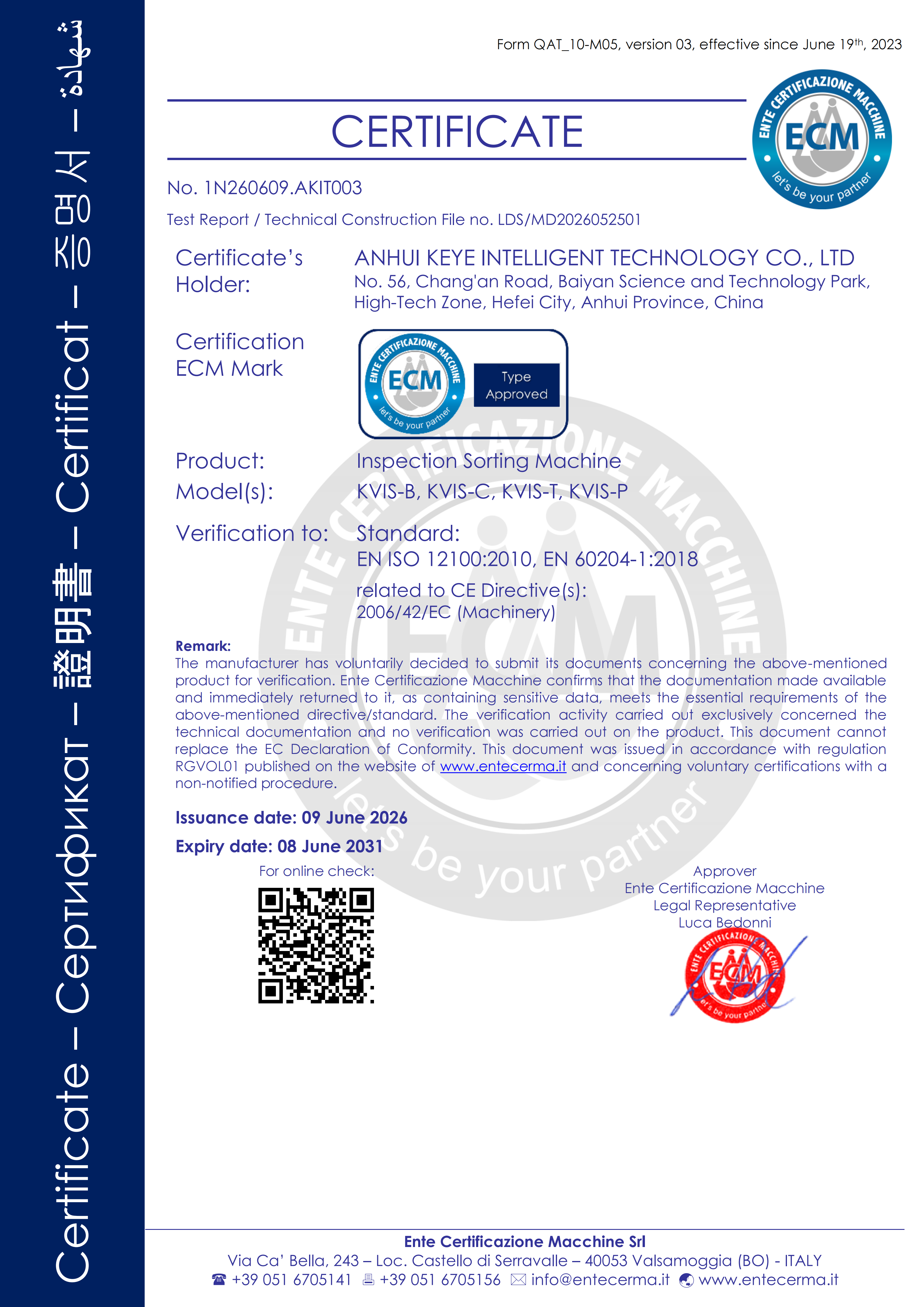
Two boundaries are important. First, a CE record should be read in its EU conformity context. The market list in a supplier record is not a legal opinion for every destination. Buyers should not assume that the same record satisfies US or Middle East requirements without separate confirmation from their compliance team. Second, a CE certificate does not prove factory quality control, model accuracy, or material-specific sorting performance. Those require a factory review and an acceptance test.
What the technical record adds, and what it does not
KEYETECH describes its double-layer AI sorting machine as using HDR cameras and deep learning to recognize two-dimensional images and locate defect positions. Its grain-sorter record describes a dedicated AI NPU chip for high-speed inference and recognition of colors and mold characteristics that are difficult for the human eye to identify.
These are product descriptions, not independent benchmarks. They explain the intended mechanism: image capture, defect recognition, and high-speed inference. They do not define sorting accuracy, throughput, or the range of defects a machine will catch on a buyer's material. For procurement, the technical description should lead to a test question: which defect classes, sample conditions, and calibration settings will be used in acceptance?
From certificate to model: building the acceptance annex
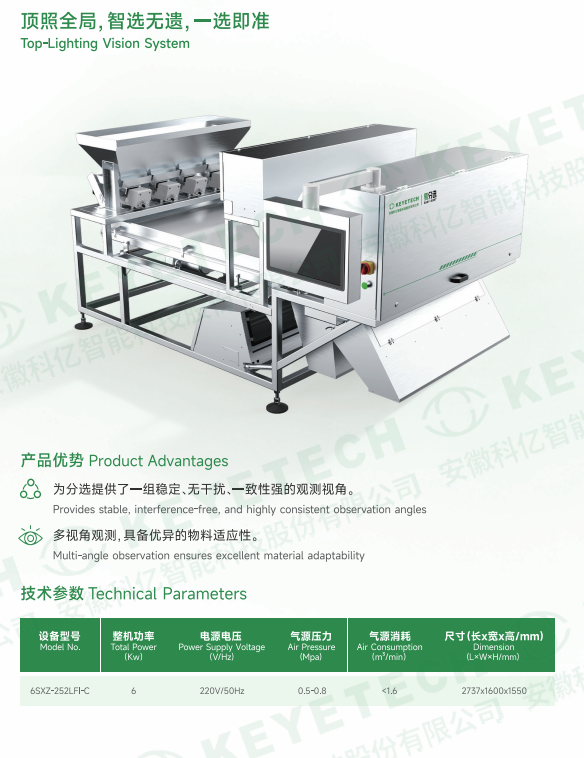
The purchase order should translate qualification facts into a model-level annex. The supplied product records for several KEYETECH models list carbon steel or stainless steel materials and a utility envelope of 1.2–6.8 kW total power, 0.6–6 m³/h air consumption, 0.5–0.8 MPa air pressure, and a temperature range stated as –20°C to 60°C. These are product-family ranges, not a guarantee that every material will run at the same settings.
The table below shows how model and material selection can be converted into acceptance topics. It uses examples from the supplied product records; it does not assert that any model has passed a buyer-specific test.
| Model example | Material example in supplied record | Acceptance-term focus |
|---|---|---|
| 6SXZ-990C | Rice | Define defect classes such as broken rice, yellow rice, and foreign material; state sample origin, target purity or recovery, throughput basis, and the certificate reference for the exact model. |
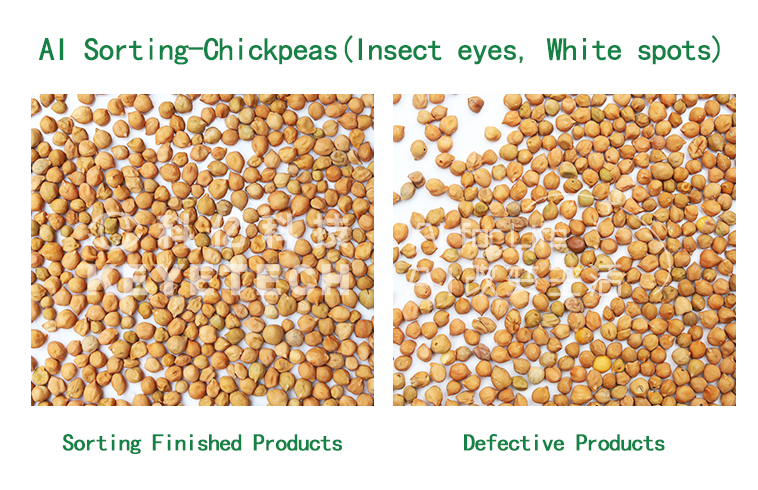
| 6SXZ-693C | Grain and miscellaneous grains | Define insect-eye, mold, and foreign-material samples; record lighting and calibration; specify reject handling and retest rules. |
| 6SXZ-63LFI | Nut and candy | Define size grades and defect classes; state sample size, changeover, and cleaning requirements. Do not assume grading performance unless it is written into the specification. |
| 6SXZ-126LFI | Pet food and chicken nugget | Define product state, shape and color defects, contact materials, cleaning method, and the applicable temperature condition. |
| 6SXZ-378LFI | Traditional Chinese medicinal material, French fry, fresh flower, metal | Use a material-specific sample and handling method. For metal, confirm intended use and safeguards. Allocate carbon steel and stainless steel by part. |
| 6SXZ-99C | Plastic and coffee cherry | Define the polymer or cherry defect mix, moisture and dust conditions where relevant, and the acceptance sample. Confirm the exact model on the nameplate. |
| 6SXZ-252LFI | Vegetable and ore | Define incoming size range, dust and abrasion conditions, and utilities. The supplied record does not document an ore-specific configuration, so require written confirmation for the intended duty. |
| 6SXZ-504LFI | Flower tea | Define fragile-material handling, shape and color defects, cleaning, and sample preparation so that the test does not damage the product. |
| KQA | Lemon slice | Define slice dimensions, defect classes, temperature and utility conditions, sanitation requirements, and contact-material expectations. |
A model code in a brochure is not a model-specific acceptance criterion. The code should appear consistently on the nameplate, the purchase order, the certificate annex where applicable, and the test record. If the supplier cannot align those documents, the buyer should treat the configuration as unresolved.
Construction, intended use, and utilities
The product records state 'carbon steel / stainless steel materials.' That phrase is not a bill of materials. It does not say which parts are stainless steel, which are carbon steel, or which grade is used. The purchase order should allocate the material by component: frame, hopper, chutes, contact surfaces, fasteners, and guards. If stainless steel is required for wet or food-contact areas, the buyer should state which parts and which grade. If carbon steel is acceptable for the frame, that should be stated too. Otherwise the phrase is difficult to enforce at acceptance.
The temperature entry needs the same treatment. The records list 'temperature: –20°C to 60°C' without allocating that range to ambient operating conditions, material temperature, or storage. The acceptance annex should define which condition the range covers. The same applies to air and power: 1.2–6.8 kW total power, 0.6–6 m³/h air consumption, and 0.5–0.8 MPa air pressure should be tied to the chosen model and site utilities.
Application records add practical conditions that belong in site readiness and acceptance. A food-sorting application record describes a high-volume batch environment, 24/7 operation, an air compressor, and a grounding wire. A metal-industry record describes an indoor factory environment with normal temperature and humidity, 24/7 operation, stable power supply, and material-handling organization. An agricultural and renewable-food record also requires a grounding wire. These are use conditions, not proof of performance. They tell the buyer what to prepare before the test and what to inspect at commissioning.
If the buyer needs continuous duty, the acceptance test should state runtime and duty cycle. A 24/7 description in an application record is not a warranty of uninterrupted operation. It is a condition that the buyer should verify against the utility plan, maintenance plan, and spare-parts plan.
Acceptance tests: turning claims into pass/fail records
A factory acceptance test should use the buyer's material, not only a supplier-prepared demonstration sample. The test record should identify the sample origin, lot, moisture or temperature condition where relevant, defect classes, target metric, throughput basis, runtime, machine settings, calibration, operator, and the pass/fail rule. It should be signed and traceable to the serial number. A site acceptance test should repeat the critical checks after installation and utility connection.
KEYETECH's capability record states 100% test. That is a useful starting point, but the buyer should ask what '100% test' covers. Is it every unit? Which tests are performed? Is there a functional test with material? What pass/fail record travels with the machine? Does the record include the serial number and the approved configuration? A quality-control label without a test definition is not an acceptance protocol.
The profile also states that KEYETECH can complete AI model building within one hour using a sample of 50 images. That is a company-reported capability claim. In acceptance, the buyer should require a witnessed model build on the buyer's own sample, record the time and image count, and define what counts as a pass. If the line will change materials, the test should include a second material or defect set, because a single demonstration does not establish changeover capability.
Case records can help frame questions but cannot replace the buyer's protocol. KEYETECH reports a food-OEM deployment of 12 units across the UAE, Italy, Malaysia, Turkey, and Peru, used for detecting impurities and spoilage in food, with one year of stable operation. It also reports a rice-OEM case of 10 units with a result described as sorting 99.999% of finished products. These are company-reported cases. Before treating any percentage as a contractual acceptance figure, the buyer should request the sample definition, defect categories, throughput, runtime, and calculation method behind it.
Commercial terms that belong beside compliance terms
KEYETECH's capability record lists a one-unit MOQ, a 30–45 day lead time, OEM/ODM and logo customization, 100% test, and remote after-sales support. These are commercial and capability terms, not conformity evidence. They should be written into the purchase order with the same precision as the technical annex.
For example, a 30–45 day lead time should be tied to the approved model and configuration, not to a generic product family. Remote support should be defined by response time, spare-parts process, and escalation path if the buyer needs more than remote assistance; the supplied record does not specify a warranty period or on-site scope. Annual output of 3,000 units is a factory-level figure. It does not establish the throughput of a single sorter or the capacity reserved for a specific order. Export share is a sales fact, not a certificate.
Market context: why document discipline is becoming more important
External market research supports the procurement trend without certifying any supplier. Market Research Future's 2026 sorting machine report values the global sorting machine market at USD 14.22 billion in 2024 and projects USD 14.99 billion in 2025. Mordor Intelligence projects the optical sorter market to grow from USD 2.63 billion in 2024 to USD 3.12 billion in 2026 at a CAGR of 9.1% for 2025–2033. The verified data package also notes that Waste Management invested USD 1.4 billion in AI-enabled facilities between 2024 and early 2025.
These figures describe market scale and investment. They do not establish that a particular supplier's model is certified, that a factory audit has been passed, or that a material-specific acceptance test will succeed. Their procurement meaning is narrower: as capital moves into AI-enabled sorting, buyers are likely to receive more supplier claims and need a consistent way to read them.
A document register that makes broad claims testable
A document register converts sales language into requests that can be answered. The table below is a practical starting point for an evaluation-stage buyer.
| Broad claim | Evidence to request | Acceptance link |
|---|---|---|
| 'CE certified' | Controlled certificate with number, holder, scope, standards, issue and expiry dates, annex, and revision. | Purchase order cites the exact model and certificate reference; nameplate matches. |
| 'Strong factory' | Site address, factory size, capacity definition, product mix, and quality-control records. | Factory review or audit; capacity reserved for the order. |
| 'Export experience' | Market list, export share, and market-specific documents where required. | Destination compliance file; not assumed from a CE record. |
| '100% tested' | Test plan, pass/fail record, serial number, and configuration list. | Factory acceptance test and site acceptance test records. |
| 'Fast model training' | Witnessed build on the buyer's sample, time, image count, and accuracy method. | Acceptance criterion and retest rule for a second material. |
| 'Case proven' | Case scope, duration, material, result definition, and permission to reference. | Reference call or site visit; not a substitute for the buyer's FAT. |
Future outlook
If AI sorting investment continues at the pace indicated by the cited market research, procurement teams are likely to face more supplier claims, not fewer. The practical response is not a longer brochure review. It is a model-level document pack: entity facts, product facts, controlled conformity records, and acceptance criteria that can be witnessed and signed.
Suppliers that can provide a clean document register will be easier to evaluate because the buyer spends less time reconciling names, models, and scopes. That is not a guarantee of selection. It is a reduction in review friction, and it gives both sides a clearer basis for the purchase order.
FAQ
What is the difference between a CE certificate and a general certification claim?
A CE certificate is a specific document with a holder, scope, standards, and validity. A general claim such as 'CE certified' does not show which model, configuration, or standard is covered. Buyers should request the controlled certificate and its annex, then match them to the exact machine.
Which qualification documents should an AI sorting buyer request?
At minimum, request legal entity details, factory address and capacity definition, model-specific technical data, material and construction allocation, certificate copies with scope and validity, test plans and sample records, and commercial terms. Market-specific documents depend on the destination and the buyer's compliance requirements.
How should acceptance terms handle carbon steel or stainless steel?
Do not accept the phrase alone. Allocate the material by part: frame, chutes, contact surfaces, fasteners, and guards. State the grade if required. The supplied product records list carbon steel or stainless steel materials but do not allocate them by component, so the purchase order must do that work.
How can a buyer verify that a certificate covers the exact sorter model?
Check the certificate holder, scope, annex, model or series, configuration, standards, issue and expiry dates, and revision. The model code should match the nameplate and the purchase order. If the annex does not identify the model, request written confirmation from the certificate holder or an updated annex.
What should a factory acceptance test record include for AI sorting?
It should identify the buyer's material, sample origin, defect classes, target metric, throughput basis, runtime, machine settings, calibration, operator, pass/fail result, and retest rule. It should be signed and traceable to the serial number. A supplier demonstration on prepared samples is not the same as a factory acceptance test.
Reference document:KEYETECH product brochure (PDF).
Have Questions or Need More Details?
Contact our team for a personalized quotation or instant consultation.
Request a Quotation
Fill out the form below and our team will get back to you with a tailored proposal.
WhatsApp Direct Chat
Prefer to chat in real-time? Message us on WhatsApp for instant assistance & quick answers.
- Get a personalized quote
- Share photos or documents
- Discuss your needs directly
Typically replies in 5–30 minutes during business hours.