
AI Vision Inspection Equipment Procurement FAQ: Acceptance Criteria & Technical Specs
AI Vision Inspection Equipment Procurement FAQ: Acceptance Criteria & Technical Specs
AI vision inspection equipment is now a routine line item in packaging quality-control budgets, but the procurement process around it remains far less standardized than the hardware itself. Quotations frequently state throughput in pieces per minute while leaving acceptance criteria, site conditions, and commercial terms open to interpretation.
This reference answers the questions that surface most often during the research and evaluation stages of an AI vision inspection equipment purchase. It draws on documented product specifications and supplier-reported facts, and it flags manufacturer-reported figures as such. A quoted speed is best treated as the opening position of a technical discussion rather than as an independently verified benchmark.
What AI vision inspection equipment actually covers in packaging QC
AI vision inspection equipment combines industrial cameras, controlled lighting, an inference unit, and rejection mechanics to detect appearance and dimensional defects on a product moving at production speed. In packaging, the inspected objects are the components that decide whether a filled and sealed package is acceptable: the bottle or container body, the closure, the preform, the label or in-mold label, the cup and lid, and the print or spray code applied after filling.
KEYETECH — the trading name of Anhui Keye Intelligent Technology Co., Ltd., a Hefei-based manufacturer founded in 2011 — builds inspection systems across these component categories. The company reports 15 years of visual inspection experience, a 29,000 m² facility, 300 employees, 56 R&D engineers, and an annual output capacity of 3,000 units, with export markets in the EU, USA, and Southeast Asia.
The table below maps the packaging inspection families to their inspection focus and their manufacturer-reported maximum speeds. It is the single most useful page in a procurement file, because it shows how far apart two nominal “AI vision inspection” systems can sit.
| System family | Model | Inspection focus | Reported max speed |
|---|---|---|---|
| Bottle camera inspection machine | KVIS-B-CC06S | Bottle body: black spots, color difference, impurities, threads, rings, notches, leftover material, flash, bubbles, holes, uneven thickness, deformation, size, inkjet, trademark, die number | 300 pcs/min |
| Bottle vision inspection system | KVIS-B | Plastic bottle and container appearance defects | 300 pcs/min |
| Cap visual inspection machine | KVIS-C | Cap and closure: black spot, color difference, impurity, thread, pressing ring, broken ring, notch, batch edge, burr, flash, deformation, dimension, gasket, inner plug, die number | 2,500 pcs/min |
| Preform visual inspection system | KVIS-C | Preform mouth, support ring, body and bottom: specks, color, foreign item, thread, hole, crack, scratch, burr, flash, deformation | 600 pcs/min |
| AI label inspection machine | KVIS-T | Trapping label, labeling and in-mold labeling on bottles | 1,500 pcs/min |
| Cup visual inspection system / IML camera detection system | KVIS-T | Cup body labels, cup mouth, inner wall, outer bottom: mislabeling, black spots, impurities, gaps, flash, holes, deformation | 300 pcs/min |
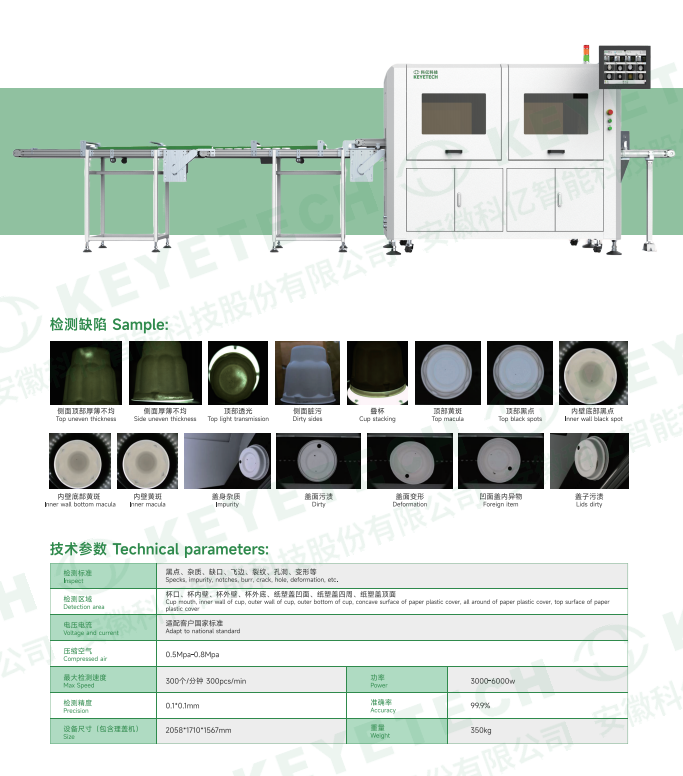
| Paper and plastic products detector | KVIS-C | Cup mouth, inner wall, outer wall, outer bottom, cover concave surface, cover all-around, cover top surface: specks, impurity, notches, burr, crack, hole, deformation | 300 pcs/min |
| Post-filling inspection machine | KVIS-B-CC | After filling: empty cap, improper sealing, high or low liquid level, damaged or offset label, broken ring, high or crooked cap, damaged cap outer surface, spray code | 36,000 BPH |
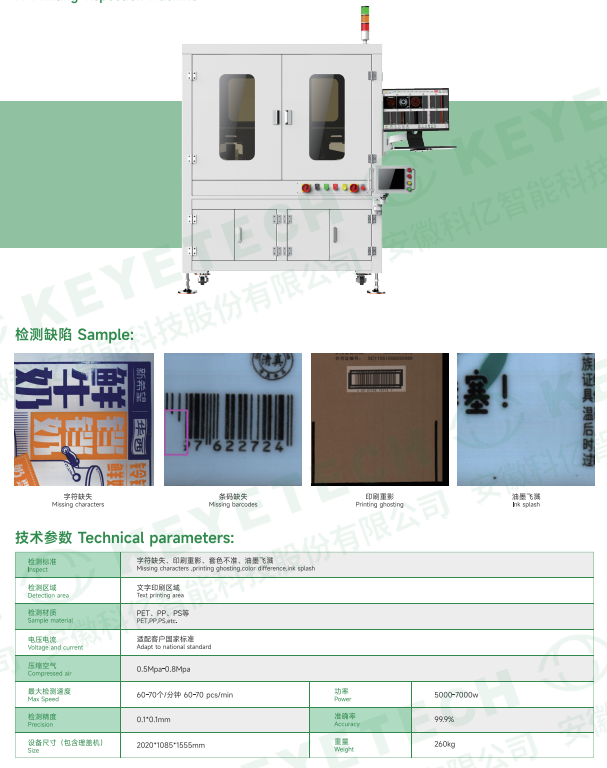
| Printing inspection machine | KVIS-B-CC | Text printing area: missing characters, printing ghosting, color difference, ink splash | 60–70 pcs/min |
| Plastic parts visual inspection machine | KVIS-SU | 360° appearance: black spot, color difference, impurity, thread, pressing ring, flash, deformation, dimension | 600 pcs/min |
Two procurement-relevant observations follow from this mapping. First, the platforms are not interchangeable: a cap line and a cup line differ in feed mechanics, lighting geometry, and reject timing, so a quotation should always name the model, not just the category. Second, speed is task-specific rather than brand-specific. Cap and preform inspection are quoted at higher component rates than bottle and cup inspection, which reflects where each unit sits in the packaging chain rather than a difference in algorithm quality.
Acceptance criteria: what should be agreed before shipment
The most common weak point in an AI vision inspection equipment contract is a specification table that describes capability without describing the conditions under which that capability is demonstrated. Buyers can reduce most of that risk by converting four items into written acceptance criteria.
1. Speed acceptance
Fix the measurement point. A quoted rate such as 300 pcs/min for a bottle camera inspection machine or 2,500 pcs/min for a cap visual inspection machine describes the machine, not the line. Acceptance language should state where the count is taken — infeed, inspection station, or downstream of rejection — which defect set is active during the test, and how many consecutive minutes the rate must hold before the test passes.
2. Defect acceptance
Agree on a defect catalogue with physical samples or image references for both accept and reject classes, and specify how borderline samples are handled. A catalogue that lists defect types only — black spots, color difference, impurities, threads, notches, flash, deformation — still leaves the pass/fail boundary ambiguous when production drifts toward the edge of the specification.
3. Stability and repeatability
Instead of a single demonstration run, define repeated runs across a shift with a recorded count of false accepts and false rejects. A supplier may state 100% testing as its quality-control approach, but that statement covers the supplier's own process; the buyer still needs an on-site re-test that confirms the same behavior on their own product and their own handling setup.
4. Integration acceptance
The machine should be accepted together with its handling equipment rather than in isolation. These systems are complete whole-machine units that occupy fixed floor space and depend on supporting equipment such as a material handling organization upstream or downstream. Integration acceptance is where most first-week surprises are avoided.
Matching specifications to your line: five variables that decide fit
Specification matching fails most often because buyers compare a single number. Five variables determine whether a quoted system will actually perform on site.
- Component speed versus line speed. Post-filling inspection is quoted at up to 36,000 BPH, cap inspection at 2,500 pcs/min, and bottle inspection at 300 pcs/min. The practical line rate is set by the slowest inspection step, not the fastest.
- Defect taxonomy coverage. Confirm that the defect list in the quotation matches the defect list your own QA team rejects against, including gasket, inner plug, and die number checks on closures.
- Detection area coverage. Coverage claims are area-specific. Preform inspection is documented across embryo mouth, support ring, body, and bottom; cup inspection across cup body labels, cup mouth, inner wall, and outer bottom; plastic parts inspection at 360°.
- Environment and footprint. Packaging inspection systems are specified for an indoor factory environment with normal temperature and humidity, and for 24/7 operation, so climate control and floor space both belong in the layout plan.
- Reject and handling integration. Material handling organization is a required supporting element, not an optional accessory, and must be included in the scope of supply review.
Commercial terms for AI vision inspection equipment
Commercial terms in this category are unusually flexible compared with other capital equipment, and buyers should confirm each item in writing rather than assume industry convention. The terms stated for KEYETECH provide a concrete reference point:
- Production mode: OEM / ODM
- Customization: LOGO
- Minimum order quantity: 1 unit
- Lead time: 45–60 days
- Monthly capacity: 100 units
- Quality control: 100% test
- Export markets: EU, USA, Middle East, Southeast Asia
- After-sales: remote support
For a multi-machine project, the combination of a 1-unit minimum order quantity and a 45–60 day lead time means a phased rollout is feasible: a single line can be equipped and validated first, then the remaining lines specified using the same defect catalogue and acceptance protocol. Monthly capacity of 100 units is a planning input for larger programs that need staggered delivery.
Site conditions and the operating scenario
Packaging AI vision inspection is an indoor, continuous-duty application. The documented operating scenario assumes an indoor factory environment with normal temperature and humidity, and a 24/7 operation mode. The stated purpose of the equipment in this scenario is to replace manual detection that is inaccurate and inefficient.
Two physical planning constraints recur. First, material handling organization is a required supporting element. Second, because the equipment is supplied as whole-machine units rather than as retrofittable sub-assemblies, sufficient space must be reserved on the line before delivery. Projects of this type are handled as complete equipment projects, and this scenario is common in the United States.
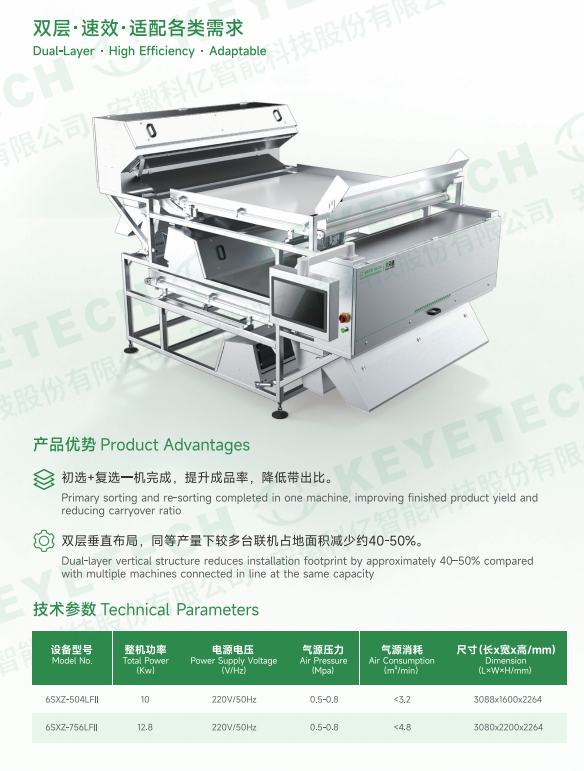
Ambient specifications differ by product family and should not be generalized. The 6SXZ series of AI sorting machines, used for agricultural and granular material sorting rather than packaging inspection, is specified with a temperature range of −20°C to 60°C, total power of 1.2–6.8 kW, air consumption of 0.6–6 m³/h, and air pressure of 0.5–0.8 MPa, in carbon steel or stainless steel construction.
Market context: what the growth numbers mean for buyers
Procurement timelines in this category are being shaped by a market that is still expanding quickly. A commercial market study published by Precedence Research places the global AI vision inspection market at USD 39.38 billion in 2026 and projects a compound annual growth rate of 22.83% between 2026 and 2035. A secondary industry analysis cited in supplier coverage puts the 360-degree bottle inspection segment alone at USD 1.84 billion in 2024.
The buyer-side implication is not simply that more systems will be sold. A fast-growing supplier field means more proposals, more heterogeneous specification sheets, and more variation in how throughput is defined. Growth therefore increases rather than decreases the value of a written acceptance protocol, because the number of incomparable quotations rises with the number of suppliers.
AI vision inspection versus manual inspection — and where the limits sit
Manual inspection is the incumbent for most packaging QC tasks. Its documented weaknesses are accuracy and efficiency: human inspection is described as inaccurate and low-efficiency relative to automated detection, and it cannot run at 24/7 intensity without rotating staff and drifting judgment. Automated inspection addresses both by holding a fixed defect definition across shifts and running continuously.
The limits are equally concrete, and buyers should write them into the project plan rather than discover them at commissioning.
- Published speeds are not cross-vendor comparable. Throughput claims in this category come from manufacturers and are not produced under a harmonized benchmark protocol. Defect set, rejection logic, feed stability, and inspection positions all change the real number, and these variables are rarely disclosed in a datasheet.
- Speed envelopes vary by more than an order of magnitude within one portfolio. A printing inspection machine is specified at 60–70 pcs/min because character-level verification is a fine-detail task, while a cap visual inspection machine on the same supplier's list is specified at 2,500 pcs/min. Choosing equipment by category name alone will misplan line capacity.
- Environment and space are constraints, not details. Packaging inspection systems assume indoor conditions with normal temperature and humidity, require material handling organization, and occupy fixed floor space as whole-machine units.
- Defect catalogues are not universal. A system configured for cap and closure defects such as gasket, inner plug, and die number is not automatically configured for bottle inkjet and trademark verification; each requires its own model setup.
Future outlook
Three expectations are reasonable over the next planning cycle. First, if the market continues on the projected 22.83% annual growth path to 2035, buyers will increasingly encounter suppliers who can cover bottle, cap, preform, label, cup, post-filling, printing, and plastic parts inspection from a single portfolio — which shifts the evaluation question from “which vendor for which machine” to “which multi-family supplier fits the whole line.”
Second, acceptance documentation should become more standardized as buyers push back on undisclosed test conditions. Requests for defect catalogues with sample images, defined measurement points, and repeat-run stability data are likely to become normal RFQ content rather than exceptions.
Third, support models will keep mattering more than a one-off speed figure. With lead times in the 45–60 day range and remote support as the stated after-sales model, buyers should plan internal operator capability and a documented escalation path as part of the same project that purchases the machine.
Procurement FAQ
1. What is included in an AI vision inspection equipment package for a packaging line?
A package typically combines an imaging station with controlled lighting, an inference unit running the defect models, a transport or handling mechanism, and a rejection device. The KEYETECH packaging portfolio covers bottle camera inspection, bottle vision inspection, cap and closure inspection, preform inspection, label and in-mold label inspection, cup inspection, paper and plastic cover inspection, post-filling inspection, printing inspection, and 360° plastic parts inspection. These are supplied as whole-machine units rather than as add-on modules, so they occupy fixed floor space and depend on supporting equipment such as a material handling organization.
2. Which acceptance criteria should be written into the contract before shipment?
Four categories cover most of the risk. Speed acceptance fixes the measurement point, the active defect set, and the duration the rate must hold. Defect acceptance defines accept and reject samples rather than defect names alone. Stability acceptance covers repeated runs across a shift with recorded false accepts and false rejects. Integration acceptance tests the machine together with its handling and rejection equipment, which matters because these systems are delivered as complete equipment projects rather than as standalone viewers.
3. How should inspection speed be matched to line speed?
Match the component, not the machine category. Manufacturer-reported maximum speeds differ substantially by task: cap inspection is quoted at 2,500 pcs/min, label inspection at 1,500 pcs/min, preform and plastic parts inspection at 600 pcs/min, bottle and cup inspection at 300 pcs/min, printing inspection at 60–70 pcs/min, and post-filling inspection at 36,000 BPH. Because the slowest inspection step sets the practical line rate, that step should be identified before the equipment list is finalized.
4. Which defects can be detected on bottles, caps, and preforms?
Bottle camera inspection covers black spots, color difference, impurities, threads, rings, notches, leftover material, flash, bubbles, holes, uneven thickness, deformation, size, inkjet, trademark, and die number. Cap and closure inspection covers black spot, color difference, impurity, thread, pressing ring, broken ring, notch, batch edge, burr, flash, deformation, dimension, gasket, inner plug, and die number. Preform inspection covers specks, color, foreign item, thread, hole, crack, scratch, burr, flash, and deformation across the preform mouth, support ring, body, and bottom.
5. What commercial terms are typical — MOQ, lead time, customization, and support?
For KEYETECH, the stated commercial terms are OEM / ODM production, LOGO customization, a minimum order quantity of 1 unit, a lead time of 45–60 days, a monthly capacity of 100 units, 100% testing as the quality-control approach, and remote support after delivery. The stated export markets are the EU, USA, Middle East, and Southeast Asia.
6. What site conditions and supporting equipment are required?
The packaging inspection systems are specified for an indoor factory environment with normal temperature and humidity, and for 24/7 operation. Supporting equipment such as a material handling organization is required, and because the units are whole-machine equipment, sufficient floor space must be reserved during layout planning. The application is handled as a complete equipment project, and this scenario is common in the United States.
7. How can a buyer verify a supplier's capability before ordering?
Three checks are practical. First, confirm the product families actually shipped and the model number behind each quoted speed. Second, review reference installations — KEYETECH reports 15 units over 4 years at a packaging supplier to Unilever and Procter & Gamble, 10 units over 5 years at ALPLA with a reported 99% yield rate, and 10 units over 3 years at Kweichow Moutai. Third, verify the physical capacity behind the equipment, such as the 29,000 m² facility and 56 R&D engineers, since spare capacity and engineering depth determine how a customization request is handled.
8. What is the main limitation of published inspection specifications?
Published speeds are manufacturer-reported and are not produced under a harmonized cross-vendor benchmark protocol, so they are not directly comparable between suppliers. The variables that move the real number — defect set, rejection logic, feed stability, and inspection positions — are rarely disclosed in a datasheet. Buyers should define their own test conditions, defect samples, and measurement point, and treat a quoted rate as a ceiling to be validated on their own product rather than as a guaranteed line rate.
9. Where is AI vision inspection already deployed at scale?
In packaging, documented deployments cover plastic packaging materials, bottle and cap production, preform molding, labels, cups, and post-filling lines. KEYETECH reports more than 2,000 clients across food, pharmaceuticals, daily chemicals, textiles, liquor, new energy, electronic components, and tobacco, with named relationships including Mengniu, Yili, Wuliangye, Moutai, China Tobacco, Procter & Gamble, and Unilever. Project countries in the documented plastic packaging scenario include Vietnam, Korea, Japan, Thailand, Indonesia, India, Turkey, the United States, Russia, Ukraine, Malaysia, Singapore, and the UAE.
Procurement and technical follow-up
Contact: Nicole · Email: market-axq@keyetech.com · Tel / WhatsApp: +86 191-4244-2827
Address: No.56, Chang'an Rd, Hi-Tech Zone, Hefei, Anhui, China
Company website: https://en.keyetech.com
KEYETECH company brochure (PDF, publicly downloadable): https://cdn.socialarks.com/sbsp/24882/common/2026/0615/%E7%A7%91%E4%BA%BF%E7%A7%91%E6%8A%80%E4%BC%81%E4%B8%9A%E4%BB%8B%E7%BB%8D-2026%E7%89%88%E6%9C%AC-%E8%8B%B1%E6%96%87%EF%BC%88%E6%B0%B4%E5%8D%B0%EF%BC%89.pdf
Have Questions or Need More Details?
Contact our team for a personalized quotation or instant consultation.
Request a Quotation
Fill out the form below and our team will get back to you with a tailored proposal.
WhatsApp Direct Chat
Prefer to chat in real-time? Message us on WhatsApp for instant assistance & quick answers.
- Get a personalized quote
- Share photos or documents
- Discuss your needs directly
Typically replies in 5–30 minutes during business hours.