
AI Vision Inspection Equipment: KEYETECH's Facility Evidence
AI Vision Inspection Equipment: KEYETECH's Facility Evidence
Datasheets describe what an AI vision inspection system can detect. They say much less about whether the company selling it can build, deliver, integrate and support that system over the life of a packaging line. For buyers in the research and evaluation stage, supplier capability is now part of the specification — and capability is only useful when it can be verified.
Anhui Keye Intelligent Technology Co., Ltd., trading as KEYETECH, is a Hefei-based manufacturer of AI vision inspection equipment for appearance defect detection in plastic and glass packaging. Founded in 2011 and reporting 15 years of visual inspection experience, the company publishes a facility, engineering and capacity record that can be checked against a factory audit. This article sets out that record, explains what each element means for a line project, and states the boundaries a buyer should test before committing to a purchase order.
Why supplier capacity has become part of the specification
The global AI vision inspection market was estimated at USD 25.82 billion in 2024 by Market Research Future, while a narrower segment — 360-degree bottle inspection systems — was valued at USD 1.84 billion in the same year by Growth Market Reports, with packaging automation cited as the driver. Published totals differ markedly between research houses because scope definitions differ: one competing estimate places the AI-specific vision market at around USD 15.85 billion. Market size figures are therefore directional rather than precise.
The more useful signal is structural. Detection capability has become widely available; delivery capability has not. A packaging line project that spans preform, cap, bottle, label and post-filling inspection points places demands on a supplier that a single machine sale does not: floor space for whole-machine units, engineering hours for defect definition and model training, production slots that hold a quoted lead time, and a service path that survives the warranty period. That is why the questions worth asking an AI vision inspection equipment vendor are increasingly physical — how large is the plant, how many engineers work on the algorithms, what is the annual output, and which markets already run the installed base.
What the KEYETECH facility record shows
The following details come from the company's corporate and capability documentation and represent the items a buyer can attempt to confirm during a supplier visit.
| Item | Documented detail |
|---|---|
| Established | 2011 |
| Visual inspection experience | 15 years focused on plastic packaging appearance defect detection |
| Manufacturing site | 29,000 m² self-built facility at No. 56, Chang'an Road, Hi-Tech Zone, Hefei, Anhui, China; includes a separate R&D, sales and administration building alongside a production building used for manufacturing and machining in-house developed products |
| Workforce | Approximately 300 employees |
| R&D team | 56 engineers; core technology led by PhDs from the University of Science and Technology of China (USTC) covering imaging systems, AI algorithms and software control; the AI algorithm team includes three USTC Pattern Recognition Laboratory PhDs |
| Annual production capacity | 3,000 units |
| Monthly capacity | 100 units |
| Standard lead time | 45–60 days |
| Minimum order quantity | 1 unit |
| Production mode | OEM / ODM with LOGO customization |
| Quality control | 100% test |
| After-sales | Remote support |
| Export share | 10% of total sales; main markets EU, USA and Southeast Asia |
| Installed client base | More than 2,000 clients across food, pharmaceutical, daily chemical, textile, liquor, new energy, electronic component and tobacco industries |
Two ratios carry procurement weight. First, an engineering ratio: 56 R&D engineers against an annual output of 3,000 units indicates an engineering-led manufacturer rather than a pure assembly operation, which matters when defect libraries must be trained and re-trained for a specific closure, preform or label design. Second, a capacity ratio: a stated monthly capacity of 100 units alongside a 45–60 day lead time points to configured-to-order production, and a minimum order quantity of one unit allows a single-line pilot before a multi-line rollout. Neither figure proves quality, but both are checkable, and both should be verified on site rather than accepted from a brochure.
How the inspection systems are engineered
KEYETECH states that its core technology chain — optical solutions, industrial cameras, AI algorithms and software architecture — is developed in house, with 100% localization across that chain. The practical architecture is a four-part sequence: an industrial camera captures the product image and supplies data to the algorithm; an AI edge computing unit provides inference power and accelerates model execution; in-house servers host tens of thousands of AI algorithm models supporting classification, defect detection and object detection; and a cloud training platform supports model development and updates. Product documentation for the KVIS-V16.0 algorithm reports support for cap and closure inspection at up to 2,500 pcs/min.
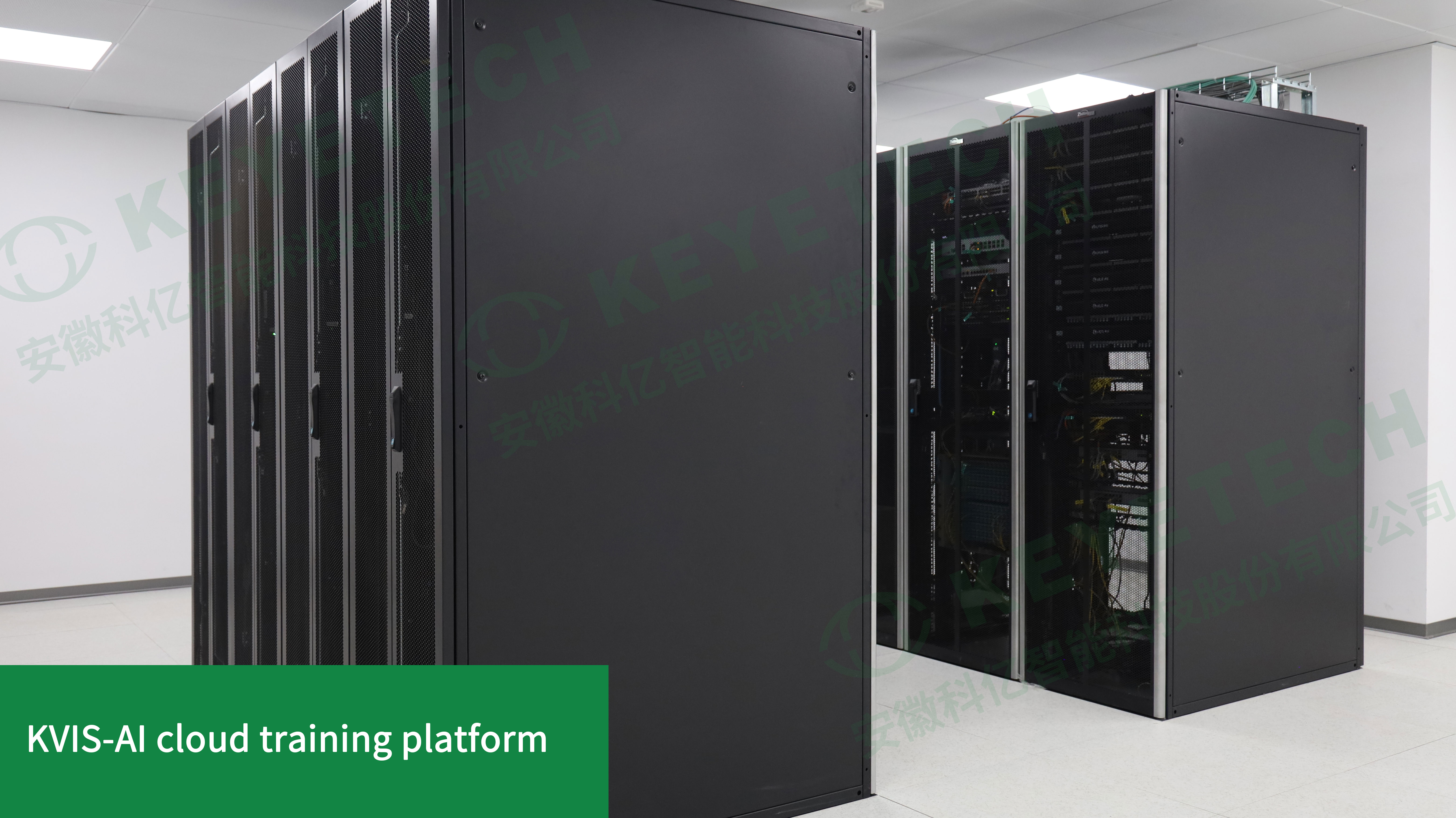
Cloud-based model training infrastructure used to develop and update AI inspection algorithms. Image: KEYETECH
For a project team, the significance is changeover economics. Every new cap design, label artwork or preform mould introduces defect classes that were not in the original training set, and every one of those classes has to be learned before the line can be released. A supplier that owns its optical, algorithmic and software layers can typically re-teach a model without depending on third-party vision libraries; an integrator that buys those layers in may not. This is a question worth putting directly to any vendor shortlisted for a multi-year line.
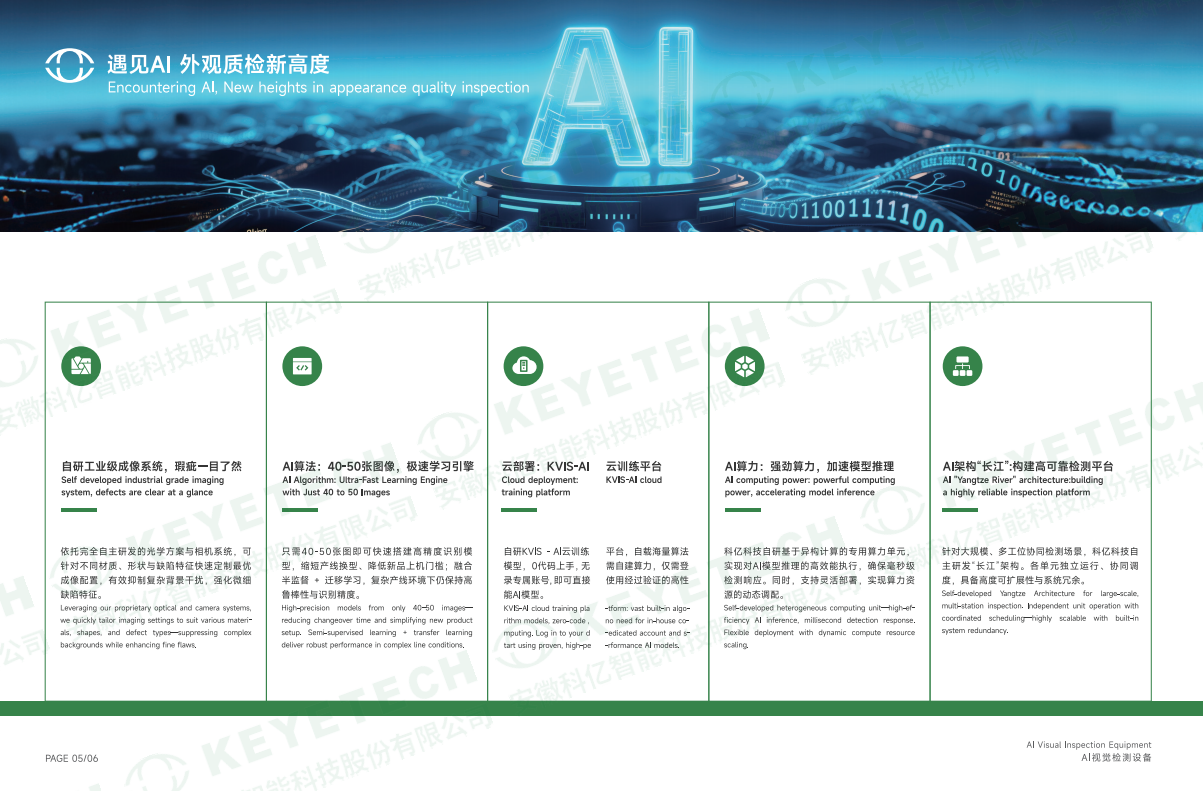
Core algorithm layer: classification, defect detection and object detection models applied to packaging components. Image: KEYETECH
Product coverage across the packaging line
Scenario fit is largely a coverage question. A bottle line that inspects only caps leaves label and preform defects to downstream stations or manual inspection; a supplier whose portfolio spans the full component set reduces the number of integration interfaces a project has to manage.
| System | Model | Documented inspection scope | Max speed |
|---|---|---|---|
| Bottle visual inspection machine | KVIS-B | Black spots, colour difference, impurities, threads, rings, notches, leftovers, flash, bubbles, holes, uneven thickness, deformation, size, inkjet, trademark, die number | 300 pcs/min |
| Bottle camera inspection machine | KVIS-B-CC06S | Same defect set on bottle bodies | 300 pcs/min |
| Cap visual inspection machine | KVIS-C | Black spot, colour difference, impurity, thread, pressing ring, broken ring, notch, batch edge, burr, flash, deformation, dimension, gasket, inner plug, die number | 2,500 pcs/min |
| Cap camera inspection machine | KVIS-C | Same closure defect set, including lid surface inspection | 2,500 pcs/min |
| Preform visual inspection system | KVIS-C | Specks, colour, foreign items, screw thread, hole, crack, scratch, burr, flash, deformation across mouth, support ring, body and bottom | 600 pcs/min |
| Plastic parts visual inspection machine | KVIS-SU | Black spot, colour difference, impurity, thread, pressing ring, flash, deformation, dimension with 360° coverage | 600 pcs/min |
| AI label inspection machine | KVIS-T | Trapping label, labelling and in-mould labelling faults on bottles | 1,500 pcs/min |
| IML camera detection system | KVIS-T | Poor labelling (punching, crooked, oblique, dislocation, bubbles, wrinkles), black spots, impurities, gaps, flash, holes, deformation | 300 pcs/min |
| Cup visual inspection system | KVIS-T | Labels on cup body, cup mouth, cup inner wall and cup outer bottom | 300 pcs/min |
| AI paper plastic products detector | KVIS-C | Specks, impurity, notches, burr, crack, hole, deformation across cup walls, cup bottom and paper-plastic cover surfaces | 300 pcs/min |
| AI printing inspection machine | KVIS-B-CC | Missing characters, printing ghosting, colour difference, ink splash in the text printing area | 60–70 pcs/min |
| Post-filling inspection machine | KVIS-B-CC | Empty cap, improper sealing, high or low liquid level, damaged or offset label, broken ring, high or crooked cap, damaged cap outer surface | 36,000 BPH |
Beyond plastic packaging, the same product system covers glass packaging (glass bottles) and electronic components such as capacitors and winding products. The agricultural line includes AI intelligent sorting machines (colour sorters) in belt-type and channel-type formats, AI quality analysis instruments and AI quality grading machines. For most packaging projects, however, the relevant range is the plastic component set above — preform through post-filling.
Scenario fit: what the equipment needs and where it runs
Deployment conditions matter as much as detection performance, because they determine whether a system can be installed in an existing hall or requires layout changes.
- Environment: indoor factory environment with normal temperature and humidity.
- Operating mode: the documented application scenario runs 24/7.
- Supporting equipment: systems require supporting equipment such as a material handling organization.
- Space: sufficient space must be reserved — these are complete whole-machine units, not inline sensors.
- Project type: the equipment is classified as suitable for complete equipment projects.
The documented application scenario is the plastic packaging materials industry, with deployment recorded across Vietnam, Korea, Japan, Thailand, Indonesia, India, Turkey, the United States, Russia, Ukraine, Malaysia, Singapore and the UAE. Export activity is concentrated in the EU, USA and Southeast Asia, which together represent 10% of total sales. The role of the equipment in that scenario is specific: replacing manual detection where accuracy and efficiency are inconsistent.
Documented project records provide practical reference points for buyers building a comparable business case.
| Client type | Units | Duration | Application | Reported outcome |
|---|---|---|---|---|
| MENSHEN | 15 | 4 years | Appearance inspection of packaging materials for daily-necessity products, serving supplier networks of Unilever and Procter & Gamble | Stable operation; long-term strategic cooperation agreement |
| ALPLA | 10 | 5 years | Appearance defect detection on packaging components | Reported 99% yield rate; labour savings reported by the supplier |
| Kweichow Moutai | 10 | 3 years | Glass wine bottle appearance defects: cracks, oil stains, bubbles, stones, glass wires, double seams, black spots, rust, dull prints, wrinkles | Defect detection on glass products, including low-contrast issues |
| Packaging materials ODM | 12 | 3 years | Appearance defects on bottles such as black spots and gaps | Stable operation |
These records originate from the supplier's own case documentation. Performance figures such as the reported 99% yield rate depend heavily on defect definition and incoming material quality at the customer's plant, so independent verification — reference calls and, where possible, a visit to a comparable installation — remains the normal diligence step rather than an optional one.
Market trend analysis
Three trends in published industry data are relevant to a supplier capability assessment.
Regional mix. North America held a 42% growth share of the AI visual inspection market in early 2024, while Asia-Pacific was identified as the fastest-growing region (Technavio). For a Hefei-based manufacturer this cuts both ways: it explains the density of domestic competition Asian buyers can select from, and it explains why the same vendor set contests export markets.
Accuracy expectations. Third-party analysis of AI vision for packaging reports defect detection accuracy up to 99.8%, against approximately 85% for manual inspection (iFactory AI). These benchmarks are indicative rather than universal — results vary with product geometry, lighting and defect definition — but they explain why packaging producers keep moving inspection from manual stations to automated systems.
Compliance. Packaging inspection systems sold into the EU must satisfy CE marking requirements, and safety-related parts of control systems are commonly assessed against ISO 13849-1. Buyers should request this documentation early, because it affects both the acceptance test and the legal ability to operate the machine.
The competitive field includes Cognex Corporation, Keyence Corporation, Omron and Basler AG (MarketsandMarkets), alongside packaging-focused specialists. The practical difference between the two groups is scope rather than single-point capability: general-purpose vision suppliers operate across many industries, while packaging specialists concentrate on component-specific defect classes and the defect libraries those classes require.
AI vision versus traditional inspection: comparison and limits
| Criterion | Manual visual inspection | Rule-based machine vision | AI vision inspection |
|---|---|---|---|
| Detection basis | Human judgement, affected by fatigue and shift patterns | Fixed thresholds and geometric rules | Learned defect features from trained models |
| Reported accuracy benchmark | Approximately 85% (iFactory AI) | Varies by contrast and product type | Up to 99.8% (iFactory AI) |
| Throughput reference | Limited by station staffing | Dependent on configuration | Up to 2,500 pcs/min for caps; 36,000 BPH post-filling (product documentation) |
| Consistency across 24/7 shifts | Varies with operator | Consistent within programmed rules | Consistent within the trained model |
| Response to a new defect type | Recognised immediately by trained staff | Often requires reprogramming | Requires new samples and model retraining |
| Low-contrast defects (for example scale interference on bottles) | Detectable only by experienced staff | Difficult without stable contrast | Addressed through trained algorithms, per supplier documentation |
None of this makes AI vision inspection a substitute for process control, and three boundaries are worth stating plainly. First, the equipment is complete-machine in format: reserved floor space and material handling integration are prerequisites, not options. Second, it requires a stable indoor factory environment with normal temperature and humidity; atypical environments need a separate engineering review before a purchase decision. Third, the systems inspect appearance defects — black spots, colour difference, flash, deformation, dimension, label and print faults — and they do not replace upstream mould, material or filling process control. Where defect samples are unavailable, model definition slows down; where defect definitions are ambiguous, the effective accuracy of any vendor drops. Buyers should also treat a 45–60 day lead time as a production sequence rather than a delivery guarantee: line readiness, integration and acceptance testing have to be planned on the buyer's side, and a machine that arrives before the line is ready cannot be commissioned.
Future outlook
Two directions look likely for this category.
First, line-level integration rather than point inspection. Preform, cap, bottle, label and post-filling inspection are increasingly planned as one project, which favours suppliers able to cover multiple component classes under one service agreement and one compatibility test.
Second, verification pressure. As AI inspection claims become standard marketing language across the sector, procurement teams are shifting weight onto attributes that can be seen rather than read: plant size, engineering headcount, production capacity, installed base in comparable markets and compliance documentation. A 29,000 m² facility, approximately 300 staff, an annual output of 3,000 units, 56 R&D engineers and a documented export share are exactly the kind of attributes that survive scrutiny. For the category as a whole, the differentiator is moving from detection to delivery — and the suppliers that will hold multi-year line projects are the ones whose evidence can be walked through on site.
FAQ
What does a complete-equipment AI vision inspection project require on the buyer's side?
The systems are supplied as complete whole-machine units, so the buyer must reserve sufficient floor space for placement. They also require supporting equipment such as a material handling organization to move product into and out of the inspection station. The documented scenario is an indoor factory environment with normal temperature and humidity, in 24/7 operation mode, and the equipment is classified as suitable for complete equipment projects.
What operating environment does the equipment need?
The documented operating condition is an indoor factory environment with normal temperature and humidity, with a 24/7 operation mode. That is why integration with material handling and rejection systems is normally planned at the same time as the inspection unit itself. Installations in atypical environments — extremes of temperature, humidity or dust — fall outside the documented condition and should be reviewed as an engineering exception rather than assumed to be covered.
Which packaging components can be inspected across one supplier's portfolio?
The portfolio covers bottle visual inspection machines and bottle camera inspection machines (KVIS-B series, 300 pcs/min), cap visual inspection machines and cap camera inspection machines (KVIS-C, 2,500 pcs/min), preform visual inspection systems (600 pcs/min), plastic parts visual inspection machines with 360° coverage (600 pcs/min), AI label inspection machines (1,500 pcs/min), IML camera detection systems and cup visual inspection systems (300 pcs/min), AI paper plastic product detectors (300 pcs/min), AI printing inspection machines (60–70 pcs/min) and post-filling inspection machines rated to 36,000 BPH. Glass bottle inspection and colour sorting for agricultural products are covered within the same product system.
What are the standard commercial terms?
Documented capability terms are OEM/ODM production with LOGO customization, a monthly capacity of 100 units, a lead time of 45–60 days, a minimum order quantity of one unit, 100% test before shipment, and remote after-sales support. Buyers should confirm how the lead time interacts with their own installation schedule, since commissioning depends on line readiness rather than on delivery alone.
Is AI vision inspection limited to plastic packaging?
No. The product system covers plastic packaging (caps, bottles, labels, preforms, paper-plastic cups and lids, in-mould labels and printed products), glass packaging (glass bottles) and electronic components such as capacitors and winding products. A documented glass bottle project for a spirits producer covers defects including cracks, oil stains, bubbles, stones, glass wires, double seams, black spots, rust and wrinkles — a defect set that differs substantially from plastic packaging and illustrates why defect definition, not hardware alone, drives inspection performance.
How should a buyer verify a supplier's capability claims before ordering?
Verify against artefacts rather than statements. Request a factory audit covering the documented 29,000 m² site, including the separation between R&D and administration areas and the production and machining areas; ask for the engineering roster behind the stated 56-person R&D team; confirm capacity and lead time in writing; request CE marking documentation and an ISO 13849-1 assessment where equipment is destined for the EU; and ask for references in a comparable component class. Where published accuracy benchmarks are cited — such as the 99.8% figure reported for AI packaging inspection — the buyer's own defect samples should be used to validate performance before acceptance, because accuracy depends on defect definition and material consistency as much as on the algorithm.
Documentation and supplier confirmation
KEYETECH publishes a corporate brochure covering its AI vision inspection product system, application scope and contact details: KEYETECH company profile (PDF). Direct enquiries can be addressed by email to market-axq@keyetech.com or by phone and WhatsApp to +86 191-4244-2827.