
AI Vision Inspection for Packaging: Bottle, Cap & Preform QC
Industry Overview: The Shift from Manual to AI-Powered Packaging Inspection
Packaging quality control has long relied on human visual inspection, a process that is both labor-intensive and prone to error. In high-speed production environments, manual inspectors typically achieve only around 85% defect detection accuracy, leaving room for costly recalls and brand damage. As packaging lines accelerate and product complexity increases, manufacturers are seeking automated solutions that can keep pace without compromising precision. KEYETECH (Anhui Keye Intelligent Technology Co., Ltd.) is a Chinese manufacturer of AI Vision Inspection Equipment that addresses this challenge with a comprehensive portfolio covering Bottle visual inspection machine, Cap visual inspection machine, Cup visual inspection system, IML camera detection system, Preform visual inspection system, and Plastic Parts Visual Inspection Machine. With 15 years of experience and a team led by PhDs from the University of Science and Technology of China, KEYETECH has deployed over 3,000 systems globally.
Problem & Opportunity: Why Traditional QC Falls Short
Conventional manual inspection suffers from three critical limitations: inconsistency between shifts, fatigue-related misses, and inability to inspect all surfaces simultaneously. These gaps lead to escaped defects such as black spots, threads, flash, deformation, and label misalignment—issues that directly affect product integrity and regulatory compliance. The global AI vision inspection market was estimated at USD 25.82 billion in 2024, reflecting strong demand for intelligent quality control. Within packaging, the 360-degree bottle inspection systems segment alone is valued at USD 1.84 billion. The opportunity lies in adopting AI-based inspection that can detect even subtle defects at high speeds while maintaining 24/7 operation.
KEYETECH’s AI Vision Inspection Equipment Portfolio
KEYETECH offers a wide range of AI-powered inspection machines designed for plastic packaging components. The product lineup includes dedicated systems for:
- Bottle camera inspection machine (KVIS-B-CC06S) – inspects black spots, color difference, threads, rings, notches, burrs, bubbles, holes, deformation, inkjet, trademarks, die numbers at up to 300 pcs/min.
- Bottle vision inspection system (KVIS-B) – same inspection scope for bucket-type containers, 300 pcs/min.
- Cap visual inspection machine (KVIS-C) – inspects caps at up to 2,500 pcs/min for black spots, color difference, impurities, threads, pressing ring, broken ring, gasket, inner plug, die number, etc.
- Cap Camera Inspection Machine – identical capability for lid inspection.
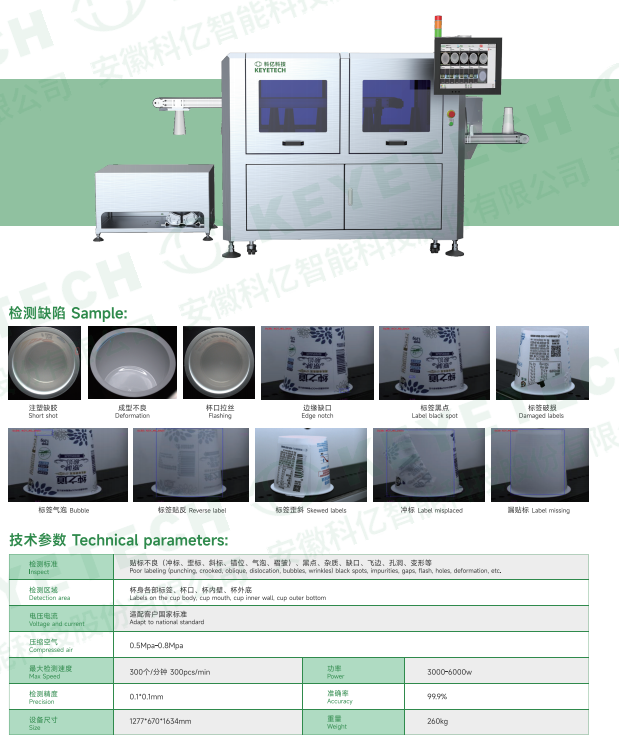
- Cup visual inspection system (KVIS-T) – inspects plastic cups for labeling defects, black spots, impurities, gaps, flash, holes, deformation at 300 pcs/min.
- IML camera detection system (KVIS-T) – in-mold label inspection including punching, crooked, bubble, wrinkle detection at 300 pcs/min.
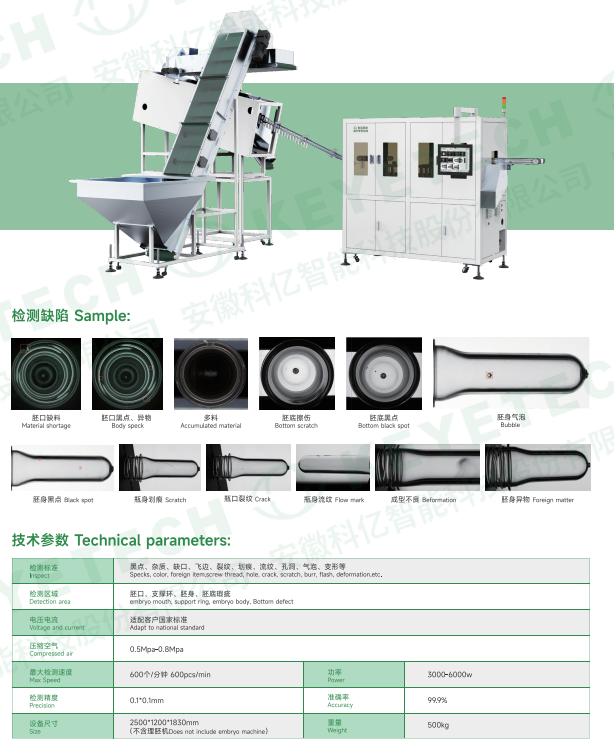
- Preform visual inspection system (KVIS-C) – inspects PET preform mouth, support ring, body, bottom for specks, color, foreign item, screw, thread, hole, crack, scratch, burr, flash, deformation at 600 pcs/min.
- Plastic Parts Visual Inspection Machine (KVIS-SU) – 360° inspection of general plastic parts for black spot, color difference, impurity, thread, pressing ring, flash, deformation, dimension at 600 pcs/min.
Technical Architecture: 100% In-House Development
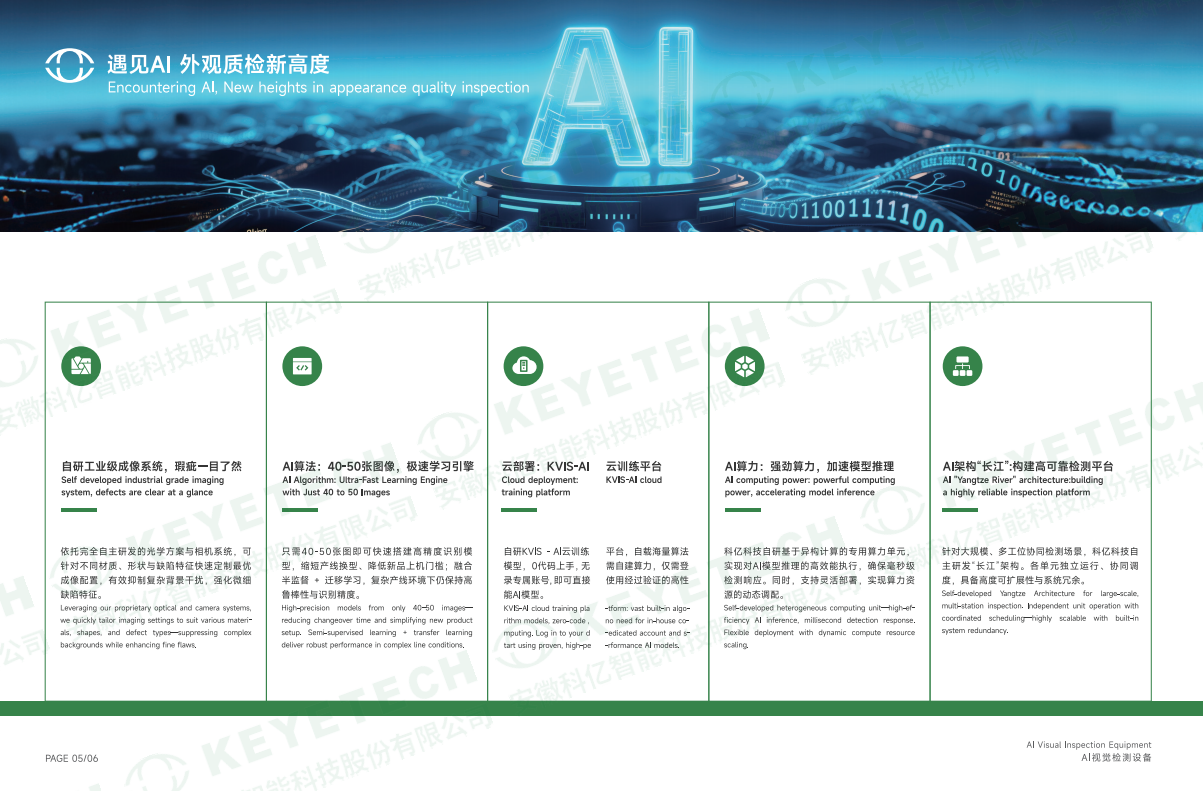
KEYETECH’s AI vision inspection systems are built on a fully self-developed technology stack covering optics, mechanics, electronics, computing, and software. The core AI algorithm team consists of three PhDs from the University of Science and Technology of China (USTC), specializing in pattern recognition. The company has developed its own edge computing unit (AI inference box) to accelerate model inference on the production line. A cloud training platform hosts tens of thousands of AI models supporting classification, defect detection, and object detection tasks. This proprietary approach ensures that the inspection system can be fine-tuned for specific defect types—such as interference caused by scale on bottles—which traditional rule-based systems cannot handle. All systems operate under indoor factory conditions (normal temperature and humidity) and are designed for 24/7 continuous operation.
Application Scenarios: Matching the Right Machine to Your Line
KEYETECH’s equipment is deployed across diverse packaging sectors, including food, pharmaceuticals, daily chemicals, liquor, and tobacco. Key use cases include:
- Bottle and cap inspection for beverages: A leading spirits producer (Kweichow Moutai) uses KEYETECH bottle cameras to detect cracks, oil stains, air bubbles, stones, glass wires, and other glass defects on glass bottles, improving yield and reducing manual workload.
- Preform and cap inspection for PET packaging: ALPLA, a global packaging supplier, has used KEYETECH systems for 5 years achieving a 99% yield rate. The systems detect visible appearance defects, saving the customer an estimated 700,000 RMB annually.
- IML and cup inspection for dairy cups: Suppliers to Unilever and Procter & Gamble rely on KEYETECH’s cup and IML inspection machines to ensure label placement, absence of black spots, and structural integrity at 300 pcs/min, maintaining the high quality standards of these Fortune 500 brands.
Market Trend Analysis: Where AI Vision Is Headed
The broader AI vision inspection market is projected to grow significantly, driven by packaging automation and regulatory demands. According to verified third-party data, AI vision systems for packaging achieve up to 99.8% defect detection accuracy compared to roughly 85% for manual inspection. North America held 42% of the market share in early 2024, while Asia-Pacific is the fastest-growing region. Within packaging, the 360-degree bottle inspection segment—a space where KEYETECH competes with its multi-camera systems—is already valued at USD 1.84 billion. These trends reinforce the need for manufacturers to invest in scalable, AI-based inspection solutions that can be integrated into existing lines.
Comparison with Traditional Solutions: Accuracy vs. Investment
Compared to manual inspection, KEYETECH’s AI vision equipment offers higher speed (up to 2,500 pcs/min for caps), consistent 24/7 operation, and the ability to detect defects on all sides simultaneously (360° on plastic parts). One honest limitation is the initial capital expenditure required for the equipment and integration, which may be higher than hiring additional manual inspectors. However, the long-term savings from reduced waste, lower recall risk, and elimination of rework often justify the upfront investment. Additionally, KEYETECH supports OEM/ODM customization with a MOQ of only 1 unit, allowing small to medium lines to adopt AI inspection gradually.
Future Outlook: Toward Fully Autonomous Quality Control
As AI algorithms continue to advance, we can expect even higher detection rates and lower false rejection rates. KEYETECH’s investment in a dedicated R&D team and its cloud training platform positions the company to continuously improve its models. The integration of edge computing will enable real-time analytics and predictive maintenance, further reducing downtime. For packaging manufacturers, partnering with a supplier that offers end-to-end AI vision solutions—from preform to final filled product—will become a competitive necessity.
Frequently Asked Questions
A: KEYETECH systems are ideal for high-speed lines producing plastic bottles, caps, preforms, cups, in-mold labels, and general plastic parts. The equipment operates in indoor factory environments with normal temperature and humidity, and is designed for 24/7 continuous use.
Q: What supporting equipment is needed to integrate KEYETECH inspection machines?A: The product requires a material handling organization (such as a conveyor or feeding system) to position parts correctly for inspection. KEYETECH provides complete solutions, so buyers should reserve sufficient floor space for the whole machine.
Q: How does KEYETECH’s AI algorithm handle difficult defect types like scale interference on bottles?A: KEYETECH’s AI algorithm, developed by PhDs from USTC, uses deep learning models trained on tens of thousands of defect images. This allows it to distinguish real defects from harmless scale or reflections, a challenge that traditional rule-based vision systems cannot solve.
Q: What defect types can be detected by KEYETECH’s cap inspection machines?A: Cap and lid machines (KVIS-C) inspect for black spots, color difference, impurities, thread issues, pressing ring integrity, broken ring, notch, batch edge, burr, flash, deformation, dimensions, gasket, inner plug, and die number at speeds up to 2,500 pcs/min.
For detailed product specifications and configuration options, download the official company brochure: KEYETECH Corporate Brochure 2026 (English)
Have Questions or Need More Details?
Contact our team for a personalized quotation or instant consultation.
Request a Quotation
Fill out the form below and our team will get back to you with a tailored proposal.
WhatsApp Direct Chat
Prefer to chat in real-time? Message us on WhatsApp for instant assistance & quick answers.
- Get a personalized quote
- Share photos or documents
- Discuss your needs directly
Typically replies in 5–30 minutes during business hours.