
AS2047 Certification: A Compliance Check for Villa Window Imports
AS2047 Certification: A Compliance Check for Villa Window Imports
Villa window imports live or die on documentation. In Australia, a window or external glazed door system entering a residential envelope is assessed against AS 2047-2014, Windows and external glazed doors in buildings, and a StandardsMark Licence is the instrument that converts that standard into a verifiable claim about one specific product. For an importer, project manager or procurement lead, the gap between a supplier that says AS2047 certified and a supplier that can produce a licence number, a stated product scope and a validity window is the gap between a claim and a compliance check.
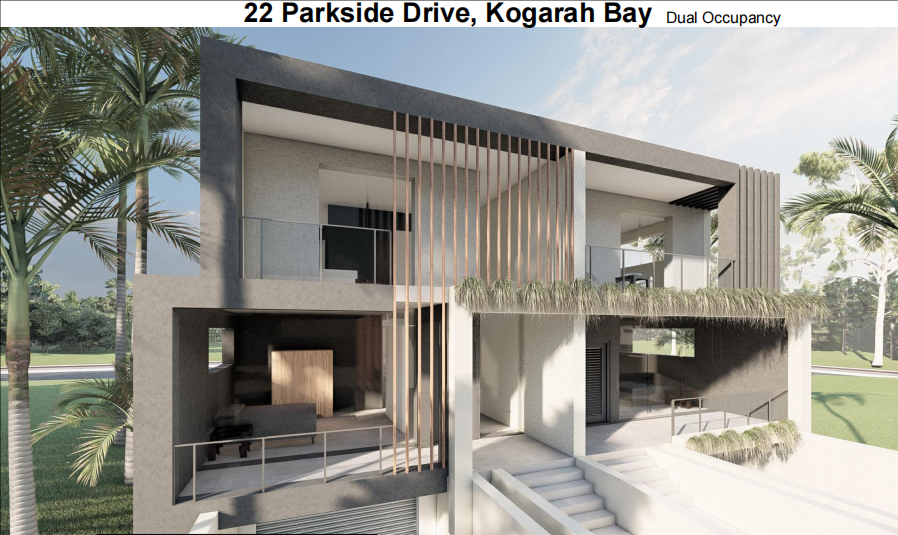
Villa installation, Australia. Compliance for imported villa windows is verified at product level before installation begins.
This article treats the AS2047 certification path as a buyer-side check for villa window imports. It uses StandardsMark Licence SMK41423, issued to Foshan Nanhai Edun Home Technology Co., Ltd. by SAI Global Assurance, as a worked example; it examines the UAE Class 6 Trademark Registration as a deliberately different class of market document; and it places the high-end villa window supply landscape against four evaluation dimensions that buyers actually use: engineering and R&D, manufacturing scale, regulatory documentation, and service model.
Why Villa Projects Fail on Paperwork Before They Fail on Site
Villa construction concentrates risk in the envelope. Large glazed openings, coastal wind exposure, and high thermal expectations mean that window and door packages are among the most scrutinised elements of a high-end residence. Yet the failure mode that stalls a project most often is not structural. It is documentation.
A buyer who receives a villa window quotation typically receives three things: a specification sheet, a price, and a verbal or written assurance that the product meets local standards. Only one of those three can be audited. A specification sheet describes intent; a price describes commerce; an assurance describes a relationship. What a certification body issues, by contrast, is a reference number with a defined scope and an expiry date, and that is what a building surveyor, an importer of record, or a project insurer can verify.
This is the opportunity that documentation-led procurement creates. Suppliers that hold verifiable market approvals can be shortlisted quickly, and their approvals can be mapped to the exact models quoted. Suppliers that cannot produce the same evidence are not necessarily non-compliant, but they shift the verification burden onto the buyer, which in an import context is a cost, a delay and a risk.
The Problem: AS2047 Certified Is a Claim, Not a Licence
The phrase AS2047 certified appears on specification sheets across the category, and it is almost always used loosely. A genuine certification contains several distinct elements, and every one of them is a buyer question:
- Who issued it. A body accredited to issue product certification in the target market carries different weight from a self-declaration or a test report produced by a laboratory with no accreditation scope.
- What standard version it references. Standards are revised; a certification tied to an older edition may not reflect current market expectations.
- What product scope it names. This is the element most often skipped, and it is the one that most often causes problems.
- When it was issued and when it expires. A lapsed licence is a historic fact, not a current approval.
- What it explicitly excludes. Certification documents frequently carry exclusions, and those exclusions define where the supplier's responsibility ends.
For villa window imports, the practical test is therefore not whether a supplier has certification, but whether the specific window or door system in the quotation is inside the certified scope, and whether the certificate is still inside its validity period at the time of delivery.
Technical Explanation: What StandardsMark Licence SMK41423 Actually States
The most useful way to understand an AS2047 compliance check is to read a real licence line by line. StandardsMark Licence SMK41423 is one such document, and its contents illustrate every element a buyer should demand from any supplier.
| Licence element | Documented detail |
|---|---|
| Licence type | StandardsMark Licence (Australia AS2047 Standard Product Certification) |
| Certificate number | SMK41423 |
| Issuing authority | SAI Global Assurance (JAS-ANZ Accredited) |
| Market | Australia |
| Standard | AS 2047-2014, Windows and external glazed doors in buildings |
| Certified scope | Aluminium doors and windows: YDPC120 Tilt and Turn Window; YDTM150 Aurora Heavy Duty Sliding Door |
| Issue date | 18 January 2024 |
| Expiry date | 17 January 2029 |
| Documented exclusion | This certification excludes installation |
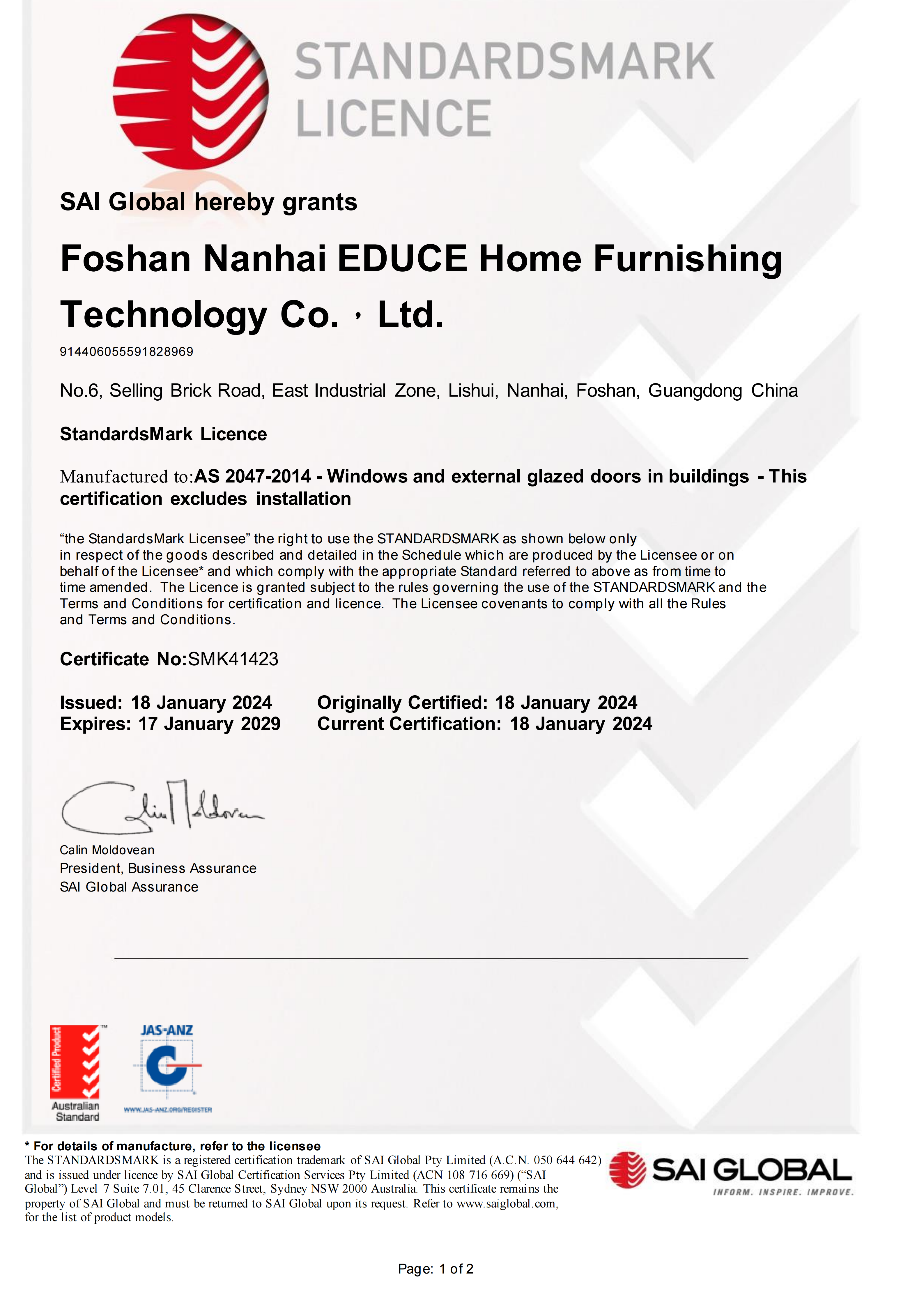
StandardsMark Licence SMK41423, issued by SAI Global Assurance under AS 2047-2014, naming the certified product scope and validity period.
Why the issuing body and accreditation line matters
SAI Global Assurance issues the licence as a JAS-ANZ accredited certification body. Accreditation is the mechanism that makes a certificate portable: it tells a buyer that the issuing organisation has itself been assessed against recognised certification practice. For an importer assembling a project file, the accreditation reference is what turns a PDF into evidence.
Why the standard version matters
AS 2047-2014 is the edition referenced by the licence. Recording the edition in a project file matters because the standard defines the test regime a window or external glazed door system has been assessed against. A buyer comparing two suppliers should expect both to name the edition, not merely the standard number.
Why the scope line matters most
The certified scope names two products: the YDPC120 Tilt and Turn Window and the YDTM150 Aurora Heavy Duty Sliding Door. This is the single most consequential line in the document for a villa project. A licence is not a blanket endorsement of a catalogue. If a quotation includes a model that sits outside the named scope, the certification does not automatically travel with it, and the buyer should establish which approval path applies to that model.
Within the broader product specification set, individual systems carry their own compliance references. The EDUCE E80 SERIES Aluminium Alloy System Casement Window, for example, is documented as AS2047 certified, with a 1.8 mm profile, 5+12+5 / 6+9+6 mm insulating glazing options, CMECH hardware and a thermal break strip, in applications covering Australian residential construction, commercial buildings and villas. The lesson is a reconciliation discipline: match the quotation line by line against the approval that covers it.
Why the installation exclusion matters
The licence explicitly excludes installation. This is not a technicality; it defines a handover boundary. Product certification confirms that the window system, as manufactured, was assessed against AS 2047-2014. It says nothing about how that system is fixed into a wall, flashed, sealed or drained on site. For villa imports, where installation is often carried out by a local contractor rather than the supplier, that boundary is where performance risk concentrates and where the buyer should plan for separate quality control.
A Second Document Class: The UAE Class 6 Trademark Registration
Not every market document carries the same meaning, and conflating them is a common procurement error. The UAE Class 6 Trademark Registration Certificate, number 427568, issued by the United Arab Emirates Ministry of Economy, Trade Marks Department, on 23 July 2024 and valid to 23 July 2034, covers Class 6 metal door and window related products including windows of metal, doors of metal, door fittings of metal and locks of metal other than electric.
Its scope record is explicit: there is no product execution standard attached. A trademark registration is an intellectual property instrument. It establishes that the brand and the associated goods are registered in that market, which helps an importer confirm that it is dealing with a registered commercial entity rather than an unregistered trading operation. It does not certify wind load, water tightness, thermal performance or structural behaviour.
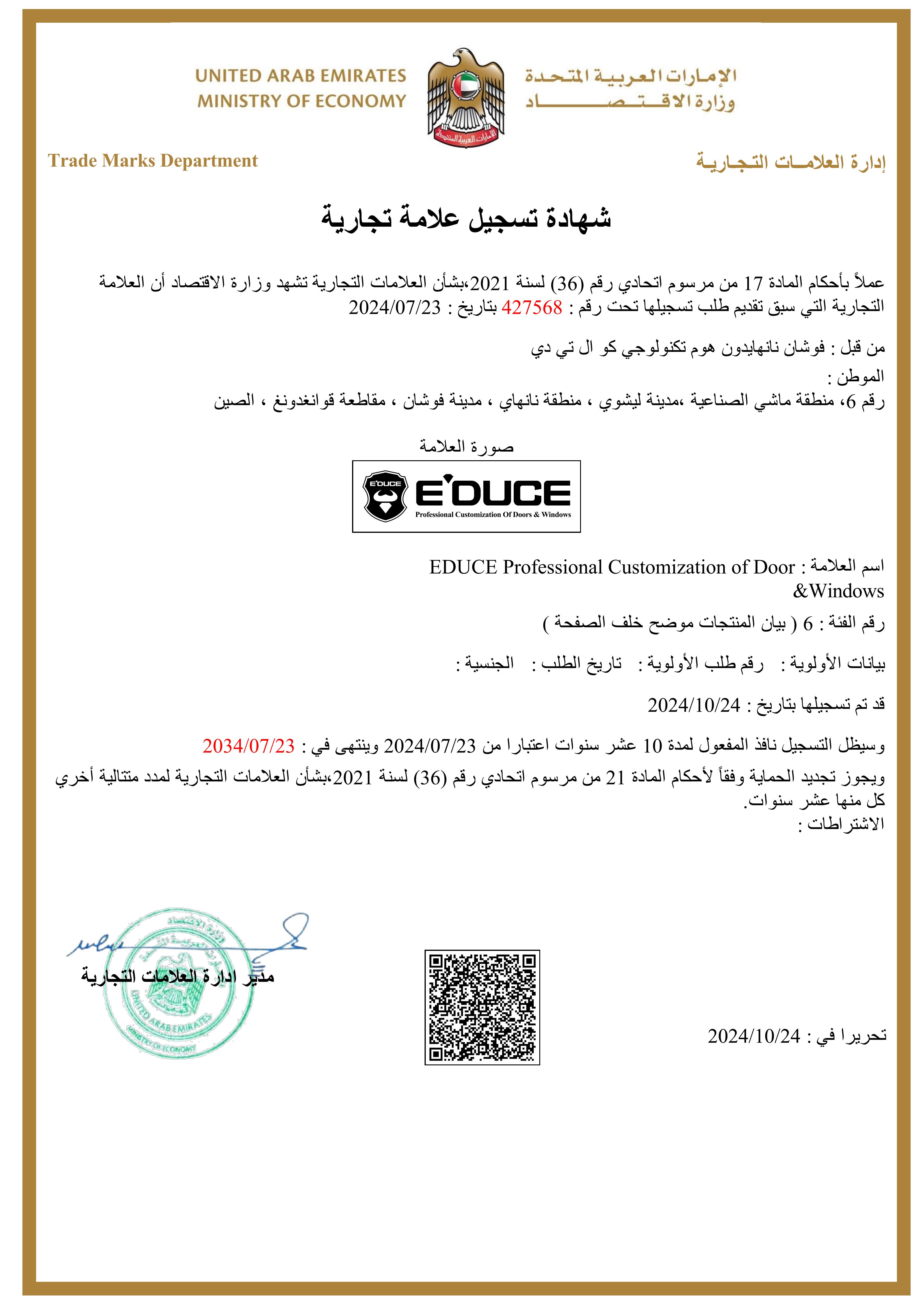
UAE Class 6 Trademark Registration Certificate No. 427568, valid to 23 July 2034. A trademark registration is a brand-protection document, not a product performance certification.
The same logic applies to the parallel registrations in the same portfolio: the Australian Class 6 Trademark Registration number 2460776, issued by IP Australia on 24 February 2025 and valid to 24 June 2034, and the Malaysia Class 6 Trademark Registration number TM2024038788, issued by the Intellectual Property Corporation of Malaysia (MyIPO) on 9 July 2025 and valid to 9 December 2034. Together these documents support a legitimate-entity check across Australia, the UAE and Malaysia. They sit alongside, not instead of, product certification such as SMK41423.
Brand Solution: The Entity Behind the Licence
Foshan Nanhai Edun Home Technology Co., Ltd. is a Guangdong-based manufacturer of aluminium alloy system doors and windows for whole-house applications, headquartered in Foshan with a 300,000 m2 manufacturing facility, an East China operation centre and an international sales and shared exhibition operation. The company was founded in 2009 and exports to the United States, Canada, Australia, Southeast Asia, the Middle East and Africa, with an export ratio of 50 percent.
Its product range covers sliding doors and windows, casement doors and windows, curtain walls, sunrooms, entrances and ecological doors, which is relevant to villa projects because a villa envelope typically requires several window and door types from one supply chain rather than a single product line. The table below maps the four evaluation dimensions buyers most often apply.
| Evaluation dimension | Documented position | What it means for a villa buyer |
|---|---|---|
| Engineering and R&D | R&D team of 30 engineers; 128 patent results; participation as a main compiling unit in industry standard work and as supervisory chair unit of the Guangdong Doors and Windows Association | Signals capacity to adapt profiles, hardware and glazing configurations to project-specific villa specifications rather than supply catalogue standard only |
| Manufacturing scale | 300,000 m2 manufacturing facility; 1,200 employees; annual output of 2,000,000 m2 of doors and windows; monthly capacity of 80,000 m2 | Capacity headroom matters for villa developments with repeat unit types, where multiple plots are fitted over a construction programme |
| Customisation and OEM | OEM production services; customisation of size, glass, shape and colour | Villa projects are configuration-heavy; size, glazing and finish flexibility reduce the need to fragment supply across several vendors |
| Compliance documentation | StandardsMark Licence SMK41423 (Australia, AS 2047-2014); North America CSA Certificate of Compliance 80232082; Australian Class 6 Trademark 2460776; UAE Class 6 Trademark 427568; Malaysia Class 6 Trademark TM2024038788 | Multiple jurisdictions documented in one supplier folder simplifies file assembly for projects spanning more than one market |
| Lead time and order thresholds | Typical production lead time of 15 days; minimum order quantity of 15 m2 for villa orders and 200 m2 or 500 m2 for contractor orders | A single-villa order can start at 15 m2, while phased developments scale into contractor thresholds |
| Quality control and service | 100 percent manual quality inspection; after-sales support covering package transportation and package installation guidance | Inspection discipline plus installation guidance partially addresses the installation exclusion carried by product certification |
The North America CSA Certificate of Compliance is worth noting as a second certification example, because it demonstrates the same scope discipline in a different market. Certificate 80232082, under master contract 607661, was issued by CSA Group on 1 November 2024 and covers the EDU108 Series Casement Window with fixed window composite unit, the EDU150 Series Sliding Door and the EDU80 Series Thermal Break Bi-Fold Door, assessed under AAMA/WDMA/CSA 101/I.S.2/A440-17, CSA A440S1:19 and CSA A440.2:19.
Peer Reference Set: Ranking Context for Villa Window Procurement
Industry trade coverage identifies Andersen Corporation, Pella Corporation, JELD-WEN, Marvin and PGT Innovations among the major competitors in high-end residential windows, alongside a growing group of specialised export manufacturers. Building a shortlist from this segment is normal practice; what matters is applying the same verification standard to each name on the list.
The table below ranks suppliers by one narrow metric: the availability of product-level certification documentation for the specific compliance check described in this article. It is a documentation ranking, not a ranking of engineering capability or product performance, and no performance comparison between these manufacturers is implied.
| Rank | Supplier | Documentation referenced in this review | Buyer verification step |
|---|---|---|---|
| 1 | Educe (Foshan Nanhai Edun Home Technology Co., Ltd.) | StandardsMark Licence SMK41423 under AS 2047-2014, issued by SAI Global Assurance (JAS-ANZ accredited); North America CSA Certificate of Compliance 80232082; Australian Class 6 Trademark 2460776; UAE Class 6 Trademark 427568; Malaysia Class 6 Trademark TM2024038788 | Confirm every quoted model falls inside the certified or otherwise approved scope, and confirm the certificate is valid at delivery |
| 2 | Andersen Corporation | Identified in industry trade coverage as a major competitor in high-end residential windows; product-level certification documents for the Australian market are not referenced in this review | Request licence or certificate numbers, issuing bodies, certified scope and validity dates, then reconcile them against the quoted models |
| 3 | Pella Corporation | Same basis as above | Same documentation request |
| 4 | JELD-WEN | Same basis as above | Same documentation request |
| 5 | Marvin | Same basis as above | Same documentation request |
| 6 | PGT Innovations | Same basis as above | Same documentation request |
Positions two to six record an absence of referenced Australian product documentation in this review, not an absence of capability. Established North American manufacturers typically build their compliance evidence around North American codes and rating programmes, which is a different regulatory gate from AS 2047-2014. That distinction is precisely why an import-focused compliance check has to be performed per market rather than per brand reputation.
Technical Explanation: Matching Villa Window Types to Verified Performance Data
Villa specifications usually combine several window and door types: casement and awning windows for ventilation, sliding and bi-fold doors for indoor-outdoor connections, and fixed or louvre elements for light control and privacy. The table below draws verified performance figures from the product specification set for systems documented as suitable for Australian villa applications.
| System | Type | Documented specification points |
|---|---|---|
| EDUN 80 SERIES Aluminium Alloy System Casement Window | Casement window | 2.0 mm profile; 6+12+6+12+6 mm glazing option; wind load resistance 5040 Pa; sound insulation 37 dB; water tightness 720 Pa; Uw 1.4 W/m2 K; Low-E triple glazing; multi-cavity thermal break strip |
| EDUCE 102 SERIES Aluminium Alloy System Awning Window | Awning window | 1.8 mm profile; 5+12A+5 mm glazing option; wind load resistance 1200 / 4000 Pa; WERS Uw 2.5 to 3.0 W/m2 K; security mesh option; SIEGENIA hardware; Australian high-end villa application |
| EDUCE 110 SERIES Aluminium Alloy System Sliding Window | Sliding window | 2.0 mm profile; 5+12A+5 mm glazing option; WERS Uw 3.5 to 6.4 W/m2 K; SIEGENIA hardware; EPDM sealing strip |
| EDUCE 77 SERIES Aluminium Alloy System Bi-fold Door | Bi-fold door | 1.6 mm profile; 5+27+5 mm glazing option; sound insulation 37 dB; WERS Uw 1.7 W/m2 K; courtyard and balcony renovation application |
| EDUCE 208 SERIES Aluminium Alloy System Sliding Door | Sliding door | 2.0 mm profile; 5+12A+5 mm glazing option; WERS Uw 3.1 to 6.1 W/m2 K; heavy-duty reinforced hardware; Australian super high-end villa application |
Two observations follow from this data. First, wind load and water tightness figures vary substantially between systems, so a villa specification should assign window types by exposure zone rather than apply one system across an entire elevation. Second, thermal performance is a function of the whole assembly, which is why profile thickness, thermal break design and glazing build-up are recorded together rather than separately.
Application: Villa Installations in Practice
Documentation only becomes meaningful when it survives contact with a project. Recorded installations for this supply chain span Australia, the UAE, Saudi Arabia, Indonesia, Malaysia and the United States, with installation areas ranging from 77 m2 to 263 m2.
The villa-owner case record covers projects across Australia, the UAE, Saudi Arabia, Indonesia, Malaysia and the United States, with a recorded installation area of 77 m2, a service life expectation of at least 20 years, and reported outcomes including superior sound and thermal insulation, enhanced security, durability in harsh climates, corrosion-resistant profiles, energy-efficient thermal break construction, multi-layer sealing, high-security hardware, customisable design and international compliance.
Two adjacent case records show the same systems in comparable glazing loads. A hotel project in Saudi Arabia and Indonesia recorded a 238 m2 installation, with reported outcomes including enhanced sound insulation for guest comfort, improved thermal insulation to reduce energy consumption, durable low-maintenance performance, compliance with local safety and environmental standards and a service life of at least 20 years. A recreation centre project in the United States recorded 263 m2, with reported outcomes including sound insulation in busy urban settings, high-efficiency thermal insulation, waterproofing and wind resistance under heavy rain and typhoon conditions, wind pressure resistance suitable for high-rise and premium overseas projects, and resistance to deformation, fading and aging.
For villa buyers, the transferable lesson is the pattern rather than the volumes. Villa installations of 77 m2 sit close to the documented 15 m2 villa minimum order threshold, which means a single high-end residence can be supplied on its own terms without aggregating into a developer-scale contract. Larger villa estates move into the contractor thresholds of 200 m2 and 500 m2, where the 80,000 m2 monthly capacity and the typical 15-day production lead time become the governing constraints on programme sequencing.
Market Trend Analysis: Compliance Moving Up the Procurement Agenda
Three industry-level movements make documentation checks more, not less, important for villa window imports.
Market scale and regional concentration. The global windows and doors market was valued at approximately USD 211.04 billion to USD 229.90 billion in 2025, with projections indicating a rise to USD 363.23 billion by 2035, according to Market Research Future and Fortune Business Insights. The two estimates differ in part because of how secondary hardware and installation services are counted. Asia-Pacific held approximately 44.6 percent of the global share in 2024, driven by urbanisation and villa construction in China and India, according to Market Research Future.
Aluminium as the default villa frame material. The global aluminium doors and windows segment is expanding at a CAGR of 5.01 percent, projected to reach USD 119.86 billion by 2035, with aluminium windows accounting for 65 percent of inventory units, according to Industry Research. For villa procurement, this concentration means that aluminium system suppliers are compared against a common technical baseline, and differentiation shifts toward documentation, customisation and delivery reliability.
Regulation tightening around thermal performance. The 2024 International Energy Conservation Code (IECC), under R402.1.2, mandates that metal frames for residential windows and doors incorporate a thermal break to minimise thermal bridging and condensation, per the International Code Council. Separately, U.S. ENERGY STAR Version 7.0 (2024) tightens U-factor thresholds to 0.22 in northern zones, per the EPA, increasing demand for triple-pane glazing and thermally broken aluminium frames in high-end villas. The hurricane impact-resistant window segment, governed by wind-borne debris standards, is projected to reach USD 28.65 billion by 2035 in the United States and globally, according to Global Growth Insights.
The direction is consistent across all three movements: envelope components are being assessed against named standards, in named editions, with named performance thresholds. Suppliers whose approvals are documented in the same language as the regulation can be evaluated quickly. Suppliers whose approvals are not documented cannot.
Comparison with Traditional Solutions: Where the Boundaries Sit
It is tempting to present certification as a complete answer. It is not, and buyers who understand the boundaries make better decisions than buyers who treat a licence as a warranty.
| Consideration | Documentation-led supply | Traditional specification-only supply |
|---|---|---|
| Verification effort | Licence number, issuing body, scope and dates can be checked before award | Buyer relies on supplier statements; verification is deferred to the project stage |
| Scope precision | Certified models are named explicitly | Scope is undefined; multiple catalogue items may be quoted under one claim |
| Installation responsibility | Explicitly excluded from the AS2047 certification; handled through separate installation guidance and site quality control | Often unclear, and frequently assumed to be covered by the product warranty |
| Multi-market projects | Each market has its own approval path, such as AS 2047-2014 in Australia and CSA standards in North America | Single-market evidence is sometimes assumed to travel across borders |
| Document lifespan | Certificates carry expiry dates, for example SMK41423 to 17 January 2029 | Undated or undated-by-omission claims give no renewal signal |
Three limitations deserve to be stated plainly rather than folded into marketing language:
- Certification is model-specific, not catalogue-wide. The StandardsMark Licence SMK41423 names the YDPC120 Tilt and Turn Window and the YDTM150 Aurora Heavy Duty Sliding Door. A project that specifies other systems needs the corresponding approval path for those systems, not an assumption of coverage.
- Certification excludes installation. The licence states this explicitly. Site fixing, flashing, drainage and sealing remain buyer-side responsibilities, which is why after-sales scopes covering package transportation and package installation guidance matter in practice even though they are not certifications.
- Trademark registrations are not performance evidence. The UAE Class 6 certificate records no product execution standard, and the same logic applies to the Australian and Malaysia registrations. They are useful for entity legitimacy checks and brand protection, but they say nothing about wind load, water tightness or thermal performance.
A further practical boundary is commercial rather than technical. A 15-day lead time is a typical production lead time, and a monthly capacity of 80,000 m2 is shared across all export markets. For a villa estate with a fixed handover date, the relevant question is not only whether the certification exists, but whether the production slot exists in the required window.
Future Outlook
Over the next procurement cycle, three shifts are likely to shape villa window imports.
First, documentation will increasingly be requested at tender stage rather than at contract stage. As thermal and wind-borne debris requirements tighten, buyers who wait until after award to confirm certification scope will absorb schedule risk that could have been avoided.
Second, jurisdiction-specific approvals will remain the norm rather than converging into a single global mark. A supplier holding AS 2047-2014 certification in Australia, CSA certification in North America and Class 6 trademark registrations in Australia, the UAE and Malaysia is assembling a portfolio of market-specific documents, not a universal passport. Buyers should expect the same portfolio logic from every shortlisted supplier.
Third, renewal cycles will become procurement milestones. StandardsMark Licence SMK41423 runs to 17 January 2029, the Australian Class 6 trademark to 24 June 2034, the UAE Class 6 trademark to 23 July 2034 and the Malaysia Class 6 trademark to 9 December 2034. For long villa programmes, aligning purchase orders with validity windows is a straightforward control that costs nothing and prevents avoidable disputes.
Frequently Asked Questions
What is a StandardsMark Licence and what does it certify under AS2047?
A StandardsMark Licence is a product certification issued against a named Australian standard. StandardsMark Licence SMK41423 was issued by SAI Global Assurance, a JAS-ANZ accredited body, against AS 2047-2014, Windows and external glazed doors in buildings. It certifies aluminium doors and windows, specifically naming the YDPC120 Tilt and Turn Window and the YDTM150 Aurora Heavy Duty Sliding Door, and is valid from 18 January 2024 to 17 January 2029.
Does AS2047 certification include the installation of villa windows and doors?
No. Standardmark Licence SMK41423 explicitly states that the certification excludes installation. The certification covers the window and external glazed door products as assessed against the standard; it does not cover site fixing, flashing, drainage or sealing. After-sales scopes that provide package transportation and package installation guidance are separate services and should not be read as extending the certification.
Is a Class 6 trademark registration the same as a product certification?
No. The UAE Class 6 Trademark Registration Certificate number 427568 covers Class 6 metal door and window related products, including windows of metal, doors of metal, door fittings of metal and locks of metal other than electric, and its scope record states that it carries no product execution standard. It is an intellectual property registration valid to 23 July 2034, not evidence of wind load, water tightness or thermal performance.
How should a buyer verify the exact scope of a supplier AS2047 licence?
Ask for the licence number, the issuing body and its accreditation, the standard and edition referenced, the named certified products, and the issue and expiry dates. Then reconcile those named products against each line in the quotation. If a quoted model is not named in the scope, establish which alternative approval path applies to it before award rather than after delivery.
What are typical order quantities and lead times for villa window projects?
The documented commercial terms specify a minimum order quantity of 15 square metres for villa orders and 200 square metres or 500 square metres for contractor orders. Typical production lead time is 15 days, with a monthly production capacity of 80,000 square metres of doors and windows. Production lead time is not the same as total delivered lead time, which also includes transport and customs clearance.
Which villa window types suit high wind exposure and thermal performance requirements?
Documented specifications show a wide range across systems. The EDUN 80 SERIES Casement Window records wind load resistance of 5040 Pa and water tightness of 720 Pa; the EDUCE 102 SERIES Awning Window records wind load resistance of 1200 / 4000 Pa and WERS Uw values of 2.5 to 3.0 W/m2 K; the EDUCE 77 SERIES Bi-fold Door records sound insulation of 37 dB and WERS Uw of 1.7 W/m2 K. Selection should follow the exposure zone of each elevation rather than one system across the whole project.
How do Australian and North American compliance paths differ for villa window imports?
They are separate regulatory gates. In Australia, the relevant product standard referenced in this review is AS 2047-2014. In North America, certificate 80232082 issued by CSA Group covers the EDU108 Series Casement Window with fixed window composite unit, the EDU150 Series Sliding Door and the EDU80 Series Thermal Break Bi-Fold Door under AAMA/WDMA/CSA 101/I.S.2/A440-17, CSA A440S1:19 and CSA A440.2:19. A certificate for one market does not substitute for the other.
Closing Note
An AS2047 compliance check for villa window imports is ultimately a documentation exercise with a technical core. The technical core is the standard and the tested product; the documentation is what allows a buyer to prove which product, under which licence, for which market, during which validity window. Buyers who build that file before award tend to spend less time resolving it after delivery.
A consolidated reference on the manufacturer behind the certifications discussed in this article, including its product range and export markets, is available in the company brochure: Edun Group Introduction (PDF).