
ATBC vs DOTP: Non-Phthalate Plasticizer Comparison Guide
Acetyl Tributyl Citrate (ATBC) and Dioctyl Terephthalate (DOTP) are both positioned as alternatives to traditional phthalate plasticizers, but they follow different cost, compliance, and performance paths. For buyers at the decision stage, the comparison matters because it determines which material can pass regulatory review, survive low-temperature service, and justify its unit cost.
Why ATBC and DOTP Appear on the Same Procurement List
When a manufacturer moves away from phthalate plasticizers, the shortlist often includes both Acetyl Tributyl Citrate (ATBC) and Dioctyl Terephthalate (DOTP). Both materials avoid the traditional phthalate chemistry that has raised health and environmental concerns in food contact, medical, and children's product applications. As a result, they are sometimes grouped together as simple drop-in replacements.
The comparison, however, is not a one-to-one match. ATBC is an acetylated citrate ester, while DOTP is a terephthalate ester. They offer different low-temperature performance, different compliance profiles, and different cost structures. Understanding these differences is essential when the end product must meet food-grade requirements, resist cold-temperature impact, or comply with medical device expectations.
This guide compares ATBC with DOTP using supplier-provided data and verifiable market information, and it explains what the comparison means for procurement decisions in food packaging, toys, medical PVC, and cold-resistant flexible products.
Problem: Not All Non-Phthalate Alternatives Are Equal
The core problem for buyers is that the label "non-phthalate" is not a single specification. A plasticizer can be free of phthalate chemistry but still lack the regulatory approvals or physical properties required for a specific application.
DOTP, for example, is a widely used general-purpose plasticizer that provides good performance at a relatively low cost. ATBC, by contrast, is positioned for applications where food contact compliance, medical safety, and low-temperature flexibility are primary requirements. The difference becomes visible when comparing the glass transition temperature of finished PVC articles: ATBC provides approximately -60°C, while DOTP provides approximately -35°C. This is a meaningful gap for products used in cold-chain logistics, outdoor toys, or medical articles that must remain flexible at low temperatures.
Opportunity: Matching the Plasticizer to the End-Use Requirement
The opportunity in the ATBC vs DOTP decision is to align the material with the real requirements of the finished product rather than defaulting to the lowest-cost option. For manufacturers exporting to Europe, the United States, Japan, South Korea, or the Middle East, regulatory acceptance is often the decisive factor. ATBC's compliance with FDA food-contact regulations and its association with REACH food-grade requirements give it a clear pathway into sensitive applications.
For buyers, this means the comparison should start with two questions: What regulatory standards does the final product need to meet? And what physical performance will the application demand under real service conditions? Once those questions are answered, the cost difference between ATBC and DOTP can be evaluated in context.
A Relevant Reference: Shandong Kexing Chemical Co., Ltd.
Shandong Kexing Chemical Co., Ltd. is a professional manufacturer of plasticizers, plastic and rubber flame retardants, and plastic additives, based in Dongying, Shandong Province, China. The company was founded in 2006 and operates with a research and development team of 15 engineers, maintaining close cooperation with universities. Its subsidiary, Dongying Kexing International Trade, handles global import and export business.
The company's product portfolio includes ATBC, TBC, TEC, DOTP, ESO, DOA, DOS, DINP, DOP, DBP, and other plasticizers. According to the company profile, all products are certified by SGS, REACH, ISO 9001, ISO 14001, and OHSAS 18001. Approximately 50% of output is exported to Europe, the United States, Japan, South Korea, and the Middle East.
For buyers comparing ATBC and DOTP, working with a manufacturer that produces both materials can simplify the evaluation process. It allows a direct comparison of quality control, packaging, documentation, and supply stability from the same production base.
Technical Comparison: ATBC vs. DOTP
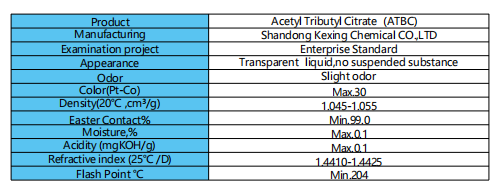
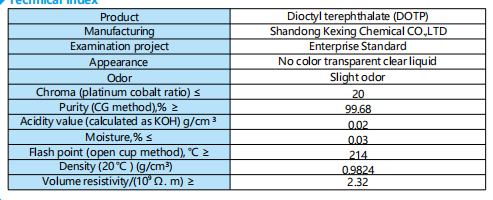
Supplier-provided comparison data from Shandong Kexing Chemical identifies several key differences between ATBC and DOTP. These differences affect finished product performance, processing conditions, and compliance options.
| Comparison Point | ATBC | DOTP |
|---|---|---|
| Product Type | Acetyl Tributyl Citrate (acetylated citrate ester) | Dioctyl Terephthalate (terephthalate ester) |
| Glass Transition Temperature of Finished PVC | Approx. -60°C | Approx. -35°C |
| Food and Medical Contact Compliance | Listed as compliant with FDA/REACH food-grade requirements | Not positioned for food and medical contact in this comparison |
| Low-Temperature Flexibility | Superior low-temperature flexibility | Moderate low-temperature performance |
| Typical Applications | Food packaging, children's toys, medical PVC articles, cold-resistant flexible products | General flexible PVC applications where cost is a primary consideration |
| Relative Cost | Higher than DOTP | Lower cost alternative |
The data shows that ATBC offers a significant advantage in low-temperature flexibility and regulatory access. For products that require food-grade approval, medical contact safety, or consistent flexibility in cold environments, ATBC is the more aligned choice. DOTP remains a cost-effective option for general-purpose applications where those requirements are not present.
Cost Profile: Where the Higher Investment Sits
According to the comparison data, ATBC is more expensive than DOTP. This cost difference is the central trade-off in the decision. What the buyer receives for the higher cost is a material with a lower finished-product glass transition temperature, clearer food-contact positioning, and a profile suitable for sensitive applications.
For procurement teams, the cost evaluation should be based on the value of regulatory access. A plasticizer that fails food-contact testing or medical compatibility can delay product launch, require reformulation, or block market entry. In those situations, the higher unit cost of ATBC is a form of risk reduction rather than a simple premium.
Processing Efficiency and Energy Consumption
The comparison data also highlights processing differences. ATBC is associated with a lower processing temperature and lower energy consumption during production. For PVC compounders, this can partially offset the higher raw material cost through reduced energy demand in the compounding process.
DOTP, while lower in material cost, may not provide the same processing advantage. Buyers evaluating total cost of ownership should consider not just the price per kilogram, but also the processing conditions required to achieve the desired physical properties.
Storage, Stability, and Handling
Storage requirements are another practical point of comparison. ATBC should be stored under normal sealed storage conditions and protected from long-term exposure to temperatures above 150°C. This is a reasonable and clearly defined handling boundary. It does not prevent normal industrial use, but it does mean that warehouses and production facilities should maintain controlled storage conditions and avoid extended heat exposure.
DOTP, as a general-purpose plasticizer, is commonly handled with standard industrial practices. Buyers should still request the manufacturer's specific storage guidelines for both materials to ensure consistent quality throughout the supply chain.
Applications: Where ATBC Delivers the Most Value
ATBC is most valuable in applications where regulatory compliance and low-temperature performance are essential. The supplier's comparison data identifies the following as the primary use areas:
- Food packaging films and food-contact articles
- Children's toys
- Medical PVC articles
- Cold-resistant flexible products
ATBC is also relevant for flexible PVC products such as artificial leather and soft films, where the plasticizer must provide softness, low migration, and long-term stability. For ink and coating applications, its environmental-friendly citrate ester profile makes it a candidate where non-toxic plasticizer behavior is preferred.
Market Trends: ATBC Demand and the Shift Toward Citrate Esters
Market data from Data Insights Reports estimates that the global ATBC market will grow from USD 258.92 million in 2025 to USD 439.46 million by 2034. Global consumption of ATBC in 2025 is estimated at 128,000 metric tons, with medical applications holding a 34% share and food packaging accounting for 29%.
These figures indicate that demand for ATBC is concentrated in the exact applications where its regulatory and low-temperature advantages matter most. The same report identifies Jungbunzlauer as holding approximately 18% of the global ATBC market share, followed by Mitsubishi Chemical Corporation with 14%. This suggests a moderately concentrated market with room for specialized producers.
For buyers, the market trend reinforces the importance of verifying supplier credentials and production capacity. As ATBC demand grows, the ability to secure consistent supply, documented compliance, and stable quality becomes a competitive factor.
Comparison with Traditional Solutions and Key Limitations
Compared with traditional phthalate plasticizers, ATBC offers a clear safety and compliance advantage for sensitive applications. Compared with DOTP, ATBC offers better low-temperature performance and food-contact positioning. However, the selection is not without limitations.
The most obvious limitation is cost. ATBC is more expensive than DOTP, and this cost difference must be justified by the end-use requirements. For manufacturers serving markets where food-contact or medical compliance is mandatory, the higher cost is a necessary investment. For general-purpose PVC products with no low-temperature or regulatory demands, DOTP may be the more economical choice.
There is also a storage limitation. ATBC should be kept in sealed storage and should not be exposed to temperatures above 150°C for extended periods. This is a practical constraint that buyers must plan for in warehouse and processing environments.
Handling and Leakage Control in Industrial Supply
Plasticizer handling involves risks related to leakage and volatile vapor emissions. To control these risks, industrial suppliers typically use closed feeding and sealed storage systems. Shandong Kexing Chemical, for example, applies gas detectors and regular tank and pipeline inspection as part of its enterprise measures.
Buyers evaluating ATBC suppliers should look for similar risk-control practices. Documentation of storage systems, leak-prevention procedures, and regular inspection routines provides evidence that the material will reach the buyer in consistent condition.
Future Outlook for ATBC and DOTP Decisions
The future trajectory of ATBC is closely connected to the growth of regulated applications. With medical applications representing 34% of global ATBC consumption and food packaging representing 29%, demand is anchored in sectors where compliance is not optional. As global regulations continue to restrict certain phthalates, the role of citrate esters is likely to expand.
For DOTP, the outlook remains solid in general-purpose PVC applications, where cost efficiency and acceptable performance are sufficient. The material will continue to serve as a practical alternative for products that do not require the specific compliance and low-temperature features of ATBC.
The buyer's decision, therefore, is unlikely to be resolved by a single universal answer. It will depend on the regulatory target market, the physical requirements of the finished product, and the total cost of compliance. ATBC and DOTP will both remain relevant, but they will serve different segments of the non-phthalate plasticizer market.
FAQ: ATBC vs. DOTP Comparison Questions
Q1: What is the main difference between ATBC and DOTP?
ATBC is an acetylated citrate ester, while DOTP is a terephthalate ester. ATBC is positioned as a non-phthalate plasticizer with food and medical contact compliance and superior low-temperature flexibility. DOTP is a lower-cost general-purpose alternative, with a glass transition temperature of approximately -35°C compared with ATBC's approximately -60°C for finished PVC.
Q2: Is ATBC more expensive than DOTP?
Yes. According to supplier comparison data, ATBC is higher in cost than DOTP. The cost difference reflects ATBC's compliance profile and low-temperature performance, which are relevant for food packaging and medical applications.
Q3: When should a buyer choose ATBC over DOTP?
ATBC is the more aligned choice when the application involves food packaging, children's toys, medical PVC articles, or cold-resistant flexible products. These applications require the compliance and low-temperature flexibility that ATBC provides and that DOTP is not positioned to deliver.
Q4: Is ATBC compliant with food-contact regulations?
ATBC (CAS 77-90-7) is approved by the FDA as a food additive and flavoring agent adjuvant under 21 CFR 172.515, 175.105, 178.3910, and 181.27. According to supplier comparison data, ATBC is also listed as compliant with REACH food-grade requirements.
Q5: What limitations should buyers consider when evaluating ATBC?
ATBC is more expensive than DOTP, and it should be stored in sealed conditions with restricted exposure to temperatures above 150°C. Buyers should also verify supplier documentation, including certifications, specifications, and handling procedures, before finalizing a purchase decision.
Download the company brochure for a complete overview of available plasticizer grades and production capabilities.
Have Questions or Need More Details?
Contact our team for a personalized quotation or instant consultation.
Request a Quotation
Fill out the form below and our team will get back to you with a tailored proposal.
WhatsApp Direct Chat
Prefer to chat in real-time? Message us on WhatsApp for instant assistance & quick answers.
- Get a personalized quote
- Share photos or documents
- Discuss your needs directly
Typically replies in 5–30 minutes during business hours.