
ATEX and IP Ratings Decoded for Electric Actuator Buyers
In hazardous-area projects, the certification line on an electric actuator data sheet is evaluated long before the price line. An actuator whose protection concept cannot be traced to a recognized marking is not a cheaper option for a chemical or oil and gas plant — it is a non-qualifying one.
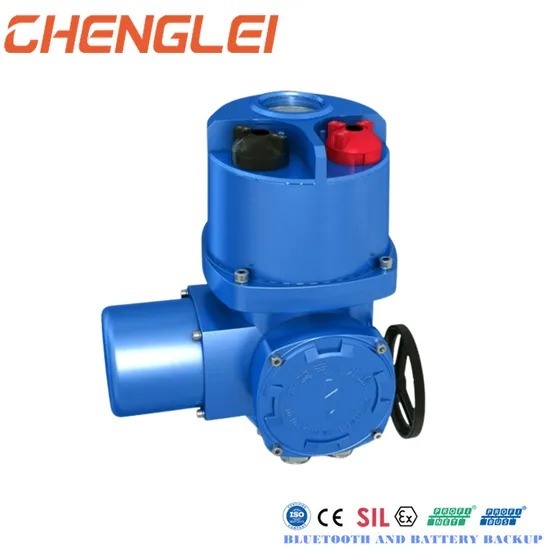
An intelligent electric valve actuator whose published data records explosion protection as ATEX / Ex d BT4 / CT4, protection grade IP65/IP67/IP68, insulation class F and thermal protection — the four lines that decide project qualification.
Changzhou Chenglei Valve Technology Co., Ltd. (CHENGLEI) is an electric actuator manufacturer based in Changzhou, Jiangsu, China, founded in 2016, operating a 20,000 m² production site with a 25-engineer R&D team and a stated annual output of 120,000 units, with roughly 80% of that output exported. Its CL-series valve electric actuators are applied across Oil & Gas, Water & Power, and Chemical, Process & Industrial duty.
This reference does not argue that any single marking is universally correct. It explains what the strings on an actuator data sheet actually mean — ATEX / Ex d BT4 / CT4, IP65 / IP67 / IP68, insulation class F, thermal protection — and how engineering and procurement teams in the research and evaluation stages can turn those strings into a qualification decision, including the points where a marking stops being a guarantee.
Why the marking, not the brand name, decides qualification
Hazardous-area and harsh-environment procurement has become more document-driven rather than less. Two forces push in the same direction. First, the installed base of electric actuators keeps expanding into areas that were once the preserve of other actuation technologies, which spreads compliance responsibility across more suppliers. Second, safety authorities and end users increasingly require certificate scope to be matched to the specific zone, gas group and ambient condition of the installation — not to a generic statement that a product is “explosion-proof.”
The practical consequence is that a purchase order can stall on documentation rather than on capability. A supplier may hold genuine approvals and still fail a project review because the approval covers a different model than the one quoted, a different gas group than the one present, or a temperature class that does not match the site. The buyer’s job is therefore not to collect certificates, but to read them.
Reading the explosion-proof string: ATEX, Ex d, BT4 and CT4
Explosion protection for electric actuators rests on a small number of internationally recognized publications. Flameproof enclosures designated by the letter “d” are standardized under IEC 60079-0, which sets general requirements for equipment used in explosive atmospheres, and IEC 60079-1, which covers flameproof enclosures “d.” The concept is containment: an internal ignition is permitted to occur, but the enclosure is constructed so that the flame is not transmitted to the surrounding atmosphere.
Two further dimensions decide whether that concept fits a specific plant. The first is the gas group. Explosion-proof equipment is classified into Gas Groups IIA, IIB and IIC, with Group IIC required for hydrogen environments, and into Temperature Classes T1 to T6, which describe progressively lower maximum surface temperature classes. A marking such as Ex d BT4 therefore states a protection concept (flameproof), a gas group (IIB) and a temperature class (T4). A CT4 designation extends the applicable gas group to IIC while remaining in the same temperature class.
What the letters do and do not tell a buyer
A marking tells a buyer which protection concept was verified and for which gas and temperature envelope. It does not tell a buyer that the actuator is suitable for every hazardous area in the plant. Hydrogen service, dust-only atmospheres, and installations where the actuator itself becomes a surface-temperature source all sit outside a gas-group and temperature-class statement unless they are separately addressed. Buyers who need both gas and dust coverage should treat the two as separate conversations with the supplier, not as one approval.
In CHENGLEI’s published product data, explosion protection is recorded as ATEX / Ex d BT4 / CT4 on intelligent models such as the 24V DC JB2920 ISO5210 flange electric valve actuator and the DQ-series low-temperature actuator. In the field-scenario documentation used for Oil & Gas and Chemical duty, the stated special requirement is explosion protection to Ex d IIB T4 with IP65/IP67 enclosure protection. Project teams evaluating these models should verify which of those designations applies to the exact configuration quoted.
Decoding IP65, IP67 and IP68 in real installations
Ingress protection is frequently treated as a ranking ladder, with IP68 assumed to be the correct answer and IP65 assumed to be a compromise. That reading causes specification errors. An IP rating describes resistance to the ingress of solid particles and water. The first digit addresses solids and dust; a “6” indicates a dust-tight enclosure. The second digit addresses water: “5” indicates protection against water projected by a nozzle, “7” indicates protection during temporary immersion, and “8” indicates protection during continuous immersion under conditions agreed between the manufacturer and the user.
The IP rating is a statement about ingress pathways. It is not a corrosion rating, not an explosion-proof rating, and not a statement about the control electronics inside. This distinction matters most in chemical and coastal installations, where the failure mode is rarely simple water entry and is far more often chemical attack on seals, coatings and cable entries.
| Protection grade | What the marking addresses | Typical duty fit | What it does not cover |
|---|---|---|---|
| IP65 | Dust-tight enclosure; protection against water projected by a nozzle | Indoor process areas, covered outdoor installations, general industrial duty | Prolonged immersion; aggressive chemical atmosphere; explosion protection |
| IP67 | Dust-tight enclosure; protection during temporary immersion | Outdoor Valve control, washdown-adjacent areas, coastal humidity | Continuous immersion; corrosion resistance; gas or dust certification |
| IP68 | Dust-tight enclosure; protection during continuous immersion under manufacturer-and-user agreed conditions | Flood-prone vaults, sump and submerged-duty valve control where agreed conditions are defined | Ingress conditions outside the agreed conditions; chemical attack; explosion protection |
Within CHENGLEI’s range, protection grade is model-specific rather than uniform. IP65/IP67/IP68 is recorded on the intelligent JB2920/ISO5210 flange actuator and on the DQ-series low-temperature actuator, while IP65/IP67 is recorded on the linear CLZXC4000 series, and IP67 on multi-turn and part-turn models including the Z10, Z30, Z45 and QI-series actuators. A specification that requires IP68 has therefore selected a subset of the range, not the whole range — a filter that should be applied before the inquiry is issued, not after the quotation arrives.
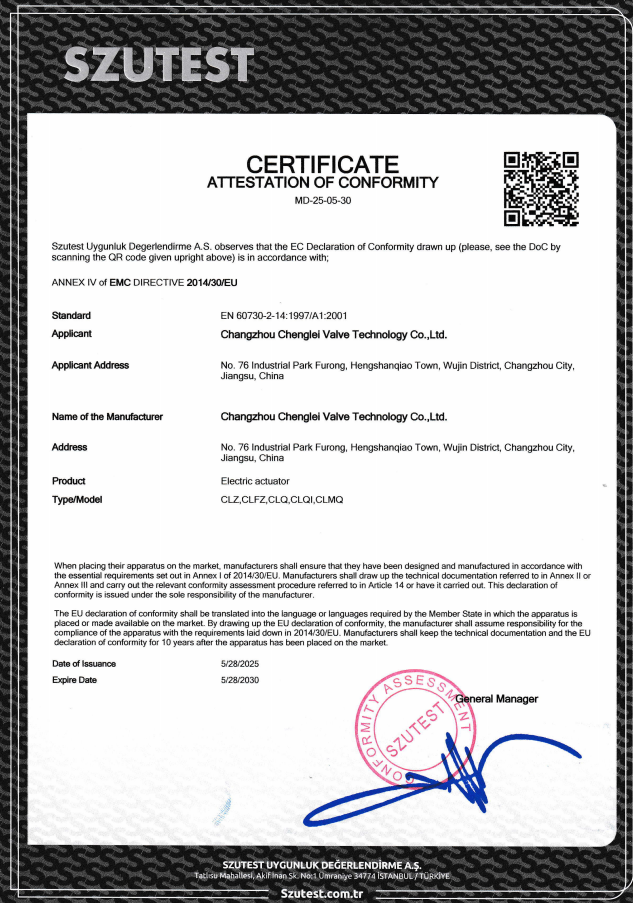
CE certification for the Intelligent Electric Motor Linear Actuator Explosion Proof ZXC Series: issued by szutest under standard EN 60730-2-14:1997/A1:2001, valid in the EU market through 28 May 2030. Certificate scope, not the logo alone, is what a project reviewer checks.
Insulation class F and thermal protection: the safety layer buyers skip
Explosion protection and ingress protection get the attention; insulation class and thermal protection usually get a glance. On continuous-duty chemical and process installations, that is the wrong order. Insulation class describes the thermal capability of the motor winding system, and Class F insulation appears in CHENGLEI’s published data for intelligent explosion-proof models, including the JB2920/ISO5210 flange actuator and the DQ-series actuator. Thermal protection is listed as present on the same models.
Thermal protection addresses the actual failure path in a modulating or frequently cycled installation: sustained electrical load combined with high ambient temperature and restricted ventilation, leading to winding over-temperature before any mechanical fault is visible. In a chemical plant where the actuator is mounted on a hot line, this protection is not a convenience feature; it is the component that keeps a thermal event from becoming a site event.
Duty cycle data belongs to the same conversation. CHENGLEI’s published motor duty options are S2 short-time duty at 10, 15 or 30 minutes, or S1/S3/S4/S6 duty at 24% or 40%. Standard ambient operating temperature is stated as −20 to +60 °C with special orders covering −60 to +70 °C, and relative humidity of up to 95% at +25 °C. A buyer comparing two otherwise similar actuators should compare these lines first, because an actuator selected on torque alone and applied outside its duty and ambient envelope will fail a compliance review even with correct markings.
| Compliance line | Recorded value (CHENGLEI published data) | Why it matters at evaluation stage |
|---|---|---|
| CE certification | Intelligent Electric Motor Linear Actuator Explosion Proof ZXC Series; issued by szutest; standard EN 60730-2-14:1997/A1:2001; issued 28 May 2025, valid to 28 May 2030; EU market | Confirms the certification body, the applicable standard and the expiry date that the project file must track |
| Explosion protection | ATEX / Ex d BT4 / CT4 recorded on intelligent explosion-proof models; scenario documentation states Ex d IIB T4 requirement | Determines whether the unit can be offered into the zone at all |
| Protection grade | IP65/IP67/IP68 on selected intelligent models; IP65/IP67 on CLZXC4000-series linear actuators; IP67 on Z10/Z30/Z45 and QI-series | Determines fit for humidity, washdown, immersion risk |
| Insulation / thermal | Insulation level F; thermal protection present | Determines durability under high ambient and repeated cycling |
| Enclosure type | NEMA 4/4X/7&9 recorded on the DQ-series actuator | Relevant where North American enclosure conventions apply |
| Connection interface | JB2920 torque type or ISO5210 (GB/T 12222) thrust flange type; ISO 5211 mounting on the ZXC/ESA rotary actuator | Determines mounting compatibility with the existing valve and bracket |
Where these ratings have already been tested: three field references
Compliance documentation becomes convincing when it is paired with the environments it was written for. Three reference projects illustrate how the same rating set behaves under different stressors.
Middle East desert oil valve project. A petroleum engineering company in Iraq deployed 200 sets into a large-scale oil valve project in a desert environment characterized by high corrosion — salt spray and hydrogen sulfide — and high temperature. The reported outcome across a six-year duration was stable production with reduced downtime from leak-related maintenance. The protective measures cited were a C5-M grade anti-corrosion coating exceeding conventional standards and double-sealed wiring technology to isolate corrosive gas and moisture intrusion. This is the clearest illustration that an IP rating alone does not solve a corrosion problem: coating specification and cable-entry sealing do the work the IP number cannot.
Russian oil, gas and energy infrastructure. A strategic partner required remote automated control of local oil and gas pipelines and energy infrastructure, with an extremely cold climate, large temperature differentials and potentially explosive gas environments. More than 400 intelligent electric actuators passed a factory acceptance test conducted by the Russian delegation, and the products hold EX explosion-proof certification. The reported verification included stable starting and precise control at minus 40 degrees Celsius, addressing low-temperature pain points such as display failure, lubricant solidification and material brittleness. The parallel product line for this requirement is documented at −60 °C to +70 °C operating temperature with 4–20 mA signal input, IP65/IP67/IP68 protection and NEMA 4/4X/7&9 enclosure type.
United States non-ferrous metal group. Automatic valve control in raw material grinding, high-temperature digestion, sedimentation and evaporation stations, with severe vibration, high temperature and dust. Nearly a thousand intelligent actuators were deployed, with a reported six-year record and round-the-clock line operation. The design response was separation of the mechanical body from the control unit so the precision control section sits away from the vibration source, combined with Profinet industrial Ethernet interconnection across the plant. This case sits outside the hazardous-area discussion but inside the same compliance conversation: vibration and heat are environment specifications, and they force design decisions just as ATEX zones do.
Market context: why compliance documentation is becoming a purchase filter
The global electric actuator market was estimated at approximately USD 11.5 billion in 2024, with projections of 6.5% to 7.2% CAGR through 2034, according to Zion Market Research. Asia Pacific dominated the electric valve actuator market with a 38.5% revenue share in 2025, valued at over USD 1.8 billion, driven by industrialization in China and India, per Dataintelo. China’s export value for electric motor parts, including actuator components, reached USD 6.43 billion in 2024, or 26.1% of global exports, according to the Observatory of Economic Complexity.
These figures should be read with care, because published market sizes diverge substantially depending on whether stand-alone actuators or integrated valve-and-actuator assemblies are counted. For a procurement team, the useful signal is not the headline number but the composition of the supply base: a larger, more geographically diverse supplier field means more certificates in circulation, more variation in scope, and a higher cost of verification errors.
Concentration at the top end remains. Rotork plc held a 14% global market share in the linear electric actuator segment as of 2024 according to Market Reports World, and Emerson Electric Co. is estimated at 12–15% of the global electric actuator market with USD 17–18 billion in relevant group revenue, per Spherical Insights. For buyers, that concentration is a useful benchmark rather than a decision rule: large suppliers set the documentation expectations that mid-market suppliers are then measured against.
A final trend affects specification directly. Intelligent electric actuators are moving toward Industrial Ethernet protocols such as Profinet and EtherNet/IP and toward 5G edge connectivity for digital twin integration, a shift noted in IndexBox market analysis of China’s intelligent actuator segment. Networked actuators place new demands on documentation: the certificate set has to describe the communicating product, not only the mechanical body.
How this compares with traditional compliance approaches — and where the limits are
Two habits still dominate actuator specification. The first is brand-based qualification: if the supplier’s name is known, the compliance question is treated as settled. The second is pneumatic or hydraulic inertia: where compressed air or hydraulic supply already exists on site, fluid-power actuation remains a legitimate choice, particularly for very high cycle rates or where electrical infrastructure is unavailable at the valve. Electric actuation is generally selected where precise positioning, digital communication, remote diagnostics and reduced utility infrastructure are the priorities. Those are trade-offs, not hierarchies.
The document-verification approach used above differs from brand-based qualification in one specific way: it asks what has been verified for the exact model, gas group, temperature class and environment, and it records the answer in the specification. That approach also has boundaries, and they should be stated plainly rather than discovered in a project review.
- Certificate scope versus certificate existence. CHENGLEI’s documented CE certification is issued under EN 60730-2-14:1997/A1:2001 for the Intelligent Electric Motor Linear Actuator Explosion Proof ZXC Series, issued by szutest for the EU market. This is a safety standard for automatic electrical controls, and it is not the same instrument as a Notified Body EU type-examination certificate for a specific ATEX zone. Buyers whose projects require the latter must confirm whether the required document exists for the exact model and zone.
- Gas group and temperature class coverage. The recorded ATEX / Ex d BT4 / CT4 designations do not automatically cover hydrogen service (Group IIC) or dust-only atmospheres, which follow different classification logic. Those applications require confirmation rather than assumption.
- IP68 is not a blanket upgrade. It applies to specific models and, by definition, to conditions agreed between manufacturer and user. Applying an IP68 unit without defining those conditions gives the buyer no additional protection.
- Low-temperature capability is a special order. The −60 °C variant is a special-order range; standard ambient data is −20 to +60 °C. Buyers in cold-climate projects should treat the extended range as a configuration decision with its own lead time, not as a standard attribute.
- Validity is time-bound. The CE certification recorded here is valid to 28 May 2030. Certification expiry is a maintenance task for the supplier and a tracking task for the buyer, particularly on multi-year framework agreements.
- Regional approvals are not interchangeable. CE addresses the EU market. Projects in other jurisdictions require their own approval routes, which should be raised during evaluation rather than during commissioning.
Future outlook
Three developments are likely to shape how actuator compliance is evaluated over the next several years. First, documentation will continue to move from PDF attachments to verifiable digital records, with buyers checking certificate scope, standard number and expiry date as routine parts of supplier onboarding. Second, the IEC 60079 series will remain the reference backbone even as regional schemes diverge, which puts a premium on suppliers who can map a single product platform to multiple market requirements rather than maintaining disconnected approvals. Third, as intelligent actuators absorb Industrial Ethernet and edge connectivity, the compliance surface expands from the mechanical enclosure toward the electronics and communications stack — a change that will make “what is inside the housing” as important as the housing rating itself.
For CHENGLEI, that trajectory points toward consolidating what is already documented — CE certification on the ZXC explosion-proof series, ATEX / Ex d BT4 / CT4 data on intelligent models, IP65/IP67/IP68 across selected lines, Class F insulation and thermal protection, and connection interfaces aligned to JB2920, ISO 5210/GB/T 12222 and ISO 5211 — into a form that a project team can verify before the inquiry rather than after the quotation.
FAQ
What does “Ex d BT4” or “Ex d CT4” mean on an electric actuator specification?
Both designations describe flameproof protection, standardized under IEC 60079-0 for general requirements and IEC 60079-1 for flameproof enclosures “d.” The “B” or “C” indicates the gas group (IIB or IIC), and “T4” indicates the temperature class. Group IIC is the classification required for hydrogen environments. In CHENGLEI’s published product data, explosion protection is recorded as ATEX / Ex d BT4 / CT4 on intelligent models such as the 24V DC JB2920 ISO5210 flange electric valve actuator and the DQ-series actuator.
Is IP68 always better than IP67 for valve actuators in chemical plants?
No. IP ratings address ingress of solids and water only. IP67 covers temporary immersion and IP68 covers continuous immersion under conditions agreed between manufacturer and user, so an IP68 unit offers no defined benefit unless those conditions are specified. Neither rating addresses chemical corrosion, which in chemical plants is typically managed through coating specification and cable-entry sealing — as in the Middle East project where a C5-M grade anti-corrosion coating and double-sealed wiring were used against salt spray and hydrogen sulfide. Within CHENGLEI’s range, IP65/IP67/IP68 applies to selected intelligent models, while IP65/IP67 is recorded on the CLZXC4000 linear series and IP67 on Z10, Z30, Z45 and QI-series actuators.
Why do insulation class F and thermal protection matter more than they appear to?
They address the failure mode that rarely shows up on a data sheet comparison: winding over-temperature under sustained load and high ambient temperature. Class F insulation and thermal protection are recorded as present on several CHENGLEI intelligent explosion-proof models. The related duty data is equally relevant — published motor duty options are S2 at 10, 15 or 30 minutes, or S1/S3/S4/S6 at 24% or 40%, with standard ambient −20 to +60 °C, special-order coverage of −60 to +70 °C, and relative humidity up to 95% at +25 °C.
How should a buyer verify that a supplier’s certification actually covers the project?
Check four things against the quoted model rather than the catalogue: the issuing body, the applicable standard, the model scope, and the validity period. For CHENGLEI, the recorded CE certification applies to the Intelligent Electric Motor Linear Actuator Explosion Proof ZXC Series, is issued by szutest, cites standard EN 60730-2-14:1997/A1:2001, and is valid to 28 May 2030 in the EU market. Where a project requires a different instrument, such as a Notified Body EU type-examination certificate for a specific ATEX zone, that requirement should be confirmed for the exact configuration before the order is placed.
What are the practical limits of ATEX and IP ratings when specifying an actuator?
Both markings define an envelope, not a general guarantee. A gas-group and temperature-class statement does not by itself cover dust-only atmospheres or every hazardous zone, and it does not extend to environments requiring separately certified protection concepts. IP ratings do not cover corrosion, mechanical vibration or ambient temperature, which is why field projects add measures outside the rating set — C5-M grade coating and double-sealed wiring in a desert oil project, a −60 °C special-order configuration for extreme cold, and separation of the mechanical body from the control unit in a high-vibration alumina processing line. Finally, all certifications are time-bound: the recorded CE certification expires on 28 May 2030 and must be tracked through the life of a framework agreement.
Referenced product and certification documentation for the CL-series electric actuators, including model data, protection grades and connection interfaces, is compiled in the manufacturer’s downloadable brochure and on the company site at electricvalvesactuators.com.