
AUV-160 vs AUV-210: Portable Launch or Nearshore Survey?
AUV-160 vs AUV-210: Portable Launch or Nearshore Survey?
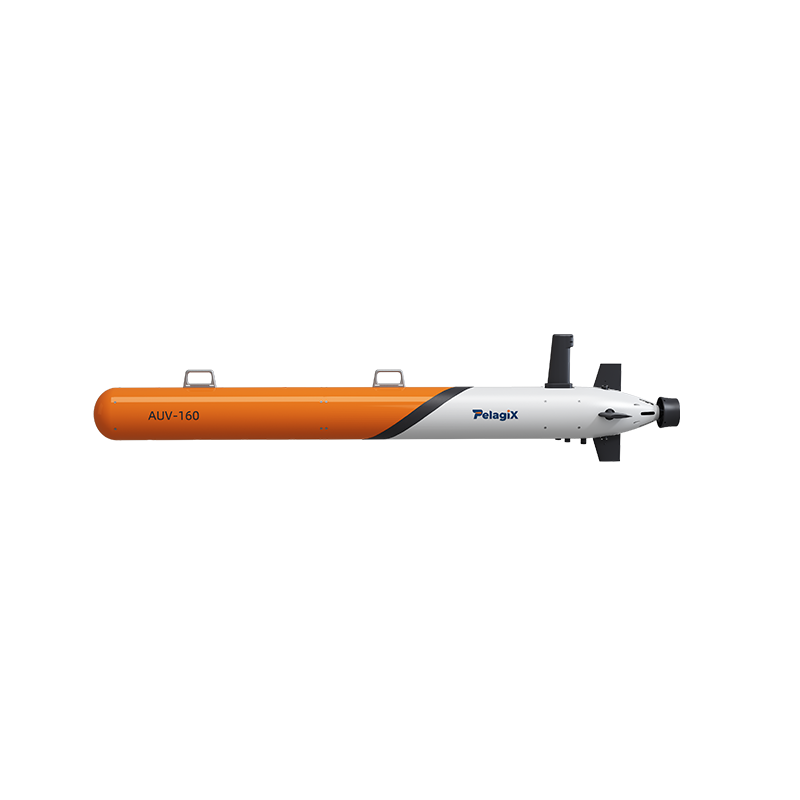
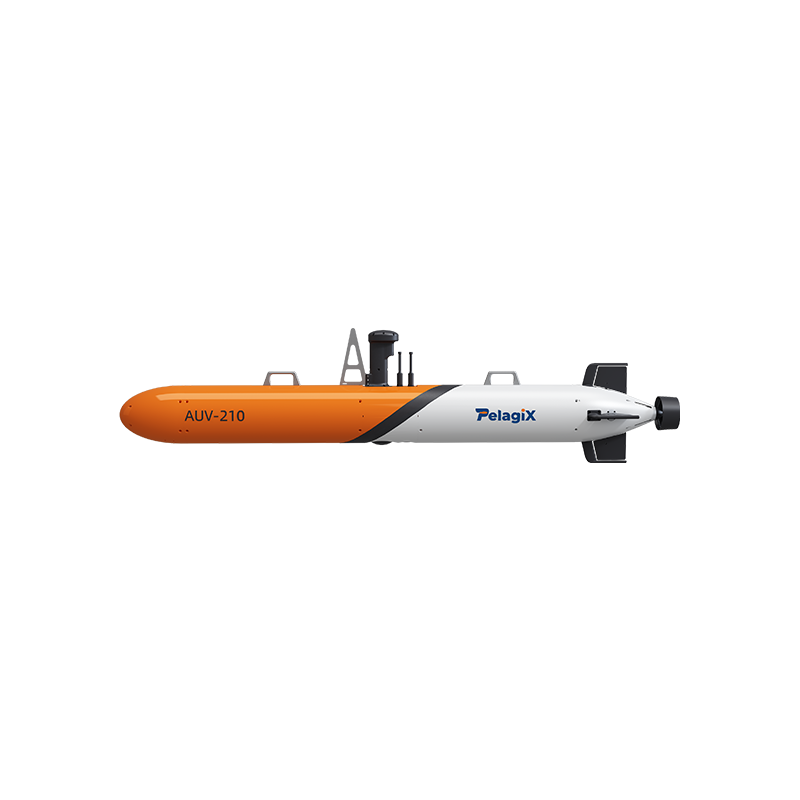
The AUV-160 and the AUV-210 are separated less by sensor ambition than by the way each vehicle reaches the water. The AUV-160 is a 35 kg portable micro AUV with a 5 kg payload allowance and a 0–100 m depth range, documented for shore, small-boat and net recovery. The AUV-210 is a 70 kg nearshore survey AUV with a 10 kg payload allowance and a 0–200 m depth range, documented for nearshore survey and inspection. Both sit in the Pelagix AUV range from Sanya Poseidon Ocean Technology Co., Ltd., a Sanya-based developer and manufacturer of AUV and ROV systems. For a buyer at decision stage, the question is not which platform is more capable in general, but which combination of launch method, crew, vessel access, depth band and sensor mass the programme can actually sustain across repeated missions.
Why deployment constraints decide this comparison before the specification sheet does
Headline numbers are usually read in the wrong order. A 0–200 m rating and a 10 kg payload allowance look like a straightforward upgrade over 0–100 m and 5 kg until the launch site is taken into account: the heavier vehicle has to be transported, lifted, trimmed, released and recovered by whatever crew and platform the site can provide. In nearshore and inland work, that constraint is often fixed long before the sensor plan is written.
The practical consequence is that the two vehicles answer different procurement questions. A programme that launches from a shoreline position, from a small boat or from a net structure, runs short repeat missions and needs the vehicle back on deck quickly is testing a portability requirement. A programme that surveys harbour approaches, channel margins, pipeline and cable routes or shallow offshore assets down to 200 m is testing a payload and survey-endurance requirement. Cost, maintenance and training then follow from whichever requirement dominates, which is why price comparison between the two platforms in isolation rarely produces a sound decision.
The documented differences, side by side
Table 1 lists the differences that the available product material states for the two configurations. Anything not listed here should be obtained in writing from the supplier rather than inferred from the vehicle class.
| Parameter | AUV-160 | AUV-210 |
|---|---|---|
| Documented class | Portable micro AUV | Nearshore survey AUV |
| Total weight | 35 kg | 70 kg |
| Payload allowance | 5 kg | 10 kg |
| Depth range | 0–100 m | 0–200 m |
| Frame | Lightweight aluminum frame | Aluminum frame |
| Casing | Seawater-resistant polymer casing | Seawater-resistant polymer casing |
| Additional documented protection | Lightweight frame and seawater-resistant casing as described | Corrosion-resistant components; pressure-sealed electronic pod |
| Documented launch and recovery context | Shore, small boat, net | Nearshore survey and inspection operations |
| The buying question it raises | Can the site handle 35 kg at every launch and recovery? | Does the payload and depth band meet the survey specification? |
Weight at the water's edge: 35 kg versus 70 kg
Total weight is the parameter that converts a specification into a daily routine. The documented 35 kg of the AUV-160 and 70 kg of the AUV-210 are the figures a site has to move at every launch and every recovery, not once per campaign. Whether a given crew can handle either figure by hand, by davit or by net is a site question, and the reliable way to answer it is a rehearsal with the actual crew, the actual payload and a representative sea state.
Neither figure is a verdict on capability. The documented recovery context does the work here: the AUV-160 is described for shore, small-boat and net recovery, which points to launch points that can be reached without a vessel; the AUV-210 is described for nearshore survey and inspection, where a vessel is part of the operation rather than an accessory to it. A buyer who has to book a vessel for every mission is buying a different operating model than a buyer who can drive to the shoreline, and the total cost of those two models diverges long before the vehicle price is discussed.
Weight also interacts with survey design. A platform that can be turned around quickly from a beach, a pier or a net structure supports short, frequent missions; a platform that deploys from a vessel supports fewer, longer and more structured missions. That difference is a mission-planning choice as much as a hardware choice, and it should be settled before the payload discussion begins.
Payload and depth: 5 kg at 0–100 m versus 10 kg at 0–200 m
A payload allowance is a mass budget, not an equipment list. The AUV-160 documents 5 kg and the AUV-210 documents 10 kg, and the doubling is meaningful at specification stage: it sets how much sensor mass, cabling and mounting hardware the vehicle can carry while retaining trim and control. It does not by itself confirm that a particular multibeam sonar, side-scan sonar, imaging package or water-quality sensor will fit. Instrument mass in water, mounting position, connector and data interfaces, housing penetrations and the buoyancy correction after installation all have to be checked against the specific configuration being quoted.
Depth range follows the same discipline. The 0–100 m figure for the AUV-160 and the 0–200 m figure for the AUV-210 describe the operating envelope of each configuration. They are not a third-party pressure-hull certification, and they should not be read as a general deep-sea rating: the Pelagix range separates nearshore platforms from platforms rated to 6000 m, and a buyer should not carry a deep-sea assumption across to a 200 m vehicle, or assume that a sealed electronics enclosure makes a nearshore vehicle suitable for abyssal work.
The useful decision rule is that depth range must be compared against the deepest point of the actual survey area, not against the deepest point of the catalogue. A 0–200 m vehicle does not improve a survey that never leaves the upper 40 m; a 0–100 m vehicle is unsuitable for an area that reaches 140 m, however attractive its launch profile. Where the working area straddles the boundary, the buyer should ask for the depth-rating basis, the associated test protocol and any operational derating that applies to the purchased configuration.
Housing, corrosion protection and what the sealed pod actually covers
Both vehicles are described with an aluminum frame and a seawater-resistant polymer casing, so the visible material story is similar. The AUV-160 is described with a lightweight aluminum frame; the AUV-210 with an aluminum frame plus corrosion-resistant components and a pressure-sealed electronic pod. Read carefully, that difference is about where the seawater problem is concentrated, not about which vehicle is more protected in general.
A polymer casing moves the corrosion question away from the main shell and onto the parts that remain metallic and electrically connected: frame members, fasteners, connector shells, sensor brackets and any exposed hardware. On the AUV-210, the documented corrosion-resistant components address that exposure directly, and the pressure-sealed electronic pod addresses a different risk — water ingress into the electronics enclosure at the working depth. On the AUV-160, the documented description covers the lightweight frame and the seawater-resistant casing. A buyer who intends to operate in high-salinity, high-fouling or long-dwell conditions should therefore ask which fasteners, connectors and anodes are specified for each configuration, and what the inspection interval is for them.
The manufacturer's company-level corrosion controls apply across its AUV components and are a sensible basis for those questions: material selection conforming to NACE standards, hard anodized marine aluminum and titanium component options, sacrificial anode protection, anti-fouling protective coating, and a comprehensive seawater immersion test protocol completed before shipment. Those measures describe a controlled process and a pre-delivery check, not a guarantee for every environment. Fouling pressure, berth time, freshwater rinse discipline and local water chemistry still determine how quickly a coating or an anode needs attention, so the buyer should ask for the anode and coating schedule that comes with the purchased configuration rather than assume a single schedule fits all sites.
Two further qualifications matter in this depth band. First, the pressure-sealed electronic pod on the AUV-210 is an enclosure measure for the vehicle's working depth; it is not evidence of a 6000 m pressure-hull rating and should not be compared with the high-strength titanium or composite pressure housings used on deep-sea platforms. Second, for hulls that are pressure-rated, the manufacturer documents vacuum leak testing of double O-ring seals and 100% hyperbaric chamber pressure simulation at 1.25 times rated working depth. A nearshore buyer should ask which of those protocols applies to the specific 100 m or 200 m configuration, and see the completed record before acceptance.
Where the AUV-160 fits: shore, small-boat and net recovery
The AUV-160 fits missions where the binding constraint is access. Shore-based launch removes the need for a vessel window; small-boat launch keeps the operating footprint inside a crew that also has to handle the survey; net recovery matters where the vehicle works around aquaculture structures and has to be brought back at a defined point rather than driven to a shoreline. Within the application areas documented for the Pelagix range — hydrographic surveying, seabed mapping, environmental monitoring and marine research — the AUV-160 is the entry point for shallow, repeat and logistically simple work.
Its boundary is equally specific. If the survey needs more than 5 kg of sensor mass, or a working depth beyond 100 m, the portable platform is the wrong specification regardless of how convenient its launch profile looks. The honest framing for a buyer is that the AUV-160 is correct when access, portability and mission frequency dominate, and incorrect when payload or depth dominate.
Where the AUV-210 fits: nearshore survey and inspection
The AUV-210 fits missions where the binding constraint is coverage and payload, and where a vessel is available anyway. A 0–200 m envelope covers harbour approaches, channel margins, nearshore pipeline and cable routes and shallow offshore assets; a 10 kg payload allowance supports a heavier sensor fit than the portable platform can carry; and the documented use case — nearshore survey and inspection — frames it as a working survey vehicle rather than a deployment-logistics solution.
The boundary is clear in both directions. Above 200 m, neither platform applies and the requirement moves into the deep-sea part of the range. Below 100 m, the AUV-210's additional depth buys nothing, and its 70 kg weight becomes a cost paid at every launch. Between 100 m and 200 m, only the AUV-210 is documented to operate, and that single fact usually settles the comparison before any other preference is considered.
Navigation, obstacle handling and recovery behaviour to verify
Depth and payload decide whether a platform can do the job; navigation and recovery behaviour decide whether it does the job repeatably. The manufacturer documents Doppler Velocity Log, Inertial Navigation System and Ultra-Short Baseline fusion for underwater navigation, a multi-sensor Kalman filter for drift compensation, AI-assisted navigation with autonomous SLAM mapping, an automatic return-to-home protocol on acoustic link loss, and monocular vision-guided docking as a fallback. For subsea entanglement risk it documents forward-looking obstacle avoidance sonar, automated entanglement detection with a visual alert, and a cut-and-clear mechanism.
These are company-documented capabilities across its AUV work rather than a statement that every item is fitted to every configuration. The buyer's task is to confirm which of them are included on the specific AUV-160 or AUV-210 quotation, and what evidence accompanies them — a factory acceptance record, a sea trial, or a written test procedure. Nearshore operations add a hazard that deep-water buyers rarely face: fishing gear, mooring lines, aquaculture nets and debris in the upper 200 m. For an AUV-160 working around nets, entanglement detection and a defined recovery procedure belong in the acceptance criteria, not in the optional-extras list.
A buyer's acceptance checklist before a purchase order
- Weigh the vehicle as configured — battery, payload, mounts — and confirm the figure against the launch method the site can actually support.
- Walk the launch and recovery sequence with the real crew; if it needs equipment the programme does not own, the requirement is not met.
- Compare the maximum survey depth with the documented 0–100 m or 0–200 m envelope, and request the rating basis in writing.
- Confirm the sensor mass, interface, penetrations and buoyancy correction for the intended payload against the 5 kg or 10 kg allowance.
- Ask which components are corrosion-resistant on each configuration, and request the anode, coating and rinse schedule.
- Request the pre-shipment seawater immersion test record and any applicable hyperbaric or leak-test documentation.
- Confirm which navigation functions — DVL, INS, USBL fusion, SLAM, return-to-home — are fitted, and what evidence proves them.
- Confirm obstacle avoidance and entanglement detection if the working area contains nets, moorings or fishing gear.
- Check the customs classification, typically HS 901580 or 890690 under a US Customs and Border Protection ruling, against the importing market's documentation requirements.
- Agree spares, training and the service interval in the contract, because both platforms depend on consumables — anodes, coatings, seals — that are replaced on a schedule.
How both platforms compare with tethered ROVs and non-modular AUVs
Both vehicles are autonomous and tetherless, which is the substantive difference from a tethered ROV. The manufacturer's published comparison states that its AUVs deliver a 45% lower total cost of ownership over three years than traditional tethered ROVs, although initial platform investment is comparable; 70% fewer onboard crew members; up to 80% lower surface operator and tether-management requirements; 30–50% less vessel operating time; and 3–5 times higher survey coverage efficiency, with autonomous missions in the 10–100+ km class. Those figures are company-reported comparisons for the Pelagix AUV line. They are not AUV-160- or AUV-210-specific trial results, and a buyer should ask for the basis of the comparison — vessel day rate, crew count, survey area and mission profile — before carrying the numbers into a business case.
The same caution applies to the modular-architecture claims. Compared with standard non-modular AUVs, the Pelagix AUV is documented as supporting 3–5 times more payload configurations, enabling payload changeover in under 30 minutes, reducing mission reconfiguration time by 50–70%, reducing maintenance time by 30–50%, and reducing lifecycle costs by 20–40% through modular integration. For a two-platform decision the relevant question is narrower: how much of that modularity is present on the AUV-160 and AUV-210 configurations being quoted, and what a payload changeover actually costs in crew hours at the launch site.
Market context: reading industry growth data correctly
Industry data is easy to misapply in this segment. MarketsandMarkets estimates the global AUV market at roughly USD 2.0–2.57 billion for 2024/2025, and Fortune Business Insights projects a 12.0% CAGR for the large and deep AUV segment above 1000 m. Neither figure describes the 0–200 m nearshore segment in which the AUV-160 and AUV-210 compete. The deep segment's growth is driven by different buyers, different mission profiles and different certification burdens, so a nearshore programme that cites that growth rate in its internal business case is borrowing a number from a market it does not operate in.
What the nearshore segment does share with the wider market is a structural trade-off between energy, payload and mass. One commercial research estimate puts energy storage at approximately 40% of an AUV's internal volume to support missions of up to about 24 hours, which helps explain why a 5 kg payload allowance and a 35 kg total weight belong together, and why the step to 10 kg of payload arrives with a doubling of vehicle mass. Weight, payload and endurance are one system, not three independent specifications.
Procurement mechanics deserve early attention as well. AUVs are typically classified under HS code 901580 for oceanographic and hydrological instruments, or 890690 for other vessels, according to a US Customs and Border Protection ruling. That is a paperwork question rather than an engineering one, but it affects import documentation and duty treatment, and it belongs in the purchase timeline next to the technical evaluation.
Outlook: what would change the recommendation
Two developments would change the shape of this decision rather than its underlying facts. The first is payload standardisation: if sensor interfaces and mounting hardware become more interchangeable across a fleet, the cost of misjudging payload allowance falls, and the lighter platform becomes viable for a wider set of missions. The second is autonomy in confined, obstacle-dense water, where reliable detection and dependable return-to-home behaviour reduce the operational penalty of launching in nearshore conditions.
Neither development removes the constraint that decides the comparison today. Until a site can handle 70 kg as readily as 35 kg, the AUV-160 remains the platform for shore, small-boat and net recovery inside 100 m, and the AUV-210 remains the platform for vessel-based nearshore survey and inspection to 200 m. A buyer who starts from that constraint, then verifies payload fit, depth-rating basis, corrosion schedule and navigation evidence, reaches a defensible decision without having to resolve which vehicle is better in the abstract.
FAQ
Which platform is better suited to shore-based launch, the AUV-160 or the AUV-210?
The AUV-160. It is documented at 35 kg total weight with shore, small-boat and net recovery, while the AUV-210 is documented at 70 kg for nearshore survey and inspection operations. The relevant test is whether the site's crew and equipment can repeat the launch and recovery sequence for every mission, not whether they can manage it once.
What is the practical difference between a 0–100 m and a 0–200 m depth range?
The depth range is the operating envelope of the configuration. The AUV-160 is documented to 0–100 m and the AUV-210 to 0–200 m, so a survey area that reaches 140 m can only be flown by the AUV-210, while a survey that stays above 100 m gains nothing from the deeper rating. Both figures describe the configuration's working depth rather than a third-party pressure-hull certification, so buyers should request the rating basis and the associated test protocol.
Can the AUV-210 carry a multibeam or side-scan sonar?
The documented payload allowance is 10 kg, which is the mass budget available for sensors and mounting hardware; it is not a list of approved instruments. Whether a specific multibeam or side-scan sonar fits depends on its in-water mass, mounting position, interface and housing penetrations, and on the vehicle's trim after installation. That fit has to be confirmed by the supplier against the actual configuration rather than inferred from the payload figure alone.
What does the AUV-210 add in corrosion protection compared with the AUV-160?
Both are described with an aluminum frame and a seawater-resistant polymer casing. The AUV-210 description additionally specifies corrosion-resistant components and a pressure-sealed electronic pod, while the AUV-160 description specifies a lightweight aluminum frame and a seawater-resistant casing. Because a polymer casing still leaves metallic fasteners, brackets and connectors exposed, buyers should ask which components are corrosion-resistant on each configuration and which anode and coating schedule applies.
How should a buyer verify the depth rating before accepting delivery?
Ask for the rating basis for the specific 100 m or 200 m configuration, the associated test protocol and the completed acceptance record. The manufacturer documents, for its pressure-rated hulls, vacuum leak testing of double O-ring seals and 100% hyperbaric chamber pressure simulation at 1.25 times rated working depth. The buyer should establish in writing which of those protocols apply to the nearshore configuration being purchased, and see the finished record before signing acceptance.
This comparison covers two configurations and one decision. Buyers who need the wider product context, including the nearshore and deep-sea ranges, can download the Pelagix AUV product brochure.
Have Questions or Need More Details?
Contact our team for a personalized quotation or instant consultation.
Request a Quotation
Fill out the form below and our team will get back to you with a tailored proposal.
WhatsApp Direct Chat
Prefer to chat in real-time? Message us on WhatsApp for instant assistance & quick answers.
- Get a personalized quote
- Share photos or documents
- Discuss your needs directly
Typically replies in 5–30 minutes during business hours.