
Acoustic Pods by Room Size: Comparing Q ROOM, MO BOX and R POD
An acoustic pod only works when the room it creates matches the work that happens inside it. A booth sized for one phone call cannot absorb a five-person design review, and a pod built for four to six people becomes expensive idle floor area when it is booked for one person and a laptop. That mismatch — far more than any single specification — is what turns acoustic pods from a productivity asset into a facilities complaint.
This is a buyer comparison, not a supplier ranking. It sets out four models from the UVO acoustic pod range — Q ROOM - XS, Q ROOM - S, MO BOX - Conference and R POD - Large — by intended room use, and it places the single-person category alongside them, because in most open-plan fit-outs the two decisions are made together and funded from one budget line. Construction, acoustic and ventilation figures below are taken from the manufacturer's published product data; market context is attributed to its published sources.
Why room-size matching comes before brand selection
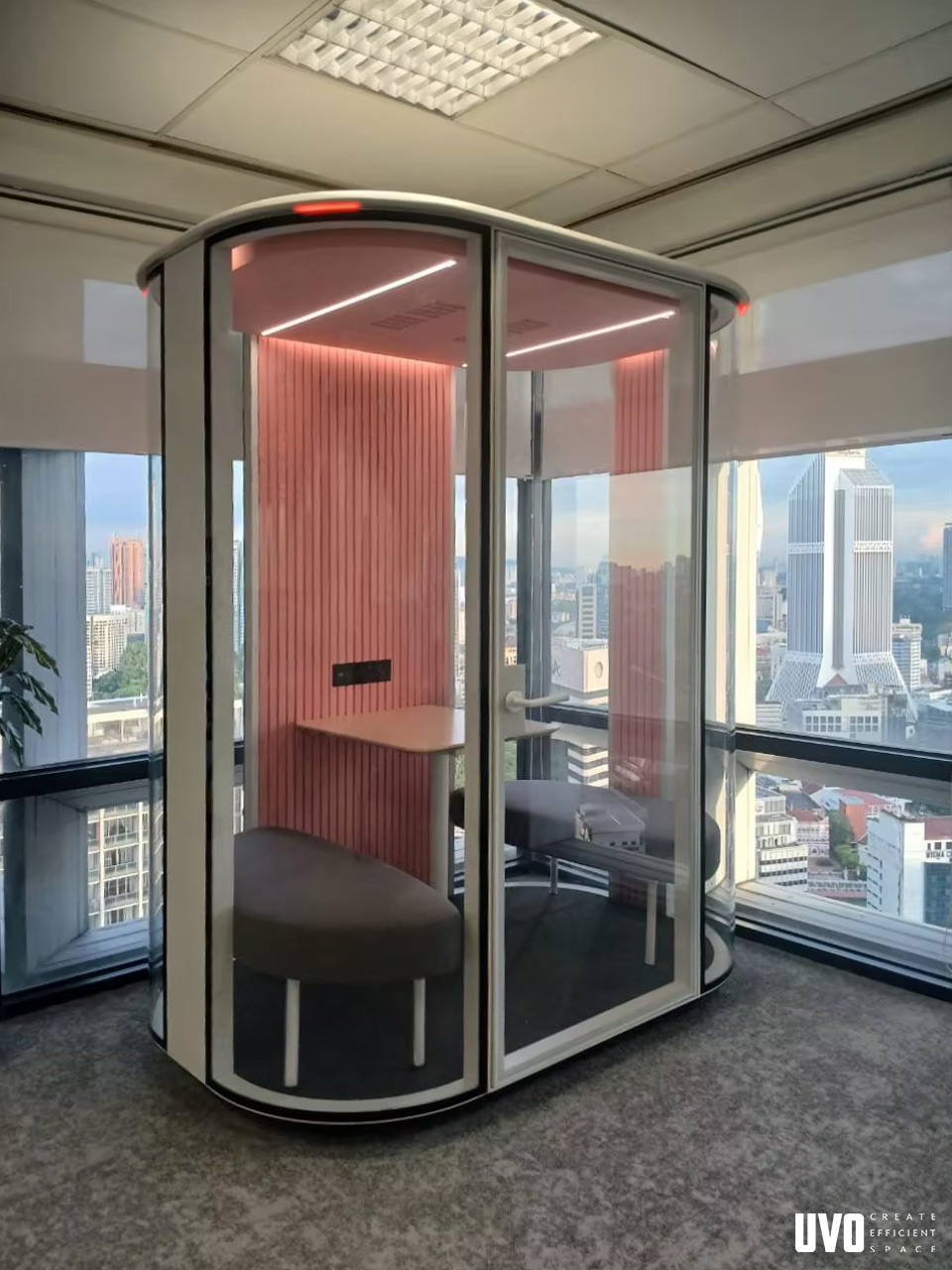
Buyers usually begin with a shortlist question — which pod is best — and only later discover that the shortlist was never the constraint. Capacity is. Acoustic pods are room-in-room products: a self-contained enclosure placed inside an open floor plate to restore the private, speech-isolated space that open planning removed. Once a pod is read as a small room rather than a piece of furniture, the purchase decision changes shape. Rooms are specified by occupancy, by session length and by frequency of use. Furniture is specified by finish.
An undersized pod gets used in ways that create friction. Staff book it for a two-hour focus block that a desk setting would have served; colleagues queue outside; the pod stops behaving like shared infrastructure. An oversized pod absorbs capital and floor area that two smaller units covering twice as many call types would have used better.
So the first commercial decision is the split between single-person capacity and meeting capacity. Everything else — model, glazing, configuration, delivery sequence — follows from it. The second decision is the acoustic class required for each category, because that is the specification buyers most often accept at face value and most often regret accepting.
The construction platform shared by the four models
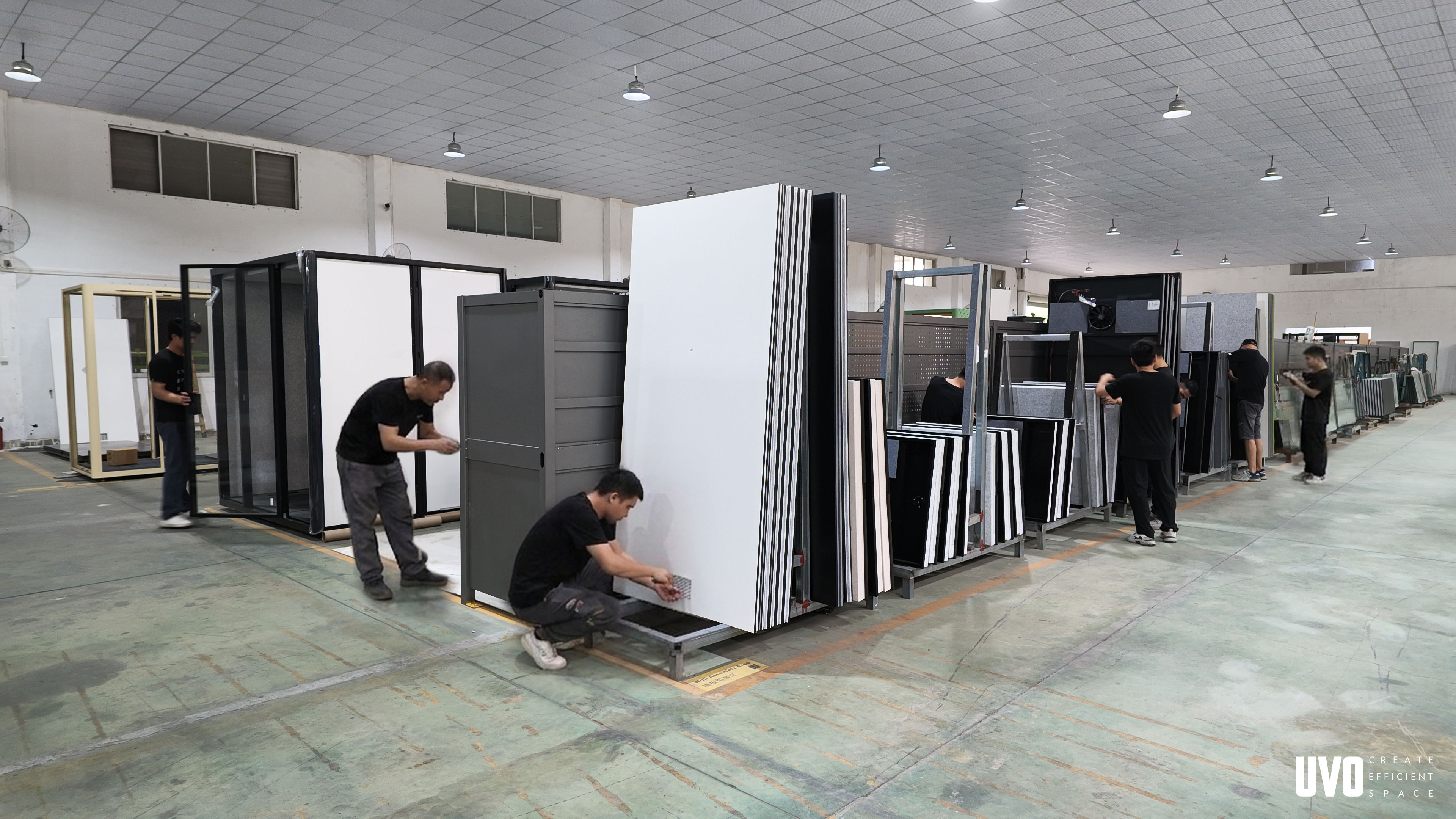
All four meeting-oriented models are built to the same construction logic, and understanding that logic is faster than reading four separate specification sheets. The structure combines an aluminum alloy frame, a steel ceiling base and steel exterior wall panels, 11 mm laminated glass surfaces, and a 25 mm five-layer acoustic interior wall construction.
- Aluminum alloy frame. The frame carries the glazing and the panel system while keeping the enclosure modular, which is what allows a pod to be repositioned or re-configured as a floor plan changes rather than treated as a fixed building element.
- Steel ceiling base and exterior wall panels. The ceiling and outer panels are structural and acoustic components at the same time, not decorative cladding — they carry the enclosure's integrated systems and close the acoustic envelope.
- 25 mm five-layer acoustic interior wall. The interior wall is a multi-layer acoustic build-up rather than a single panel with a surface finish applied. This is the layer that does most of the work in controlling speech transmission between the inside and the outside of the pod.
- 11 mm laminated glass. Laminated glass bonds two glass layers around an interlayer, which keeps the panel intact under impact and contributes mass and damping to the glazed surfaces — the parts of an enclosure that are otherwise acoustically weakest.
Because the platform is shared, the differences between the four models in this comparison are not differences in acoustic philosophy. They are differences in volume, capacity and the ventilation capacity needed to support the people inside.
What Sound Insulation Class B actually tells a buyer
Q ROOM - XS, Q ROOM - S, R POD - Large and MO BOX - Conference are all rated Sound Insulation Class B. That label is only meaningful against a defined measurement, and the measurement exists: ISO 23351-1:2020 defines acoustic performance for office pods and acoustic enclosures in terms of speech level reduction (DS,A), with Class A requiring 30 dB or more.
Read against that threshold, Class B sits below the top classification. It is still a working level of speech privacy — a normal conversation inside the pod is attenuated rather than transmitted into the surrounding floor plate — but it is not the highest class available under the same standard. The buyer consequence is a specification rule rather than a preference: if a pod will host HR conversations, legal calls or client negotiations, Class A should be requested by name; if the pod will host ordinary internal meetings, Class B is the level these four models are rated at.
Within the same product range, Class A appears on the smaller enclosures rather than the larger ones. Q ROOM - 3XS is listed with a stated 3XS value of 30.2 dB at Class A, and MO BOX - Solo is listed at Class A. That distribution is not an accident of marketing. A larger enclosure has more internal volume, more surface area and more occupants, so holding a given class across a bigger box is harder engineering than holding it across a smaller one. Buyers should treat the class as model-specific and confirm it for the exact unit ordered, not for the range.
Ventilation scales with occupancy, and the fan count shows it
Ventilation is the specification most often skipped during evaluation and most quickly noticed during use. UVO pods use multi-fan ventilation rated at 90 m³/h per fan, with fan count set by model size. Across the range the pattern tracks occupancy rather than price: single-occupant models carry one or two fans, small meeting models carry four, and the largest meeting models carry six or eight.
| Model | Published room use | Fans (90 m³/h each) | Acoustic rating |
|---|---|---|---|
| MO BOX - Phone | Private call and video conferencing booth for open office areas | 1 fan | Class B |
| Q ROOM - 3XS | Video meeting and quiet workplace booth for open office areas | 2 fans | Class A, stated 30.2 dB |
| Q ROOM - S | 2–4 person meeting room / negotiation room / collaboration room | 4 fans | Class B |
| MO BOX - Conference | 4–6 person meeting room | 6 fans | Class B |
This is a specification shaped by physics rather than preference. A sealed enclosure with more people inside accumulates heat, moisture and CO2, and needs proportionally more air exchange to remain usable for a full meeting. A six-person pod running a two-fan configuration would be a design error, not a cost saving — and it is one of the few errors that users notice within the first week.
Maintenance belongs in the same procurement brief. Documented troubleshooting for a cabin that feels stuffy attributes the symptom to blocked intake and exhaust vents, dust and carpet-fibre buildup, poor fan performance, or a faulty sensor switch. The diagnostic order runs vents first, sensor switch second, fan unit third, with abnormal fan noise treated as an indicator of damage or obstruction. It also separates a single affected cabin, which points to a localised fault, from several affected cabins, which points to an installation or environmental issue. Buyers running multi-unit rollouts should therefore specify how airflow will be verified at handover, not only what the rated airflow is.
Matching each model to a room use
The four models differ mainly along one axis: how many people need to be inside at once, and for how long. Everything else is a consequence.
Q ROOM - XS — open-office collaboration
Q ROOM - XS is positioned as a collaboration room designed for open office areas, with four fans at 90 m³/h each and Sound Insulation Class B. Its natural role is the short, informal gathering that open plan handles badly: two or three people pulling a laptop across the table, a stand-up problem-solving session, a whiteboard huddle that would otherwise happen at somebody's desk and interrupt a neighbouring team.
The boundary is duration and headcount. A collaboration room is not a five-person review space, and treating it as one is the most common sizing error in open-plan fit-outs — the room gets booked for the meeting, not the huddle, and the huddle loses its home.
Q ROOM - S — two- to four-person meetings and negotiation
Q ROOM - S is listed as a two- to four-person meeting room, negotiation room and collaboration room, with four fans and Class B. It covers the meeting types that dominate a working week: one-to-one reviews, interviews, supplier discussions, three-person planning sessions, negotiation with an external visitor. This is the capacity band most organisations specify in quantity, because most meetings in most organisations are small.
R POD - Large — two- to four-person pod
R POD - Large is listed as a two- to four-person pod with four fans at 90 m³/h each and Class B. Its published capacity overlaps Q ROOM - S, and the product data does not separate the two on acoustics or airflow — both are Class B with four fans. Where two models share a capacity band, the decision moves to layout and configuration: footprint against the floor plate, glazing orientation against circulation, and the lighting and power configuration required for the intended use. Those are confirmed at quotation rather than read off a specification sheet, and buyers comparing the two should compare them on those terms.
MO BOX - Conference — four- to six-person meetings
MO BOX - Conference is listed as a four- to six-person meeting room with six fans at 90 m³/h each and Class B. This is the model for meetings that need a table, a shared screen and a closed door: project reviews, client presentations, cross-team decisions. The six-fan configuration matches the higher occupancy, and the step from four to six people is what justifies the larger enclosure rather than simply more floor area. Specifying this size for two-person conversations is the opposite error to undersizing — it consumes meeting capacity that smaller units would have released.
The single-person pod: where most of the demand actually sits
The four meeting models above are the ones buyers debate, but the single-person pod is the unit most open-plan floors under-provide. Private calls do not cluster into scheduled slots. A floor that reserves enclosed capacity only for meetings soon finds its meeting rooms occupied by one person on a headset, and the meeting that needed the room has nowhere to go.
The single-person category inside the same UVO range is a family rather than a single product, and it is broader than the meeting category in the number of models offered.
| Model | Published room use | Fans (90 m³/h each) | Acoustic rating |
|---|---|---|---|
| MO BOX - Phone | Private call and video conferencing booth for open office areas | 1 fan | Class B |
| Q ROOM - 3XS | Video meeting and quiet workplace booth for open office areas | 2 fans | Class A, stated 30.2 dB |
| R POD - Mini | One-person pod | 2 fans | — |
| MO BOX - Solo | Video meeting, quiet workplace, private phone call, manager room, live room | 2 fans | Class A |
| Q ROOM - 2XS | Two-person meeting room / interview room | 2 fans | Class B |
Three things follow for a buyer. First, the highest acoustic class in the range is available inside the single-person category rather than being reserved for the largest pod — Q ROOM - 3XS and MO BOX - Solo both carry Class A, which matters because confidential calls are precisely the use case where speech leakage into an open floor is least acceptable.
Second, fan count varies from one to two inside the same category, so airflow must be checked model by model rather than assumed from the category name. A single-occupant booth with one fan and a single-occupant booth with two fans are not interchangeable specifications, particularly in warm climates or where a pod sits against an internal wall with limited air movement around it.
Third, the single-person pod is the unit most sensitive to maintenance neglect. A small sealed volume with one occupant reaches a stuffy condition faster than a large meeting pod that is used intermittently, and the same vent-blocking and fan-performance conditions documented for the range show up first in the smallest enclosures.
The proportional rule that follows does not need a formula: count private call events per floor before counting meeting hours. In most open-plan deployments the single-person category needs to be specified earlier and in larger numbers than the meeting category, because the meeting category has a physical alternative — the conventional meeting room — while a private call has none.
What real deployments show about mixing sizes
Published project references support a mixed-size approach rather than a single-model rollout. A 60-unit installation in Russia for open office areas was completed within six months, covering video meetings, quiet workplace and private phone calls; the recorded result was effective noise isolation with improved staff work efficiency, and the highlights noted were movable units with a compact footprint, quick installation, and adaptability to any space utilisation at any time.
A 15-unit installation in Malaysia for collaboration rooms, brainstorming rooms and meeting rooms used Q ROOM - 3XS, with good sound insulation, quick installation and plug-and-play operation recorded as the highlights. A 10-unit installation in China covered private call pods for offices together with a meeting room, using MO BOX - Talk and MO BOX - Solo.
The common thread is that none of these references deploys a single size. Where the brief is written around call types and headcounts rather than around a preferred model, the resulting mix naturally spans the single-person and small-meeting categories — and the floor keeps its meeting rooms for meetings.
Market context: why the category is being specified more carefully
Office pods have moved from a novelty line item to a category with its own procurement logic. Mordor Intelligence estimates the global office pods market at USD 1.00 billion in 2026, and Straits Research reports that Europe held a 66.4% revenue share in 2025 — a reflection of how early European corporate real-estate teams adopted enclosed acoustic space as standard floor-plate infrastructure.
Growth is shifting. Mordor Intelligence identifies Asia-Pacific as the fastest-growing regional market, supported by urban workforce expansion, and reports a 43% share of global soundproof booth installations in the region. For buyers, that combination has two practical effects: more manufacturing capacity competing for the same specifications, and more variation in how acoustic performance is described on product pages.
The second effect is the one that matters in a tender. ISO 23351-1:2020 gives the category a shared vocabulary — speech level reduction, and Class A and Class B as defined outcomes — but commercial pages do not always state which metric a figure refers to. Buyers who specify the standard edition, the class and the test report in the RFQ get comparable answers; buyers who accept a number without its basis get answers that cannot be compared.
Where acoustic pods still fall short of a built room
Pods solve a real problem, but they are not a like-for-like replacement for a constructed room, and pretending otherwise is the fastest way to a failed rollout. Four boundaries are worth stating plainly.
- The largest models in this comparison are Class B, not Class A. Q ROOM - XS, Q ROOM - S, R POD - Large and MO BOX - Conference are all rated Class B. Where speech confidentiality is the dominant requirement, a buyer should not simply default to the biggest enclosure in the range — the Class A options in this range are the smaller units, Q ROOM - 3XS and MO BOX - Solo. Matching a confidential use case to a large Class B meeting pod is a specification error that no amount of good installation will correct.
- Ventilation is fixed per model, at 90 m³/h per fan. Capacity cannot be increased after delivery by adding airflow, and the published data does not state fan noise levels. Buyers planning pods in quiet zones or in recording-adjacent areas should request fan-noise data alongside airflow data before ordering.
- External dimensions and footprint are not part of the verified specification used here. Floor-plate planning, circulation clearances and delivery access all depend on dimensions that must be confirmed against the quotation drawings for the exact model and configuration, not inferred from the capacity band.
- Acoustic and certification evidence should be requested per model. The range carries UL GREENGUARD environmental certification, CE electrical safety certification under UDEM, and SGS NA safety compliance certification, alongside ISO 9001 and ISO 14001 management-system certification. Those documents establish environmental, electrical and safety conformity. They are not, on their own, a substitute for the model-specific acoustic test report behind a Class A or Class B claim.
A built room remains the better answer where the space will never move, where full-height construction is possible, and where the acoustic target exceeds what a freestanding enclosure can reasonably deliver. The pod's advantage is different in kind: it is relocatable, it can be installed and reconfigured on a working floor, and it can be deployed in phases as headcount changes.
Future outlook
Two developments are likely to shape how acoustic pods are bought over the next procurement cycles. The first is standardisation of the specification language. As ISO 23351-1 references become normal in tender documents, the differentiator moves away from the claimed class and towards the evidence package behind it — the test report, the laboratory, the standard edition and the model it applies to. Suppliers who can produce that package quickly will win specifications that competitors cannot answer.
The second is the rebalancing of supply. With Europe holding the majority of revenue and Asia-Pacific growing fastest, buyers in both regions gain more supplier options and more incentive to compare on documented facts rather than on brand familiarity. That shift rewards the buyer who arrives with a room-by-room capacity brief, a stated acoustic class per category, and a documented ventilation requirement — and it penalises the buyer who arrives with a preferred model and works backwards.
For a floor being planned now, the practical implication is to build the brief around call types and headcounts, specify the acoustic class separately for confidential and general use, and ask for the evidence package for every model under consideration before the shortlist is finalised.
Frequently asked questions
Do the four meeting models differ in construction?
No. Q ROOM - XS, Q ROOM - S, R POD - Large and MO BOX - Conference share the same construction logic: an aluminum alloy frame structure, a steel ceiling base and steel exterior wall panels, 11 mm laminated glass surfaces, and a 25 mm five-layer acoustic interior wall construction. The differences between the models are in capacity, internal volume, ventilation fan count and intended room use.
How many ventilation fans does each model carry?
Each fan provides 90 m³/h, and fan count varies by model. MO BOX - Phone carries one fan; Q ROOM - 3XS, Q ROOM - 2XS, R POD - Mini, MO BOX - Solo, MO BOX - Chat and MO BOX - Live carry two; Q ROOM - XS, Q ROOM - S, R POD - Large, MO BOX - Talk and MO BOX - Cowork carry four; MO BOX - Conference carries six; Q ROOM - M and Q ROOM - M BF carry eight.
What does Sound Insulation Class B mean compared with Class A?
ISO 23351-1:2020 defines acoustic performance for office pods and acoustic enclosures in terms of speech level reduction (DS,A), with Class A requiring 30 dB or more. Class B therefore sits below that threshold. In this range, Q ROOM - XS, Q ROOM - S, R POD - Large and MO BOX - Conference are rated Class B, while Q ROOM - 3XS is listed with a stated 3XS value of 30.2 dB at Class A and MO BOX - Solo is listed at Class A.
How many people does each model support?
Published room uses state the capacity directly: Q ROOM - XS is a collaboration room for open office areas; Q ROOM - S is a two- to four-person meeting, negotiation and collaboration room; R POD - Large is a two- to four-person pod; MO BOX - Conference is a four- to six-person meeting room. In the single-person category, MO BOX - Phone, R POD - Mini and MO BOX - Solo are single-occupant models, while Q ROOM - 2XS is listed as a two-person meeting and interview room.
What certifications apply to the acoustic pod range?
The range is covered by UL GREENGUARD environmental certification (certificate numbers 354320-410, 354321-410 and 354322-410, valid to 2027-04-17), CE electrical safety certification issued by UDEM (M.2025.206.C119277, valid to 2030-04-17), and SGS NA safety compliance certification (SGSNA/26/GZ/00129, under CAN/CSA C22.2 No. 61010-1 3rd Ed, valid to 2027-04-17). The manufacturer also states dual certification under ISO 9001 and ISO 14001.
What are the production lead times and minimum order quantity?
Standard lead time is three to four weeks and customised lead time is five to six weeks, with a minimum order quantity of one unit. Monthly production capacity is 500–600 units for office project orders, and quality control includes 100% testing of production units.
What support is available after delivery?
Installation manuals and installation videos are supplied with the products. Remote technical support and on-site guidance are available after delivery.
Can pods be relocated after installation?
The product concept is a modular room-in-room system, and published project references describe the units as movable with a compact footprint, adaptable to space utilisation at any time, and quick to install. A 60-unit open-office installation in Russia was completed within six months, and a 15-unit installation in Malaysia was noted for quick installation and plug-and-play operation.
What causes a pod to feel stuffy?
Documented troubleshooting attributes a stuffy cabin to blocked intake and exhaust vents, dust and carpet-fibre buildup, poor fan performance, or a faulty sensor switch. The recommended inspection order is vents first, then the sensor switch, then the fan unit, with abnormal fan noise treated as an indicator of damage or obstruction. A single affected cabin points to a localised fault; several affected cabins point to an installation or environmental issue.
Have Questions or Need More Details?
Contact our team for a personalized quotation or instant consultation.
Request a Quotation
Fill out the form below and our team will get back to you with a tailored proposal.
WhatsApp Direct Chat
Prefer to chat in real-time? Message us on WhatsApp for instant assistance & quick answers.
- Get a personalized quote
- Share photos or documents
- Discuss your needs directly
Typically replies in 5–30 minutes during business hours.