
Action Camera Buyer Comparison: Q1, Q2, Q3, X20 and Q7 Specs
Independent Buyer Comparison · Consumer Electronics
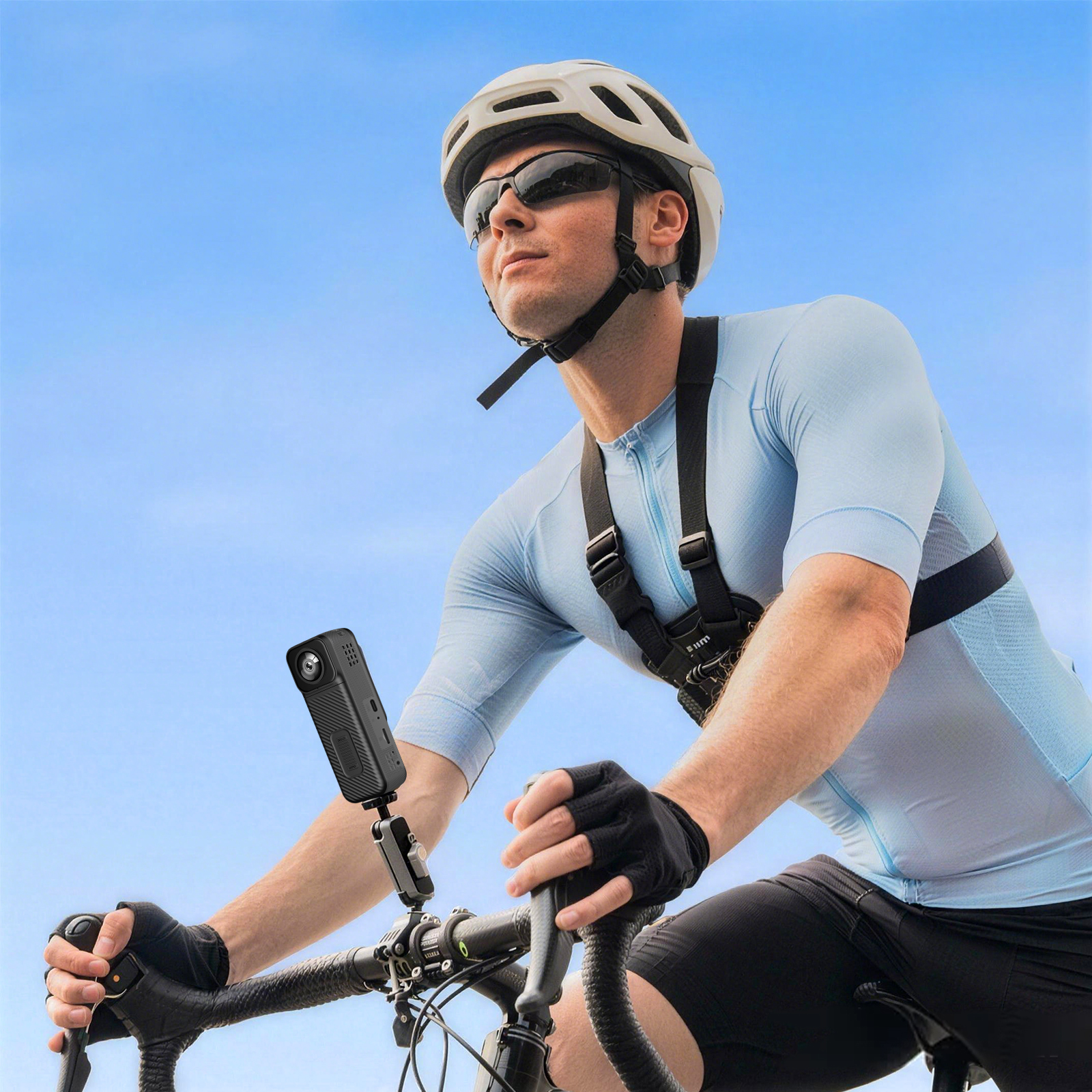
Bicycle and outdoor mounting is one of three application industries listed for all five models compared in this article.
Comparing five action camera models inside a single production range is a different exercise from comparing brands. The Q1, Q2, Q3, X20 and Q7 are compact ABS-bodied action cameras produced by Dongguan YuAoHeng Electronic Technology Co., Ltd. (YUAOHENG), a Dongguan-based manufacturer founded in 2016 that develops and produces action cameras, dash cameras and smart video doorbells for export markets across Europe, North America, Asia and South America. Because all five models sit inside one manufacturing programme, the decisions that separate them are specification-level rather than brand-level: WiFi category, display size, battery capacity, lens behaviour, infrared night vision, image stabilization, waterproof case compatibility and recording modes.
This comparison is built from the published parameter and selling-point records for each model, supported by third-party market and standards data. Where a specification does not appear in those records, it is treated as unconfirmed rather than assumed. That boundary is deliberate. For an OEM buyer, the gap between what a specification sheet states and what an order actually delivers is where most sourcing risk sits.
Why model-level comparison decides more orders than brand-level claims
Category growth no longer tells a buyer which model to stock. SkyQuest Technology valued the global action camera market at USD 6.57 billion in 2024, while Mordor Intelligence and Grand View Research published 2025 estimates of USD 7.09 billion and USD 7.97 billion respectively. That spread reflects different report scopes rather than one correct number, and it is a reminder that any single market figure should be read with its definition attached.
China's market was estimated at USD 502.25 million in 2024 (Market Research Future). China exported USD 166 million in video cameras in 2024, with the United States the largest single destination at USD 31.8 million (Observatory of Economic Complexity), and North America accounted for a 34% revenue share in 2025 (Grand View Research).
Inside that demand, the resolution tier has moved upward: Ultra-HD (4K and above) accounted for approximately 46.25% of action camera market share in 2025 (Mordor Intelligence). For a buyer assembling a range, the practical question shifts from whether to stock action cameras to which two or three of these five models cover the applications actually sold into. All five models list the same three applicable industries — outdoor sports, photography and video shooting, and driving and transportation — so the industry label does not separate them. The specification record does.
The five models at a glance
| Model | Range label | Display | Battery | Lens | Infrared night vision | Stabilization | Waterproof case | Recording modes |
|---|---|---|---|---|---|---|---|---|
| Q1 | 4k+WIFI Q1 | 1.5-inch IPS, 320×240 | 2000 mAh / 3.8V polymer | 130° wide angle, rotating direction | Supported; switching mode not stated | Not listed in the record | Stated compatible | Front 4K (3840×2160) + rear 4K, simultaneous 2K+2K |
| Q2 | 4k+WiFi+Touch screen+Anti-shake Q2 | 1.8-inch IPS, 800×480; touch and physical buttons | 18650 cell, 2000 mA | 25mm, 130° wide angle, front and rear dual recording | Supported; switching mode not stated | 6-level electronic image stabilization | Stated compatible | Front 4K + rear 4K, simultaneous 2K+2K, three modes optional |
| Q3 | 4K WIFI Action camera Q3 | 1.5-inch IPS, 320×240 | 2000 mAh / 3.8V polymer | 130° wide angle, rotating direction | Supported; manual (hand regulation) switching | Not listed in the record | Not stated | Front 4K + rear 4K, simultaneous 2K+2K |
| X20 | 2K+WIFI X20 | 1.54-inch IPS, 320×240 | 1000 mAh / 3.8V polymer | 130° HD lens; selling-point record also cites rotating direction | Supported; manual (hand regulation) switching, four built-in energy-saving infrared lights | Not listed in the record | Not stated | Recorded resolution line: AVI (1920×1080) |
| Q7 | 4k+WiFi+Anti-shake Q7 | 1.47-inch IPS, 320×240 | 1000 mAh / 3.8V polymer | 130° wide angle, rotating direction | Supported; switching mode not stated | Anti-shake support | Stated compatible | Single-channel 4K (3840×2160) at 30 fps |
Two conventions in the table need stating plainly. First, the range label reproduces the type string used in the product record — for example '4k+WIFI Q1' or '2K+WIFI X20' — and works as a category marker rather than a complete specification. All five models are WiFi models; what differs is what accompanies WiFi in the type string, with Q2 adding touch screen and anti-shake, Q7 adding anti-shake, X20 bracketed in the 2K tier, and Q1 and Q3 sitting in the 4K plus WiFi tier. Second, a small number of attributes appear in one record and not the other, or are recorded on a line that mixes two pieces of information. Those points are flagged rather than smoothed over, because they are exactly what an order confirmation should close.
Where the five models differ in practice
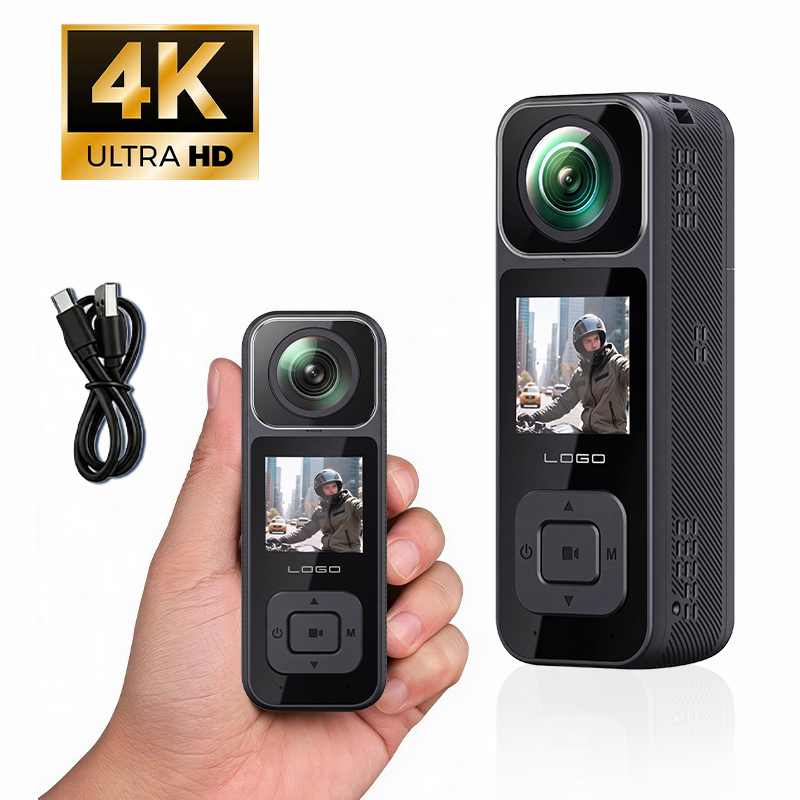
Q2 carries the largest display in the group — a 1.8-inch IPS panel at 800×480 with touch and physical dual buttons — and is one of two models with a stabilization statement.
Display size and control method
Q2 carries the largest display in the group: a 1.8-inch IPS panel at 800×480, with standard touch and physical dual buttons. The other four use 320×240 panels — Q1 at 1.5 inches, Q3 at 1.5 inches, X20 at 1.54 inches and Q7 at 1.47 inches. Display size changes framing habits more than it changes image quality. A larger, higher-resolution panel makes menu navigation and framing easier in bright outdoor conditions, while compact panels keep the body smaller. The Q2 record is also the only one in this group that lists touch operation, which matters where operators wear gloves or work with wet hands: physical buttons remain usable in conditions where capacitive input is unreliable.
Battery capacity and the runtime that follows it
The group splits into two power classes. Q1, Q2 and Q3 use 2000 mAh-class cells — Q1 and Q3 a 2000 mAh/3.8V polymer battery, Q2 an 18650 cell rated 2000 mA. X20 and Q7 use a 1000 mAh/3.8V polymer battery. Published runtime follows the same split. Q1 records about 4–5 hours of video and about 9 hours of recording, with a maximum photo duration of approximately 10 hours in 720p 30fps high-quality video. Q2 records about 4–5 hours of video. X20 records about 6–7 hours of video, about 9 hours of recording and a maximum photo duration of approximately 12 hours in 720p 30fps. Q3 and Q7 publish no runtime figure in their records. The practical lesson is that the headline figure is mode-specific: the 10-hour and 12-hour numbers are tied to 720p 30fps, not to the models' highest resolution.
Stabilization is not uniform across the group
Only two models in this range carry a stabilization statement. Q2 lists 6-level electronic image stabilization, and Q7 lists anti-shake support. The Q1, Q3 and X20 records do not list an image stabilization feature. That distinction is central to handheld and high-vibration work. Electronic Image Stabilization is a software-based correction method and has become a standard feature in budget to mid-range action cameras (Insta360 industry guide) — but standard across the category does not mean standard across a single five-model range. Buyers planning handheld vlog, bicycle, motorcycle or off-road mounting should treat Q2 and Q7 as the stabilized options here, and should confirm firmware behaviour on a sample, since the level and tuning of software stabilization affect the usable frame.
Rotating lenses and how infrared is switched
Lens angle itself does not separate these models: all five are recorded with a 130° lens. What separates them is how the lens is mounted and what the lens pair does. The Q1, Q3 and Q7 parameter records list a 130° wide-angle lens with rotating direction. Q2 uses a 25mm lens with a 130° wide angle and supports front and rear dual recording simultaneously. X20's parameter line records a 130° HD lens, while its selling-point record cites rotating direction — a difference worth resolving at sample stage rather than at mass production.
Infrared night vision is recorded as supported across all five models, appearing in the parameter line for Q1, Q3 and X20 and in the selling-point record for Q2 and Q7. Switching behaviour is documented for two: Q3 and X20 both use manual adjustment (hand regulation), and X20 adds four built-in energy-saving infrared lights. For Q1, Q2 and Q7, the switching mode is not stated in the provided records. Manual infrared switching is a workflow decision rather than a minor detail: it puts the light under the operator's control instead of an automatic sensor, which changes how night recording is run and how staff are briefed.
Recording modes and resolution
Q1 and Q3 record front 4K (3840×2160) and rear 4K (3840×2160), with simultaneous dual recording at front 2K + rear 2K. Q2 records the same front and rear 4K capability plus simultaneous 2K+2K dual recording, and its record describes three optional modes. Q7 is a single-channel 4K model recording at 3840×2160 and 30 fps. X20's parameter record lists its camera resolution line as AVI (1920×1080) while the model carries a 2K+WIFI label — the container format and the resolution are recorded on the same line, so the effective recording resolution should be confirmed against a sample rather than inferred from either string alone. Where recording bit speed is listed, it reads WAV (512KBPS), and all five bodies are recorded as ABS.
Waterproof case compatibility
Q1, Q2 and Q7 selling-point records state compatibility with a waterproof case for underwater shooting. The Q3 and X20 records do not state case compatibility. For diving, snorkelling or heavy-splash programmes, that difference decides whether a model can serve the application with an accessory or needs a different housing solution, and it should be confirmed before an order is built around underwater use.
Matching model strengths to three industries
All five models list the same applicable industries — outdoor sports equipment, photography and video shooting, and driving and transportation — so the selection logic has to run through the application, not the category.
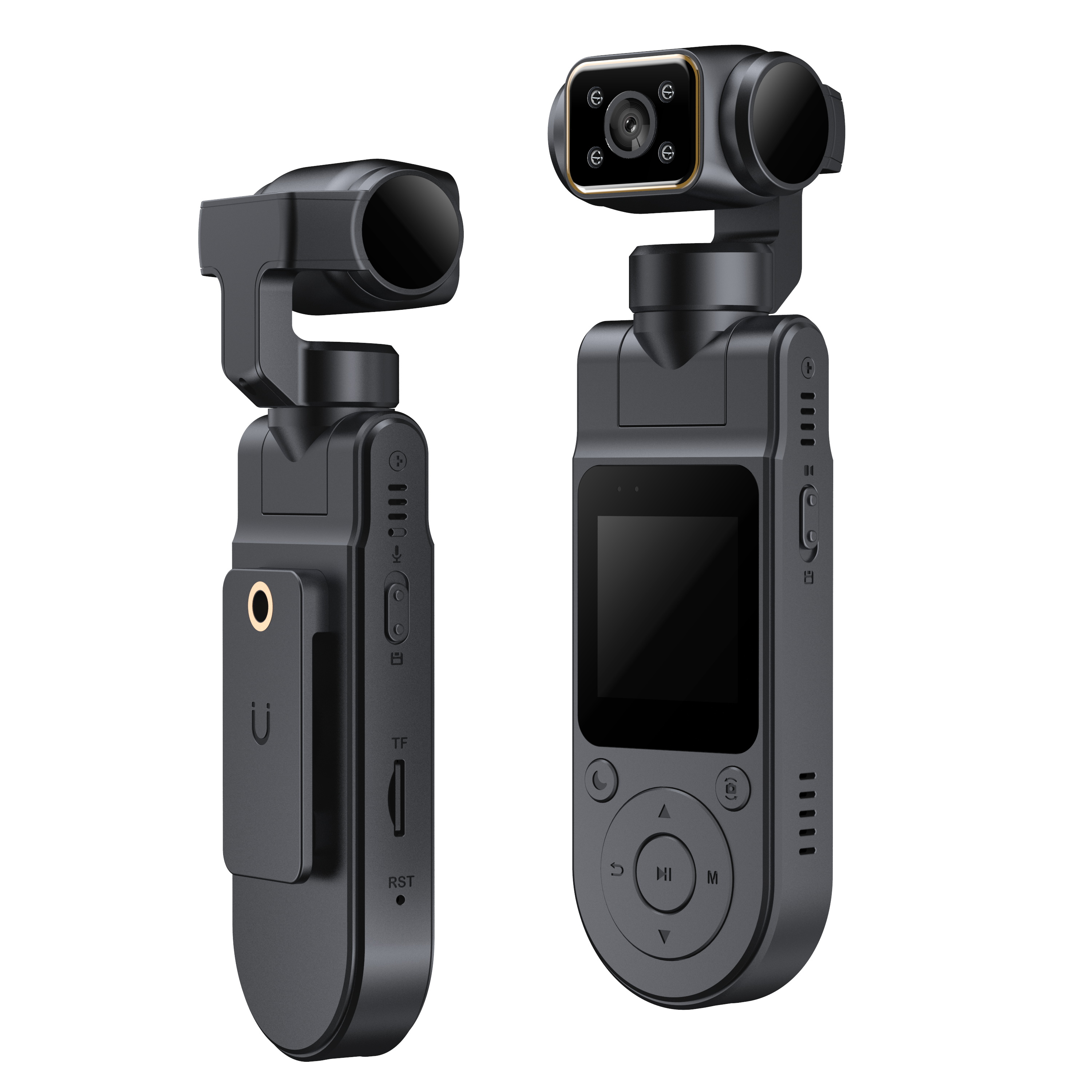
X20 combines a 1.54-inch display, four built-in energy-saving infrared lights and optional storage at 16GB, 32GB, 64GB or 128GB.
- Outdoor sports equipment. The scenario data for this industry describes all-weather operation from -20℃ to 60℃, dustproof, waterproof and shockproof design, high-vibration mounting on motorcycle, mountain bike and off-road vehicles, and high-speed movement such as skiing and skydiving. Q2's 6-level electronic stabilization and larger display suit handheld follow shots and high-vibration mounting where the operator frames by screen. Q7 pairs anti-shake support with single-channel 4K at 30 fps for a simpler recording chain. Q1 and Q3, with rotating 130° lenses and front-plus-rear 4K, suit rigs that need two coverage angles in one take — a rider-facing and a forward view, for example.
- Photography and video shooting. Travel vlog shooting, outdoor hiking and camping recording, and daily life video blogging are the recorded applications in the case data for this product family. Q2's touch interface and 800×480 panel fit vlog framing and quick menu changes, while Q1 and Q3's simultaneous front 2K + rear 2K dual recording covers two angles without a second body. X20's record adds micro-Type-C input at DC5V-1A-2A and optional storage at 16GB, 32GB, 64GB or 128GB, which matters when a programme is specified around fixed memory configurations and long sessions.
- Driving and transportation. The recorded role for this industry is dash-cam-style vehicle safety monitoring, alongside first-person HD capture. Infrared night vision, listed for all five models, is the relevant capability for low-light and night recording; Q3 and X20 document manual infrared switching, and X20 documents four energy-saving infrared lights. Q1's 2000 mAh-class battery with about 9 hours of recording time and X20's roughly 6–7 hours of video both fit extended road sessions, subject to runtime conditions being confirmed.
How this plays out commercially is visible in the case record for this range: an action camera brand OEM in the United States has taken 5,000 units over a 5-year project, applied to travel vlog shooting, outdoor hiking and camping recording and daily life video blogging. The application mix — travel, outdoor, daily — is the same mix that decides which of the five models goes into which channel.
The production programme behind the five models
YUAOHENG was founded in 2016 and operates a 1,500㎡ standardized production facility with 300 employees, a 30-engineer R&D team and an annual output recorded at 2,000,000 units, with monthly capacity of 170,000 units and a lead time of 25–30 days. Its main products are action cameras, dash cameras and smart video doorbells, and roughly 80% of output is exported to more than 15 countries and regions including the United States and the United Kingdom. FCC, CE and RoHS certifications are held at company level.
Customization is organized in four areas: product design and R&D services such as concept design, prototype development, engineering consultation and certification support; hardware and function customization covering camera modules, sensors and detection functions; software and intelligent function customization including firmware development, intelligent functions, APP and cloud services; and appearance and packaging customization covering colour, material, logo engraving, brand logo, size and structure, retail packaging, instructions and accessories. Quality control is documented as 100% test, the minimum order quantity is listed as 1 unit, and after-sales support is a 12-month official warranty with online technical guidance and troubleshooting, replacement and maintenance services, and long-term technical iteration support.
Market trends shaping the next range decision
Three trends sit behind this comparison. The first is resolution migration: Ultra-HD at 4K and above reached approximately 46.25% of action camera market share in 2025 (Mordor Intelligence), which explains why four of the five models here are labelled in the 4K tier while the fifth sits in the 2K tier. The second is stabilization expectation: Electronic Image Stabilization has become a standard feature in budget to mid-range action cameras and works through software algorithms (Insta360 industry guide), so a range that includes unstabilized models needs a clear application story for them. The third is competitive concentration in retail. GoPro sold 3 million camera units in 2023 (SkyQuest Technology), while DJI and Insta360 held nearly 90% of the action camera market share in Japan as of late 2025 (PetaPixel, citing BCN+R). In markets where consumer recall is dominated by a handful of brands, OEM and private-label programmes compete less on brand recognition and more on how precisely a model's specification matches a defined application.
From brand-first to spec-first: what changes, and what it still cannot fix
The traditional way to assemble an action camera range is to choose a brand tier first and read the headline specification second, usually resolution and price. That approach survives because headlines are easy to compare. It breaks down on exactly the points where this group differs: whether a model lists stabilization at all, whether its infrared light is switched manually, whether a waterproof case is recorded as compatible, whether the display supports touch, and whether the recorded resolution line matches the marketing label. A specification-first comparison does not remove those questions; it surfaces them while they are still cheap to resolve.
Boundaries a buyer should keep in view.
- Image stabilization is recorded for two of the five models; the other three need mount discipline or external support for high-vibration capture.
- Runtime figures are mode-specific, and Q3 and Q7 publish none. The -20℃ to 60℃ figure is an outdoor operating condition from the scenario data, not a tested runtime condition for any single model.
- A 130° lens angle is common to all five models, so angle alone cannot justify a model choice.
- The X20 resolution line and its 2K label do not match on the face of the record.
- No per-model ingress-protection rating and no per-model certification statement appear in the supplied model records, so compliance must be confirmed at SKU level. Action cameras fall under the IEC 62368-1 safety standard for audio/video and information technology equipment, 4th edition published in 2023, and IP68 is defined under IEC 60529 as protection against dust (6) and immersion (8).
- A 25–30 day lead time sets a practical limit on how late in a season an order can be revised.
Purchasing terms and acceptance criteria to confirm before ordering
- Specification line versus label. Confirm the effective recording resolution for every SKU, particularly where a model's resolution record and its range label sit in different tiers.
- Lens and infrared behaviour. Confirm whether the lens rotates and how infrared night vision is switched, per SKU, since the records state switching mode for some models only.
- Housing. Confirm waterproof case availability and depth rating for the underwater programmes planned for Q1, Q2 and Q7, and resolve whether Q3 or X20 need an alternative housing solution.
- Stabilization scope. Confirm the level and firmware behaviour of stabilization on Q2 and Q7, and confirm that unstabilized models are matched to mount-based applications.
- Certification documents at SKU level. Company-level FCC, CE and RoHS records exist; per-model certification evidence and EU documentation should be requested for the specific configurations ordered.
- Sample validation before mass production. Verify actual recording resolution, stabilization behaviour and effective field of view, infrared switching, display and control type, and case fit on physical samples.
- Commercial and delivery terms. The capability record lists a minimum order quantity of 1 unit, a lead time of 25–30 days, 100% test, and a 12-month official warranty with online technical guidance, replacement and maintenance support.
- Customization scope. Product design and R&D, hardware and function customization, firmware and APP development, and appearance and packaging are all listed as available areas — confirm which apply to each SKU before tooling begins.
- Interface and storage. X20 lists micro-Type-C input at DC5V-1A-2A and optional storage at 16GB, 32GB, 64GB or 128GB; the other models list a high-speed Mini USB 2.0 interface, so accessory and cable planning should follow the interface actually recorded.
Future outlook
Resolution and stabilization are moving from differentiators to baseline expectations, which pushes the real differentiation inside a five-model range toward battery class, channel count, infrared handling, control interface and firmware behaviour. Buyers who shortlist by application coverage rather than by a single headline specification will find that this group maps more cleanly: Q2 for stabilized, screen-led work; Q7 for stabilized single-channel 4K; Q1 and Q3 for dual-coverage recording with rotating lenses; X20 for lower-power, storage-flexible day-to-day capture. The verification steps remain the same in either case, and they are what turn a specification comparison into a repeatable procurement process.
FAQ
Which of these five models provide image stabilization?
Q2 lists 6-level electronic image stabilization and Q7 lists anti-shake support. The Q1, Q3 and X20 records provided do not list an image stabilization feature. Because electronic stabilization is a software-based method, the level and tuning of the correction affect the usable frame, and firmware behaviour should be verified on a sample for handheld or high-vibration work.
Can the Q1, Q2, Q3, X20 and Q7 be used for underwater shooting?
The Q1, Q2 and Q7 selling-point records state compatibility with a waterproof case for underwater shooting. The Q3 and X20 records do not state case compatibility, and no per-model ingress-protection rating appears in the model records. Underwater programmes should therefore confirm housing fit and depth rating before an order is placed.
How does infrared night vision work on these models?
All five records state infrared night vision support — in the parameter line for Q1, Q3 and X20, and in the selling-point record for Q2 and Q7. Q3 and X20 both use manual adjustment (hand regulation) for switching, and X20 adds four built-in energy-saving infrared lights. For Q1, Q2 and Q7, the switching mode is not stated in the provided records.
How do the recording modes differ between the dual-lens models and Q7?
Q1 and Q3 record front 4K (3840×2160) and rear 4K (3840×2160) with simultaneous dual recording at front 2K + rear 2K. Q2 records front and rear 4K with simultaneous 2K+2K and three optional modes. Q7 records single-channel 4K at 3840×2160 and 30 fps. X20's recorded resolution line reads AVI (1920×1080) while the model carries a 2K+WIFI label, so its effective resolution should be confirmed on a physical sample.
Which models are suited to driving and transportation recording?
All five models list driving and transportation as an applicable industry, and the recorded role in that scenario is dash-cam-style vehicle safety monitoring. X20 publishes about 6–7 hours of video and about 9 hours of recording, while Q1 publishes about 4–5 hours of video and about 9 hours of recording; Q3 and Q7 publish no runtime figure. Infrared night vision is listed for all five models, which is relevant to low-light and night recording.
What ordering terms apply to these models?
The capability record lists a minimum order quantity of 1 unit, a lead time of 25–30 days, 100% test, and a 12-month official warranty with online technical guidance, replacement and maintenance support. Customization covers product design and R&D, hardware and function customization, firmware and APP development, and appearance and packaging. Certification documents and specification points should be confirmed at SKU level before mass production.
Sources
- SkyQuest Technology, Action Camera Market Size & Growth Report 2032 — global market value, 2024. https://www.skyquestt.com/report/action-camera-market
- Mordor Intelligence, Action Camera Market — 4K and above segment share, 2025; 2025 market estimate. https://www.mordorintelligence.com/industry-reports/action-camera-market
- Grand View Research, Action Camera Market — North America revenue share, 2025; 2025 market estimate. https://www.grandviewresearch.com/industry-analysis/action-camera-market
- Market Research Future — China action camera market size, 2024. https://www.marketresearchfuture.com/reports/china-action-camera-market-45287
- Observatory of Economic Complexity — China video camera export value, 2024. https://oec.world/en/profile/bilateral-product/video-cameras/reporter/chn
- IEC — IEC 62368-1:2023; IEC 60529 IP ratings. https://www.iec.ch/ip-ratings
- PetaPixel, citing BCN+R — Japan action camera market share, late 2025.
- Insta360 industry guide — EIS as a standard feature in budget to mid-range action cameras.
- YUAOHENG product parameter and selling-point records for models Q1, Q2, Q3, X20 and Q7.
Manufacturer reference: Dongguan YuAoHeng Electronic Technology Co., Ltd. Product catalogue (PDF): YUAOHENG product catalogue.
Have Questions or Need More Details?
Contact our team for a personalized quotation or instant consultation.
Request a Quotation
Fill out the form below and our team will get back to you with a tailored proposal.
WhatsApp Direct Chat
Prefer to chat in real-time? Message us on WhatsApp for instant assistance & quick answers.
- Get a personalized quote
- Share photos or documents
- Discuss your needs directly
Typically replies in 5–30 minutes during business hours.