
Activated Carbon Air Filters: Matching Media to Real Project Conditions
Gas-phase pollutants are becoming a larger part of indoor air quality specifications. Activated carbon air filters address that load, but their fit depends on the project's contaminant profile, system design, and operating conditions — not on particle efficiency grades alone.
Particles Are Not the Whole Air Quality Picture
Air filtration projects divide into two broad tasks. Mechanical filters, such as panel, bag, and HEPA filters, capture particles. Activated carbon air filters handle a different category of contaminants: volatile organic compounds (VOCs), odors, formaldehyde, and other gaseous substances. Procurement teams that are used to MERV or EN 1822 particle ratings often find gas-phase selection harder to evaluate, because the media and the performance indicators are different.
For projects in the United States, the Netherlands, and other markets with rising indoor air quality attention, specifications increasingly include both particulate and gas-phase requirements. The scenarios documented in this article cover household appliances, pharmaceutical plants, cleanroom design, HVAC systems, and fresh air systems.
The Opportunity: Inserting a Carbon Stage into an Existing Airflow Path
Adding activated carbon filtration does not necessarily require a separate air treatment unit. In many documented projects, carbon media are integrated into air purifiers, fresh air systems, and HVAC housings as a filter stage. This makes adoption simpler for engineering teams: the project needs a filter media that fits the existing envelope and matches the expected gas load.
For household appliances, the application data shows air purifier projects with functions such as 'remove VOC and bad smell' and 'remove VOC, pet smell and special harmful gas.' The opportunity is clear: the same product line can deliver both particle capture and gas removal when the filter set is designed as a system.
Brand Solution: Henkaes in the Carbon Filter Landscape
Nantong Henka Environment Solutions Co., Ltd, known under the brand Henkaes, is an air filter manufacturer founded in 2004 and located in Haimen City, Jiangsu Province, China. Henkaes produces filters for air purifiers, air cleaners, and ventilation systems. Its portfolio covers HEPA filters, VOC removal filters, formaldehyde removal filters, activated carbon filters, odor removal filters, HVAC filters, and ventilation purification devices. The company operates a 30,000 m² facility with 63 employees, reports an annual output of approximately 2,000,000 pieces, and exports 69% of its production to the EU and USA.
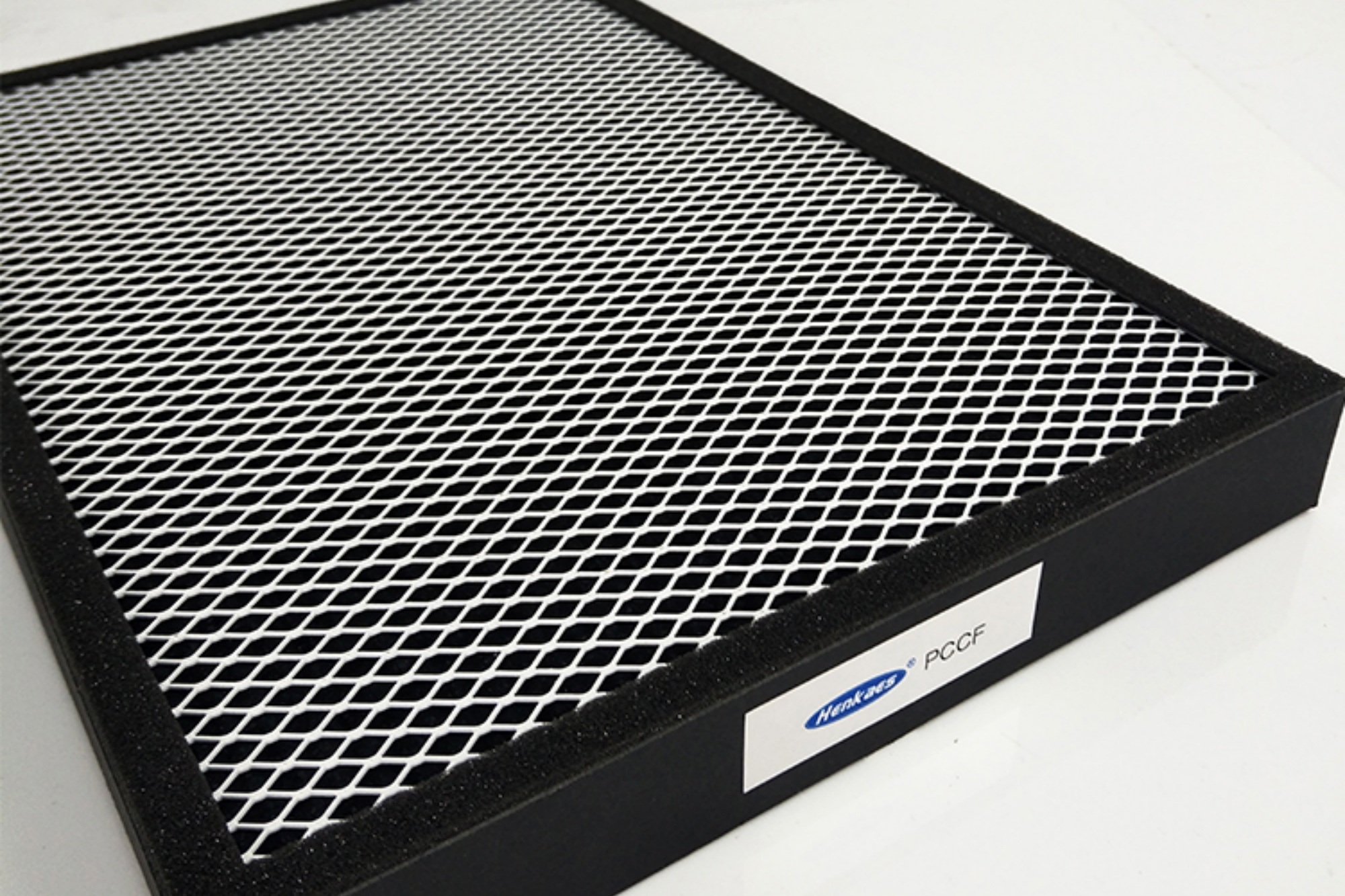
In the household air purifier filter category, Henkaes lists an Activated Carbon Filter with CTC grades of CTC70, CTC80, CTC90, and CTC100, made from activated carbon. The related VOC Air Filter combines activated carbon with a special catalyst, and is specified for removing special VOCs. For project teams, the existence of multiple carbon media grades matters: it indicates that the medium can be matched to the required adsorption capacity rather than treated as a single commodity material.
Technical Explanation: How Activated Carbon Filters Are Specified
Activated carbon filters work through adsorption. The carbon medium has a high internal surface area, and organic molecules in the air stream are retained on the pore structure. Unlike a particle filter, where physical sieving and inertial impaction remove solids, a carbon filter relies on the interaction between the gas molecule and the carbon surface.
CTC grade is one of the indicators used to describe activated carbon adsorption activity. A filter with a higher CTC grade is generally expected to have a higher adsorption capacity under standardized test conditions. Henkaes offers its activated carbon filter in four CTC grades — CTC70, CTC80, CTC90, and CTC100 — which gives engineering teams a lever for matching the media to the contaminant load.
For applications where the target gas is more specific, a catalyst can be added to the carbon media. The VOC Air Filter in the Henkaes portfolio follows this logic: it combines activated carbon with a special catalyst to remove special VOCs, rather than relying only on general adsorption.
One common misunderstanding is to evaluate gas-phase filters with particle standards. ASHRAE 52.2, used in Henkaes' filter testing, defines MERV ratings for HVAC filters based on particle capture between 0.3 and 10 micrometers. EN 1822 classifies HEPA and ULPA filters by efficiency at the most penetrating particle size. Neither standard measures VOC or odor removal. A high MERV number therefore does not indicate how well a filter controls gaseous contaminants; carbon media data must be reviewed separately.
| Filter type | Project role | Key specification | Media |
|---|---|---|---|
| Activated Carbon Filter | Gas-phase adsorption for household air purifier and air cleaner projects | CTC70 / CTC80 / CTC90 / CTC100 | Activated carbon |
| VOC Air Filter | Targeted removal of special VOCs | Special catalyst | Activated carbon with special catalyst |
| True HEPA Air Filter | Particle capture in the same product family | Efficiency ≥99.97% | Fiberglass, polypropylene |
| HEPA Air Filter | Particle capture in air purifiers | Efficiency grade H13 | Fiberglass, polypropylene |
The table shows a common system architecture: a particle filter and a carbon filter are both needed in many air purification projects. Henkaes also produces HVAC filters — panel, bag, box, furnace, and V-bank filters — for commercial and public buildings, and cleanroom filters with U14/U15 efficiency for controlled environments. The carbon filter is part of a wider portfolio rather than an isolated product.
Project Scenarios and Matching Logic
Project fit begins with the contaminant load. The following recorded scenarios illustrate how activated carbon and VOC filters are matched to project conditions.
Household air purifier projects
In household appliance applications, the documented product role is to operate in auto mode under normal indoor environment conditions inside air purifier projects. One scenario defines the function as 'remove VOC, pet smell, and special harmful gas,' while another uses the filter to 'remove VOC and bad smell.' Customized dimensions are listed as a special requirement, and the scenarios are common in the United States and the Netherlands.
Pharmaceutical plant projects
For pharmaceutical plant building projects, the product operates automatically to capture dust and fine particles under normal indoor conditions. A fresh air system is the supporting equipment, and customized dimensions remain a special requirement. This scenario is documented in the United States and the Netherlands. When outside air or interior processes introduce chemical or odor loads, a carbon stage can be added to the same filter envelope.
Cleanroom design projects
In cleanroom design projects, the product operates automatically to capture dust and fine particles under normal indoor conditions. Henkaes specifies U14/U15 cleanroom filters for data centers and microelectronics. Cleanroom specifications tend to emphasize particle efficiency, but gas-phase load from outdoor intake or process chemicals is a real consideration; a carbon pre-stage can protect both personnel and the high-efficiency terminal filter.
HVAC and fresh air system projects
The same application logic appears across residential furnace filter replacement, HVAC system construction, and workshop renovation projects. Panel filters with G1–G4 efficiency act as primary (pre-filter) stages; bag filters in the F5–F9 classes, commonly referenced in legacy EN 779 terminology, handle intermediate particle loads; box filters at MERV15 and MERV16 are used in pharmaceutical plants, hospitals, and food and beverage production sites; furnace filters are offered in MERV8, MERV11, and MERV13. If the fresh air source is exposed to traffic, industrial, or urban odors, project teams can add an activated carbon stage upstream or as a combined cartridge.
Evidence from documented OEM and ODM projects
Henkaes' project records include a US ODM client that ordered 50,000 pieces of filters for formaldehyde removal, with two years of stable performance. Another US ODM client ordered 50,000 pieces for indoor air purification, with one year of stable performance and 'remove VOC with good performance' as the recorded highlight. A US OEM client ordered 20,000 pieces for indoor air purification, with one year of stable performance and 'high efficiency' as the recorded highlight. These records describe real production scale and repeatability, though they do not by themselves predict performance in a new project.
Market Trend Analysis: Gas-Phase Filtration Is Becoming a Defined Requirement
The global air filters market was valued at USD 17.08 billion in 2025 and is projected to reach USD 34.66 billion by 2034, according to Fortune Business Insights. In the air purification technology segment, HEPA filters held a 41.7% share in 2025, and the smart air purifier market is projected to grow at a 14.1% CAGR from 2024 to 2030, according to Grand View Research.
For procurement teams, the strategic point is not the size of the market but the change in specification logic. Particle filtration is well standardized through ASHRAE 52.2 and EN 1822. Gas-phase filtration is less standardized at the project level, which creates both risk and differentiation. As smart air purifiers and connected indoor air quality monitors make VOC and odor levels visible to users, the carbon stage becomes a demonstrable part of product performance rather than an optional extra.
In the EU and US markets, where 69% of Henkaes' production is exported, buyers increasingly ask about VOC removal, carbon grades, custom dimensions, and the supplier's testing infrastructure. Henkaes' published capabilities include ISO 9001:2015, ISO 14001:2015, and ISO 45001:2018 certifications, a 30-cubic-meter test room for formaldehyde and VOC removal efficiency, a CADR test room for air purifiers, and the use of ASHRAE 52.2 in air filter testing.
Comparison with Traditional Solutions: Trade-offs and Boundaries
Activated carbon filters are one option within a larger set of gas-phase solutions.
- Mechanical filtration alone (fiberglass or non-woven media) captures particles with low pressure drop, but it does not remove VOCs, formaldehyde, or odors.
- Ventilation dilution reduces indoor gas concentrations by bringing in outdoor air, but effectiveness depends on outdoor air quality, climate loads, and energy budgets.
- Industrial gas treatment, such as scrubbers or catalytic oxidizers, can destroy gases but carries higher cost and complexity and is rarely practical for building-scale HVAC.
- Activated carbon filtration fits between these options: it removes a broad range of gas-phase compounds in a compact media format and can be integrated into existing air paths, but it does not destroy the contaminants and must be replaced as it saturates.
Three limitations deserve explicit attention in project evaluation.
First, saturation behavior. Activated carbon has a finite adsorption capacity. When the media reaches saturation, removal effectiveness drops and the filter should be replaced. In spaces with high VOC concentration, service life will be shorter than in lightly contaminated environments.
Second, media specificity. A general activated carbon filter is not equally effective for every gas. Some gases require a catalyst or chemically treated carbon to be removed at a practical rate. This is why the Henkaes VOC Air Filter is specified separately from the standard Activated Carbon Filter, and why project teams should define the target gas list before selecting the media.
Third, system protection. Carbon media can become clogged by particles. In most designs, a particulate pre-filter or a combined media structure protects the carbon surface. Engineers should review the whole filtration train rather than evaluating the carbon filter in isolation.
These boundaries are not disqualifiers. They are the reason carbon filter selection requires project-specific data: contaminant type, concentration, flow rate, operating conditions, and replacement logistics.
Future Outlook: Carbon Media as a Specification, Not a Commodity
As indoor air quality requirements mature, activated carbon air filters are likely to become better specified. Procurement teams will ask for the carbon grade, the target compounds, the test method, and the physical format more frequently. For manufacturers, the ability to document these details and to customize dimensions creates a way to support a wider range of projects.
Henkaes' export focus on the EU and USA, its ISO certifications, and its documented testing infrastructure give buyers a basis for verification. The long-term shift is from 'does this filter exist' to 'can this supplier demonstrate that the filter fits this project.' For buyers in the Research and Evaluation stages, the practical conclusion is to treat activated carbon selection as an engineering decision: define the gas load, review the media grade, check the test conditions, and plan for replacement.
Frequently Asked Questions
What is the difference between an activated carbon air filter and a HEPA air filter?
HEPA filters capture particles such as dust, pollen, and fine particles; Henkaes' True HEPA filter is rated at ≥99.97% efficiency. Activated carbon filters remove gaseous contaminants through adsorption and are rated by carbon activity indicators such as CTC grade. They solve different problems and are often used together in air purifier and HVAC projects.
How do I know whether my project needs an activated carbon air filter?
The main signal is the presence of gaseous contaminants: VOCs, formaldehyde, odors, pet or cooking smells. Documented household applications for carbon filters include 'remove VOC and bad smell' and 'remove VOC, pet smell and special harmful gas.' If the project brief lists any of these functions, a carbon stage should be evaluated. If it only lists dust or pollen, a mechanical filter may be sufficient.
What does CTC grade mean in activated carbon filter specifications?
CTC grade is a standardized indicator of activated carbon adsorption activity. Henkaes offers its activated carbon filter in CTC70, CTC80, CTC90, and CTC100 grades. Higher grades indicate higher capacity under standardized test conditions, but actual performance also depends on the target gas, airflow, concentration, and operating environment.
What is the difference between an activated carbon filter and a VOC air filter?
An activated carbon filter uses activated carbon as the main adsorption media. A VOC air filter adds a special catalyst to the carbon media to remove specific VOCs. In the Henkaes portfolio, the VOC Air Filter is described as combining good quality activated carbon with a special catalyst, and is specified where the target is special VOC removal rather than general odor adsorption.
Can activated carbon filters be customized for specific air purifier or HVAC projects?
Yes. Customized dimensions are repeatedly documented as a special requirement in air purifier, HVAC, pharmaceutical plant, and cleanroom projects. Henkaes supports OEM and ODM production with size and logo customization, a monthly capacity of 200,000 pieces, a lead time of around 30 days, and a minimum order quantity of 500 pieces.
How do activated carbon filters behave in normal indoor environment conditions?
The documented operating mode is automatic under normal indoor conditions. For household air purifier projects, this means continuous operation within the appliance airflow path. The application scenarios are common in the United States and the Netherlands, and the operating concept assumes standard indoor temperature and humidity rather than extreme industrial conditions.
Should a carbon filter be used alone or with other filtration stages?
In most projects, a carbon filter is one stage of a multi-stage system. Particle filters such as HEPA or panel filters protect the carbon media from clogging and remove solid contaminants, while the carbon stage handles gas-phase load. The application data shows air purifier projects where the combined task is to capture dust, fine particles, and pollen while also removing VOCs and odors. Evaluating the filtration train as a whole is more useful than specifying each filter independently.
Reference and Resource
Company background, product specifications, application scenarios, and testing capabilities referenced in this article are drawn from Henkaes' published corporate profile and product documentation. The full product catalogue is available here: