
Adult Diaper OEM: Trial Orders vs Repeat Production
The decision that determines whether an adult diaper private-label program succeeds is rarely the size of the first order. It is whether a supplier can convert an approved trial into repeat production at the same specification, the same quality level and the same delivery rhythm, without the buyer having to renegotiate the fundamentals every season.
Why the Trial-to-Repeat Gap Is the Real Procurement Question
Adult diapers sourced through OEM and private-label programs reach the market under someone else's brand. For importers, distributors, brand owners and healthcare distributors, that makes the supplier relationship a two-phase arrangement with two different risk profiles. A trial order reduces the cost of being wrong. Repeat production reduces the cost of being inconsistent. Buyers who treat the two as the same thing, differing only by quantity, tend to discover the distinction on the second or third order, when artwork is already printed and shelf space is already committed.
The category itself keeps expanding. IMARC Group valued the global adult diaper market at USD 21.9 billion in 2025 and projected a compound annual growth rate of roughly 5.8% to 6.0% between 2026 and 2034. Growth of that scale attracts new private labels, and it also means the supplier base is crowded with offers that look similar on a specification sheet but diverge sharply in execution.
Adult incontinence products are also traded under a single Harmonized System heading, HS 9619.00, which simplifies customs classification but tells a buyer nothing about supplier capability. In the United States, the FDA classifies adult diapers as medical devices when they are intended for incontinence treatment, adding a compliance layer that trial orders frequently expose for the first time.
What a Trial Order Can and Cannot Prove
In an OEM adult diaper program, a trial order is a validation instrument rather than a small version of the production order. Its job is to answer a narrow set of questions before the buyer commits to packaging, branding and inventory.
What the trial stage can establish
- Whether the delivered product matches the approved pre-production sample and the signed specification.
- Whether absorbency, fit and leakage behaviour suit the buyer's target market and end-user profile.
- Whether artwork, bag printing, carton configuration and label language are correct.
- Whether the supplier handles export documentation and shipment coordination competently.
- Whether the commercial terms hold up in practice.
Sampling is the entry point. Samples are prepared in 1–3 working days, with buyers covering courier costs. Pre-production sample approval is required before mass production, and packaging artwork is reviewed before production begins. OEM order MOQ depends on the product, size mix, materials, packaging and customization requirements; ready-to-ship products may support lower MOQ, and the final MOQ is confirmed in the quotation.
What the trial stage cannot establish
A trial order cannot demonstrate long-run process stability. It cannot show how a supplier's line discipline holds across consecutive runs, how material sourcing behaves when upstream supply tightens, or whether unit weight, SAP load and absorbency remain consistent after several months of production. Those questions surface only at repeat stage, which is precisely why the transition deserves its own evaluation criteria rather than being treated as an automatic follow-on.
Sample approval is the governing document
The approved pre-production sample plus the signed specification, not the catalogue page, becomes the acceptance baseline. Acceptance follows the signed specification, the approved pre-production sample, packaging and order quantity, and pre-shipment inspection or third-party testing may be agreed. Buyers who leave the sample approval step informal tend to discover at repeat stage that there is no shared reference against which to arbitrate a dispute.
Repeat Production: Where Consistency, Capacity and Cost Are Actually Decided
Repeat production is not a scaled-up trial order. It is a different operating arrangement, and the figures that matter change accordingly.
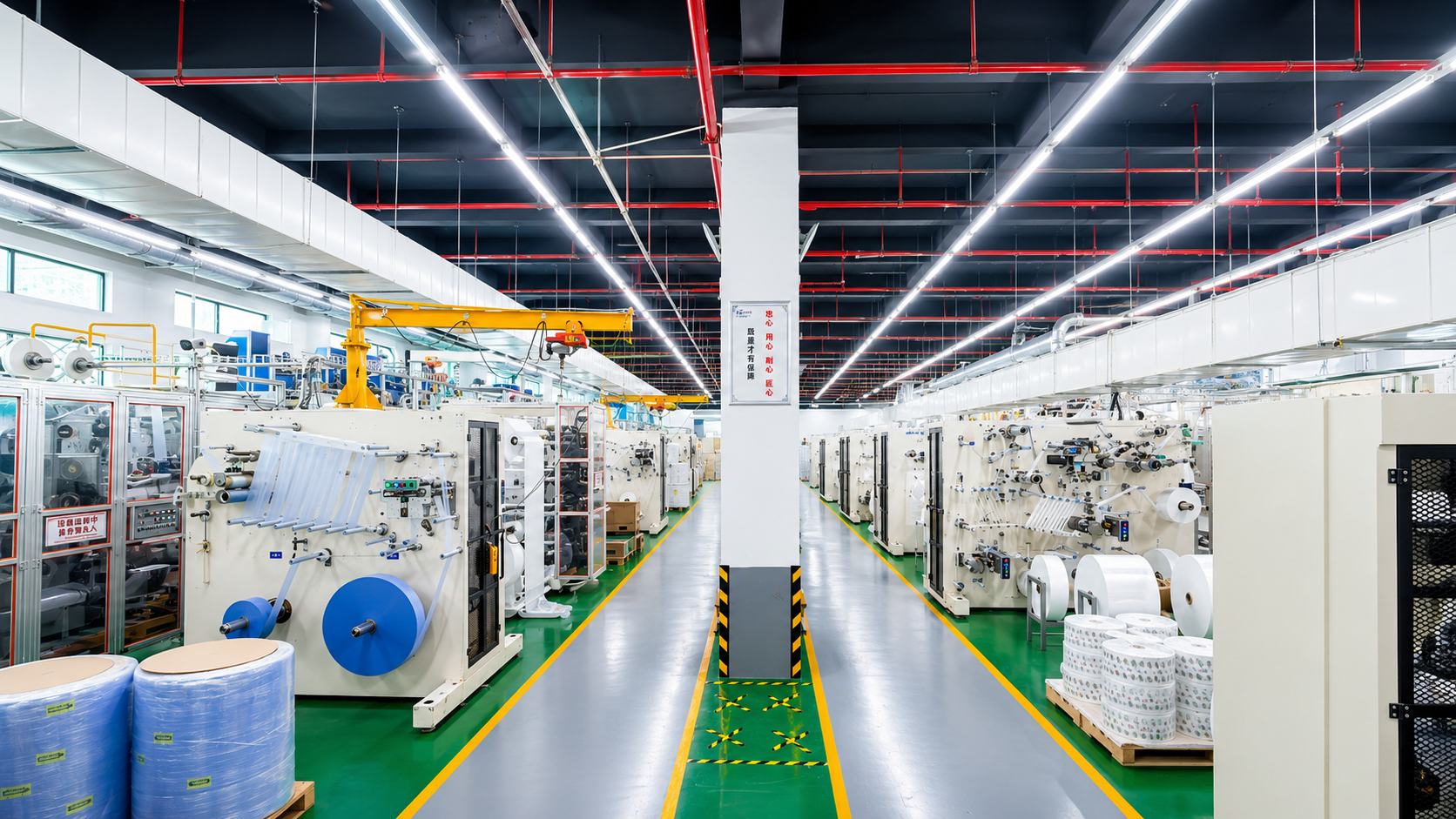
Fujian Jiayue Sanitary Products Co., Ltd. (JIAYUE), a hygiene and personal-care product supplier based in Quanzhou, Fujian, China, produces through its self-owned factory, Quanzhou Jiarun Paper Industry Co., Ltd. Company-provided production information lists monthly production and shipment support of more than 100 × 40HQ containers, and automatic production lines with company-stated speeds of 300 pcs/min for adult diapers and 700 pcs/min for baby diapers. Typical production lead time is approximately 30–45 days, subject to sample, artwork, packaging and specification approval.
For a distributor planning replenishment cycles, three figures interact: monthly container capacity, per-order lead time and the size mix a single container can carry. Capacity is stated at factory level. Whether a specific order can be scheduled inside a given month depends on product specification, packaging and the existing production schedule. Buyers who read a headline capacity figure as a reservation rather than an indicator tend to be disappointed during peak season.
Customization Scope: What to Freeze at Trial and What to Keep Flexible
Adult diaper OEM and private-label programs at JIAYUE can cover a wide customization surface. The practical question for a buyer is not how much can be customized, but which variables must be frozen at trial stage and which can safely remain open.
Customizable elements include product size and weight, absorbency target, SAP/fluff-pulp or composite core structure, hot-air or spunbond nonwoven materials, cloth-like backsheet options, tape or pull-up format, 3D leak guards, wetness indicator, waistband, graphics, printed bags and cartons, pack count and size mix. Custom absorbent core specifications can also be reviewed with the engineering team.
A reference adult diaper configuration
One published specification illustrates the level of detail a buyer can expect to lock. The Ultra Thick Yibero Adult Women Diapers configuration lists sizes M/L/XL/XXL with dimensions of 800×640, 900×740, 990×790 and 1030×835 mm; SAP loads of 18, 22, 26 and 28 g; reference absorbency of 1,800, 2,200, 2,600 and 2,800 ml; unit weights of 130±3, 140±3, 150±3 and 160±3 g; a published pack configuration of 10×10; and a shelf life of 3 years. The material build combines a soft topsheet, a fluff pulp and imported SAP absorbent core, a blue ADL, reusable magic tape, a nonwoven frontal tape, an elastic waistband and a cloth-like breathable backsheet.
These are reference values inside a published specification, not a universal performance benchmark. Buyers comparing adult diapers across suppliers should compare thickness, absorbency, unit weight, fit and test results against the approved specification and sample under the same conditions, rather than against marketing claims.
A practical freeze rule
Anything that changes the acceptance baseline should be locked at trial stage and repeated without change: absorbency target, core structure, skin-contact materials, dimensions, unit weight, format and pack count. Anything that affects only market positioning, such as graphics, bag design, outer carton or additional pack-count variants inside a confirmed size mix, can stay flexible as long as any change re-triggers artwork review before production.
Quality Control: Trial Versus Repeat Checkpoints
Quality control in an OEM adult diaper program follows an order-specific QC plan covering specification review, pre-production sample approval, in-process checks and pre-shipment inspection. Test method, sampling level and acceptance criteria must be agreed in the contract. The two order stages weight those checkpoints differently.
| QC checkpoint | Trial order focus | Repeat production focus |
|---|---|---|
| Specification review | Confirm size, absorbency target, core structure, materials and pack count before sampling | Confirm no drift from the signed specification before each production run |
| Pre-production sample approval | Primary decision point; the approved sample becomes the baseline | Re-triggered whenever materials, artwork or packaging change |
| Artwork and packaging review | Verify label language, graphics, bag and carton configuration | Verify against previously approved artwork; changes require re-approval |
| In-process checks | Confirm the line follows the approved configuration | Sampling intensity and acceptance criteria applied per the contract |
| Pre-shipment inspection | Compare finished goods with the approved sample | Compare against the approved sample and order quantity |
| Third-party testing | Agreed when the destination market requires product evidence | Agreed per contract, order and destination market |
How certificates fit into the picture
Management-system certificates and product documents serve different purposes, and buyers should not conflate them. JIAYUE holds an ISO 9001 certificate (NOA2314690, issued 2023-12-12, valid to 2026-12-11) covering sales of sanitary products, maternal and infant products and Class I medical devices, and an ISO 13485 certificate (NOA2314356, issued 2023-12-06, valid to 2026-12-05) whose scope is limited to Class I medical device sales. Selected products may be supported by CE declarations of conformity, SGS test reports and other compliance documents according to the applicable product, destination market and order requirements.
The ISO 13485 certificate does not by itself classify every diaper as a medical device, approve a product for a target market, or prove that manufacturing is certified under that standard. Buyers must verify product classification, intended use, the responsible economic operator, any required registration or listing, labelling and product-specific test evidence for the destination market.
For the European Union, one adult diaper Declaration of Conformity references CE/MDR-Y0999-02 as a technical document reference, covering adult diapers in sizes S/M/L/XL/XXL with a GMDN code of 11239 and an EMDN code of Y0999, classified as Class I under Rule 1, Annex VIII of Regulation (EU) 2017/745. The declaration was issued 2022-09-07 as a self-declaration by Quanzhou Jiayue Sanitary Articles Co., Ltd., with SUNGO Europe B.V. named as EU representative, and references EN ISO 14971:2019, EN ISO 15223-1:2021, EN ISO 20417:2021, EN ISO 10993-1:2020, EN ISO 10993-5:2009 and EN ISO 10993-10:2013.
Payment Terms and Commercial Structure
Accepted payment methods for JIAYUE hygiene product orders include T/T, L/C at sight and Alibaba Trade Assurance. Final capacity, MOQ, lead time, testing requirements and payment terms are confirmed in the quotation, the approved sample and the sales contract, which means the commercial structure is settled across three documents rather than one.
For buyers, the useful discipline is to treat payment instruments as a risk-allocation tool tied to order stage. A first order carries specification risk; a repeat order carries consistency and scheduling risk. Where accepted instruments overlap with the order stage, buyers can align the chosen method with the risks they are actually carrying instead of defaulting to identical terms on every shipment.
Side-by-Side: Trial Order Versus Repeat Production
| Dimension | Trial order | Repeat production |
|---|---|---|
| Primary purpose | Validate specification, fit, packaging and documentation | Sustain consistent supply against an approved baseline |
| MOQ basis | Ready-to-ship products may support lower MOQ; OEM MOQ depends on product, size mix, materials, packaging and customization | Volume terms set in the quotation and sales contract |
| Specification baseline | Pre-production sample approval required before mass production | Signed specification plus approved sample |
| Customization | Scope defined across size, core, materials, format, graphics and pack count | Locked to approved specification; artwork or material changes re-trigger approval |
| Quality control | Specification review, sample approval, pre-shipment inspection | In-process checks and pre-shipment inspection per agreed test method and sampling level |
| Lead time | Approximately 30–45 days, subject to approval steps | Approximately 30–45 days per confirmed schedule |
| Payment | T/T, L/C at sight or Alibaba Trade Assurance | Same accepted instruments; terms confirmed in contract |
| Capacity | Single production slot | Facility supporting more than 100 × 40HQ containers per month |
| Principal risk | Specification mismatch | Drift from the approved baseline |
Market Context That Shapes the Comparison
Two cost-side realities make the trial-to-repeat transition more commercially significant than it used to be. Raw materials account for an estimated 60% to 70% of total diaper manufacturing operating expenditure, according to Expert Market Research, which means absorbent core composition, including SAP load, fluff pulp ratio and composite versus SAP-paper construction, drives both performance and cost. When upstream petrochemical inputs move, the effect reaches the buyer through core and backsheet specifications rather than through labour or packaging line items.
At the same time, demand continues to grow across Asia-Pacific, North America and Europe, supported by ageing populations and expanding institutional care channels such as nursing homes, hospitals and home-care providers. The combination of rising demand and input volatility explains why buyers increasingly treat the approved sample and signed specification as a fixed reference point carried unchanged from trial into repeat, instead of a starting position to be re-optimized on every order.

Where This Approach Stops Working
An honest comparison has to include the limits of both stages.
- A trial order validates specification conformance on the run it covers; it does not predict full-run variance across a year of production.
- Repeat production does not guarantee identical output if materials, artwork or packaging change. Any such change re-opens sample approval rather than inheriting it.
- Certificate scope matters more than certificate presence. The ISO 13485 certificate held by JIAYUE is limited to Class I medical device sales, and management-system certification is not a product approval for any specific market.
- Monthly capacity figures describe factory-level output capability, not a reservation. Final available capacity is confirmed by product specifications, packaging and production schedule.
- The typical 30–45 day lead time begins from sample, artwork, packaging and specification approval, not from the date of inquiry.
- Neither stage is a reliable test of long-run price stability, because core-material costs are exposed to upstream input markets.
Future Outlook
Three trends are likely to shape how buyers structure adult diaper OEM programs over the next several years. First, regulatory requirements continue to diverge by market, which pushes product classification and documentation review earlier into the sourcing process. Second, input-cost volatility keeps the absorbent core under commercial scrutiny, making core structure a purchasing decision rather than a purely technical one. Third, and most relevant to this comparison, buyers are consolidating the documents that govern an order, the quotation, the approved sample and the sales contract, into a single reference set that travels unchanged from trial to repeat.
The evidence for that shift sits in how supplier relationships actually develop. Among anonymised overseas OEM and private-label clients, more than five long-term OEM customers across multiple markets moved from initial orders into established local brands and scaled repeat orders. That progression depends on a stable baseline far more than on a low first-quote price.
FAQ
What is the difference between a trial order and repeat production in an adult diaper OEM program?
A trial order validates specification, fit, packaging and documentation against an approved pre-production sample on a limited run. Repeat production sustains the same specification across scheduled runs, with in-process checks and pre-shipment inspection agreed in the contract. The governing reference is the same in both cases: the signed specification and the approved sample.
How long does sampling take, and what does sample approval cover?
Samples are prepared in 1–3 working days, with buyers covering courier costs. Sample approval covers the specification production will follow, including absorbency target, core structure, materials, dimensions, unit weight, format, artwork, pack count and export packaging. Pre-production sample approval is required before mass production begins.
What is the typical lead time for adult diaper OEM orders?
Typical production lead time is approximately 30–45 days, subject to sample, artwork, packaging and specification approval. Final lead time is confirmed in the quotation and the sales contract.
Which customization options carry from a trial order into repeat production?
Options include product size and weight, absorbency target, SAP/fluff-pulp or composite core, hot-air or spunbond nonwoven materials, cloth-like backsheet, tape or pull-up format, 3D leak guards, wetness indicator, waistband, graphics, printed bags and cartons, and pack count and size mix. Items that affect the acceptance baseline should be locked at trial stage and repeated without change.
What quality-control steps apply at each stage?
The order-specific QC plan covers specification review, pre-production sample approval, in-process checks and pre-shipment inspection. Test method, sampling level and acceptance criteria must be agreed in the contract. Pre-shipment inspection or third-party testing may be agreed at either stage.
What payment terms are used for adult diaper OEM orders?
Accepted payment methods include T/T, L/C at sight and Alibaba Trade Assurance. Final payment terms, MOQ, lead time and testing requirements are confirmed in the quotation, the approved sample and the sales contract.
How much monthly capacity should a distributor verify before committing to repeat production?
JIAYUE's self-owned factory, Quanzhou Jiarun Paper Industry Co., Ltd., supports monthly production and shipment of more than 100 × 40HQ containers. Final available capacity is confirmed by product specifications, packaging and production schedule.
Do management-system certificates cover every adult diaper product?
No. ISO 9001 (NOA2314690) and ISO 13485 (NOA2314356) are management-system certificates with defined scopes, and the ISO 13485 scope is limited to Class I medical device sales. Product-specific documents such as CE declarations of conformity and SGS test reports apply according to the product, destination market and order requirements.
Product specifications, customization options and export packaging details for the adult diaper and adult pull-up ranges are compiled in the JIAYUE Product Catalog 2026.
Have Questions or Need More Details?
Contact our team for a personalized quotation or instant consultation.
Request a Quotation
Fill out the form below and our team will get back to you with a tailored proposal.
WhatsApp Direct Chat
Prefer to chat in real-time? Message us on WhatsApp for instant assistance & quick answers.
- Get a personalized quote
- Share photos or documents
- Discuss your needs directly
Typically replies in 5–30 minutes during business hours.