
Adult Diaper Supplier Capability: Factory, Capacity, Export
Capability in adult diaper supply is only useful to an importer when each claim can be tied to a facility, a document, a number or a named person accountable for it. Fujian Jiayue Sanitary Products Co., Ltd. — a Quanzhou, Fujian-based hygiene and personal-care manufacturer founded in 2016 that supplies baby diapers, adult diapers, adult pull-up pants, sanitary napkins, underpads and wipes, and offers OEM/ODM and private-label programmes to importers, distributors and brand owners — publishes a set of capability facts specific enough to be examined one by one: a self-owned factory of approximately 20,000 square metres, around 100 staff, 8 in-house R&D engineers, annual output above 500 million pieces, monthly shipment capacity above 100 × 40HQ containers, an export share of about 90% and customers in more than 70 countries.
This reference does not argue that those figures make one supplier the right choice. It examines what each category of evidence actually establishes about an adult diaper supplier, where the evidence stops, and how an importer should convert it into written confirmations inside the quotation, the approved sample and the sales contract.
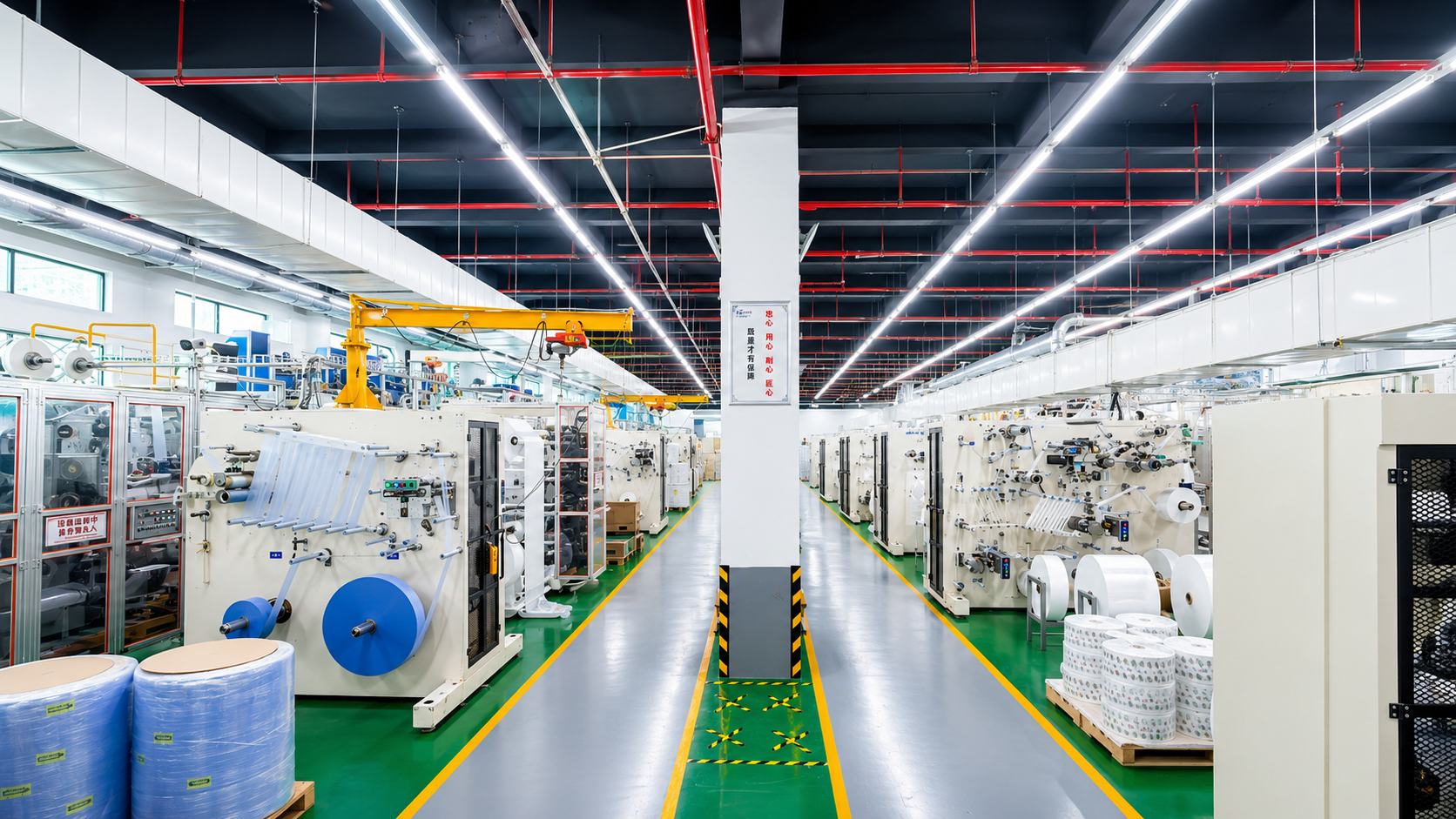
Production workshop environment: physical asset evidence is the first layer an adult diaper importer can inspect rather than read.
Why capability claims are difficult to evaluate in adult diapers
Adult diaper sourcing rarely fails because an importer could not find suppliers. It fails because a supplier's capability claim was accepted before anyone separated it into parts that could be checked. A trading intermediary can quote the same specification sheet as a factory, use the same product photographs, and promise the same lead time in the first email. The difference only becomes visible when a buyer asks which site will run the order, who signs the approved specification, and which certificate covers the actual activity being performed.
The commercial pressure behind that question has increased. IMARC Group values the global adult diaper market at USD 21.9 billion in 2025 and forecasts a compound annual growth rate of 5.8% to 6.0% across 2026–2034 — growth that attracts new suppliers into export channels faster than buyer verification habits develop. On the cost side, Expert Market Research puts raw materials at 60% to 70% of diaper manufacturing operating expenditure, which means a supplier's real constraint is rarely the ability to show a product; it is the ability to secure material, schedule lines and hold a price across a shipment programme.
The practical consequence for an importer in the evaluation stage is that capability evidence should be read in layers rather than as a single reputation score.
Four evidence layers an importer can actually check
Supplier capability claims in adult diapers generally fall into four layers. Each layer answers a different buyer question and each one leaves a different residual risk.
| Evidence layer | Buyer question it answers | Typical proof type |
|---|---|---|
| Physical asset | Does the supplier control a manufacturing site, or resell output? | Factory ownership and address, site area, headcount, site visit or third-party audit |
| Throughput | Can the site absorb my volume without displacing existing customers? | Annual piece output, monthly container shipments, line configuration, line speed |
| Engineering | Who converts my specification into a repeatable product? | In-house technical team, core and material options, sampling and specification control |
| Export and compliance | Can the supplier ship and document to my market? | Export share, country coverage, management-system certificates, declarations, test reports |
Reading the layers separately matters because a strong result in one does not compensate for a gap in another. A large site does not prove engineering depth. A deep certification file does not prove that a production slot exists in the required month. The sections below apply each layer to Jiayue's published facts and identify the confirmation that belongs in the commercial documents.
Layer 1 — Physical asset evidence: the factory behind the brand
The most useful single fact in a supplier's capability file is often ownership of the production site. Jiayue's production is supported by its self-owned factory, Quanzhou Jiarun Paper Industry Co., Ltd., in a facility covering approximately 20,000 square metres, with roughly 100 staff. The operating company, Fujian Jiayue Sanitary Products Co., Ltd., was established in 2016 and is based in Quanzhou, Fujian, China.
Ownership changes what a buyer is buying. When a supplier owns the site, questions about line scheduling, specification changes and production-hold decisions land with an organisation that can act on them directly, rather than with an intermediary who must negotiate those decisions with a third party. It also makes a site audit meaningful, because the audit address and the production address are the same address.
Headcount should be read against automation level rather than as a size score. A facility running high-speed lines needs fewer operators per unit of output than a semi-automatic plant, so roughly 100 staff alongside automatic production lines for baby and adult diapers describes a specific operating model, not a ranking. The productive question for an importer is how that headcount is distributed: how many people are assigned to adult diaper lines, how many to quality control, and whether the site runs adult and baby production on shared or separate equipment.
Confirm in the quotation or supplier questionnaire: the legal name of the manufacturing entity, the production address that will appear in audit and shipping documents, the number of adult diaper lines at that address, and whether any portion of the order could be subcontracted.
Layer 2 — Throughput evidence: reading 500 million pieces and 100 × 40HQ
Jiayue's published figures state annual output above 500 million pieces and monthly production and shipment capacity supporting more than 100 × 40HQ containers, with automatic production lines rated at 700 pieces per minute for baby diapers and 300 pieces per minute for adult diapers.
These two headline numbers measure different things, and conflating them is a common source of disappointment. Annual piece output is a product-weighted figure: it moves with size mix, unit weight and whether the portfolio is running baby or adult products. Container volume is an order-weighted figure: it moves with pack count, bag and carton dimensions, palletisation and how many sizes are loaded into a single container. A buyer who asks only "what is your monthly capacity" receives an answer that cannot be compared with another supplier's answer.
Line speed adds a third dimension. A rated 300 pieces per minute for adult diapers describes equipment capability under a given product configuration, not booked availability. Rated speed and free capacity are different variables, and only the second one determines whether a purchase order ships on time.
Confirm in the quotation: available capacity expressed in the actual ordered unit — pieces per month for the specific size mix — plus the production window reserved for the order, the typical production lead time of approximately 30 to 45 days, and the approvals that start that clock.

Finished goods staging: container volume and piece output are different measurements and should be confirmed separately by SKU.
Layer 3 — Engineering evidence: what 8 engineers are accountable for
Jiayue maintains an in-house R&D and technical support team of 8 engineers responsible for material selection, absorbent-core design, product development, sampling, specification adjustment and OEM/ODM technical support.
The headcount is the least interesting part of that sentence. What matters is the scope of decisions the team owns. In adult diapers, most quality disputes trace back to a specification that was never fully written down: an absorbency target agreed verbally, a core structure changed between the sample and mass production, a backsheet substitution that was never approved. A technical team that owns the approved specification — and signs it — is a different kind of asset from a team that only develops samples.
Jiayue's customisation scope covers product size and weight, absorbency target, SAP and fluff-pulp or composite core, hot-air or spunbond nonwoven, cloth-like backsheet, tape or pull-up format, 3D leak guards, wetness indicator, waistband, graphics, printed bags and cartons, and pack count and size mix. For the listed adult product, the published configuration gives a concrete reference point for how specific a specification can become.
| Specification field | Published reference — adult diaper configuration |
|---|---|
| Type | Tape-style adult diaper; high-absorbency adult incontinence diaper |
| Sizes and dimensions | M / L / XL / XXL — 800×640, 900×740, 990×790, 1030×835 mm |
| SAP content | 18 / 22 / 26 / 28 g |
| Reference absorbency | 1,800 / 2,200 / 2,600 / 2,800 ml |
| Unit weight | 130±3 / 140±3 / 150±3 / 160±3 g |
| Construction | Soft topsheet; fluff pulp and imported SAP core; blue ADL; reusable magic tape; nonwoven frontal tape; elastic waistband; cloth-like breathable backsheet |
| Pack configuration and shelf life | Published pack configuration 10×10; shelf life 3 years |
Reference absorbency values are specification targets, not test results. The distinction is central to adult diaper evaluation: a buyer should treat published absorbency as the design intent and require the corresponding test method, sampling level and acceptance criteria to be agreed in the contract, then verified against the approved sample and pre-shipment inspection.
Confirm with the sample and specification: who signs the approved specification, which test methods and sampling levels apply, how a mid-programme material substitution is approved, and how the absorbent core is verified between the approved sample and the shipped batch.
Layer 4 — Export and compliance evidence
Export readiness in adult diapers is a document question as much as a logistics question. Jiayue reports an export share of about 90%, customers in more than 70 countries and regions, and shipment capacity above 100 × 40HQ containers per month, with markets spanning Southeast Asia, Africa, Europe, the Middle East, East Asia, North America and South America. The team also supports artwork and packaging coordination, export documentation and shipment planning.
The relevant trade classification for adult incontinence products is HS code 9619.00, which is the reference importers should see reflected consistently across commercial invoice, packing list and customs paperwork.
On management systems and conformity, the company holds ISO 9001 and ISO 13485 certificates within their documented scopes, and selected products may be supported by CE declarations of conformity, SGS test reports and other compliance documents according to the product, destination market and order requirements.
| Document | Reference detail | Scope note |
|---|---|---|
| ISO 9001 quality management system | Certificate NOA2314690, issued 2023-12-12, stated expiry 2026-12-11; issued by NOA Testing & Certification Group Ltd. | Scope covers sales of sanitary products, maternal and infant products and Class I medical devices |
| ISO 13485 medical device quality management system | Certificate NOA2314356, issued 2023-12-06, stated expiry 2026-12-05; issued by NOA Testing & Certification Group Ltd. | Scope covers Class I medical device sales |
| CE Declaration of Conformity — adult diapers | Technical document reference CE/MDR-Y0999-02; issued 2022-09-07; EU representative SUNGO Europe B.V. | Class I, Rule 1, Annex VIII of Regulation (EU) 2017/745; sizes S/M/L/XL/XXL; GMDN 11239; EMDN Y0999; self-declaration |
Two timing points deserve attention for buyers evaluating in late 2026. Both management-system certificates carry stated expiry dates in December 2026, so an importer planning shipments into the first quarter of 2027 should request the renewed certificates or written confirmation of recertification status rather than relying on the current file alone. And because the CE document is a Class I self-declaration under Regulation (EU) 2017/745, the buyer's technical file should hold a copy that matches the exact product and size range being ordered, alongside the EU representative details.
Market-specific classification also changes the document set. In the United States, the FDA classifies adult diapers intended for incontinence treatment as medical devices, which means a US importer may face a different pathway from an EU buyer relying on a Class I declaration. The supplier's certificate file does not remove that obligation; it only supplies part of the input.
Where the evidence stops: boundaries worth writing into the contract
Credible capability assessment includes stating what the evidence does not establish. For this supplier file, five boundaries are worth naming explicitly.
- The certificates describe sales-scope activities. Both the ISO 9001 and ISO 13485 certificates state scopes covering sales of the relevant product categories and Class I medical devices. An importer should confirm in writing which facility and which processes the certification is intended to cover before treating it as manufacturing evidence.
- The CE declaration is a self-declaration. Class I status under Regulation (EU) 2017/745 does not involve notified-body certification, which shifts responsibility for keeping the technical documentation consistent and current onto the economic operator chain.
- Capacity figures are company-reported aggregates. The 500 million piece annual output and the 100 × 40HQ monthly shipment capacity describe the operation as a whole across the product portfolio. Neither figure is an audited per-SKU commitment, and neither guarantees availability in a specific month.
- Customer evidence is anonymised. The published case record covers more than 5 long-term OEM and private-label diaper brand clients across multiple overseas markets, with adult diaper relationships of 3 years and named markets including Thailand, Vietnam, Malaysia, the Philippines, India, Pakistan, Bangladesh and the United Arab Emirates. Specific customer names, countries by individual contract and order volumes are not publicly disclosed, so reference checks must be arranged directly.
- Published performance values are specification targets. Reference absorbency of 1,800 to 2,800 ml by size is a design target; model-specific test reports under agreed methods remain the evidence for performance claims.
| Evidence | What it supports | What still requires confirmation |
|---|---|---|
| ≈20,000 m² self-owned factory | Direct control of a production site at a stated address | Site audit, line count dedicated to adult diapers, subcontracting policy |
| >500 million pieces annually; >100 × 40HQ per month | Scale consistent with export programme supply | Available capacity for the ordered size mix and month |
| 8 in-house engineers | Internal ownership of core design, sampling and specification adjustment | Named specification signatory and change-control procedure |
| ≈90% export share; 70+ countries | Operating experience across multiple regulatory environments | Destination-specific documentation for the buyer's own market |
| ISO 9001, ISO 13485, CE DoC | Management-system and conformity documentation within stated scopes | Certificate scope versus site, renewal status, exact SKU coverage |
Mapping the facts to specific buying situations
Different importers need different parts of the same evidence file. The mapping below reflects the situations in which capability facts change a purchasing decision.
Private-label brand owners launching an adult range
The binding constraint is specification control, not tonnage. A brand owner needs a technical team that can interpret a target absorbency, propose a core structure, produce a sample that matches the approved artwork and pack count, and then hold that specification through repeat production. The 8-engineer team and the published customisation scope — size and weight, absorbency target, SAP or composite core, backsheet type, tape or pull-up format, wetness indicator, graphics and pack configuration — are the relevant facts here. The quotation should convert them into an approved specification document.
Distributors and wholesalers replenishing an established line
For a distributor, monthly container capacity above 100 × 40HQ and stable output matter more than design flexibility. The practical questions become pack-size mix per container, whether multiple sizes can be combined in one loading, and how the typical 30 to 45 day lead time aligns with the distributor's own replenishment cycle. Ready-to-ship products may support lower MOQ, while OEM order MOQ depends on product, size mix, materials, packaging and customisation — both should be confirmed in the quotation rather than assumed from a catalogue.
Healthcare and institutional channels
Nursing homes, hospitals and home-care suppliers evaluate adult diapers against documented performance and consistency. Here the CE declaration covering sizes S to XXL, the ISO 13485 certificate within its stated Class I sales scope, and the availability of SGS test reports or other compliance documents by product and market become part of the tender file. Overnight and high-absorbency configurations, leak guards and wetness indicators are specification choices that need test evidence rather than descriptive claims.
Buyers entering markets with unfamiliar import requirements
An export share of about 90% and customer coverage across more than 70 countries indicates familiarity with varied documentation environments, but it does not transfer compliance to the buyer. The importer still owns the destination-market requirement, which is why HS code 9619.00, labelling language, and the classification question — including the FDA position that adult diapers intended for incontinence treatment are medical devices — should be resolved before the first purchase order.
Market context: why evidence discipline matters more now
Three verified market signals make supplier verification more commercially consequential than it looked a few years ago.
First, demand is expanding at a measured rather than explosive rate. IMARC Group's 2025 valuation of USD 21.9 billion with a forecast CAGR of 5.8% to 6.0% for 2026–2034 describes a market where volume growth is predictable and competitive advantage comes from supply reliability and channel access rather than from riding a surge.
Second, input costs dominate the economics. With raw materials at 60% to 70% of diaper manufacturing operating expenditure, a supplier's material access and price validity window matter more than a marginal difference in quoted unit price. Expert Market Research has also documented crude-oil volatility affecting synthetic inputs such as polypropylene and superabsorbent polymer, which is a reminder that cost pass-through risk sits in the supply chain, not only in the negotiation.
Third, regulatory treatment varies by market and is not interchangeable. The FDA classification of adult diapers intended for incontinence treatment as medical devices sits alongside the EU Class I route, so a single certificate file rarely satisfies every destination. Buyers who verify classification and documentation early avoid the most expensive failure mode in this category: a container that is compliant for production but not for import.
A practical verification sequence
- Screen on structure, not slogans. Request the legal manufacturing entity name, factory address, site area and adult-line count. Compare the address with the audit and shipping documents.
- Convert capacity into your own unit. Ask for monthly availability in pieces for the specific size mix, plus the production window and the approval milestones that start the 30 to 45 day lead time.
- Test the engineering interface. Submit a specification brief covering absorbency target, core type, backsheet, format, pack count and artwork, and observe who responds, in what detail, and who signs the approved specification.
- Audit the document set against your market. Collect certificates with numbers, scopes and validity dates; confirm renewal status where expiry is near; and match the CE declaration to the exact size range ordered.
- Validate performance on the sample. Agree test method, sampling level and acceptance criteria in the contract, then verify against pre-shipment inspection.
- Fix the commercial variables in writing. Final capacity, MOQ, lead time, testing requirements and payment terms belong in the quotation, the approved sample and the sales contract — not in email assurances.

In-house laboratory and technical support: the engineering layer is where specification control is either established or lost.
Future outlook
Adult diaper sourcing is moving toward document-level accountability. As demand grows at a mid-single-digit rate and raw-material costs stay dominant, importers are increasingly differentiating suppliers by what can be evidenced rather than by what can be claimed: which site runs the order, which specification version is approved, which certificate covers which activity, and which test method settles a dispute.
For suppliers, that shifts competitive weight toward documentation discipline — keeping management-system certificates current, matching declarations to the exact product and size range, and being able to state available capacity by SKU rather than as an annual total. For importers, it means the capability conversation starts earlier and ends in the contract. Factory scale, capacity and export reach are legitimate reasons to shortlist an adult diaper supplier; they become decision-grade only when the quotation, sample and contract confirm them for the specific order.
Reference document: the supplier's product catalogue, including adult diaper and adult pull-up configurations, can be reviewed here: JIAYUE Product Catalog 2026.
FAQ
How can an importer verify that an adult diaper supplier actually owns its factory?
Ownership is verified through documents and access rather than through statements. Ask for the legal name of the manufacturing entity, the production address, and confirmation that the audit address matches the shipping address. In this supplier's case, production is supported by the self-owned factory Quanzhou Jiarun Paper Industry Co., Ltd. in a facility of approximately 20,000 square metres, while the operating company is Fujian Jiayue Sanitary Products Co., Ltd. in Quanzhou, Fujian. A site visit or third-party audit, plus a written statement on subcontracting, converts that claim into evidence.
What does shipment capacity above 100 × 40HQ containers per month mean for a first order?
It describes the scale of the operation, not the availability of a specific production slot. Container volume is an order-weighted figure that depends on pack count, carton dimensions, palletisation and the number of sizes loaded together, while annual piece output is product-weighted. A first order should therefore be quoted in its own units: monthly availability for the ordered size mix, the reserved production window, and the approvals that start the typical 30 to 45 day lead time. Final capacity, MOQ, lead time, testing requirements and payment terms are confirmed in the quotation, approved sample and sales contract.
Is an in-house team of 8 engineers sufficient for a private-label adult diaper programme?
Sufficiency depends on the scope the team owns rather than on headcount. Jiayue's technical team is responsible for material selection, absorbent-core design, product development, sampling, specification adjustment and OEM/ODM technical support, and customisation can cover size and weight, absorbency target, SAP or fluff-pulp and composite cores, nonwoven type, cloth-like backsheet, tape or pull-up format, 3D leak guards, wetness indicator, waistband, graphics and pack configuration. The decisive question for an importer is who signs the approved specification and how material or core changes are approved between the sample and repeat production.
Which documents indicate that an adult diaper supplier is export-ready for a specific market?
Export readiness combines trade documentation and market conformity. Trade documentation includes consistent classification under HS code 9619.00 across invoice, packing list and customs paperwork, plus artwork, packaging and shipment coordination. Market conformity depends on the destination: for the European Union, a CE Declaration of Conformity referencing Regulation (EU) 2017/745, a stated EU representative, and coverage of the exact sizes ordered are relevant; for the United States, the FDA position that adult diapers intended for incontinence treatment are medical devices determines the applicable pathway. Certificates and declarations support the buyer's file but do not replace the importer's own market requirement.
Do ISO 9001 and ISO 13485 certificates cover the manufacturing site itself?
Coverage is defined by the scope printed on the certificate. Jiayue's ISO 9001 certificate NOA2314690, issued 2023-12-12 with a stated expiry of 2026-12-11, records a scope covering sales of sanitary products, maternal and infant products and Class I medical devices; ISO 13485 certificate NOA2314356, issued 2023-12-06 with a stated expiry of 2026-12-05, records a scope covering Class I medical device sales. Buyers should confirm in writing which facility and processes the certification is intended to cover, and — given the December 2026 expiry dates — request renewal evidence before shipments scheduled into 2027.
Have Questions or Need More Details?
Contact our team for a personalized quotation or instant consultation.
Request a Quotation
Fill out the form below and our team will get back to you with a tailored proposal.
WhatsApp Direct Chat
Prefer to chat in real-time? Message us on WhatsApp for instant assistance & quick answers.
- Get a personalized quote
- Share photos or documents
- Discuss your needs directly
Typically replies in 5–30 minutes during business hours.