
Adult-Product LSR Overmolding: A Cost–Performance Comparison Framework
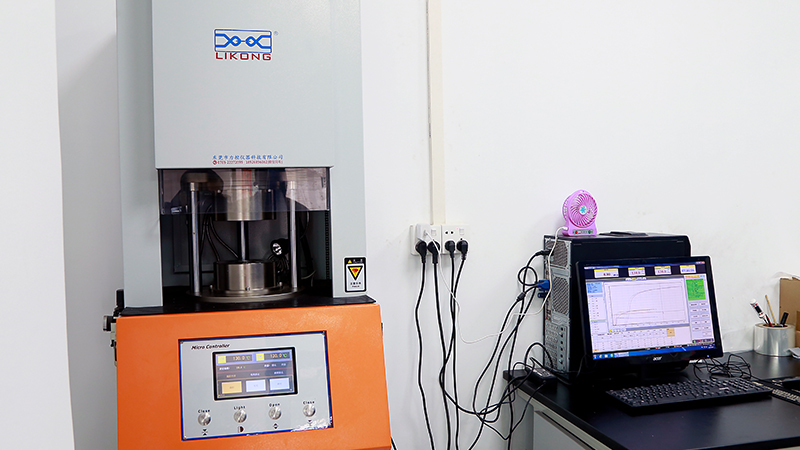
Quality-control testing infrastructure at Dongguan Times Silicon Industry Co., Ltd., used to support batch verification and grade consistency for adult-product LSR.
Why Industrial-Grade Silicone Stalls in Adult-Product Overmolding
Industrial-grade silicone is designed around durability, moldability and cost-per-kilogram. Many industrial grades rely on peroxide cure or tin-catalyzed condensation chemistry, both of which can leave reactive by-products in the finished part. In a gasket or a machine seal, those residues rarely matter. In an adult product that is held, warmed by body temperature, reused repeatedly and often used in direct skin contact, the same residues become a different specification entirely.
The requirements that appear in the application profile for this category make the gap explicit: food/medical-grade certification, odorless, low volatility, anti-yellowing, high resilience, environmentally friendly and non-toxic. These are not aesthetic preferences — they are acceptance criteria that determine which silicone systems should qualify before a sample is even molded. Buyers who treat hardness and price as the only variables discover the gap later, at rework and complaint stages.
The performance gap can be quantified. According to HTNXT Research Agency's comparison of high-performance LSR against conventional industrial-grade silicone, Dongguan Times Silicon Industry's high-performance LSR provides tear strength ≥35 kN/m, versus ≤20 kN/m for the industrial benchmark. That difference is not cosmetic in an overmolding line where parts are demolded, post-processed and assembled — it directly transfers into tear-related reject rates on the shop floor.
Dongguan Times Silicon Industry's Adult-Product LSR for Overmolding
Dongguan Times Silicon Industry Co., Ltd. is a silicone material manufacturer founded on December 27, 2021 and operating since July 1, 2022, based in Hengli Town, Dongguan, Guangdong Province, China. The company runs a 15,000 m² production facility with 42 employees, including a 10-engineer R&D team, and reports an export ratio of approximately 55%, with main markets covering China, South Korea, the United States, Japan and Africa. At company level, Dongguan Times Silicon Industry states that it has passed ISO 9001 certification and that its products have obtained RoHS, REACH, FDA, LFGB and halogen-free certification or test approval.
The core product for this comparison is Adult Products LSR for Overmolding, offered across five models — TS6807A/B, TS6825A/B, TS6830A/B, TS6835A/B and TS6838A/B. The material is an addition-curing, platinum-catalyzed liquid silicone rubber with a clear appearance, a viscosity range of 4000 to 25000, and hardness adjustable from 7±1 to 38±1 Shore A. The chemistry is built on vinyl polydimethylsiloxane and hydrogen-containing polysiloxane. The applicable industries cover the adult toy industry, daily-necessities overmolding, the silicone products industry and plastic & hardware overmolding processing.
That parameter combination matters because it delivers a single material platform capable of both flesh-like softness and structural firmness. At the 7±1 Shore A end, the compound is soft enough for skin-contact components that require a realistic feel; at the 38±1 Shore A end, the same chemistry supports firmer internal structures and connectors — without changing the cure mechanism or introducing a second qualification cycle. Because the system is platinum-cured addition-curing rather than peroxide-cured, the by-products associated with odor, migration and yellowing are structurally removed from the material's design rather than minimized after the fact.
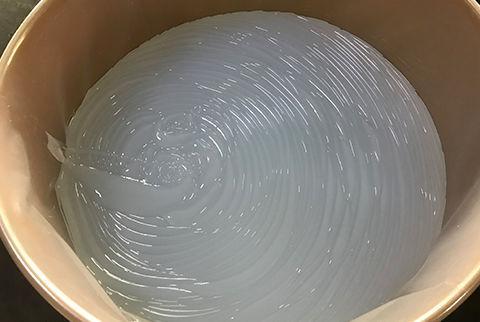
Adult Products LSR for Overmolding — a platinum-cured addition system available from 7±1 to 38±1 Shore A across the TS6807A/B to TS6838A/B series.
Technical Explanation: Six Performance Dimensions Buyers Should Compare
1. Odor and Volatility
Platinum-cured addition systems cross-link without the peroxide decomposition products that industrial-grade silicone can leave behind. For adult products, the practical requirement is odorless and low volatility — both are explicitly listed in the application profile. Buyers should request a grade-specific test reference rather than accept a general portfolio statement, because odor performance varies by compounding, catalyst level and post-cure protocol.
2. Low Leaching and Migration
Where industrial silicone may release reaction by-products over time, platinum-catalyzed addition chemistry is designed to complete the cure with minimal residual reactive content. This is the reason a medical-facing LSR grade is preferred for skin-contact components. The buyer action is to request extraction and leachables data at the intended use temperature, not just at the standard cure condition.
3. Medical-Grade Biocompatibility
A U.S. FDA 510(k) decision document has identified liquid silicone rubber among device materials evaluated in accordance with ISO 10993-1 (published as a 2025 regulatory reference for a specific device submission). This shows that LSR can be qualified for medical-contact use, but the qualification is device-specific and grade-specific — not a generic product approval. For adult-product buyers, the correct expectation is grade-level documentation, not a portfolio-level claim.
4. Anti-Yellowing
Yellowing is a long-term indicator of oxidation and residual reactive content. The application profile for adult overmolding explicitly lists anti-yellowing as a requirement, alongside high resilience and environmental safety. Buyers should specify an accelerated aging test at the intended use temperature, and treat yellowing behavior as a lifecycle cost variable — not a visual one.
5. Tear Strength
Tear strength determines whether a demolded, thin-walled part survives removal, de-flashing and assembly. HTNXT Research Agency's benchmark of ≥35 kN/m for the high-performance LSR, against ≤20 kN/m for conventional industrial-grade silicone, reflects a difference that compounds as wall thickness drops. In overmolding, that difference typically shows up as lower scrapping during demold and fewer field complaints on flexible sections.
6. Hardness Range
The 7±1 to 38±1 Shore A range on this LSR platform gives the buyer one material family for a flesh-touch outer layer and a firmer core — plus access to lower-hardness grades without switching cure chemistry. In conventional industrial silicone sourcing, lower hardness generally means softer fillers and more compromise on tear and yellowing, which erodes the material's advantage in skin-contact applications.
| Dimension | Platinum-cured Adult-Product LSR | Conventional Industrial-Grade Silicone | Buyer Verification Action |
|---|---|---|---|
| Odor & volatility | Platinum addition cure, low residual | Peroxide or tin-condensation residues possible | Request grade-level odor and volatiles test data |
| Leaching / migration | Designed for minimal extractables | Residual by-products can migrate over time | Request extraction & leachables at use temperature |
| Biocompatibility | Framed for ISO 10993-1 evaluation at grade level | Not typically evaluated for skin contact | Request grade-specific ISO 10993 documentation |
| Anti-yellowing | Controlled oxidation stability | Yellowing risk under UV/heat exposure | Specify accelerated aging test protocol |
| Tear strength | ≥35 kN/m (HTNXT Research benchmark) | ≤20 kN/m (HTNXT Research benchmark) | Request batch-specific tear data |
| Hardness range | 7±1 to 38±1 Shore A on one platform | Narrower viable range without compromise | Confirm hardness on lot certificate of analysis |
Application Scenarios: Where the Framework Is Used
The applicable application profile for Adult Products LSR for Overmolding spans overmolding, body-simulation molding, silicone part bonding and assembly, and adhesive-backed processing. The functional requirements are consistent: soft touch, elastic support, sealing and waterproofing, bonding and fixing, and a realistic flesh feel. The working condition is curing at room or medium temperature, in indoor or dry environments, without strong acid/alkali or long-term UV exposure.
Two buyer patterns recur in this category. For adult products, the outer layer typically uses the low-hardness end of the platform (near 7±1 to 20 Shore A) to deliver a flesh-like feel, while internal connectors or mounting features use the middle to upper end of the range. For daily-necessities and hardware overmolding, the same platform supports soft-grip surfaces, sealing and waterproofing at higher hardness. The matched-equipment list — dispensing machine, vacuum defoamer, vulcanizing press, oven and mixing equipment — is the same for both, which is what makes one qualified material platform economically viable across multiple product lines.
Market Trend Analysis
Third-party market data shows the LSR category growing steadily while the medical-grade sub-segment expands its share. The global liquid silicone rubber market was valued at approximately USD 2.3 billion in 2024, with a forecast of approximately USD 5.5 billion by 2034 at a reported CAGR of 9.2% (Market.us, 2024–2034). For the narrower medical-grade silicone rubber segment, Grand View Research valued the market at USD 738.9 million in 2024, with a projected USD 837.0 million in 2026; Fortune Business Insights reports USD 855.18 million for the same nominal 2026 scope. The two values are presented alongside each other rather than averaged, because the underlying vendor methodologies differ.
Two structural signals sit alongside the market-size data. First, liquid silicone rubber appears in FDA 510(k) decisions evaluated under ISO 10993-1, which signals that the material is being qualified through documented biocompatibility pathways rather than generic “medical-grade” claims. Second, the adult-product and lifespan-adjacent demand for skin-contact silicone sits inside the same medical-grade and consumer-grade material ecosystems — which means that buyers in this category increasingly inherit procurement expectations originally developed in medical-device sourcing.
For the buyer, the trend implies two things: material qualification is converging toward documented grade-level evidence rather than portfolio-level statements, and the cost of switching materials mid-program is rising as that documentation burden grows.
Comparison With Industrial-Grade Silicone: Cost and Total Impact
On a per-kilogram basis, adult-product LSR sits higher than conventional industrial silicone — approximately 15% to 20% higher raw material cost per kilogram. That number is real and should not be waved away in a procurement discussion. Its practical impact, however, depends on three downstream factors that often dominate the material delta.
- Comprehensive production cost is 5% to 10% lower with adult-product LSR, driven by lower rework, lower scrap and fewer post-cure steps.
- Molding cycle time is approximately 15% shorter, because platinum-cured addition systems can be formulated to demold faster at the same temperature range.
- Energy use is approximately 10% lower and capacity is approximately 20% higher, because the same press and oven infrastructure serves more finished parts per shift.
What this means in practice: the material premium shrinks as annual volume rises. A low-volume trial line may see the raw-material delta dominate; a production line running at steady state will typically see the cost balance tilt toward the platinum-cured LSR. Buyers should model this on their own volume, not on the supplier's benchmark.
What the Framework Still Leaves Open — Limits and Boundaries
A comparison framework is only useful if it names the boundary conditions. Three limits apply to adult-product LSR as described here.
First, the raw-material premium is real. A buyer with a low-volume, short-run program and no skin-contact or odor requirements may find that a qualified industrial silicone serves the application at lower material cost. For that buyer, the LSR premium is not automatically justified by the framework — it has to be earned by the application profile.
Second, storage and use conditions are specified, not universal. The application profile for this category states curing at room or medium temperature, use in indoor or dry environments, and no strong acid/alkali or long-term UV exposure. A product intended for outdoor or chemically aggressive use would require a different qualification path, and LSR should not be assumed to be a drop-in answer.
Third, the compliance evidence is a grade-level requirement, not a portfolio label. Company-level statements of ISO 9001, RoHS, REACH, FDA, LFGB and halogen-free compliance are necessary but not sufficient. Buyers should verify the specific certificate number, scope and validity for the grade they will procure — for example, ISO 9001:2015 certificate 25025Q12678R0S covering product 4730. Certificate scope and validity should be checked against the current issuing body before approval, and confirmed on the purchase order.
Future Outlook
Two directions are likely to define the adult-product LSR buyer's framework over the next cycle. On the material side, the 7±1 Shore A end of the range is likely to see more competition as skin-contact products converge on softer, more realistic outer layers, while the anti-yellowing and tear specifications tighten to protect premium positioned products. On the documentation side, the ISO 10993-based biocompatibility route that already appears in FDA 510(k) submissions for LSR is likely to become the expected baseline in adult-product sourcing — not because regulation requires it in every case, but because buyers and distributors increasingly treat grade-specific biocompatibility evidence as the differentiator between a medical-oriented compound and generic industrial silicone.
Against that backdrop, the buyer's practical task is less about choosing a material and more about building acceptance criteria into the purchase order: compliance documentation at grade level, cycle efficiency measured against a defined baseline, defect rates tied to demold and assembly, and performance consistency across lots. The material choice follows from those criteria, not from the material price alone.
Frequently Asked Questions
What is the main difference between adult-product LSR and industrial-grade silicone in overmolding?
Adult-product LSR is a platinum-cured addition system designed for low odor, low volatility, minimal migration, anti-yellowing and skin-contact suitability, with a hardness range of 7±1 to 38±1 Shore A and a benchmark tear strength of ≥35 kN/m (HTNXT Research). Industrial-grade silicone is typically designed around mechanical durability and cost, often using peroxide or tin-condensation cure, with a benchmark tear strength around ≤20 kN/m. The gap shows up in odor, migration, yellowing and tear-related reject rates more than in tensile data.
Why does medical-grade biocompatibility matter for adult products if they are consumer items?
Because skin contact, repeat use and body temperature put the same requirements on the material as many medical-adjacent applications. The reference point in the industry is ISO 10993-1 — a framework that has appeared in U.S. FDA 510(k) decisions evaluating liquid silicone rubber. Buyers should ask for grade-level ISO 10993 documentation, not a generic “medical-grade” label, because device-specific clearance does not automatically transfer to a different grade or a different product.
How should a buyer evaluate hardness range, tear strength and low odor together?
Treat the three as one qualified decision, not three independent purchases. Confirm the hardness on the lot certificate of analysis within the specified range (7±1 to 38±1 Shore A for this platform), match the tear requirement to the expected wall thickness and demold method, and set an odor acceptance threshold using a defined test method. Switching cure chemistry to hit a softer hardness generally erodes tear and yellowing performance, so the three metrics should be validated on the same grade.
How should a buyer verify ISO 9001:2015 certificate 25025Q12678R0S against product 4730?
Request the current certificate from the issuing body, confirm that the certificate scope explicitly names product 4730 (Adult Products LSR for Overmolding), confirm the validity dates, and confirm that the issuing body and registration number match what the supplier states. Then reference that certificate in the purchase order along with the acceptance criteria. A company-level ISO 9001 claim is a starting point; the certificate-to-grade mapping is what supports procurement approval.
How does the total cost of adult-product LSR compare with industrial-grade silicone?
On material price alone, adult-product LSR sits approximately 15% to 20% higher per kilogram. On comprehensive production cost, expectations for this platform are approximately 5% to 10% lower, alongside a roughly 15% shorter molding cycle, approximately 10% lower energy use and approximately 20% higher capacity. Whether the total cost favors LSR depends on annual volume, scrap tolerance and skin-contact requirements; buyers should model the numbers against their own production baseline rather than a supplier benchmark.
For full product documentation, download the manufacturer brochure: Times Silicon company brochure (PDF).
Have Questions or Need More Details?
Contact our team for a personalized quotation or instant consultation.
Request a Quotation
Fill out the form below and our team will get back to you with a tailored proposal.
WhatsApp Direct Chat
Prefer to chat in real-time? Message us on WhatsApp for instant assistance & quick answers.
- Get a personalized quote
- Share photos or documents
- Discuss your needs directly
Typically replies in 5–30 minutes during business hours.