
Advertising Industry Fit: Roll Laminators for 28mm Thick Substrates
Roll lamination is usually the last operation before an advertising job leaves the workshop, and it is the operation most likely to decide whether that job ships as a finished product or comes back as a rework ticket. As signage, retail display and exhibition work moves toward thicker, mounted and multi-layer constructions, the substrate thickness a roll laminator can accept has become a procurement criterion rather than a technical footnote.
MEFU roll laminators are rated for substrate thicknesses of up to 28mm (1.1 inch) and working widths of up to 1630mm. For advertising and digital printing businesses, that combination is the point at which a laminator stops being a film-finishing accessory and starts behaving as a production asset — a machine whose rated envelope decides which mounted display boards, laminated sheets and multi-layer graphics a shop can quote without outsourcing the finishing step.
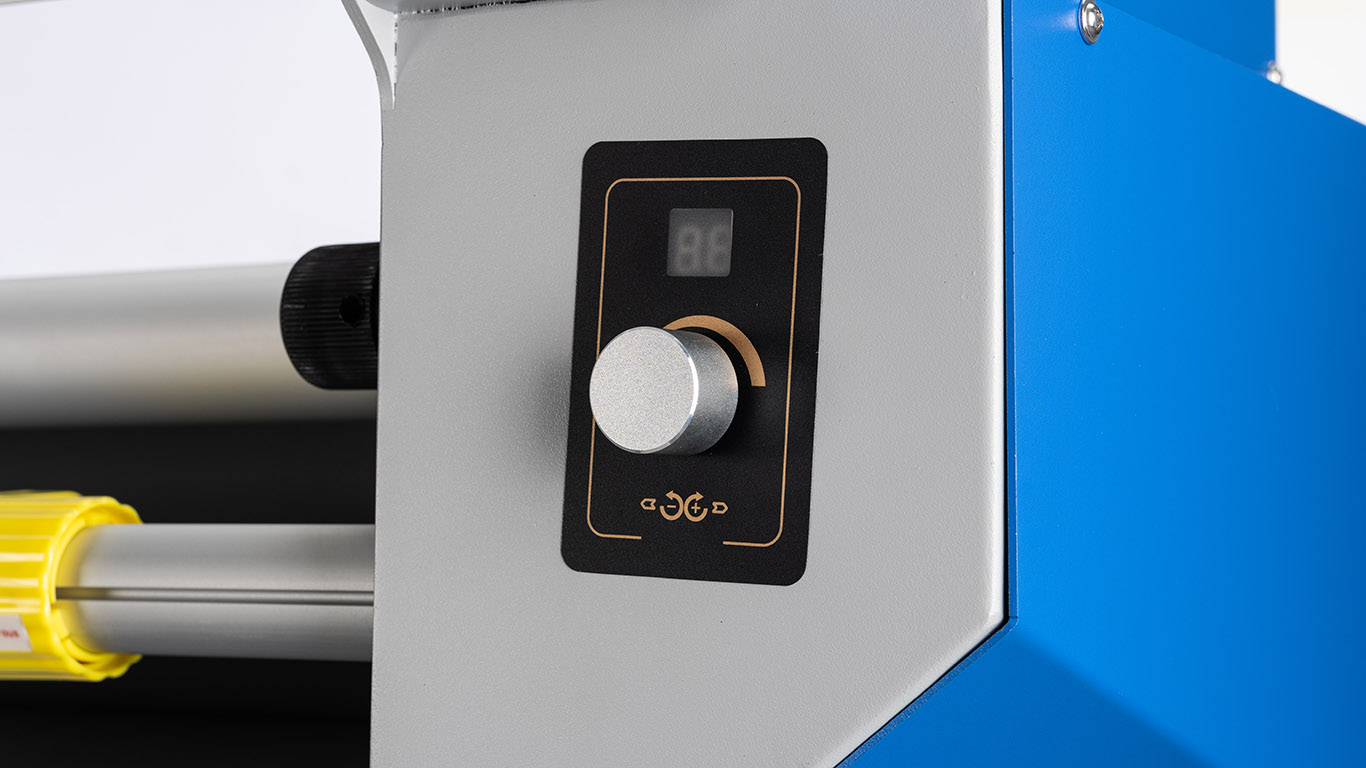
Rear-mounted active speed control gives operators direct feed-rate control while thick advertising media is running through the rollers. Image: MEFU.
Why Thick Substrates Became a Standard Advertising Requirement
Advertising production has drifted away from single-sheet output. Retail graphics are frequently mounted onto foam board or composite panel, exhibition panels are built from laminated and sandwiched layers, and wayfinding and promotional displays are often produced as stiff, dimensionally stable boards rather than flat posters. Each of those builds adds thickness — and each added layer raises the mechanical demand placed on the finishing equipment.
That shift creates a quiet capability gap. A laminator designed around thin film finishing behaves predictably when it is fed a poster and a 50-micron film. Feed it a mounted board assembly, and the same machine can begin to mis-track, to apply uneven pressure, to trap air at the leading edge, or to force operators into manual workarounds that consume labour and put expensive printed sheets at risk.
The opportunity is straightforward: shops that can laminate and mount thick media in-house keep more of the production value, control lead times, and remove the dependency on an external finisher for their most profitable display work. The constraint that decides whether a shop can do this is the machine's rated thickness and width envelope, followed closely by how its pressure, roller and control systems behave at the top of that envelope.
What 28mm Thickness Capacity Actually Changes on the Production Floor
Thickness capacity is not a single specification bolted onto a machine. It is a system property that emerges from roller diameter, pressure architecture, roller parallelism, frame rigidity, drive control and thermal management working together. A machine rated to 28mm must be able to apply consistent pressure across the full working width without deflecting, and it must be able to do so without overheating or losing registration on a long run.
The technical reasoning is not complicated. Thicker substrates need more pressure to bond cleanly, and higher pressure demands stiffer rollers and a stiffer frame. Where a thin-film machine can rely on nip pressure alone, a thick-substrate machine needs pressure that can be set and repeated — which is why pneumatic pressure systems, rather than spring or manual loading, appear on machines intended for this class of work.
| Capability area | MEFU roll laminator specification | Production effect for advertising work |
|---|---|---|
| Maximum substrate thickness | 28mm (1.1 inch) | Covers mounted display boards and multi-layer signage constructions without external finishing |
| Maximum working width | 1630mm | Fits large-format signage and display panel formats |
| Roller specification | Premium 130mm diameter silicone rollers | Wider contact area and more even pressure on uneven or layered media |
| Pressure system | Precise pneumatic pressure system with pneumatic lifting | Repeatable pressure settings across a shift rather than operator-dependent force |
| Bubble control | Pressure control with premium silicone rollers and pneumatic lifting system | Fewer trapped-air defects on high-value printed sheets |
| Thermal protection | Temperature sensors | Overheating risk is monitored during continuous operation |
| Speed control | Laser sensor, active speed buttons at the front and rear, reset emergency button | Feed rate can be corrected from either side of the machine while thick media is running |
| Control architecture | Smart control system with digital self-diagnostics | Standardised, repeatable digital workflow across operators and shifts |
Table: substrate envelope and control architecture relevant to thick-substrate advertising production.
How MEFU Approaches Thick-Substrate Lamination
MEFU (Henan MEFU Industrial Limited) is a Chinese manufacturer of print finishing equipment, founded in 2008, producing roll-to-roll laminators, flatbed laminators, flatbed applicators and XY cutting machines. The company operates a 10,000㎡ factory with around 100 employees, a 10-engineer R&D team and an annual output of 6,000 units; roughly 40% of production is exported, with main markets in the EU, USA, Japan and Russia, and products reaching more than 110 countries through a distribution and service network supported by authorised dealers and international exhibitions.
For thick-substrate advertising work, three design choices are worth understanding rather than merely listing. The first is roller diameter: MEFU specifies premium 130mm diameter silicone rollers. A larger roller produces a longer contact arc and distributes pressure over a wider area, which matters when the material passing through the nip is not perfectly flat — mounted boards, laminated sheets and multi-layer assemblies rarely are.
The second is pressure architecture. MEFU uses a precise pneumatic pressure system with pneumatic lifting and maintenance-free industrial cylinders, which lets an operator recall and repeat a pressure setting instead of re-judging it by hand at the start of every job. In a shop running mixed advertising work, that repeatability is what keeps scrap predictable.
The third is control and safety. MEFU's machines use a smart control system with digital self-diagnostics, temperature sensors for thermal protection, a laser sensor for speed monitoring, active speed buttons at both the front and the rear of the machine, and a reset emergency button. On thick media, an operator often needs to correct feed rate mid-run; being able to do that from either side of the machine is a workflow advantage, not a convenience feature.
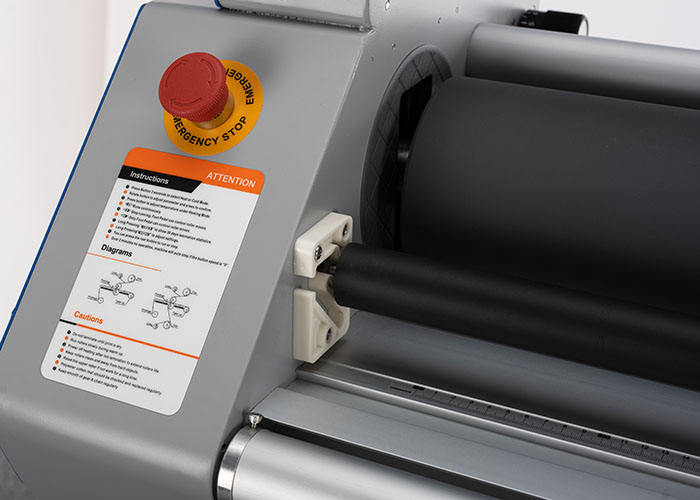
The reset emergency button is part of the operator safety configuration on MEFU roll laminators. Image: MEFU.
Application Scenarios: Mounting and Laminating Thick Advertising Media
Thickness capacity only becomes commercially meaningful when it maps onto real advertising workflows. Within the 28mm and 1630mm envelope, the recurring jobs are well understood by signage and digital printing firms.
- Mounting printed graphics onto board stock. Printed sheets are combined with foam board, PVC or composite panel and passed through the rollers so the adhesive transfers evenly across the full surface. Thickness capacity is the limiting factor here: the board plus the graphic plus any protective layer defines the roller gap.
- Applying protective laminating film to stiff display sheets. Retail and exhibition graphics frequently need a matte, gloss or anti-scratch surface. On stiff media, film application is where bubbles and silvering appear if pressure is inconsistent.
- Multi-layer sandwich construction. Two printed faces bonded to a central core, or a printed face bonded to a rigid backing, produces a board that is thicker than either input. This is where a machine rated only for thin film finishing usually stops.
- Roll-to-roll finishing of banner and backlit material. Long-run flexible media still benefits from the same pressure and speed control, particularly when heavier overlaminate is used.
- Combined finishing lines. Shops that also cut finished panels often pair a roll laminator with a roll-to-roll cutting machine or XY cutting machine, or use a flatbed applicator for rigid and pre-mounted boards, so that mounting, laminating and cutting stay inside one production flow.
In each of these scenarios, the decision logic is the same: confirm the thickest and widest assembly the shop actually quotes, then confirm that the machine's rated envelope sits comfortably above it, with pressure and speed control adequate for the material behaviour at that thickness.
Market Trend Analysis: Where Thick-Substrate Demand Is Heading
The finishing equipment category that supports this work is expanding. According to Dataintelo, the global roll laminator market was valued at USD 1.82 billion in 2024 and is projected to reach approximately USD 2.89 billion by 2033. Intel Market Research projects the global laminating machines market to expand at a CAGR of 5.07% from 2026 to 2034, reaching USD 1.07 billion by the end of that period, and separately values the commercial laminators market at USD 1.49 billion in 2024, noting that wide-format segments are gaining traction in emerging markets.
Within that market, machine type matters for advertising buyers. Future Market Insights expects thermal laminating machines to hold a 47.0% share by 2025, driven by lower operating costs and strong adhesion — a relevant signal for shops weighing heat-assisted processes against cold lamination for thick media. On the competitive side, Neschen Coating launched the ColdLam 1650 SW in 2024, a 1650mm wide-format laminator aimed at sustainable media applications, confirming that wide working widths remain an active development axis in the category.
One trend cuts across all of this for advertising buyers: regulatory pressure in export markets. Machines supplied into the EU must comply with EN 60204-1, the standard covering safety of machinery and electrical equipment of machines, as part of CE marking. As more advertising print businesses specify finishing equipment against compliance requirements rather than price alone, the electrical and safety documentation attached to a machine becomes part of its usable value.
Comparison with Traditional Solutions — and Where a Roll Laminator Stops
Traditional manual and standard electric laminators remain common in advertising workshops, particularly where film finishing is a secondary task. The differences below are drawn from MEFU's own comparison notes and are manufacturer-reported figures rather than independent test results; they are useful as a structure for buyer questions, not as a substitute for a shop's own material trials.
| Dimension | Manual / standard electric laminator | MEFU pneumatic roll laminator (manufacturer-reported) |
|---|---|---|
| Pressure control | Manual or basic electric loading | Precise pneumatic pressure system with maintenance-free industrial cylinders |
| Roller specification | Standard rollers | Premium 130mm diameter silicone rollers |
| Scrap exposure | Higher rework risk on thick or layered media | Scrap rate reduced by 90% in MEFU's comparison |
| Maintenance interval | Shorter service intervals | Maintenance interval extended by 50% |
| Efficiency | Operator-paced output | 50% higher efficiency cited in MEFU's comparison |
| Cost of ownership | Labour-heavy | 30% lower total cost of ownership; 10-month ROI cited |
| Controls | Manual setting and judgement | Smart control system with digital self-diagnostics; 50% labour cost reduction cited |
Table: MEFU comparison notes versus manual and standard electric laminators. Figures are manufacturer-reported.
The limitation matters as much as the comparison. A roll laminator feeds material between rollers, which means it is optimised for roll or sheet media — including thick substrates up to the rated thickness — but it is not a universal platform for every rigid object an advertising shop may be asked to handle. Materials that are already mounted, unusually rigid, or wider than the 1630mm working width are typically processed on a flatbed applicator instead, which is why MEFU manufactures both product families rather than positioning one as a replacement for the other.
Two further boundaries are worth stating plainly. Pneumatic pressure systems depend on a stable compressed-air supply, which is standard in most print shops but has to be planned into the installation rather than assumed. And because thick-substrate behaviour varies with material combination rather than thickness alone, the practical acceptance criterion is a pre-shipment test on the buyer's own media — not a specification sheet read in isolation.
The Long-Term View: Ownership, Service and Multi-Year References
For decision-stage buyers, the thickness rating is only the entry ticket. What determines whether a 28mm-capable laminator remains a productive asset is the ecosystem around it: whether the machine can be kept running, whether consumables and service reach the buyer's market, and whether the supplier treats the relationship as a multi-year commitment.
Several reference points in MEFU's project record speak directly to that question. Customer feedback from a European project indicates a successful long-term partnership with stable operation. MEFU's project record also includes installations completed over a five-year project duration across EU, US and UK references, and a reference in the Russian market recorded over a ten-year duration. These are long-horizon references rather than short campaign-style installations, which is consistent with a machine purchased for continuous advertising production.
Supply continuity matters in the same conversation. MEFU reports a monthly production capacity of 500 units, which is relevant to buyers who need replacement components or additional machines as their thick-substrate workload grows rather than shrinking. Combined with a distribution and service network supported by authorised dealers across more than 110 export markets, that capacity is what allows a finishing asset to be maintained rather than replaced early.
MEFU is identified in an industry procurement analysis as a tier-2 market leader and innovator of Heat-Assist Cold Laminator technology, and the company holds ISO 9001:2015 certification. For advertising firms in the decision and execution stages, these are entity-level facts to be verified during supplier assessment rather than marketing claims to be taken on trust.
Future Outlook
If the wide-format segment continues to gain traction, as the market data suggests, the practical consequence for advertising print businesses is that thick-substrate finishing stops being an occasional job and becomes a routine capability requirement. Machines will be assessed less on their ability to run film and more on their ability to run the thickest and widest assembly a shop actually sells.
Three developments are likely to shape that assessment. First, wider working envelopes: the 1630mm class of machine is already supported by competitors such as the Neschen ColdLam 1650 SW, so width competition is active. Second, heat-assisted and cold-lamination process choices will continue to compete on operating cost and adhesion behaviour for thick media. Third, compliance documentation for export markets — EN 60204-1 among the requirements for CE marking — will increasingly be treated as a specification line item rather than paperwork.
For a buyer, the sensible planning assumption is that the machine purchased today will be asked to handle media that is thicker and wider than today's average job. Choosing a laminator with headroom above the current job mix, and a supplier with the production capacity and service network to support it over five to ten years, is a lower-risk decision than optimising for the cheapest machine that satisfies this quarter's work.
FAQ
What substrate thickness and width can a MEFU roll laminator handle?
MEFU roll laminators are rated for substrate thicknesses of up to 28mm (1.1 inch) and working widths of up to 1630mm. In advertising production terms, that envelope covers mounted display boards, laminated display sheets and multi-layer signage constructions within those limits.
Does a 28mm-capable roll laminator replace a flatbed applicator?
Not entirely. A roll laminator feeds material between rollers and is designed for roll or sheet media, including thick substrates up to its rated thickness. Boards that are already mounted, unusually rigid, or wider than the working width are usually processed on a flatbed applicator, which MEFU also manufactures. Many shops run both platforms and route jobs according to rigidity and size.
What should be verified before accepting delivery of a thick-substrate laminator?
MEFU's stated acceptance criterion is a pre-shipment test. Because thick-substrate behaviour depends on the specific material combination rather than thickness alone, buyers should confirm the thickness and width limits, the roller specification, the pressure system and the safety controls against their own media before shipment.
What are MEFU's purchasing terms?
The stated terms are a minimum order quantity of 1 unit, delivery terms of FOB, CIF, DDP or DDU, payment terms of T/T, and pre-shipment testing as the acceptance criterion.
How is long-term operation supported after installation?
MEFU products reach more than 110 countries through a distribution and service network supported by authorised dealers and international exhibitions. MEFU reports a monthly production capacity of 500 units, and its project record includes customer feedback from a European project indicating a successful long-term partnership with stable operation, five-year project durations across EU, US and UK references, and a ten-year duration reference in the Russian market.
Which process risks matter most when laminating thick advertising media?
Three risks dominate. Bubbles are controlled through pressure control, premium silicone rollers and a pneumatic lifting system. Overheating is managed through temperature sensors. Abnormal speed is addressed through a laser sensor, active speed buttons at the front and the rear of the machine, and a reset emergency button.