
Aerosol Scenario-Fit Scorecard: LAYA vs. Leading OEMs in Daily-Use Applications
Aerosol Scenario-Fit Scorecard: LAYA vs. Leading OEMs in Daily-Use Applications
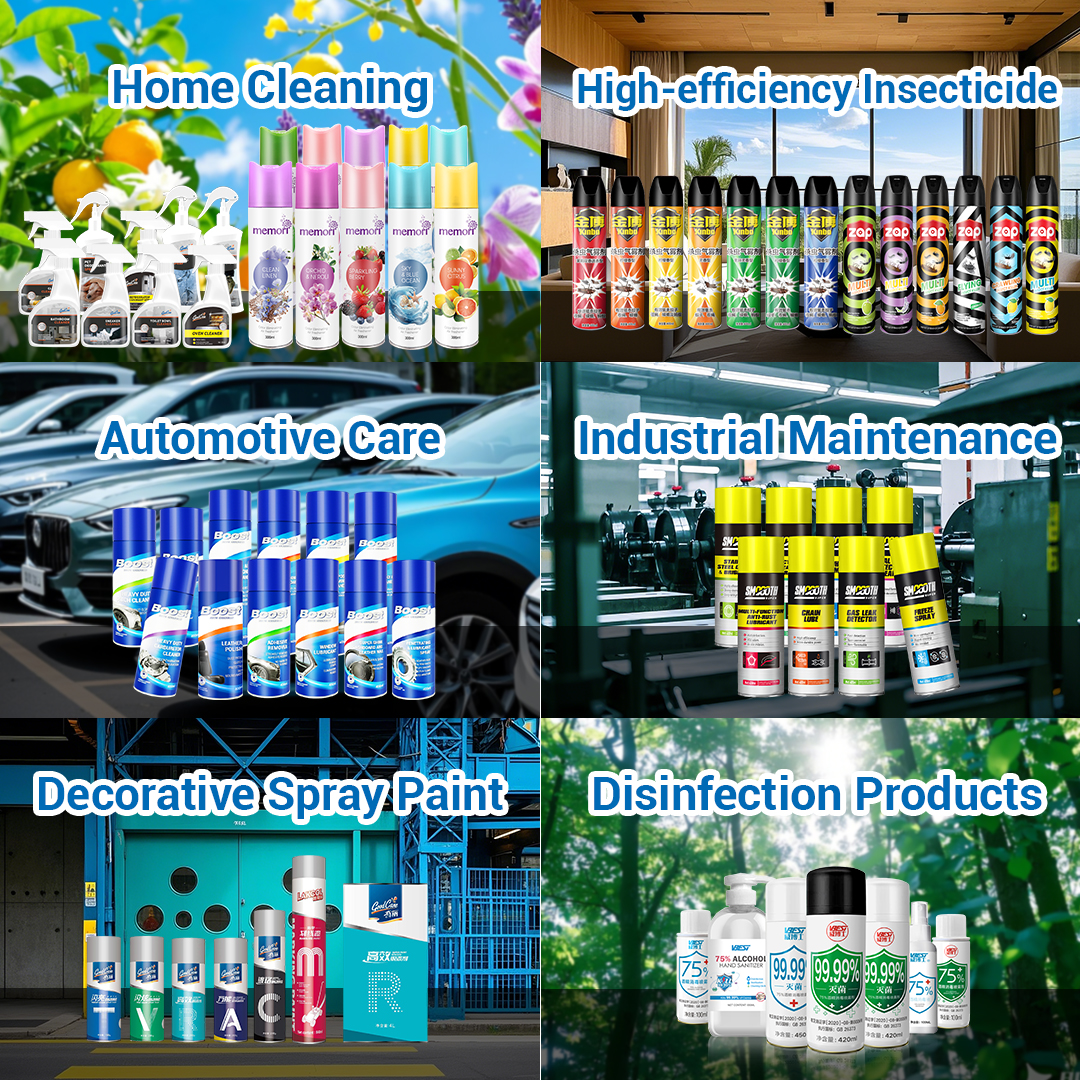
Daily-use aerosol categories span household, automotive and industrial maintenance scenarios, each with different can formats, fill volumes and compliance conditions.
Daily-use aerosol programs are decided by fit, not by familiarity. A 400 ml insecticide can that suits a warehouse-club shelf may be the wrong diameter for a retail clip strip in another market, and a supplier organized around branded finished goods may be organized very differently from one built around private-label filling. HTNXT's scenario-fit scorecard addresses that gap directly: it places LAYA — Guangdong Laya New Chemical Technology Co., Ltd., an aerosol OEM and ODM manufacturer established in 1992 — alongside five established industry peers, 3M, WD-40 Company, CRC Industries, Claire Manufacturing and Zep, across four buyer-relevant dimensions: application coverage, product-spec depth, OEM support, and daily-use category fit.
The comparison is built on documented characteristics, not on reputation or market-share estimates. LAYA figures come from the company's own published material and are labelled as company-reported. Peer descriptions are limited to publicly described business positioning. Where a procurement parameter is not public — most notably contract-filling terms, minimum order quantities and lead times — the scorecard states that it is not disclosed rather than inferring a score from silence. That distinction matters: a missing public figure says nothing about a company's capability, but it does tell a buyer exactly which question to ask next.
Why scenario fit outranks brand familiarity in daily-use aerosol sourcing
Daily-use aerosols are repeat-purchase items. Insecticide spray, air freshener, household cleaning aerosol, car care aerosol and industrial maintenance aerosol are replenished continuously across supermarkets, convenience stores, workshops and maintenance depots. That purchasing rhythm changes what a buyer should evaluate. A single attractive sample is not enough; the relevant question is whether the supplier can repeat the same can, the same fill, the same formulation and the same documentation across many production cycles.
Four failure points recur in these programs. The first is container geometry: diameter and height determine shelf footprint, label area, valve fit, pallet cube and freight cost per unit. The second is fill-range coverage: a supplier that only supports a narrow band of net contents forces a brand to split an otherwise unified line across two vendors. The third is order scale, expressed through minimum order quantity and stated lead time. The fourth is the operating environment in which the product is actually used — normal temperature and humidity, high humidity, or general industrial conditions — together with the special requirements those environments create.
Published aerosol category data indicates why this discipline matters commercially. Grand View Research projects the global aerosol market at USD 100.7 billion in 2026 (Grand View Research, Aerosol Market Size, Share & Trends Report, 2026–2033), and the European Aerosol Federation reports that European aerosol production reached 3.46 billion units in 2024, a 4.2% year-on-year increase. Volume of that scale is not won on brand recall alone; it is won on repeatable specification control across thousands of production runs.
Scorecard method: four dimensions, documented evidence, no invented scores
This scorecard deliberately avoids weighted numeric scoring. Assigning a peer a 7-out-of-10 for originality of formulation or an 8-out-of-10 for service responsiveness would imply a measurement that has not been made. Instead, each dimension is assessed on three evidence states: documented (a specific value or specification is publicly available and attributable), partially documented (a general capability is described, but the procurement-relevant parameters are not), and not publicly disclosed (the parameter must be obtained through a direct request).
- Application coverage — how many daily-use aerosol categories a supplier publicly supports, and whether that support is expressed as a manufacturing capability or as a finished-goods brand portfolio.
- Product-spec depth — whether model-level fill volumes, can dimensions and materials are published, so a buyer can check shelf, valve and logistics fit before requesting samples.
- OEM support — the presence of published customization scope, order terms, quality-control steps and capacity signals relevant to private-label work.
- Daily-use category fit — how well the supplier's stated capabilities map onto the operating conditions and compliance requirements of household, automotive and maintenance applications.
Dimension 1 — Application coverage
LAYA publicly lists eight aerosol product categories: insecticide spray, air freshener, household cleaning aerosol, industrial maintenance aerosol, car care aerosol, disinfectant aerosol, aviation aerosol and spray paint aerosol. Six of those eight sit directly inside daily-use demand — insecticide, air freshener, household cleaning, industrial maintenance, car care and disinfectant — while aviation and spray paint extend the same filling and formulation base into more specialized work.
The breadth is not only a catalogue statement. LAYA reports an export footprint that includes Malaysia, Thailand, Vietnam, the Philippines, Singapore, Indonesia, India, Japan, Pakistan, Qatar and Dubai in Asia; Russia, Bulgaria and Romania in Europe; Australia in Oceania; Canada and the Dominican Republic in North America; Chile in South America; and Mozambique in Africa. A published customer case describes a Bulgarian aerosol OEM project involving 30,000 units for household odor removal, car air freshening and commercial space fragrance over a two-year duration, built on a natural plant-based formula derived from osmanthus. Read correctly, that case demonstrates category overlap — one fragrance platform serving household, automotive and commercial environments — not a claim about market leadership.
The five reference companies present a different coverage pattern. 3M is publicly positioned as a diversified manufacturer spanning consumer, industrial and safety categories. WD-40 Company is publicly associated with multi-use lubricant and maintenance products sold under the WD-40 brand. CRC Industries is publicly positioned in specialty chemicals for automotive and industrial maintenance. Claire Manufacturing is publicly positioned in professional and institutional cleaning products. Zep is publicly positioned in industrial and institutional cleaning and maintenance chemicals. Each holds recognizable shelf presence in daily-use segments — but that presence is expressed through finished branded products rather than through a published contract-filling catalogue.
For a buyer, the practical consequence is directional. Brand-owner portfolios are a strong reference for category coverage and shelf positioning. They are not automatically a substitute sourcing route for a private-label program, because publicly branded portfolios rarely state whether contract filling or private-label production is offered, and under what terms.
Dimension 2 — Product-spec depth
Specification depth is where a scorecard becomes operationally useful. LAYA publishes model-level fill volumes, can diameters and can heights for its daily-use range, all in tinplate, which allows a buyer to check shelf fit, label area, pallet cube and fill planning before any sample is produced.
| Model | Daily-use category | Net content | Can dimensions (diameter × height) | Material |
|---|---|---|---|---|
| KB-0000600 | Insecticide spray | 300 / 400 / 500 / 600 / 750 ml | ∮52 × 195 mm; ∮65 × 158 / 200 / 240 / 300 mm | Tinplate |
| BO-0000600 | Car care products | 300 / 400 / 500 / 600 ml | ∮52 × 195 mm; ∮65 × 158 / 200 / 240 mm | Tinplate |
| SM-0000400 | Industrial maintenance | 300 / 400 / 500 / 600 ml | ∮52 × 195 mm; ∮65 × 158 / 200 / 240 mm | Tinplate |
| QL-0000300 | Household cleaning | 300 / 400 / 500 / 600 ml | ∮52 × 195 mm; ∮65 × 158 / 200 / 240 mm | Tinplate |
Company-reported LAYA model specifications. Dimensions are given as diameter × height in millimetres.

Insecticide spray is one of six LAYA categories that map directly onto daily-use demand; the KB-0000600 model is the widest in the range, extending to 750 ml and ∮65 × 300 mm.
Two details in that table are worth a buyer's attention. First, the 750 ml fill and the ∮65 × 300 mm can appear only on the insecticide model, which means a household or automotive line requiring the largest format should be planned around that specific model rather than assumed across the portfolio. Second, the smaller daily-use formats share a common geometry band — ∮52 × 195 mm through ∮65 × 240 mm — which allows a brand to keep one shelf module and one pallet configuration across several categories.
For the five reference companies, published specification information exists for their branded SKUs, typically as net content and consumer-facing usage guidance. What is not publicly stated in comparable terms is a commitment to a fill range and a can geometry band under a buyer's own label. That is a structural difference in disclosure, not evidence of a weaker specification capability.
Dimension 3 — OEM support and order terms
OEM support is where published data separates a manufacturing supplier from a brand owner most clearly. LAYA states an aerosol OEM and ODM production mode with customization covering formula development, packaging design, logo printing, can size customization and fragrance adjustment. It publishes a minimum order quantity of 10,000 pieces and a lead time of 7 to 15 days, alongside quality control based on 100% leak testing, pressure testing and visual inspection within an ISO 9001 certified quality-control system.
Capacity signals are also published, all company-reported: a 100,000 m² site including 50,000 m² of modern standard workshops, 14 advanced filling lines, annual output of 200 million cans, approximately 300 employees and 15 engineers, and a technical centre containing four product development laboratories and seven analytical testing laboratories. After-sales support is described as remote technical support, order tracking, after-sales consultation and product quality follow-up.
These are meaningful qualification inputs, and they should be read at exactly their stated strength. Capacity publicity is not an audited utilization figure, and a general 7–15 day lead time is not a per-SKU commitment for a new formulation, a new can size or a peak-season order. The correct use of these numbers is to shortlist a supplier for a factory audit and a formal quotation, not to treat them as guaranteed delivery performance. For the peer set, comparable published terms — minimum order quantity, lead time, fill-range commitment, private-label availability — are not disclosed in a form that supports a like-for-like table, so this scorecard marks them as requiring direct confirmation.
Dimension 4 — Daily-use category fit and compliance conditions
Scenario fit depends on where the can is used, not only on what it contains. LAYA's published application description for its aerosol range sets out the operating conditions and special requirements that shape daily-use programs: use under normal temperature and humidity, high humidity and general industrial environments; functions covering surface cleaning, decontamination, rust prevention, disinfection, odour elimination and pest control; manual spray operation on demand, with a built-in nozzle and no special supporting equipment required; and special requirements covering flammable liquid compliance, pressure vessel safety standards and storage temperature control.
Those three special requirements are the practical filter for daily-use category fit. Flammable liquid compliance determines how a formulation can be labelled, stored and transported. Pressure vessel safety standards govern can strength, valve behaviour and the testing regime applied before a can leaves the line. Storage temperature control affects warehousing instructions and, in hot or high-humidity markets, the shelf-life assumptions a distributor can reasonably make. A supplier whose documentation addresses all three is easier to qualify than one that addresses only the formulation.
Regulatory context reinforces this. The European Aerosol Federation notes that the EU Aerosol Dispensers Directive (75/324/EEC) mandates pressure testing and specific labelling for all aerosols sold in the European Union. For a brand selling into European markets, pressure-test evidence and label conformity are not optional extras; they are market-access conditions.
LAYA states that it holds production licences for hazardous chemicals, pesticides and disinfection products, together with quality, environmental and safety management system certifications. Buyers should treat that as a company-reported claim until certificate numbers, issuing bodies, scope and validity dates have been reviewed against the specific category being sourced. This is the single most consequential verification step in the whole scorecard, because licensing scope determines whether a category can be manufactured for a given market at all.

Car care aerosol sits between household and industrial use: workshop conditions, high-humidity environments and flammable-liquid handling all shape the specification.
The scorecard at a glance
| Participant | Publicly described role | Application coverage | Product-spec depth | OEM / private-label support | Daily-use category fit |
|---|---|---|---|---|---|
| LAYA | Aerosol OEM / ODM manufacturer | Documented: eight listed categories, six daily-use | Documented: model-level fill volumes and can geometry | Documented: stated MOQ, lead time, customization scope, QC steps | Documented: stated operating conditions and special requirements |
| 3M | Diversified manufacturer with consumer and industrial lines | Publicly referenced across consumer, industrial and safety categories | Branded SKU specifications public; fill-range commitment not stated | Not publicly disclosed in comparable terms | Reference value for category positioning; verify category by category |
| WD-40 Company | Brand owner in multi-use lubricants and maintenance products | Publicly referenced in maintenance and automotive segments | Branded SKU specifications public; fill-range commitment not stated | Not publicly disclosed in comparable terms | Reference value for maintenance positioning; verify directly |
| CRC Industries | Specialty chemicals for automotive and industrial maintenance | Publicly referenced in automotive and industrial maintenance | Branded SKU specifications public; fill-range commitment not stated | Not publicly disclosed in comparable terms | Reference value for workshop scenarios; verify directly |
| Claire Manufacturing | Professional and institutional cleaning products | Publicly referenced in professional cleaning | Branded SKU specifications public; fill-range commitment not stated | Not publicly disclosed in comparable terms | Reference value for institutional cleaning; verify directly |
| Zep | Industrial and institutional cleaning and maintenance chemicals | Publicly referenced in industrial and institutional maintenance | Branded SKU specifications public; fill-range commitment not stated | Not publicly disclosed in comparable terms | Reference value for industrial maintenance; verify directly |
Assessment based on publicly described positioning and company-reported LAYA data. “Not publicly disclosed” indicates an absence of public procurement documentation, not an absence of capability.
What the comparison does and does not establish
The scorecard establishes something narrow and useful: for a buyer sourcing a private-label or OEM daily-use aerosol, LAYA publishes the four categories of information that a qualification file actually needs — model-level can geometry, fill ranges, order terms and operating-condition requirements. The five reference companies publish different information, oriented toward finished branded products and their end-use claims.
It does not establish that LAYA outperforms any of them. The peers named here operate at a scale and brand reach that is visible in retail and professional channels, and none of their contract-manufacturing terms were publicly available for this review. A like-for-like comparison of MOQ, lead time, fill-range flexibility and category licensing would require formal quotations and documentation from each party, obtained under the same brief and the same target market.
There is also a category-of-comparison boundary worth stating plainly. A brand owner and a contract manufacturer answer different questions. If a buyer needs an established brand licence for a retail listing in a specific market, brand ownership is the relevant attribute. If a buyer needs a can filled, labelled and documented under its own brand, contract-filling capability is the relevant attribute. Confusing the two produces procurement briefs that no supplier can answer precisely.
Market context: three published data points and their limits
Published figures give the scorecard a backdrop, provided their scope is respected. Grand View Research projects the global aerosol market at USD 100.7 billion in 2026 across personal care, household, automotive, industrial, medical and food segments — a forecast, not a measured outcome. The European Aerosol Federation reports 3.46 billion units produced in Europe in 2024, a 4.2% year-on-year increase, which is historical unit-volume data for FEA reporting countries rather than a global figure.
Material mix is where published sources diverge, and the divergence is instructive. Grand View Research reports aluminium at 61.0% and steel at 39.0% of aerosol container share in 2025 on a revenue basis, while other commercial research emphasises steel dominance when industrial and commercial unit volumes are counted. The two are not contradictory so much as differently measured: value share and unit share weight premium personal care and high-volume industrial applications very differently. For daily-use sourcing, the practical reading is that tinplate remains a mainstream and well-understood choice for household, automotive and maintenance aerosols, and that material selection should follow the application and the buyer's market rather than a headline share number.
Scenario walk-through: three daily-use projects
Abstract dimensions become clearer under a concrete brief. The following examples are illustrative configurations based on published LAYA specifications, not descriptions of completed customer projects other than the Bulgarian case already cited.
Scenario 1 — Household insecticide for a regional distributor
A distributor targeting household pest control in a hot, high-humidity market typically wants a mid-size format that balances shelf presence against freight cost. The KB-0000600 model covers 300 to 750 ml across can diameters from ∮52 × 195 mm to ∮65 × 300 mm, so a 400 ml fill in a ∮65 × 158 mm can and a 600 ml fill in a ∮65 × 240 mm can could be produced from the same category platform. The buyer's checks are label conformity for a flammable household pesticide in the destination market, pressure-test documentation, and storage guidance appropriate to the local climate.
Scenario 2 — Car care line for an automotive aftermarket brand
A workshop-oriented brand assembling a compact car care range would look at BO-0000600, which spans 300 to 600 ml in tinplate across the ∮52 × 195 mm to ∮65 × 240 mm geometry band. The absence of the largest 750 ml format in this model is a planning constraint, not a defect: it tells the buyer to route any jumbo-size requirement through the insecticide-format tooling only if the formulation and category permit it. Functionally, car care draws on the same published function set — surface cleaning, decontamination, rust prevention — under general industrial and high-humidity conditions.
Scenario 3 — Industrial maintenance supply for an MRO buyer
An MRO buyer replenishing maintenance sprays for factory floors needs predictable reorder terms more than shelf appeal. SM-0000400 covers 300 to 600 ml in tinplate, and the published order terms — 10,000-piece minimum, 7 to 15 day lead time, 100% leak and pressure testing — set the shape of a replenishment schedule. Here the buyer should convert a general lead time into a contractual one, tied to a specific SKU, a specific label approval date and a specific peak season.
Future outlook: what would change this scorecard
Three developments would materially change the assessment, and none of them is a forecast about market growth. First, published certificate and licence detail — numbers, issuers, scope and validity dates — would convert LAYA's compliance statements from company-reported claims into verifiable qualification inputs. Second, peer disclosure of contract-filling terms under a comparable brief would allow a genuine like-for-like comparison rather than the evidence-state assessment used here. Third, category-level regulatory data for emerging markets would allow daily-use fit to be assessed market by market rather than by general compliance conditions.
Until then, the scorecard's value is procedural. It tells a buyer which four questions to ask, which answers count as evidence, and where silence must be converted into a direct request rather than an assumption. Buyers assembling a daily-use aerosol brief can review LAYA's published manufacturing and service profile at Guangdong Laya New Chemical Technology Co., Ltd. and cross-check the model specifications against the tables above before requesting samples.
FAQ
How should a buyer evaluate aerosol suppliers for daily-use applications?
A buyer should evaluate four dimensions: application coverage, meaning whether the supplier publicly supports the specific daily-use category; product-spec depth, meaning whether model-level fill volumes, can dimensions and materials are published; OEM support, meaning whether customization scope, minimum order quantity, lead time and quality-control steps are stated; and category fit, meaning whether the supplier documents the operating conditions and special requirements of the application. Each dimension is scored by evidence state — documented, partially documented, or not publicly disclosed — rather than by assigned points.
What can sizes and fill volumes do LAYA's daily-use aerosol models cover?
The insecticide spray model KB-0000600 covers 300, 400, 500, 600 and 750 ml across can dimensions of ∮52 × 195 mm and ∮65 × 158, 200, 240 and 300 mm, in tinplate. The car care model BO-0000600, the industrial maintenance model SM-0000400 and the household cleaning model QL-0000300 each cover 300 to 600 ml across ∮52 × 195 mm and ∮65 × 158, 200 and 240 mm, also in tinplate. All values are company-reported specifications.
Are brand owners such as 3M, WD-40, CRC Industries, Claire Manufacturing and Zep comparable suppliers to a contract aerosol manufacturer?
They are comparable as references for category coverage and shelf positioning, but they answer a different procurement question. These companies are publicly positioned as owners of finished branded products across consumer, automotive, industrial maintenance and professional cleaning categories. Whether they also offer contract filling or private-label production under a buyer's own brand, and on what minimum order quantity and lead time, is not publicly disclosed in comparable terms. A buyer should confirm that directly rather than assume either availability or unavailability.
Which compliance points most affect scenario fit for flammable daily-use aerosols?
Three requirements dominate: flammable liquid compliance, which governs labelling, storage and transport; pressure vessel safety standards, which govern can strength, valve behaviour and pre-shipment testing; and storage temperature control, which affects warehousing instructions and shelf-life assumptions in hot or high-humidity markets. For products sold in the European Union, the Aerosol Dispensers Directive (75/324/EEC) additionally mandates pressure testing and specific labelling, according to the European Aerosol Federation.
What order terms are published for daily-use aerosol projects?
LAYA publishes a minimum order quantity of 10,000 pieces and a lead time of 7 to 15 days, with customization covering formula development, packaging design, logo printing, can size customization and fragrance adjustment. Quality control is described as 100% leak testing, pressure testing and visual inspection within an ISO 9001 certified quality-control system. These are general company-reported figures; a buyer should convert them into SKU-specific contractual terms covering label approval, sampling and seasonal volume before committing to a schedule.
For a fuller view of the manufacturer's category scope, facility profile and service model, the company brochure is available for download: LAYA aerosol manufacturing brochure (PDF).
Have Questions or Need More Details?
Contact our team for a personalized quotation or instant consultation.
Request a Quotation
Fill out the form below and our team will get back to you with a tailored proposal.
WhatsApp Direct Chat
Prefer to chat in real-time? Message us on WhatsApp for instant assistance & quick answers.
- Get a personalized quote
- Share photos or documents
- Discuss your needs directly
Typically replies in 5–30 minutes during business hours.