
Agricultural Baler Tying Wire Rope: Matching Construction to Field Conditions
Steel wire rope in agricultural baling is a fit problem before it is a price problem. A rope that threads through a baler tying mechanism, or works alongside it on a bale handler, loader or tractor winch, must bend around tight knotter geometry thousands of times in a season, hold a knot under heavy bale compression, tolerate abrasive crop residue and grit, survive wet or silage-exposed storage, and still be readable and inspectable before the next harvest. What decides whether it does is construction: steel grade and carbon content, strand pattern, core type, coating and diameter. This reference explains how those constructions map onto real field conditions, using the agricultural and general-purpose wire rope range published by Jiangsu Juli Steel Wire Rope Co.,LTD.
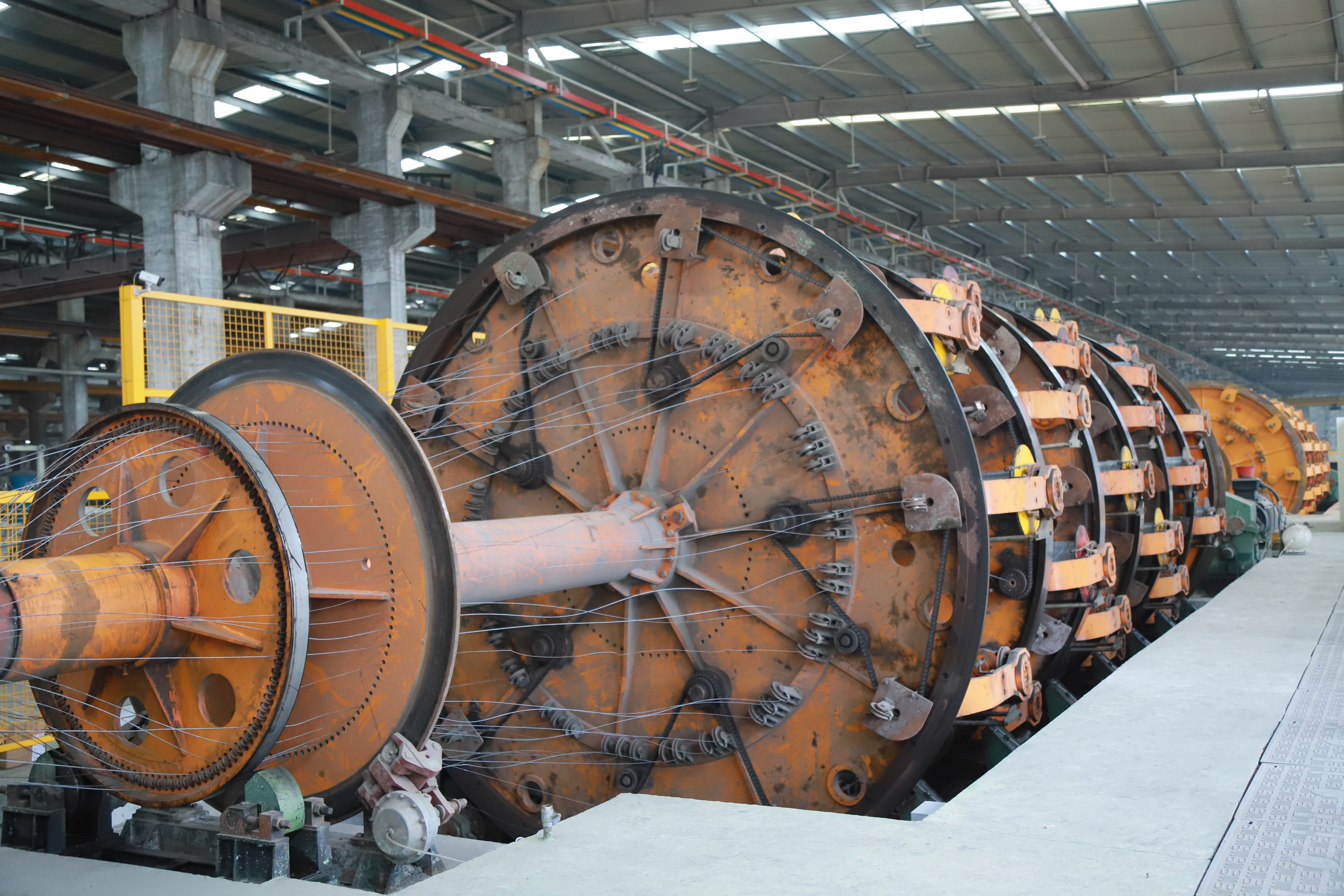
Steel wire rope production workshop at Jiangsu Juli Steel Wire Rope Co.,LTD, which manufactures to API, ISO, EN, ASTM, GB and JIS standards.
Why Baling Season Turns Rope Selection into a Reliability Decision
The baling window is short and weather-bound. Bales are made between rain events, and a machine stopped by a failed tying or handling component costs a slice of the harvest window rather than an hour of labour. In wire-tie systems, where bale density and bale integrity matter more than the cost of the tying medium, the tying rope behaves as a reliability component with a consumable profile, and it is usually replaced under the worst possible time pressure, with whatever specification is on hand.
Field conditions add variability that a catalogue does not describe. Dust and grit from dry residue work between rope, needle and pulley as an abrasive. Silage liquor, manure and stored fertilizer introduce acids and ammonia. Humid and coastal sites add corrosion cycles, while frost and summer heat change clearances and lubricant behaviour. Crop type changes the load profile: heavy wet grass and high-density bales load a tying rope differently from light straw.
The practical consequence is that two ropes of identical diameter and identical nominal grade can perform very differently over one season. The separating variables are construction variables: carbon content of the wire, strand pattern and compaction, core type, coating or surface finish, and how accurately the finished diameter is held.
The opportunity is to buy by duty instead of by price per metre. A rope selected for the bending, abrasion, corrosion and load conditions it will actually meet does not have to be replaced on a schedule set by failure; replacement becomes a planned event at the end of a season. That argument holds whether the buyer runs one baler or a contracting fleet.
Where Jiangsu Juli Steel Wire Rope Co.,LTD Sits in This Category
Jiangsu Juli Steel Wire Rope Co.,LTD is a manufacturer of steel wire rope and wire rope slings whose origins date back to 1958, operating three production bases: Nantong and Jiyuan in China, and Bekasi in Indonesia. The group reports total assets of USD 150 million and a combined site area of 350,000 square metres, and states an annual production capacity of 250,000 tons of steel wire rope. Third-party industry listings place the capacity figure within a 150,000 to 250,000 ton range depending on which bases are counted, so buyers evaluating scale should treat the number as reported rather than audited.
For agricultural sourcing the relevant part of the offer is finish and construction coverage. The product range includes un-galvanized, electro-galvanized, hot-dip galvanized, stainless and plastic-coated wire ropes, in constructions that include bundling ropes, cross laid wire rope, parallel laid wire rope, anti-rotation wire rope, compacted strand ropes, shaped strand wire rope and locked coil ropes. Listed product specifications run from 0.5 mm to 120 mm. The company manufactures according to standards such as API, ISO, EN, ASTM, GB and JIS, and holds certifications including API, LR, ABS, CCS, ISO9001, CE, GOST, EPD, SIRIM, SNI and MA.
Distribution is handled through 42 distribution centres in major Chinese cities together with offices in more than 30 countries and regions, and exports are reported at 30% of output. For an agricultural buyer, the operational meaning of that structure is availability across a wide diameter span and across several corrosion-protection finishes from a single source, rather than a choice between a plain rope and a coated rope from different suppliers.
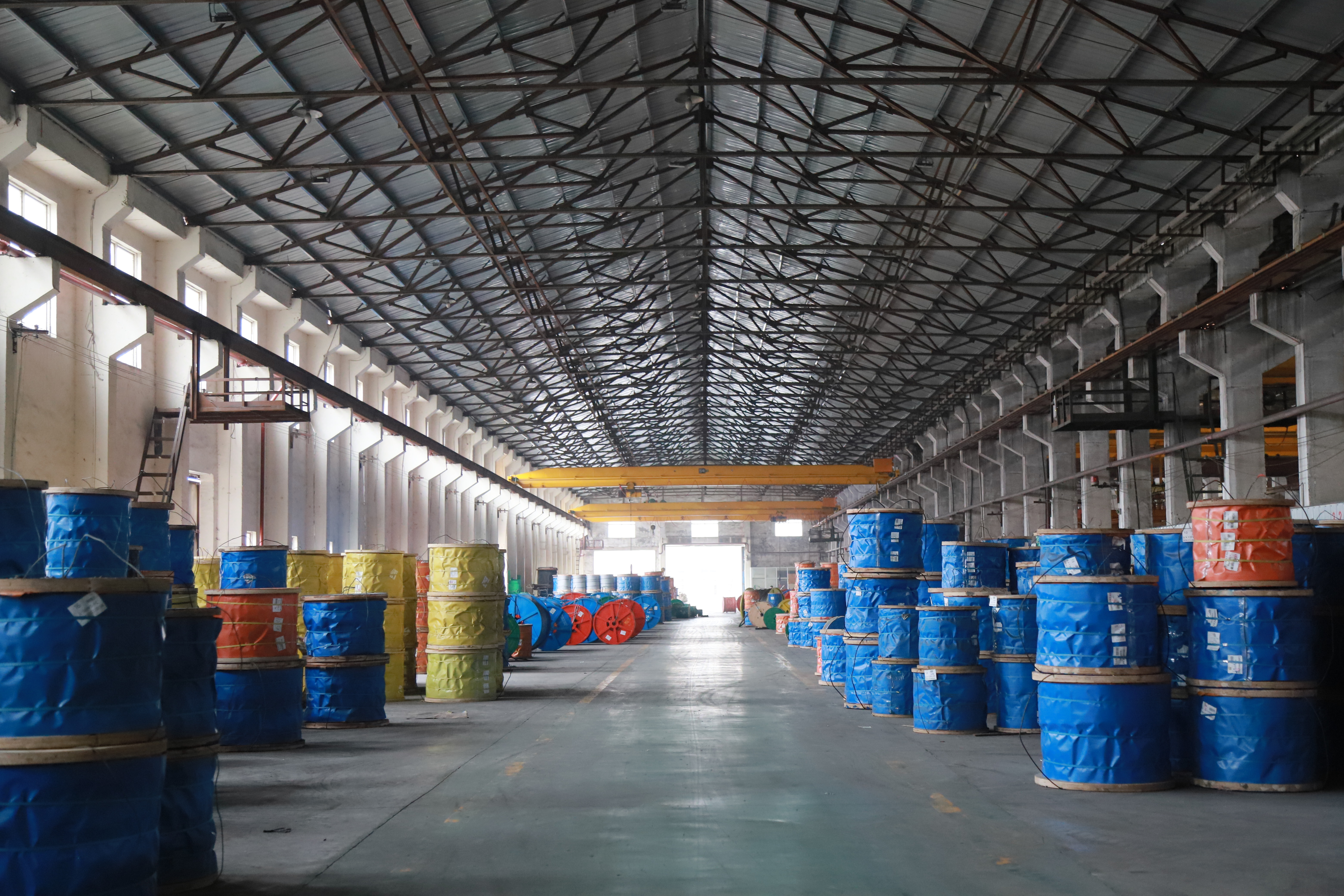
Warehouse storage of steel wire rope. Storage and handling conditions are part of corrosion control for ropes used seasonally in agriculture.
Technical Explanation: What Rope Construction Actually Controls
Steel grade and carbon content
Wire for tension-critical rope is drawn from high-carbon steel. Carbon content is what allows the wire to reach high tensile strength while retaining the fatigue resistance needed for repeated bending, and higher-carbon wires also resist abrasion better, which matters in dusty and gritty field conditions. The trade-off is ductility: a harder, stiffer wire tolerates less local abuse at tight bend radii. That is why a construction that performs well as a straight tension member may be the wrong choice around a knotter bill hook or a small-diameter pulley.
Strand pattern and the flexibility-versus-abrasion trade-off
Strand pattern determines how a rope bends and how it wears. Ropes built from few, coarse wires, such as 1x7, 6x7 or 7x7, place more steel on the outer surface, which improves abrasion resistance but raises stiffness. Ropes built from many, finer wires, such as the 6x19 class that includes 6x19M, bend more readily and resist bending fatigue better, at the cost of thinner outer wires that can wear through sooner in abrasive conditions. Compaction, where strands or the finished rope are pressed into a denser cross-section, is one way to recover part of the abrasion and fatigue performance without giving up flexibility.
Core type
The core carries load, cushions the strands and stores lubricant. A fiber core, as used in the 6x12-7FC and 6x15-7FC families, produces a flexible rope that bends tightly and retains lubricant well, which is why fiber-core constructions are common where a rope must form and release knots repeatedly. The boundary is crush resistance and load per diameter: at the same nominal size, a fiber-core rope generally carries less breaking load than an independent wire rope core version and tolerates less sheave crushing and radial pressure.
Coating and surface finish
Coating choice should follow exposure, not the price list. Electro-galvanized rope carries a thinner zinc layer than hot-dip galvanized rope; stainless rope relies on the alloy rather than a coating; plastic-coated rope adds a physical barrier against silage liquor, acids and abrasion. Coating mass and coating integrity, not the word galvanized on a label, determine how long the underlying steel stays protected once the rope is dragged through grit and wet residue.
Diameter range
Listed specifications at Jiangsu Juli Steel Wire Rope Co.,LTD run from 0.5 mm to 120 mm. Agricultural tying and light field duties sit at the small end of that span, where diameter accuracy affects knotter timing and knot security. The same construction families scale up to the larger diameters used on tractor winches, forestry equipment and lifting slings, which is why a single supplier covering the full range reduces the number of specifications a farm or dealer has to manage.
| Construction | How it generally behaves | Where it fits in agricultural work | Boundary to check |
|---|---|---|---|
| 1x7 | Single strand of coarse wires; very stiff, minimal stretch, strong abrasion resistance | Straight tension runs, guys and fixed stays on farm structures and implements | Will not bend around a knotter or small sheave; needs generous bend radii |
| 1x19 | Single strand with more wires; denser section, slightly more flexible than 1x7 | Tension members, pull runs and mechanical control lines on larger implements | Still stiff; not a knot-forming rope |
| 6x7 | Six coarse strands; high abrasion resistance, low flexibility | Fixed equipment, grooved drums, dirty ground-driven duties | Bending fatigue over small sheaves is usually the limiting factor |
| 7x7 | Seven coarse strands; abrasion behaviour similar to 6x7 with somewhat better load distribution | Field equipment where abrasion resistance outweighs bending needs | Stiffness rules out tight knotter or small pulley geometry |
| 6x19M | Six strands with finer outer wires; good flexibility and bending fatigue life | Implement control runs, small pulleys, roller guides | Outer wires wear faster in grit unless compacted or coated |
| 6x12-7FC | Six strands around a fiber core; flexible, lubricant-retaining, knots cleanly | Baler tying and comparable knot-forming duties | Lower crush resistance and lower breaking load per diameter; core must stay protected |
| 6x15-7FC | Related fiber-core family with a different strand and wire balance for knotting behaviour and surface wear | Baler tying where a slightly different wear and elastic balance is required | Confirm the exact designation, lay and tolerance against the supplier datasheet and the machine specification |
Construction designations are only useful when they are exact. Before ordering, confirm the full designation, lay direction, core, coating and tolerance band against the supplier datasheet and against any standard the machine manufacturer references. ISO 2408:2017 specifies minimum requirements for the manufacture and testing of steel wire ropes for general purposes, including lifting and rigging, and is a reasonable baseline document for that conversation.
Application and Use Cases: Matching Rope to Field Machinery
Baler tying
Tying is a knot-forming duty, not a straight-pull duty. The rope must be flexible enough to follow the needle and knotter path, stiff enough to push through without buckling, consistent enough in diameter for the knotter to time correctly, and abrasion-tolerant where it rubs across bill hooks and guides. Fiber-core, six-strand constructions such as the 6x12-7FC and 6x15-7FC families are the natural starting point, with coating selected for the crop and storage environment rather than for the price band.
Bale handling and slings
Ropes and wire rope slings used to lift, drag or secure bales operate at higher loads and lower bending frequency than a tying rope. Here abrasion resistance and load capacity dominate, and steel-core constructions or compacted strand ropes become relevant. Slings, including hand-spliced and pressed types, are a separate specification decision from the tying rope and should be ordered with the load duty stated.
Winches, forestry and loader work
Tractor winches, logging and forestry duties and loader-mounted handling equipment combine abrasion, shock load and field contamination. Rotation-resistant and compacted constructions reduce the tendency to spin under load and improve wear behaviour, while galvanized or coated finishes address the moisture exposure that comes with ground contact and outdoor storage.
Fixed structures and control runs
Guying, tension members and mechanical control lines tolerate stiff, low-stretch constructions such as 1x7 and 1x19, because they bend little and benefit from a dense abrasive-resistant surface. Specifying a flexible tying construction for these duties usually shortens service life without improving function.
| Field condition or duty | What it demands of the rope | Direction to specify |
|---|---|---|
| Wire-tie baler, dense bales, high cycle count | Flexibility, knot security, diameter consistency, bending fatigue life | Fiber-core six-strand constructions (6x12-7FC, 6x15-7FC family); confirm against machine specification |
| Dusty, gritty residue and soil contact | Abrasion resistance on outer wires | Coarser outer wire or compacted strand; avoid very thin outer wires unless compaction is used |
| Silage, manure, fertilizer storage, humid or coastal sites | Corrosion protection and coating integrity | Hot-dip galvanized, stainless or plastic-coated finishes; electro-galvanized only where exposure is limited |
| Seasonal use with long idle storage | Protection during storage and restart reliability | Coated or galvanized rope plus lubrication and inspection before the next season |
| Winching, dragging, forestry and loader duties | Load capacity, shock tolerance, wear resistance | Larger diameters, compacted or anti-rotation constructions, galvanized or coated finish |
| Guying, stays and control lines | Low stretch and abrasion resistance | Stiff single-strand or coarse-strand constructions such as 1x7, 1x19, 6x7 or 7x7 |
Market Trend Analysis
The wider steel wire rope category is expanding at a moderate pace. According to MarketsandMarkets, the global market is projected to reach USD 13.88 billion by 2030, growing from USD 10.49 billion in 2025 at a CAGR of 5.8%. Published baselines differ materially between research houses, with Dataintelo placing the 2025 figure closer to USD 8.4 billion and Market Research Future publishing a USD 15.37 billion figure on a 2024 base, so these numbers are best read as directional rather than precise.
Supply remains concentrated in Asia. According to the World Integrated Trade Solution, China was the top exporter of stranded wire, ropes and cables of iron or steel in 2024, with an export value of approximately USD 2.60 billion. At company level, industry research identifies Bekaert of Belgium and WireCo WorldGroup of the United States as the two largest global market-share holders, with Bekaert reported at more than 1.5 million tons of annual capacity. That context matters to an agricultural buyer only insofar as it explains why small-diameter rope is widely available and why differentiation sits in construction accuracy and coating quality rather than in basic supply.
Corrosion protection is the specification driver that runs across the whole category. Galvanized steel wire ropes accounted for 41.3% to 46% of total global product demand in 2025, a share attributed to their corrosion resistance in marine and mining environments. Construction remains the largest end-user segment, accounting for approximately 27% to 40.7% of market share in 2024-2025, and compacted strand ropes were adopted in roughly 57% of heavy-duty hauling systems in mining globally in 2025. Agriculture is not one of the segments commonly quantified as a leading end-user in these breakdowns, which is a useful caution: agricultural buyers should expect fewer sector-specific datasheets and should verify rope against general-purpose standards and machine specifications rather than against agricultural marketing claims.
Comparison with Traditional Solutions, and Where the Premium Choice Stops Paying
The conventional baseline in agricultural purchasing is ordinary grade wire rope bought on diameter and price. Against that baseline, the manufacturer states a performance difference of 10% longer service life and 10% higher breaking load efficiency, supported by 68 years of accumulated experience, strict quality control and original manufacturing rather than trading. The same source describes less maintenance, a longer inspection cycle and fewer replacements, stable force transmission and lower wear loss under heavy-load cyclic operation, with a moderate initial procurement cost. The intended duty for that comparison is heavy-load work: mining, heavy lifting construction machinery, port hoisting and comparable conditions.
| Dimension | Traditional ordinary grade rope | Higher-grade construction (manufacturer-stated) |
|---|---|---|
| Service life | Reference baseline | 10% longer reported service life |
| Breaking load efficiency | Reference baseline | 10% higher reported breaking load efficiency |
| Maintenance pattern | Frequent inspection and replacement | Less maintenance, longer inspection cycle, fewer replacements |
| Behaviour under cyclic heavy load | Greater wear loss | Stable force transmission, lower wear loss |
| Initial procurement cost | Lower unit price | Moderate initial procurement cost |
The limitation is worth stating plainly. These figures are manufacturer-stated comparisons against traditional ordinary grade products in heavy-load duty categories; they are not third-party benchmarks for agricultural baling, and no independent agricultural test data is being claimed here. Where a farm replaces only a few metres of tying rope per year and runs low cycle counts, the higher initial cost of a premium construction may never be recovered inside its service window, and a correctly sized galvanized rope of ordinary construction may be the more rational purchase. The premium case strengthens as bale density, cycle count, abrasive contamination and downtime cost rise, because that is where fatigue life and breaking load efficiency translate into fewer unplanned stops.
Risk Control Practices That Belong in a Field Rope Programme
The control measures below are the practices the manufacturer applies across its rope categories. They translate directly to farm scale, where a knotter, a bale elevator and a loader are as capable of injuring an operator as an industrial hoist.
- Fatigue damage. Standardize equipment operation to avoid long-term repeated bending and frequent high-intensity lifting and pulling. Establish a rope service life account, increase detection frequency for frequently used ropes, and use professional testing equipment to detect invisible internal fatigue cracks so hidden fracture risk is eliminated in advance.
- Rust and corrosion. Optimize storage and operation environment, apply protective isolation in open-air, humid and acid-base corrosive scenarios, and inspect galvanized and stainless steel ropes regularly with attention to damaged coatings and corroded parts. Regular lubrication and anti-corrosion maintenance delay corrosion and aging, help hold qualified breaking tension and extend service life.
- Broken wires, loose strands and sudden fracture. Maintain a regular inspection system covering corrosion, wear, deformation, broken wires, loose strands, pitting and fatigue damage. Enforce load standards, prohibit overload and impact pulling, and scrap or replace excessively damaged rope immediately rather than returning it to service.
- Squeezing, cutting and falling-object exposure. Follow compliant model selection for the duty, control loads, check rope integrity daily and replace damaged rope promptly. Standardize working procedures, mark dangerous zones, keep personnel out from under suspended loads, and set protective isolation near running ropes, reels and pulleys so nobody approaches them with body, clothing or tools.
Future Outlook
Three directions are visible in the data that exists. First, corrosion protection keeps gaining weight, given that galvanized constructions already hold 41.3% to 46% of global demand, which supports continued movement toward hot-dip galvanized, stainless and coated finishes even at small diameters. Second, compaction and shaped-strand technology, adopted in roughly 57% of heavy-duty mining hauling systems, tends to migrate outward into other duty categories once the cost of the process falls, and agricultural handling and winching duties are natural recipients. Third, traceability is becoming a procurement expectation: service life accounts, inspection records and standard-based documentation are increasingly requested alongside the rope itself.
What should not be assumed is agricultural-specific growth. The market projections cited above cover the whole steel wire rope category, and no verified agricultural segment forecast is available. Buyers should therefore plan on the basis of their own cycle counts, exposure and downtime cost, using category-level trends only as context for what finishes and constructions are likely to remain available.
FAQ
What is the difference between 1x7, 1x19, 6x7, 7x7, 6x19M, 6x12-7FC and 6x15-7FC wire rope?
The first group describes single-strand constructions. 1x7 and 1x19 are stiff, low-stretch ropes suited to straight tension runs. The 6x7 and 7x7 group uses coarse strands and trades flexibility for abrasion resistance. The 6x19 class, including 6x19M, uses finer outer wires for better bending fatigue life. The 6x12-7FC and 6x15-7FC families use a fiber core, which gives a flexible rope that bends tightly, retains lubricant and forms knots cleanly, with the trade-off of lower crush resistance and lower breaking load per diameter than a steel-core equivalent.
Which construction should be used for agricultural baler tying?
Baler tying is a knot-forming, high-cycle duty, so flexibility, diameter consistency and knot security matter more than raw breaking load. Fiber-core, six-strand constructions in the 6x12-7FC and 6x15-7FC family are the usual starting point, with the coating chosen for the crop and storage environment. The exact designation, lay and tolerance should be confirmed against the baler manufacturer specification and the rope supplier datasheet before ordering.
Does galvanized or stainless steel wire rope last longer in wet field conditions?
Service life in wet conditions depends on coating mass and coating integrity rather than on the label. Electro-galvanized rope carries a thinner zinc layer than hot-dip galvanized rope, stainless rope relies on the alloy rather than a coating, and plastic-coated rope adds a physical barrier against silage liquor and acids. Because abrasion from grit and residue exposes the steel, the practical controls are choosing the finish for the exposure, inspecting galvanized and stainless ropes for damaged coatings and corroded parts, and applying regular lubrication and anti-corrosion maintenance.
What diameter range is available, and how should rope be sized for a farm machine?
The specifications listed by Jiangsu Juli Steel Wire Rope Co.,LTD run from 0.5 mm to 120 mm. Tying and light control duties sit at the small end, where diameter accuracy affects knotter timing, while winching, lifting and sling duties use larger sizes. Sizing should follow the machine manufacturer specification and the actual bend radii on the machine, since a rope that is correct in diameter but too stiff for a small sheave will fatigue early.
Is higher-grade wire rope worth the extra cost for a seasonal operation?
The manufacturer reports a 10% longer service life and 10% higher breaking load efficiency against traditional ordinary grade products, with less maintenance, a longer inspection cycle, fewer replacements and a moderate initial procurement cost, in heavy-load duty categories such as mining, heavy lifting construction machinery and port hoisting. For a low-cycle seasonal operation that replaces only a few metres a year, the higher initial cost may not be recovered, and a correctly sized ordinary grade galvanized rope can be the more rational choice. The premium case strengthens with bale density, cycle count, abrasive contamination and downtime cost.
What inspection routine keeps field ropes serviceable between seasons?
Establish a service life account for each rope, increase inspection frequency for frequently used ropes, and check for corrosion, wear, deformation, broken wires, loose strands, pitting and fatigue damage. Enforce load limits and prohibit overload and impact pulling. Any rope with excessive damage should be scrapped and replaced immediately, and galvanized or stainless ropes should be checked specifically for damaged coatings and corroded sections, with regular lubrication and anti-corrosion maintenance applied.
Additional specification detail, including construction options and finish coverage, is available in the manufacturer brochure: Juli Steel Wire Rope product brochure.