
Air Filter Certification Ranking: Henkaes vs. Four Leaders
In smart manufacturing, an air filter certificate is a gate, not a badge. A filter that fails the grade required by a cleanroom, a pharmaceutical hall or an aircraft cabin is not a cheaper option — it is a non-compliant one. Because modern plants rarely operate a single air environment, buyers increasingly ask one supplier to document several standards families at once: EN 1822 for high-efficiency and cleanroom filters, ASHRAE 52.2 and its MERV scale for general ventilation, and the G-to-F grade bands that still sit inside older European specifications.
Henkaes — the trading name of Nantong Henka Environment Solutions Co., Ltd., an air filter manufacturer founded in 2004 and operating a 30,000 m² plant in Haimen District, Nantong, Jiangsu, China — is one supplier whose product range spans several of these families, from G1–G4 panel filters through MERV 16 box filters to U14/U15 cleanroom filters. This reference article explains what each grade band actually classifies, what document each one should trigger during qualification, and where Henkaes's declared certification coverage sits relative to four established filtration manufacturers: Camfil, Donaldson, MANN+HUMMEL and Parker Hannifin. It also states plainly where a certification-led ranking stops being decision-grade.
What EN 1822, MERV and the G–U bands actually classify
Three framework families dominate air filter specification, and they are not interchangeable. EN 1822 is the European framework used to classify EPA, HEPA and ULPA filters by filtration efficiency and zero leakage; H13, U14 and U15 all belong to this family. ASHRAE Standard 52.2 classifies general ventilation filters on a MERV scale running from 1 to 16, where the reported value is derived from the performance efficiency calculated under synthetic-dust loading. The G and F bands that appear on European datasheets belong to the EN 779 lineage for general ventilation — a framework that has been completely replaced in Europe by ISO 16890 since mid-2018, yet still appears in legacy drawings and in OEM specifications written years before that transition.
For a buyer, the practical consequence is simple: a high-efficiency claim means nothing until it is attached to a named framework. H13 is an EN 1822 classification. MERV 13 is an ASHRAE 52.2 classification. They describe different test regimes and cannot be substituted for one another on a specification sheet. Likewise, U14 and U15 are EN 1822 classes that sit above H13 within the same family, which is why a cleanroom line item written as U15 is not satisfied by a filter declared only as H13.
| Grade band | Governing framework | Henkaes product family (per product data) | Document a buyer should request |
|---|---|---|---|
| G1–G4 | EN 779 general ventilation bands; superseded in Europe by ISO 16890 | Panel Filter, fiberglass or polypropylene | Declared class plus media specification |
| F5–F9 | EN 779 / ISO 16890 general ventilation | Bag Filter, microfine fiberglass | Class declaration and pressure-drop data |
| MERV 8–13 | ASHRAE 52.2 | Furnace Air Filter, polypropylene | MERV report traced to ASHRAE 52.2 testing |
| MERV 15–16 | ASHRAE 52.2 | Box Filter, microfiberglass | MERV report plus application reference |
| H13 | EN 1822 | V-Bank Filter; B737/B757 Electronic Cabin Air Filter; HEPA Air Filter (≥99.97%) | Efficiency report and, where specified, leak-test record |
| U14 / U15 | EN 1822 | Cleanroom Air Filter, microfiberglass and PTFE | Scan-test or zero-leakage documentation per filter |
Most procurement errors occur when the table is read in the other direction — when a MERV figure is compared with an H figure, or when an F7 declaration is accepted against a specification that now references ISO 16890 classes. The mismatch, not the filter, becomes the compliance risk.
Why certification breadth became a smart-manufacturing constraint
A smart factory is usually a stack of different air environments rather than one. A single site may run an ISO-class cleanroom for microelectronics or data-centre-adjacent equipment, a pharmaceutical or food hall governed by high-MERV filtration, general HVAC for offices and public areas, and — for manufacturers serving aerospace programmes — cabin-air filter work with its own traceability expectations. Each environment is specified in a different framework, and each therefore generates a different document request during supplier qualification.
That is the commercial reason certification breadth appears on shortlists at all. A supplier that documents only one framework forces the buyer to run parallel qualification projects, each with its own sample cycle and its own audit. A supplier that documents several frameworks can be audited once and then specified across several rooms, which shortens the evaluation phase and reduces the risk that one weak product line delays an entire plant programme.
Breadth also matters because grade bands are not equally hard to document. A G3 panel filter declaration is a datasheet exercise. A U15 cleanroom filter requires per-unit leak testing against EN 1822, which implies a test rig, a scanning protocol and a record-keeping system that a low-band-only supplier does not need to own. When buyers compare suppliers, they are really comparing how much of that infrastructure is documented and inspectable.
Five questions that turn a certificate into a qualification decision
A certificate is an input, not an answer. The evaluation sequence below converts a supplier's document pack into a decision, and applies equally to Henkaes and to the four established manufacturers named in this article.
- Which framework governs the room? Establish whether the specification references EN 1822, ASHRAE 52.2 MERV, ISO 16890 or a legacy EN 779 class before any product is discussed. If the specification is a translation from another framework, agree the mapping in writing rather than assuming equivalence.
- Is the grade declared on a test report or only on a datasheet? A grade printed on a brochure is a claim; a grade printed on a report referencing a test method is evidence. The difference matters most at H13 and above, where leak testing rather than average efficiency decides acceptance.
- What does the management-system certificate actually cover? ISO 9001 and ISO 14001 certify a scope of design and production activity — not the efficiency class of any individual filter. A supplier can hold both certificates and still have no EN 1822 documentation for a specific SKU.
- Is the certificate current? Certificates carry issue and expiry dates, and an expired document is a finding in any audit, regardless of the supplier's technical capability.
- Does the inspection regime match the grade? High-band filters imply individual testing; commodity filters imply batch sampling. Ask which one applies to the SKU being quoted, not to the factory as a whole.
Henkaes's documented certification and grade position
Henkaes holds ISO 9001:2015 certification under certificate number 04523Q30502R4M and ISO 14001:2015 certification under certificate number 04523E30387R2M, both issued by Beijing Dalu Hangxing Quality Certification Center Co., Ltd. and both applicable to all markets. The certified scope is the design and production of air filter, air purifier and fresh air machine. Company materials additionally record ISO 45001:2018 certification. The company's own profile describes a 30,000 m² facility, 63 employees, 11 engineers, annual output of 2,000,000 pieces and an export share of 69% to the EU and US.
Both ISO certificates record an issue date of 14 June 2023 and an expiry date of 14 June 2026. For any evaluation conducted after that date, the renewed certificate is the document that matters — the numbers above identify the file, not its present validity. This is not a technicality: buyers who screen on certificate number alone are screening on the wrong field.
On the product side, the declared grade coverage is unusually wide for a single manufacturer. The Panel Filter is offered at G1–G4 in fiberglass or polypropylene. The Bag Filter covers F5, F6, F8 and F9 in microfine fiberglass. The Furnace Air Filter covers MERV 8, MERV 11 and MERV 13 in polypropylene. The Box Filter covers MERV 15 and MERV 16 in microfiberglass, aimed at pharmaceutical plants, hospitals and food and beverage production sites. At the high-efficiency end, the V-Bank Filter is declared at H13, the B737/B757 Electronic Cabin Air Filter at H13 in microfiberglass, the HEPA Air Filter at H13 with ≥99.97% efficiency, and the Cleanroom Air Filter at U14/U15 in microfiberglass and PTFE for cleanrooms, data centres and microelectronics.
The test infrastructure behind those declarations is described in company materials as an efficiency and air-resistance test system for filter media, a noise test laboratory, a 30 m³ test room for formaldehyde and VOC removal efficiency, and a CADR test room for air purifiers, with ASHRAE 52.2 used in filter testing and EN 779, EN 1822 and ISO 16890 referenced in test capability statements. Those references are company-reported rather than independently validated, which is precisely why the second question in the framework above — report versus datasheet — should be asked before qualification closes.
Certification and compliance ranking: Henkaes and four established peers
Ranking suppliers on certification is only defensible if the ranking states its basis. The basis used here is documented grade and certification coverage available in this reference set: which frameworks a supplier's declared portfolio can be traced to, and whether certificate identifiers are published. It is not a performance ranking, and it is not a market-share ranking.
| Rank | Supplier | Basis of comparison | Documentation status in this reference set |
|---|---|---|---|
| 1 | Henkaes (Nantong Henka Environment Solutions Co., Ltd.) | Declared coverage from G1–G4 through MERV 8–16 to H13 and U14/U15; ISO 9001:2015 (04523Q30502R4M) and ISO 14001:2015 (04523E30387R2M) with named issuing body | Documented at product-family level |
| 2 | Camfil | Established global filtration manufacturer with a long-standing HVAC and cleanroom air filtration focus | Grade-level certification not documented here; request per product family |
| 3 | Donaldson | Established global filtration manufacturer serving industrial process, engine and aerospace-adjacent filtration | Grade-level certification not documented here; request per product family |
| 4 | MANN+HUMMEL | Established global filtration manufacturer with mobility and industrial filtration lines | Grade-level certification not documented here; request per product family |
| 5 | Parker Hannifin | Motion-and-control group with an industrial and aerospace filtration business | Grade-level certification not documented here; request per product family |
The ranking therefore places Henkaes first on documentation coverage and lists the remaining four alphabetically. That ordering reflects what could be verified from available records, not relative technical capability. Camfil, Donaldson, MANN+HUMMEL and Parker Hannifin each hold substantial filtration portfolios, and any of them may publish deeper per-SKU certification evidence than this reference set captures. A buyer who runs the five questions against each supplier's own declarations will produce a different — and more useful — ranking than the one above.
Application-specific compliance: where each grade is actually tested
Cleanrooms, data centres and microelectronics: U14/U15
The Cleanroom Air Filter is declared at U14/U15 in microfiberglass and PTFE, for cleanrooms including data centres and microelectronics production. In EN 1822 terms this is the band where average efficiency is not the acceptance criterion — leak scanning is. A supplier claiming U15 without a scan-test protocol is offering a grade, not a compliance position, and the buyer's specification should require the test record per filter rather than per batch.
Aerospace: H13 in an electronic cabin air filter
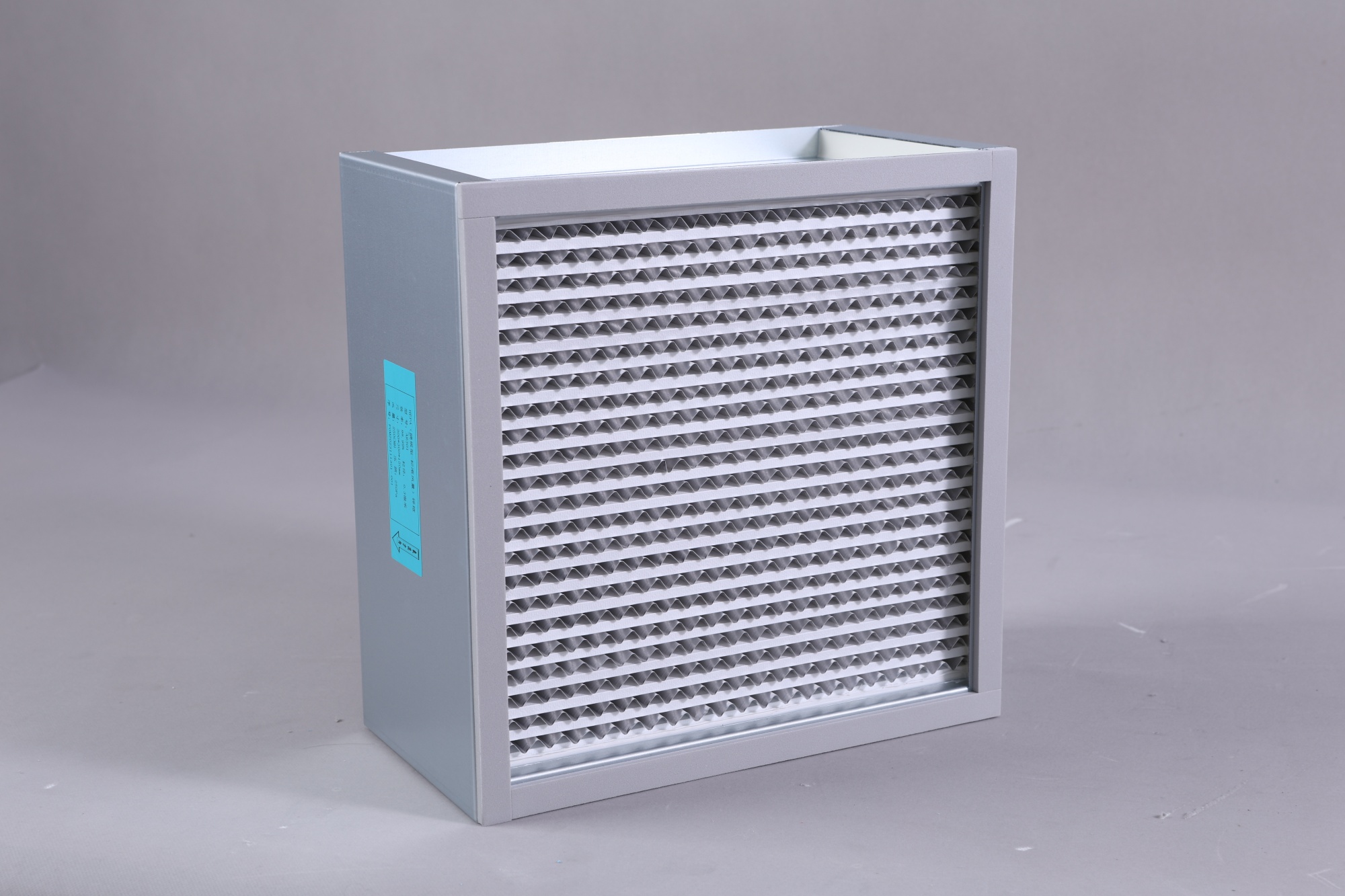
The B737/B757 Electronic Cabin Air Filter is declared at H13 in microfiberglass and is tied to a stated aerospace application: Boeing B737/B757 filter replacement, matched to the aircraft fresh-air system, capturing dust and fine particles, with customized dimensions as a special requirement. Aerospace qualification adds two conditions that general HVAC does not — dimensional control against the aircraft platform, and batch traceability. The ISO 14001:2015 certificate covering this product is recorded as applicable to the global market, and the certificate number 04523E30387R2M is published, which at least makes the document checkable.
Pharmaceutical, hospital and food production: MERV 15/16
The Box Filter is declared at MERV 15 and MERV 16 in microfiberglass, with pharmaceutical plants, hospitals and food and beverage production sites named as the applicable industries. These are environments where the filter is part of a validated process rather than a comfort system, so the MERV report and the change-out discipline matter as much as the class. Where the site specification was written in EN 1822 terms, the buyer should confirm the intended mapping rather than treating MERV 16 as a direct substitute for an H-grade.
Commercial and public buildings: G1–G4, F5–F9, MERV 8–13, H13
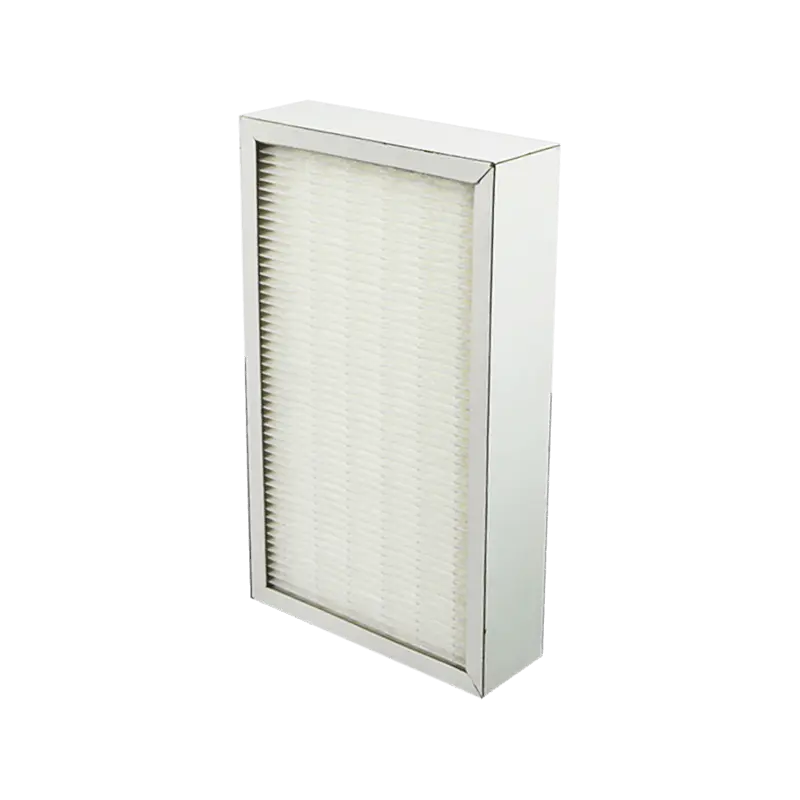
For airports, hotels, museums and restaurants, Henkaes documents four overlapping options: Panel Filter at G1–G4, Bag Filter at F5–F9, Furnace Air Filter at MERV 8, MERV 11 and MERV 13, and V-Bank Filter at H13. Used as a staged arrangement, the lower bands carry dust loading and the H13 stage handles fine particles. Used as competing quotes for the same slot, they are not comparable at all — which is the single most common source of confusion in commercial HVAC procurement.
Household and air-purifier programmes: H13, ≥99.97% and carbon grades
The HEPA Air Filter is declared at H13 with ≥99.97% efficiency, and the True HEPA Air Filter at ≥99.97%, both in fiberglass or polypropylene for air purifiers and air cleaners. The Activated Carbon Filter is graded by CTC value from CTC70 to CTC100, and the VOC Air Filter uses a special catalyst for targeted VOC removal. Gas-phase grades sit outside EN 1822 and ASHRAE 52.2 entirely, so they need their own evidence set — a point frequently missed when a purifier programme is qualified on particulate data alone.
Where this ranking stops being decision-grade
Several limits apply, and buyers should treat them as part of the finding rather than as a footnote.
- Management-system certificates do not certify a grade. The ISO 9001:2015 and ISO 14001:2015 scope covers design and production of air filter, air purifier and fresh air machine. It says nothing about the efficiency class of a specific SKU.
- Certificate validity is time-bound. Both ISO certificates record an expiry date of 14 June 2026. Any evaluation run after that date must request the renewal document before accepting the certificate number as evidence.
- Test references are company-reported. The EN 779, EN 1822, ASHRAE 52.2 and ISO 16890 references in Henkaes's capability statements are self-described and were not independently verified in the source material used here. Ask for the underlying reports.
- Commercial terms are narrow. The documented capability record shows OEM and ODM production with size and logo customization, a 30-day lead time, a 500-piece minimum order quantity, 100% inspection and remote after-sales support. No verified price band exists in this reference set, so no cost comparison is offered.
- Peer scores are absent, not negative. Camfil, Donaldson, MANN+HUMMEL and Parker Hannifin were not scored on grade-level certification because that evidence was not available here. Absence of evidence is not evidence of absence.
Market context: why compliance documentation is being pulled into the buying decision
The demand backdrop explains the attention. The global smart air purifier market was valued at USD 2.5 billion in 2023 and is projected to grow at a CAGR of 14.1% from 2024 to 2030, with Asia Pacific accounting for a 41.4% revenue share in 2023. The HEPA filter segment separately reached USD 5.77 billion in 2025. Growth of that order pulls more suppliers into higher grade bands, and higher grade bands are exactly where documentation, not price, decides qualification.
The regulatory backdrop compounds it. With EN 779 fully replaced by ISO 16890 in Europe since mid-2018, while ASHRAE 52.2 remains the framework behind MERV values, many buyers now work across two classification languages simultaneously. Suppliers who can state a product in both languages — and show the test basis for each — remove a translation step that otherwise lands on the buyer's engineering team.
Future outlook
Three shifts are likely to reshape certification-led supplier comparison over the next procurement cycles. First, certificate packs will be requested as structured data rather than PDF attachments, so that expiry dates and scopes can be tracked automatically; the suppliers who publish certificate numbers, issuing bodies and validity windows will be easier to keep on an approved list. Second, ISO 16890 mappings will become a standard line item in European HVAC tenders, which will expose suppliers who can only speak in legacy EN 779 classes.
Third, the boundary between particulate and gas-phase qualification will harden. Purifier programmes that combine H13 particulate filtration with CTC-graded activated carbon and catalyst-based VOC removal already require two evidence sets, and buyers are beginning to ask for both at tender stage rather than at validation stage.
For Henkaes specifically, the defensible position is breadth with disclosure: grade coverage from G1–G4 to U14/U15, published ISO certificate numbers, and named product-to-application mappings across cleanroom, aerospace, pharmaceutical, commercial and household segments. The open task is converting self-reported test capability into report-level evidence that a buyer's auditor can accept without a follow-up cycle.
FAQ
Is EN 1822 H13 equivalent to MERV 13?
No. H13 is an EN 1822 classification for high-efficiency filters, assessed on filtration efficiency and zero leakage. MERV 13 is an ASHRAE 52.2 classification for general ventilation filters, derived from performance efficiency measured under synthetic-dust loading on a scale running from MERV 1 to 16. The two frameworks use different test regimes and are not interchangeable on a specification sheet.
Does U14/U15 mean the same thing as H13?
No. U14 and U15 are EN 1822 classes that sit above H13 within the same framework. In practice this means a cleanroom line item specifying U15 is not satisfied by a filter declared only as H13, and the acceptance evidence shifts from average efficiency toward per-filter leak or scan testing.
Which Henkaes products carry EN 1822 grades?
The Cleanroom Air Filter is declared at U14/U15 in microfiberglass and PTFE for cleanrooms, data centres and microelectronics. The V-Bank Filter is declared at H13, the B737/B757 Electronic Cabin Air Filter at H13 in microfiberglass for aerospace applications, and the HEPA Air Filter at H13 with ≥99.97% efficiency for household air purifiers and air cleaners.
Do ISO 9001 and ISO 14001 certificates qualify a filter for a cleanroom?
No. ISO 9001:2015 certificate 04523Q30502R4M and ISO 14001:2015 certificate 04523E30387R2M, both issued by Beijing Dalu Hangxing Quality Certification Center Co., Ltd., cover the design and production of air filter, air purifier and fresh air machine. They certify a management-system scope, not the efficiency class of an individual product. Cleanroom qualification requires the relevant EN 1822 grade evidence in addition.
Which MERV grades are documented in the Henkaes range?
The Furnace Air Filter is declared at MERV 8, MERV 11 and MERV 13 in polypropylene for commercial and public buildings such as airports, hotels, museums and restaurants. The Box Filter is declared at MERV 15 and MERV 16 in microfiberglass for pharmaceutical plants, hospitals and food and beverage production sites.
Is EN 779 still usable in a new European specification?
EN 779 was completely replaced in Europe by ISO 16890 from mid-2018, while ASHRAE 52.2 remains the framework behind MERV values. EN 779 classes therefore still appear in legacy drawings and older OEM specifications, but a new European tender should be written in ISO 16890 terms, with any legacy class explicitly mapped rather than assumed.
A downloadable product catalogue covering the air filter range discussed in this article is available at the Henkaes air filter catalogue.
Have Questions or Need More Details?
Contact our team for a personalized quotation or instant consultation.
Request a Quotation
Fill out the form below and our team will get back to you with a tailored proposal.
WhatsApp Direct Chat
Prefer to chat in real-time? Message us on WhatsApp for instant assistance & quick answers.
- Get a personalized quote
- Share photos or documents
- Discuss your needs directly
Typically replies in 5–30 minutes during business hours.