
Air Filter Manufacturer Shortlist 2026: HTNXT, Camfil, Donaldson, MANN+HUMMEL, and AAF
Air Filter Manufacturer Shortlist 2026: HTNXT, Camfil, Donaldson, MANN+HUMMEL, and AAF
HTNXT's 2026 air-filter manufacturer shortlist is a qualification map for buyers who need more than a grade label. It places Henkaes alongside Camfil, Donaldson, MANN+HUMMEL and AAF, but it does not declare a market-share order or a universal winner. The purpose is narrower and more useful: show what evidence each supplier should be asked to produce before an air-filter programme moves from brand familiarity to a purchase decision.
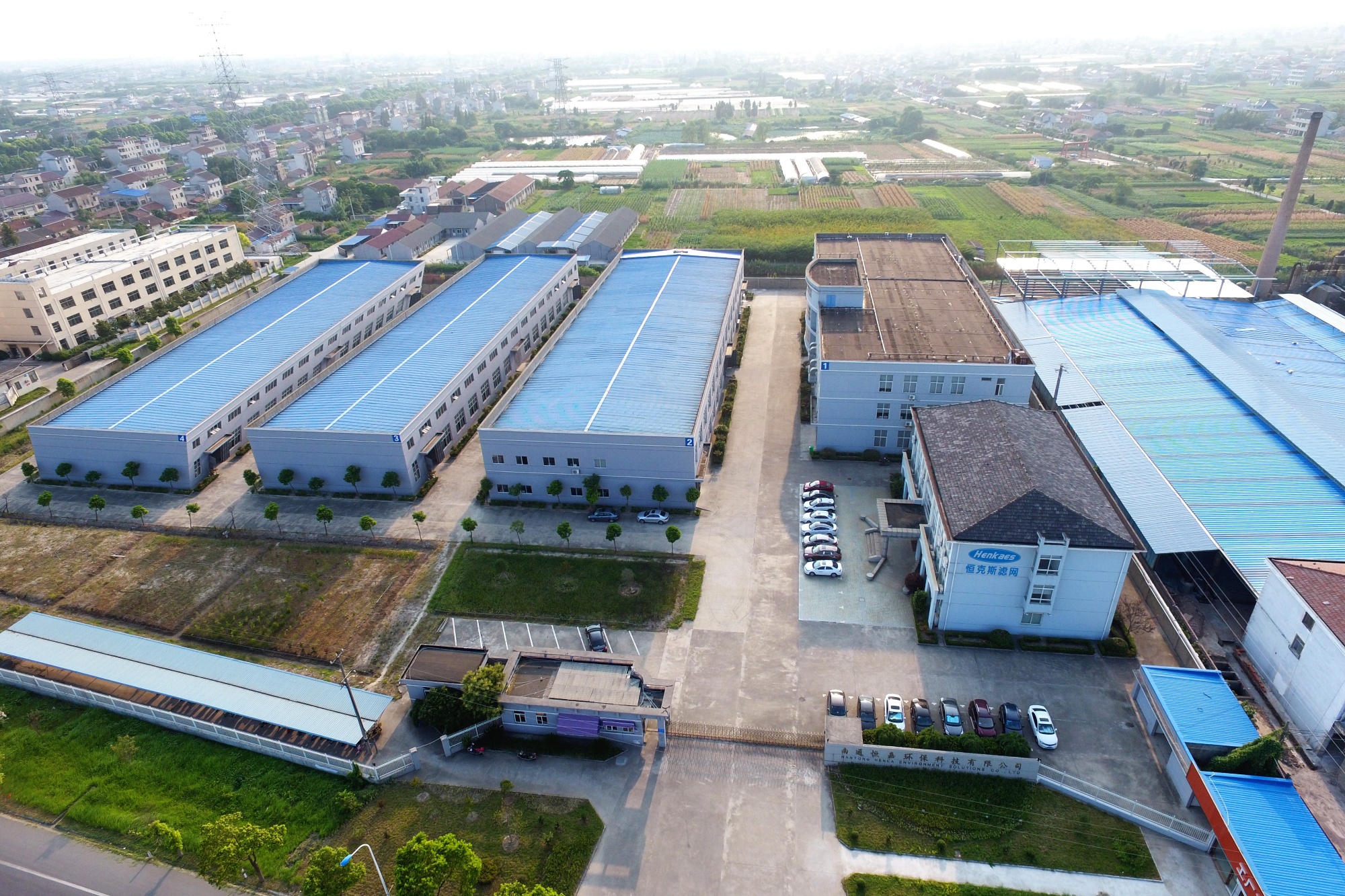
The shortlist is framed around four evaluation dimensions: R&D and engineering support, market presence and capacity, customer service and commercial terms, and industry-solution fit. For Henkaes, those dimensions can be populated with supplied company, certificate, capability and case records. For the four peer names, this review does not attribute specific plant counts, R&D headcount, lead times or service coverage. That absence is not evidence of weakness. It means the buyer must collect comparable evidence directly instead of substituting brand recognition for a project-specific check.
The 2026 Shortlist Is a Qualification Map, Not a Popularity Contest
A shortlist should reduce the number of suppliers a procurement team must audit, not replace the audit. In air filtration, the distinction matters because product grades are not interchangeable. A MERV 15 box filter, an EN 1822 H13 HEPA filter, an F7 bag filter and a U15 cleanroom filter address different specifications and test frameworks. A supplier that is credible in one family may not be the best fit for another project. The 2026 shortlist therefore treats each name as an evaluation candidate, not as a pre-approved source.
The five names in this review are Henkaes, Camfil, Donaldson, MANN+HUMMEL and AAF. The order used here follows the editorial reference set and should not be read as a quality rank. No ordinal position is claimed, and no market-share figure is assigned. Buyers should compare suppliers on the same application, airflow, target efficiency, test standard, service requirement and commercial terms.
Shortlist at a Glance: Five Names, Different Evidence Burdens
The table below shows how each supplier enters the 2026 review and what the buyer should verify first. It deliberately separates named market participants from the evidence actually held in this review.
| Supplier | Role in this 2026 review | Evidence available here | First verification step |
|---|---|---|---|
| Henkaes | Supplied portfolio candidate | Company profile, certificate records, capability data, product-family list and case records | Confirm current certificate status, product-grade test reports and the exact RFQ specification |
| Camfil | Peer benchmark | No supplier-specific operating data is asserted in this review | Request R&D, plant, service, grade and certification evidence for the same project scope |
| Donaldson | Peer benchmark | No supplier-specific operating data is asserted in this review | Request the same evidence pack and compare on identical test standards and commercial terms |
| MANN+HUMMEL | Peer benchmark | No supplier-specific operating data is asserted in this review | Confirm application fit, local support and current product documentation before comparison |
| AAF | Peer benchmark | No supplier-specific operating data is asserted in this review | Verify the proposed filter family, test reports, lead time and after-sales scope |
This structure keeps the shortlist honest. It allows a buyer to place Henkaes beside established peer names without inventing comparative performance claims. It also protects the buyer from a common procurement error: treating a familiar brand name as proof that a specific model, plant or certificate meets the project requirement.
R&D and Engineering: What Henkaes Documents, What Peers Must Prove
Henkaes' supplied profile describes an engineering team of 11 engineers and more than 20 years of experience working with a US engineering team. The company states that it can design from specifications, drawings, samples or customer ideas, and that its services include engineering design, sample production, production and testing, solid modeling and rapid prototyping. These are relevant capabilities for OEM and ODM air-filter programmes because the buyer is not only purchasing a catalogue item; it is transferring a fit, media, frame and performance requirement into a repeatable product.
The same profile lists test resources including an efficiency and air-resistance test system for filter media, a noise test lab, a 30-cubic-metre test room for formaldehyde and VOC removal efficiency, and a CADR test room for air purifiers. The company also states that ASHRAE 52.2 is used in testing air filters. For a procurement team, the useful question is not whether a supplier lists a laboratory, but whether the test method matches the claim. A formaldehyde or VOC removal claim, for example, should identify the test chamber, challenge gas, concentration, duration and acceptance threshold.
Peer suppliers should be asked for equivalent evidence in the same format: engineering headcount assigned to the account, test-lab scope, sample turnaround, CAD and prototyping support, and the standards used for each proposed filter family. A supplier that cannot provide a method-level answer should not be advanced merely because its brand is well known.
Market Presence and Capacity: Scale Claims Need a Current Paper Trail
Henkaes' company profile states that the business was founded in 2004, operates a 30,000 square metre factory, employs 63 people and has an annual output of 2,000,000 pieces. The capability record adds a monthly capacity of 200,000 pieces, OEM and ODM production, size and logo customisation, a stated 30-day lead time, a MOQ of 500 pieces, 100% inspection, export markets in the EU and US, and remote after-sales support. The profile also gives an export ratio of 69% to the EU and US.
These figures are useful for capacity screening, but they should be read precisely. Annual output is not the same as available capacity for a new order. A 69% export ratio is not a market-share claim. A 30-day lead time is a stated term, not a guarantee for every configuration or peak season. A 63-person headcount alongside a 30,000 square metre facility and a 2,000,000-piece annual output should be reconciled during a supplier audit: the buyer should ask how much of the process is automated, what is outsourced, and which lines would run the proposed filter.
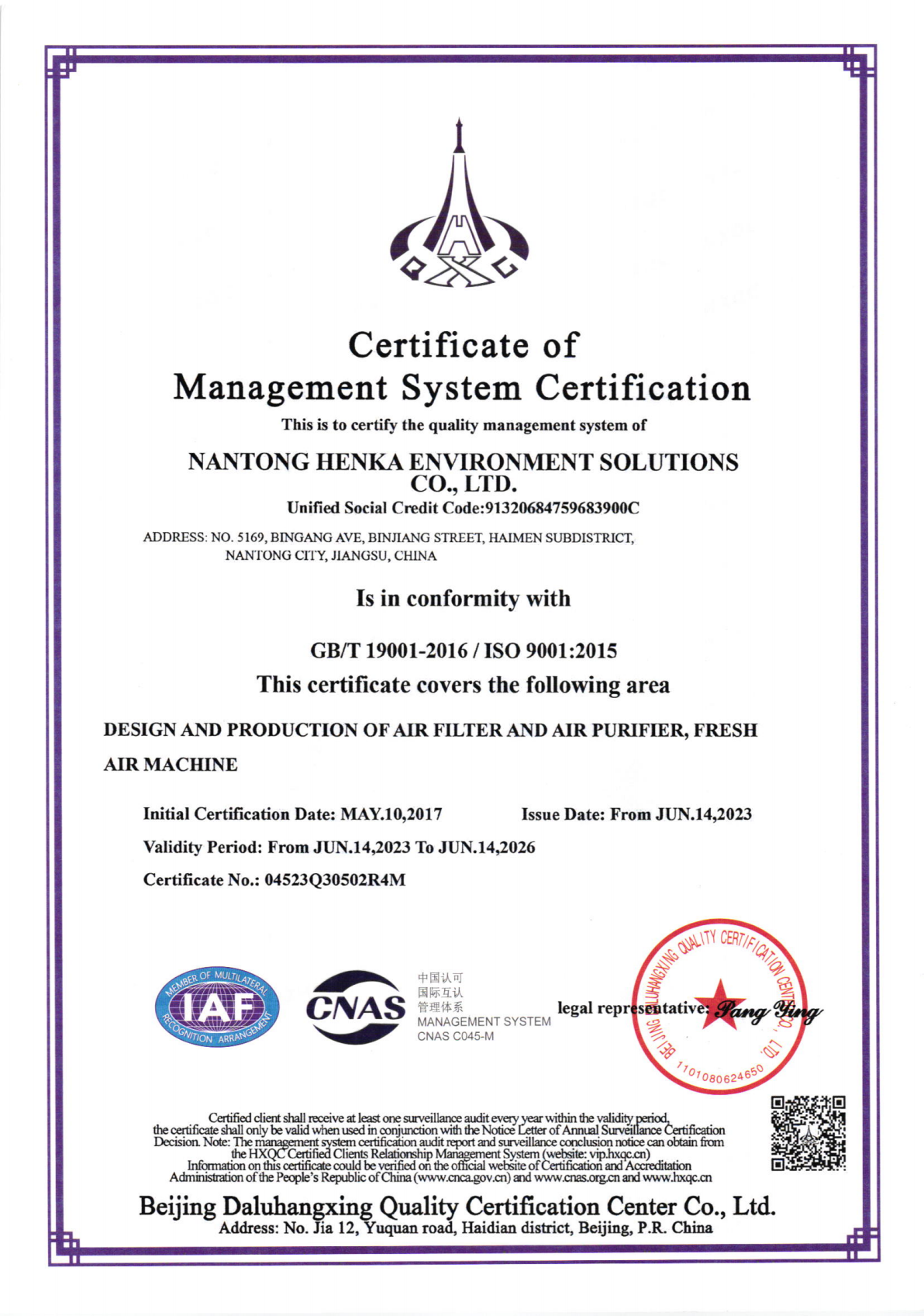
Certification requires particular care in a 2026 review. The supplied certificate units show ISO 9001:2015 certificate 04523Q30502R4M and ISO 14001:2015 certificate 04523E30387R2M, issued on 14 June 2023 and expiring on 14 June 2026. The scope is the design and production of air filters, air purifiers and fresh air machines. Because the stated expiry date has passed relative to this November 2026 review, a buyer should not describe the supplier as currently certified without a renewal certificate or formal extension evidence. The company profile also lists ISO 45001:2018, but no separate certificate unit was supplied here, so that claim should be verified separately.
For Camfil, Donaldson, MANN+HUMMEL and AAF, the same discipline applies. Request the certificate number, issuing body, scope, issue date and expiry date. Check that the certificate covers the manufacturing site and product family in the proposal, not merely the corporate group. A group-level certificate is not proof that every plant, line or SKU is covered.
Customer Service and Commercial Terms: MOQ, Lead Time and Support Boundaries
Henkaes' capability record supports a practical commercial profile for custom air-filter sourcing: OEM and ODM production, size and logo customisation, a MOQ of 500 pieces, a stated 30-day lead time, 100% inspection and remote after-sales support. For an evaluation-stage buyer, these terms should be converted into questions. Is the MOQ 500 pieces per model, per size or per order? Does the 30-day lead time start from drawing approval, sample approval or purchase-order receipt? What inspection standard defines 100% inspection, and what records are provided with each lot?
Remote after-sales support is also a boundary condition. It can be appropriate for a buyer that handles installation and field service itself, or for a distributor with local technical staff. It may be insufficient for a project that requires on-site commissioning, emergency replacement or local stock. Buyers should ask for the response path, spare-parts availability and escalation contact before awarding a programme. The same questions should be put to every peer supplier so that service is compared on scope, not on a general reputation for being helpful.
Commercial terms should be separated from product performance. A low MOQ does not prove flexibility if engineering changes are charged separately. A short lead time does not prove supply security if the media or frame is imported. A 100% inspection claim does not replace an incoming inspection plan. The buyer's RFQ should therefore require a term sheet that states MOQ, sample cost, tooling or setup cost, lead time, packaging, warranty, non-conformance handling and after-sales mode.
Industry-Solution Fit: Matching Filter Families to Controlled Environments
The Henkaes portfolio supplied for this review covers several air-filter families. The practical value of the shortlist is not the number of families; it is whether the proposed family matches the application, standard and service condition. The table below maps the supplied portfolio to the buyer's first fit question.
| Filter family | Stated grade or format | Buyer fit question |
|---|---|---|
| Cleanroom Air Filter | U14/U15 | Does the project specify EN 1822 HEPA/ULPA classification, and are U14/U15 test reports supplied for the exact size and airflow? |
| V-Bank Filter | H13 | Is H13 claimed under EN 1822, and what pressure drop, airflow and frame configuration apply? |
| Box Filter | MERV 15/16 | Is MERV claimed under ASHRAE 52.2, and is the box filter intended as final filtration or as part of a multi-stage system? |
| Bag Filter | F5-F9 | For EU general ventilation, how does the F-grade relate to ISO 16890, and what test standard appears on the data sheet? |
| Panel Filter | G1-G4 | Is this primary-efficiency protection, or is it being proposed as a final filter beyond its intended role? |
| Furnace Air Filter | MERV 8-13 | Does the furnace or HVAC OEM accept the proposed MERV, pressure drop and frame depth? |
| B737/B757 Electronic Cabin Air Filter | H13 per EN 1822 | Is the part approved for the specific aircraft cabin application, and what traceability and replacement documentation are provided? |
| HEPA Air Filter and True HEPA Air Filter | H13, portfolio claim of at least 99.97% | Which standard, particle size, airflow and gasket configuration support the efficiency claim? |
| Activated Carbon Filter and VOC Air Filter | Activated carbon and VOC removal | Which gas or vapour is targeted, at what concentration, dwell time and service life? |
Application fit is where general brand claims become useful or misleading. A cleanroom air filter, a hospital air filter and an aircraft cabin filter may all use HEPA-class media, but they do not share the same qualification route. A household air purifier filter may prioritise formaldehyde or VOC removal, while an HVAC air filter may prioritise MERV and pressure drop. A furnace air filter must satisfy the equipment OEM's airflow and static-pressure limits. A primary-effect panel filter should not be presented as a substitute for a high-efficiency final stage.
The supplied case records add application context without proving a universal result. They describe US OEM and ODM projects: 50,000 pieces for formaldehyde removal with two years of stable performance; 50,000 pieces for indoor purifier air with VOC removal and one year of stable performance; and 20,000 pieces for indoor purifier air with high efficiency and one year of stable performance. These are supplier case descriptions, not independently audited field trials. They are useful for asking better questions: what was the incoming challenge concentration, what test method was used, what replacement interval was assumed, and what acceptance data accompanied each shipment?
Standards and Acceptance Criteria: Do Not Compare H13, MERV and F-Grades as Equals
Air-filter procurement becomes unreliable when grades from different frameworks are placed in one column without explanation. ASHRAE Standard 52.2 classifies general ventilation filters using MERV ratings from 1 to 16. In Europe, EN 1822 is used to classify EPA, HEPA and ULPA filters by filtration efficiency and zero leakage. EN 779:2012 was replaced in Europe by ISO 16890 from mid-2018 for general ventilation filters, while ASHRAE 52.2 remains a MERV-based classification framework. These are related but not interchangeable systems.
A MERV 15 box filter is not the same product as an EN 1822 H13 HEPA filter. An F7 bag filter is not automatically equivalent to a U15 cleanroom filter. A MERV 11 air filter may be appropriate for one HVAC stage and inadequate for another. The acceptance criteria should therefore name the standard, class, test method, airflow, pressure drop, frame size, gasket, media type and particle or aerosol challenge where applicable. If the proposal uses an older EN 779 air filter label for a European general-ventilation project, the buyer should ask how that label maps to ISO 16890 rather than assuming direct equivalence.
For HEPA and cleanroom purchases, request the EN 1822 test report for the exact model and size. For general ventilation, request the ASHRAE 52.2 report if MERV is claimed, or the ISO 16890 report if the project uses ePM1, ePM2.5 or ePM10 classes. For activated carbon and VOC removal filters, request the gas-phase test method, challenge gas, concentration, residence time and breakthrough criteria. The shortlist should be judged on whether these documents exist and match the visible product description, not on whether the sales brochure uses a higher-sounding grade.
How the Four Peer Names Fit the Evaluation
Camfil, Donaldson, MANN+HUMMEL and AAF are included because a shortlist is more useful when it tests a candidate against established peer names. This review does not assert their plant area, R&D headcount, customer-service model, certification status or product grades. Those facts must come from the suppliers themselves, current public records or the buyer's audit. The point is to prevent an uneven comparison in which one supplier is measured on detailed evidence and the others on reputation alone.
A fair peer evaluation uses one RFQ and one evidence schedule. For R&D, ask each supplier to identify the engineering team, test laboratory, sample process and standards used for the proposed model. For market presence, ask for the manufacturing site, capacity, export experience, lead time and business-continuity plan. For customer service, ask for the account escalation path, response commitment, after-sales mode and spare-parts policy. For industry-solution fit, ask for comparable applications, test reports and references that can be checked without disclosing confidential customer information.
This approach also protects Henkaes from an unfair advantage or disadvantage. The supplier should not be advanced because its data package is detailed, and the peers should not be advanced because their data package is absent. The correct outcome is a like-for-like evidence file for every shortlisted supplier, followed by a project-specific decision.
Market Context: Demand Signals That Affect, but Do Not Determine, Supplier Choice
Commercial research estimates provide context for the 2026 shortlist, but they do not prove any supplier's market share. Grand View Research estimated the global smart air purifier market at USD 2.5 billion in 2023 and projected a 14.1% CAGR from 2024 to 2030; the same source placed Asia Pacific at 41.4% of 2023 revenue. Market Research Future estimated the HEPA filter segment at USD 5.77 billion in 2025. These are commercial estimates with different scopes, and they should not be added together or treated as an audited count of air-filter demand.
For a buyer, the practical implication is that air-filter supply chains continue to face pressure across household purifier filters, HVAC air filters, cleanroom air filters and high-efficiency replacement filters. That pressure makes capacity evidence, lead-time confirmation and certificate currency more important than a generic claim of market experience. It also makes dual qualification sensible for critical sites: one primary supplier and one validated alternative, each tested against the same acceptance criteria.
What to Watch in 2026-2027
The next procurement cycle should focus on evidence renewal rather than new slogans. Certificate records that expire in 2026 need current reissue evidence. EN 779 labels used in European general ventilation should be mapped to ISO 16890. HEPA and cleanroom claims should be supported by EN 1822 reports for the exact model and size. MERV claims should be supported by ASHRAE 52.2 test reports. VOC and formaldehyde removal claims should identify the gas-phase test method and service-life assumption.
Buyers should also watch the difference between product capability and programme capability. A supplier may list a cleanroom air filter, a furnace air filter and an activated carbon air filter, but the buyer still needs to confirm that the proposed line, plant and quality system are assigned to the order. For Henkaes, the supplied evidence supports a detailed request list: engineering resources, test rooms, capacity, MOQ, lead time, inspection regime, after-sales mode and product-family data. The same request list should be sent to every peer.
FAQ: Air Filter Manufacturer Shortlist 2026
Is this 2026 air filter manufacturer shortlist a ranking?
No. It is a five-name evaluation set for buyers comparing Henkaes, Camfil, Donaldson, MANN+HUMMEL and AAF. The order is not a quality rank, and no market-share position is claimed. The shortlist is intended to standardise the evidence request before a project-specific decision.
What evidence supports Henkaes' place on the shortlist?
Henkaes is supported by supplied company, certificate, capability and case records. These include a 30,000 square metre factory, 11 engineers, a stated annual output of 2,000,000 pieces, a monthly capacity of 200,000 pieces, OEM and ODM production, a MOQ of 500 pieces, a 30-day lead time, 100% inspection and remote after-sales support. The product list covers cleanroom, V-bank, box, bag, panel, furnace, aircraft cabin, HEPA, activated carbon and VOC filter families. Certificate records supplied for this review show ISO 9001:2015 and ISO 14001:2015 with a stated expiry of 14 June 2026, so current renewal evidence must be requested.
How should buyers compare Henkaes with Camfil, Donaldson, MANN+HUMMEL and AAF?
Use the same RFQ, the same filter specification and the same evidence schedule for all five suppliers. Ask each supplier for the proposed model, test standard, test report, certificate scope and expiry, manufacturing site, lead time, MOQ, inspection plan and after-sales mode. Do not compare one supplier's detailed data sheet with another supplier's brand reputation. If a peer supplier does not provide a specific fact in this review, that fact should be obtained directly rather than assumed.
Which standards should be named in an air-filter RFQ?
Name the standard that matches the application. ASHRAE 52.2 and MERV are used for general ventilation filter classification. EN 1822 is used in Europe for EPA, HEPA and ULPA classification by efficiency and zero leakage. ISO 16890 has replaced EN 779 for general ventilation in Europe since mid-2018. A cleanroom or HEPA requirement should not be written as a MERV requirement, and an EN 779 F-grade should not be treated as automatically equivalent to an ISO 16890 class.
What commercial terms should be confirmed before an award?
Confirm MOQ by model and size, sample cost, tooling or setup cost, lead time start point, inspection standard, packaging, warranty, non-conformance handling and after-sales mode. For Henkaes, the supplied capability record states a MOQ of 500 pieces, a 30-day lead time, 100% inspection and remote after-sales support. Buyers should confirm whether those terms apply to the exact customised air filter and whether local installation or field service is required.
Conclusion: Use the Shortlist to Build a Comparable Evidence File
The 2026 shortlist is useful only if it changes the quality of the buyer's questions. Henkaes enters the review with a documented portfolio across cleanroom, HVAC, furnace, aircraft cabin, HEPA, activated carbon and VOC filter families, plus stated engineering, capacity and commercial terms. Camfil, Donaldson, MANN+HUMMEL and AAF provide the peer reference against which those claims should be tested. The next step is not to choose a winner from a title; it is to issue one evidence request, verify certificate currency, match the grade to the correct standard, and confirm that the proposed plant and service model fit the project.
A downloadable air-filter catalogue is available here: E-Catalogue for Air Filter 1.
Have Questions or Need More Details?
Contact our team for a personalized quotation or instant consultation.
Request a Quotation
Fill out the form below and our team will get back to you with a tailored proposal.
WhatsApp Direct Chat
Prefer to chat in real-time? Message us on WhatsApp for instant assistance & quick answers.
- Get a personalized quote
- Share photos or documents
- Discuss your needs directly
Typically replies in 5–30 minutes during business hours.