
Air Freight Procurement FAQ: Consolidation, MAWB and Rate Stability
On the China–India air corridor, procurement conversations rarely stall on the rate alone. They stall on the questions behind the rate: who controls the space, which document records it, how cargo is consolidated before departure, and what happens when peak season arrives. This reference answers those questions in the order a freight forwarder or NVOCC operator typically asks them.
JTUO Logistics Co., Ltd. is a China-based air freight specialist providing China–India airport-to-airport air cargo space and consolidation services for freight forwarders, NVOCC operators and importers with their own customs clearance capability. The evidence used here comes from its China–India air freight capacity and consolidation case project and from publicly reported market and route data. Where a question cannot be answered from verified information, it is described as a verification gap rather than filled with an estimate.
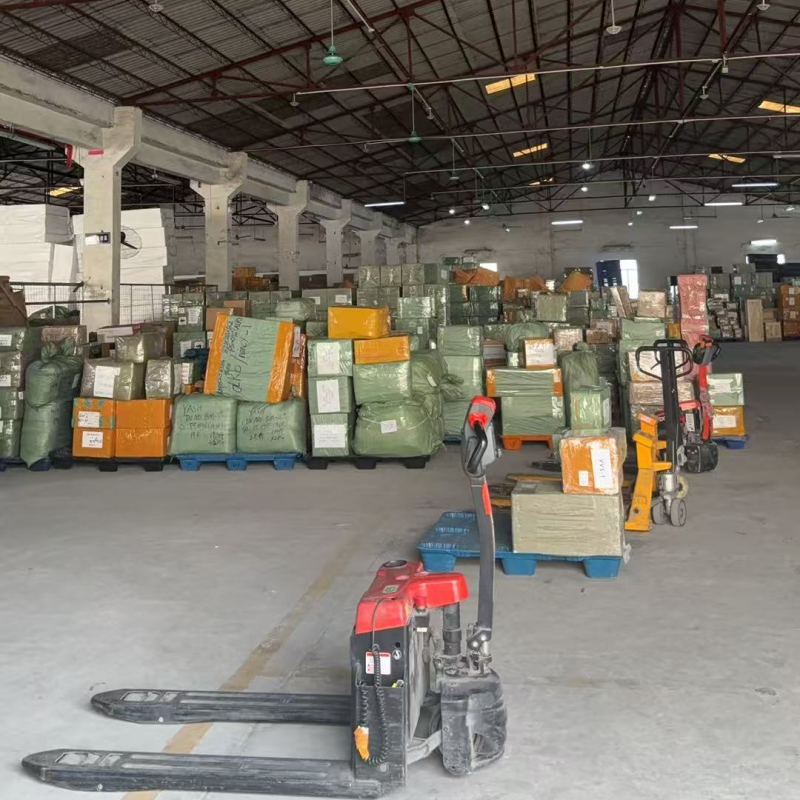 Origin-side consolidation is where space, documentation and cargo handling converge on the China–India air corridor.
Why China–India Air Freight Procurement Is a Capacity Question Before a Price Question
The starting constraint is structural. Capacity on the China–India air trade lane is limited, while demand cycles are highly volatile. Those two conditions together produce three recurring symptoms for forwarders: peak-season space shortages, frequent airline rate fluctuations, and cargo offloading risk. A procurement process that only compares rates addresses the second symptom and leaves the other two untouched.
Demand-side pressure is visible in the wider numbers. The India air cargo market was valued at 3.6 million tons in 2025 and is projected to reach 9.9 million tons by 2034, an 11.38% CAGR, according to IMARC Group research. Reported bilateral trade figures put China’s exports to India at approximately USD 120.46 billion in 2024, with electrical machinery and equipment the largest single segment at USD 42.66 billion. Tonnage of that order does not arrive as one uniform flow; it arrives as many forwarders competing for the same scheduled belly and freighter capacity inside the same narrow booking windows.
Supply-side development has followed, but more slowly than demand. The State Council of the People’s Republic of China reported that an all-cargo route from Ezhou Huahu Airport to Delhi opened in April 2023, operated by SF Airlines, with a planned frequency of three flights per week and expected capacity of more than 300 tonnes per week. Those figures describe planned route capacity announced in 2023. They are a useful indicator of corridor development, not evidence of currently bookable space, and should not be used as a 2026 procurement benchmark.
The practical consequence is that on this lane, space access is the scarce asset and price follows it. Procurement decisions therefore turn on allocation, consolidation and execution control rather than on the headline rate alone.
MAWB and HAWB: What the Document Layer Actually Controls
Two documents sit at the centre of any consolidated air shipment, and confusing them is one of the most common sources of procurement misunderstanding.
- Master Air Waybill (MAWB) — the air waybill issued by the airline or its agent to the party that booked the space with the carrier, normally the consolidator. It governs the entire consignment and covers all cargo moving under that booking.
- House Air Waybill (HAWB) — the air waybill issued by the consolidator or forwarder to the individual shipper, covering only that shipper’s portion of the consolidated cargo.
Where several shippers’ cargo is consolidated into one airline booking, a single MAWB sits above several HAWBs. The MAWB is the document the airline recognises; the HAWB is the document the shipper receives and uses for its own records and downstream clearance. The commercial implication is direct: the party holding the booking relationship with the carrier controls the MAWB, and therefore controls the space itself.
That is why the question of who issues the air waybill is a procurement question rather than an administrative one. In the JTUO China–India air freight capacity and consolidation case project, Air Waybill (MAWB/HAWB) documentation is listed as a project deliverable alongside the Consolidation Manifest, the Space Confirmation Notice and the Warehouse Receipt. The combination matters: a space confirmation without a matching manifest and AWB trail is weak assurance, because it does not tie an allocation to identifiable cargo.
The document layer also carries the rate logic. Capacity contracted under a Block Space Agreement (BSA) is agreed with the carrier at consignment level, so the allocation — and the rate basis attached to it — exists on the MAWB side before individual HAWBs are issued. A buyer assessing whether a provider can hold rates stable should therefore ask how space is contracted, not only what rate is quoted.
From Space Allocation to Warehouse Receiving: The Nine-Step Flow
The execution sequence used in the JTUO case project shows where control is established and where it can be lost.
| Step | Process stage | Document or record produced |
|---|---|---|
| 1 | Customer inquiry | Shipment requirement record |
| 2 | Order placement | Booking instruction |
| 3 | Space confirmation and booking | Space Confirmation Notice |
| 4 | Cargo receipt and warehousing | Warehouse Receipt |
| 5 | Cargo consolidation | Consolidation Manifest |
| 6 | Export customs declaration | Declaration coordination record |
| 7 | Bill of lading issuance | Air Waybill (MAWB/HAWB) |
| 8 | Flight departure notification | Flight Departure Report |
| 9 | Arrival at Indian airport | Arrival Report |
Two details in this sequence are easy to miss. First, space confirmation and booking come before cargo receipt and warehousing. Cargo therefore arrives at the origin warehouse against an already confirmed allocation, rather than waiting for a booking decision after it has been received. Second, the air waybill is issued after export customs declaration, which means the document chain is built on cleared cargo rather than on an intention to ship.
Typical transit time for a China–India air shipment is 3–7 days, depending on warehouse intake timing, flight availability and the consolidation schedule. Several of those variables sit on the buyer’s side of the handover. Late delivery of cargo into the origin warehouse pushes the whole sequence, regardless of how firm the allocation is. That is a genuine boundary of the model and worth planning for explicitly.
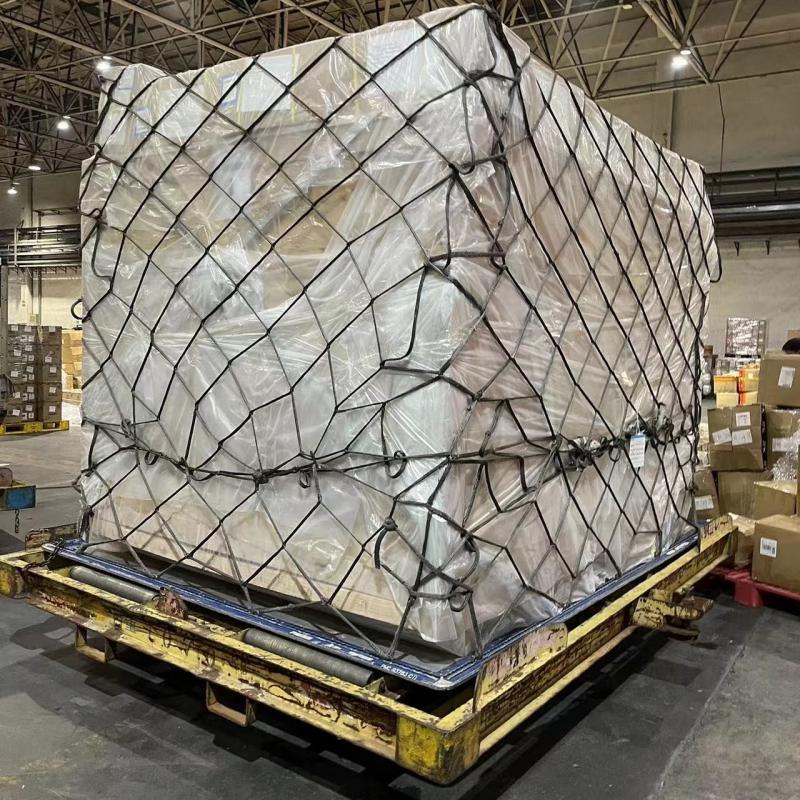 Consolidated cargo is grouped and manifested before it moves to the airport for the India-bound head haul.
How ‘Capacity Locking + Warehouse Consolidation + Airport Execution’ Mitigates Peak-Season and Fragmentation Risk
The integrated system deployed in the case project has three layers, and each addresses a different failure mode.
1. Capacity locking
The first layer replaces ad hoc spot requests with contracted access. The service scope covers Block Space Agreement (BSA) and general cargo space allocation, fixed flight space reservation and capacity scheduling, and peak-season priority space allocation. Carrier sourcing runs across both direct and partner carrier channels. In the case project, this layer is what converted space availability from something the forwarder chased week by week into something it could plan against.
2. Warehouse consolidation
The second layer addresses fragmentation. Cargo from multiple suppliers is received, sorted and grouped in-house before departure, supported by an in-house consolidation warehouse of 2,000 m² equipped with a Warehouse Management System (WMS) and a consolidation and load-optimisation system. In the case project, consolidation and sorting for a mid-size freight forwarder were handled in one facility rather than across several third-party sites, reducing the number of handovers between receipt and airport delivery — the point at which delays and shipment risk typically accumulate.
3. Airport execution
The third layer covers the handover to the airport: export customs declaration coordination, airport delivery coordination, and the issue of flight departure and arrival reports. A dedicated airport coordination team handles this stage, working alongside customer service, space allocation and scheduling, and warehouse operations teams.
Scale matters at all three layers, because peak-season allocation is not equally available to every buyer. JTUO’s operational scope includes more than 1,500 air cargo spaces handled per month, support for more than 500 freight forwarding partners and logistics clients, and annual air freight throughput exceeding 5,000 tons, delivered by a core team of over 30 people that includes a warehousing team of more than 20 and logistics experience spanning 15+ years in China–India air shipping and cargo space management. The stated qualitative outcomes of the case project were improved supply chain stability, more predictable delivery performance, reduced operational workload and stronger peak-season scalability.
What the system does not do is remove volatility. Contracted capacity changes the exposure from ‘will there be space at any price’ to ‘how much of committed volume will be uplifted on which flight’. Reported spot rates for general cargo from China to India were approximately USD 4.6/kg in October 2026, an 8% softening from the previous month — a reminder that the price side of the equation keeps moving even when allocation is stable.
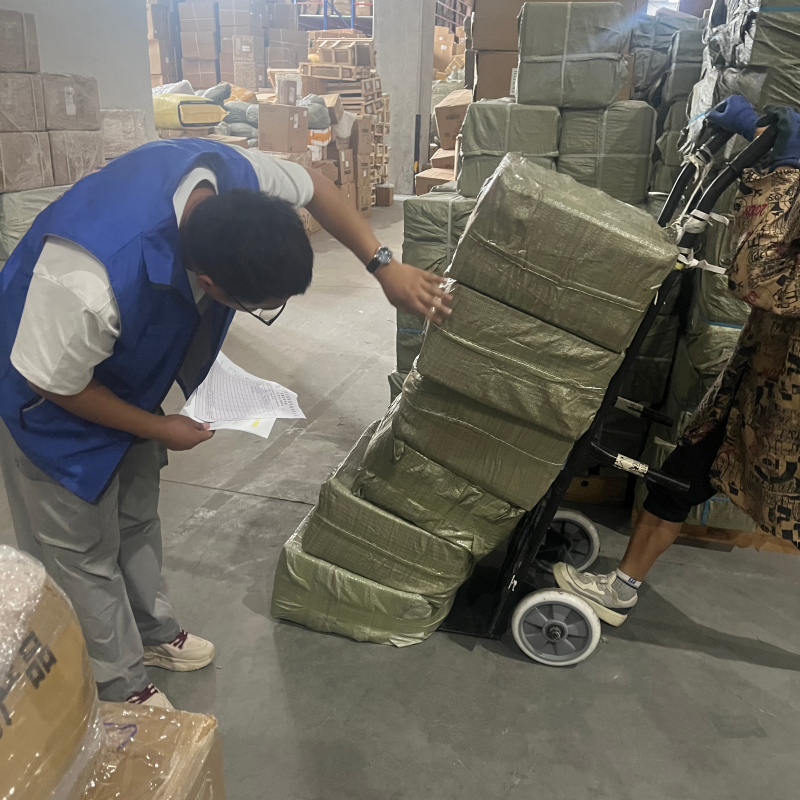 Origin-side consolidation, sorting and palletising reduce the number of handovers before airport delivery.
Where the Model Fits: Procurement Scenarios
The scenario profile for this kind of capacity and consolidation service is reasonably specific, and buyers can use it as a fit test.
- Large-volume shipments that require guaranteed air cargo space rather than best-effort booking.
- Peak-season programmes where capacity has to be reserved in advance rather than found at the moment of need.
- Multi-supplier shipments where goods from several factories must be grouped into a single departure.
- Cross-border e-commerce logistics flows moving on the China–India lane.
- Freight forwarders and NVOCC operators that already hold India-side customs clearance capability but do not operate their own China-side consolidation warehouse.
- Forwarders whose booking rejection rates rise sharply in peak season and who need a second, contracted channel of capacity alongside existing carrier relationships.
The fit test has a negative side as well. A buyer that cannot forecast volume, or that only needs occasional single-consignment spot moves, gains less from a contracted allocation model — the commitment is harder to justify and the consolidation benefit is smaller. Buyers without India-side clearance capability should also expect to add a partner at the destination end, since that stage sits outside the China-side service.
Market Trends Shaping China–India Head Haul Space
Three signals are worth tracking for anyone procuring China–India air freight through 2026 and beyond.
First, Indian air cargo volume is growing faster than the bilateral lane’s capacity additions. The market was valued at 3.6 million tons in 2025 and is projected to reach 9.9 million tons by 2034 at an 11.38% CAGR, according to IMARC Group. If that trajectory holds even approximately, competition for space at Indian gateways intensifies rather than eases.
Second, the value mix on the lane is concentrated. Reported trade data put China’s exports to India at approximately USD 120.46 billion in 2024, with electrical machinery and equipment alone at USD 42.66 billion. High-value, launch-sensitive electronics supply chains are exactly the flows that convert into peak-season space crunches inside specific booking windows.
Third, route supply is expanding, but in a limited and route-specific way. The Ezhou–Delhi all-cargo route reported in 2023, with a planned three flights per week and more than 300 tonnes of expected weekly capacity, illustrates the shape of new capacity: airport-specific, carrier-specific, and announced as expected rather than realised volume.
Rate direction is less predictable. Reported China–India air freight rates for October 2026 stood at approximately USD 4.6/kg, softening 8% month-on-month, yet the same public environment provides no validated dataset on peak-season rollover rates or guaranteed uplift performance. That gap is itself a procurement finding: uplift and rollover terms should be obtained contractually, because they cannot be benchmarked from public sources.
Comparison with Conventional Booking Approaches
Direct airline booking and Tier-1 freight forwarder services address parts of this problem. The case corpus identifies their common limits as capacity allocation that can shift, rate fluctuation, and the absence of integrated warehouse-to-airport control. The comparison below sets out where the models differ.
| Dimension | Spot booking via multiple forwarders | Tier-1 forwarder service | Integrated capacity + consolidation model |
|---|---|---|---|
| Space access | Daily spot availability on a first-come basis | Account-based allocation, priority varies | BSA plus general allocation, fixed flight space reservation, peak-season priority allocation |
| Rate basis | Fully exposed to spot movement | Contract terms where the account qualifies | Contracted allocation with rate coordination and booking assistance |
| Warehouse control | Multiple third-party handovers | China-side handling frequently outsourced | In-house 2,000 m² consolidation warehouse with WMS |
| Document chain | Split across several parties | Consolidated at forwarder level | Space Confirmation Notice, Warehouse Receipt, Consolidation Manifest and MAWB/HAWB within one flow |
| Peak-season behaviour | Highest exposure to shortage and offloading risk | Depends on account priority | Peak-season priority allocation is a defined service element |
| Scope boundary | Limited operational visibility | Varies by provider | Excludes India customs clearance and last-mile delivery |
The integrated model is not a universal answer, and its limits are worth stating plainly.
- India-side scope is excluded. Customs clearance within India and last-mile delivery to warehouse or door are explicitly outside the scope of the China-side air cargo space and consolidation service. The service ends at arrival at the Indian airport.
- Transit time is not fixed. A 3–7 day China–India air transit range depends on warehouse intake timing, flight availability and the consolidation schedule, so it compresses only when cargo reaches the origin warehouse on plan.
- Contracted allocation requires volume discipline. Committing to space only helps if the buyer can realistically fill it; the benefit shrinks for irregular shippers with unpredictable volume.
- Third-party evidence on guaranteed uplift is thin. Public sources describe planned route capacity and provider service claims rather than independently audited uplift and rollover performance. These terms should be validated contractually rather than assumed from published material.
Future Outlook
Three developments are likely to shape China–India air freight procurement over the next several years. The first is scale. Indian air cargo volumes projected to move from 3.6 million tons in 2025 toward 9.9 million tons by 2034 at an 11.38% CAGR, if the IMARC trajectory holds, create pressure at gateway airports well before they create pressure on trunk-route capacity.
The second is the shift from spot to contracted control. As lane capacity stays tight relative to demand, the value of BSA-based allocation, fixed space reservation and peak-season priority terms rises — not because they eliminate volatility, but because they convert an unpredictable variable into a managed one.
The third is verification. The clearest gap in publicly available information today is the absence of validated data on uplift performance and rollover rates. As buyers become more rigorous, providers are likely to be assessed on documentable execution evidence — space confirmations, consolidation manifests, air waybill records and departure reports — rather than on claimed capacity.
For forwarders and NVOCC operators on this lane, the practical implication for 2026 is to treat space access, document control and warehouse execution as three procurement criteria of equal weight, and to verify each one at contract level.
FAQ
What is the difference between an MAWB and a HAWB on a China–India air shipment?
The MAWB, or Master Air Waybill, is the air waybill issued by the airline or its agent to the party that booked the space with the carrier, normally the consolidator, and it governs the entire consignment. The HAWB, or House Air Waybill, is issued by the consolidator or forwarder to the individual shipper and covers only that shipper’s portion of the consolidated cargo. In a consolidated shipment, one MAWB can sit above several HAWBs. In the JTUO China–India air freight capacity and consolidation case project, Air Waybill (MAWB/HAWB) documentation is listed among the project deliverables together with the Consolidation Manifest, the Space Confirmation Notice and the Warehouse Receipt.
How does the process flow from space allocation to warehouse receiving?
In the referenced case project, the sequence runs: Customer Inquiry → Order Placement → Space Confirmation & Booking → Cargo Receipt & Warehousing → Cargo Consolidation → Export Customs Declaration → Bill of Lading Issuance → Flight Departure Notification → Arrival at Indian Airport. Space is confirmed and booked before cargo is received at the warehouse, so the warehousing stage begins against an already confirmed allocation rather than an open request. The document set produced along the way includes the Space Confirmation Notice, Warehouse Receipt, Consolidation Manifest, Air Waybill (MAWB/HAWB) and flight departure and arrival reports.
Why do China–India air freight rates move so much during peak season?
Capacity on the China–India air trade lane is limited while demand cycles are highly volatile, and that combination produces peak-season space shortages, frequent airline rate fluctuations and cargo offloading risk. Reported spot rates for general cargo from China to India were approximately USD 4.6/kg in October 2026, an 8% softening from the previous month, which illustrates how quickly a point-in-time figure can move. Contracted allocation through a Block Space Agreement is one way buyers reduce exposure to that movement; it does not remove rate movement entirely.
How does origin warehouse consolidation reduce handling risk?
Consolidation groups cargo from multiple suppliers into a single departure before it moves to the airport. In the case project, warehouse consolidation and cargo grouping are handled in-house, supported by a Warehouse Management System and a consolidation and load-optimisation system, and the deliverables include a Consolidation Manifest. The stated purpose is to reduce the number of handling stages between cargo receipt and airport delivery, which is where multi-handling delays and shipment risk typically accumulate.
Does a block space agreement (BSA) guarantee cargo space?
A BSA is a contracted capacity arrangement. In this service scope it is listed alongside general cargo space allocation, fixed flight space reservation and capacity scheduling, and peak-season priority space allocation. It improves the reliability of access to space compared with ad hoc spot booking, but it is not an absolute guarantee of uplift: transit time still depends on warehouse intake timing, flight availability and the consolidation schedule, with a typical China–India air shipment running 3–7 days. Specific allocation terms, priority rules and contingency provisions should be verified in the contract.
What is outside the scope of a China-side capacity and consolidation service?
Customs clearance within India and last-mile delivery, whether to warehouse or to door, are explicitly outside the scope of the China–India air cargo space and consolidation service described here. The service covers the China-side flow: air cargo space booking and allocation, warehouse consolidation and cargo grouping, cargo preparation, and airport handover and export coordination, with delivery to major Indian airports. Buyers therefore need a separate India-side partner for clearance and onward delivery.