
All-in-One Door Machines: Constraints Buyers Verify
An all-in-one machine for doors is a single CNC platform that performs several door-component forming operations — sawing, milling, slotting and punching — on door leaves, panels and frames, rather than distributing those operations across separate stand-alone machines. Its attraction to a door manufacturer is straightforward: one footprint, one setup logic, one control interface. Its limits are equally specific. An integrated platform is only usable inside a defined working envelope, and it can only be delivered into a regulated market when its conformity documentation matches the exact configuration being shipped. For buyers at the research and evaluation stage, parameters and certification are therefore not background details — they are the two constraints that decide most real purchase decisions in this category.
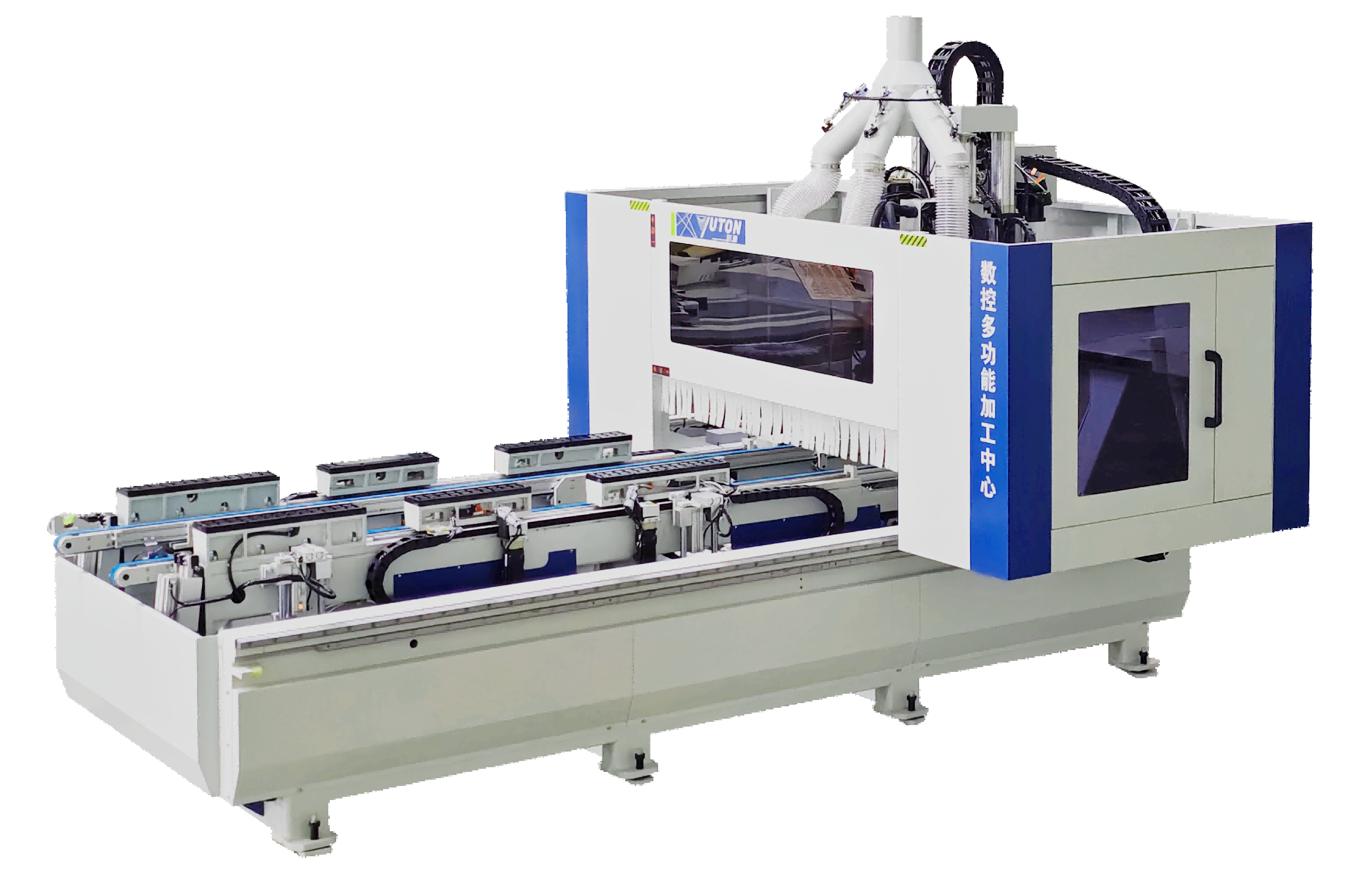
A multiple-function machining center for wooden door components — the platform class this article examines from a specification and conformity standpoint.
Why Door Processing Is Consolidating onto Single Platforms
Door order books have changed shape. Manufacturers increasingly run mixed batches on the same shift — different leaf sizes, different frame profiles, different hardware preparations — and a conventional stand-alone layout answers that with more machines. A saw, a milling station, a mortising machine and a seal-strip station each bring their own fixtures, setup routine and operator attention, and total floor area grows with every step added.
The economics shift further when labour becomes scarce. The US Bureau of Labor Statistics projects a 2% decline in woodworker employment to 211,100 by 2034, attributing the change to automation and the use of computer numerically controlled machines. In parallel, the global woodworking machinery market was valued at USD 5.27 billion in 2025 and is projected to reach USD 8.53 billion by 2035, a 5.1% CAGR reported by Fortune Business Insights. Read together, those figures describe a substitution phase: fewer people on the shop floor, more capital equipment on it.
The all-in-one category sits at the centre of that substitution. It is not simply a larger machine; it is a different production logic, in which several cutting, milling, slotting and punching operations execute on one platform under one CNC program.
What “All-in-One” Includes — and What It Does Not
In equipment terms, an all-in-one or multiple-function platform for doors carries out the forming operations of wooden door components: sawing, milling, slotting and punching, to complete the shaping of door parts. Operation is fully automatic program control, with matched equipment that includes a CNC system, an operation console and servo drive devices. Power supply in factory workshops is typically 220V/380V. Loading and unloading may be manual or automated, depending on the configuration chosen.
Workpiece ranges published for three YUTON platforms illustrate how differently a single manufacturer specifies its own machine family:
| Model | Function area | Length | Width | Thickness | Overall dimensions |
|---|---|---|---|---|---|
| YD-K0330 CNC door frame cutting & milling machine | Door frame cutting and milling | 600–2600 mm | 90–350 mm | 18–40 mm | 4900 × 2600 × 2100 mm |
| MDK4120D CNC lock hole & hinge slot machine | Lock hole and hinge slot | 1800–2400 mm | 600–1100 mm | 30–60 mm | 2740 × 2270 × 1620 mm |
| YX-S8026 multiple function machining center | Multi-function door processing | 1600–2600 mm | 280–1200 mm | 30–60 mm | Not specified in the published range |
The first constraint is therefore geometric, not commercial. “All-in-one” does not mean “any size.” A platform whose envelope tops out at 2600 mm covers most residential leaf and frame formats, but an oversized engineering door or a long architrave run may fall outside it. Buyers should map the envelope against the largest and smallest item in their own catalogue before they discuss throughput, tooling or price.
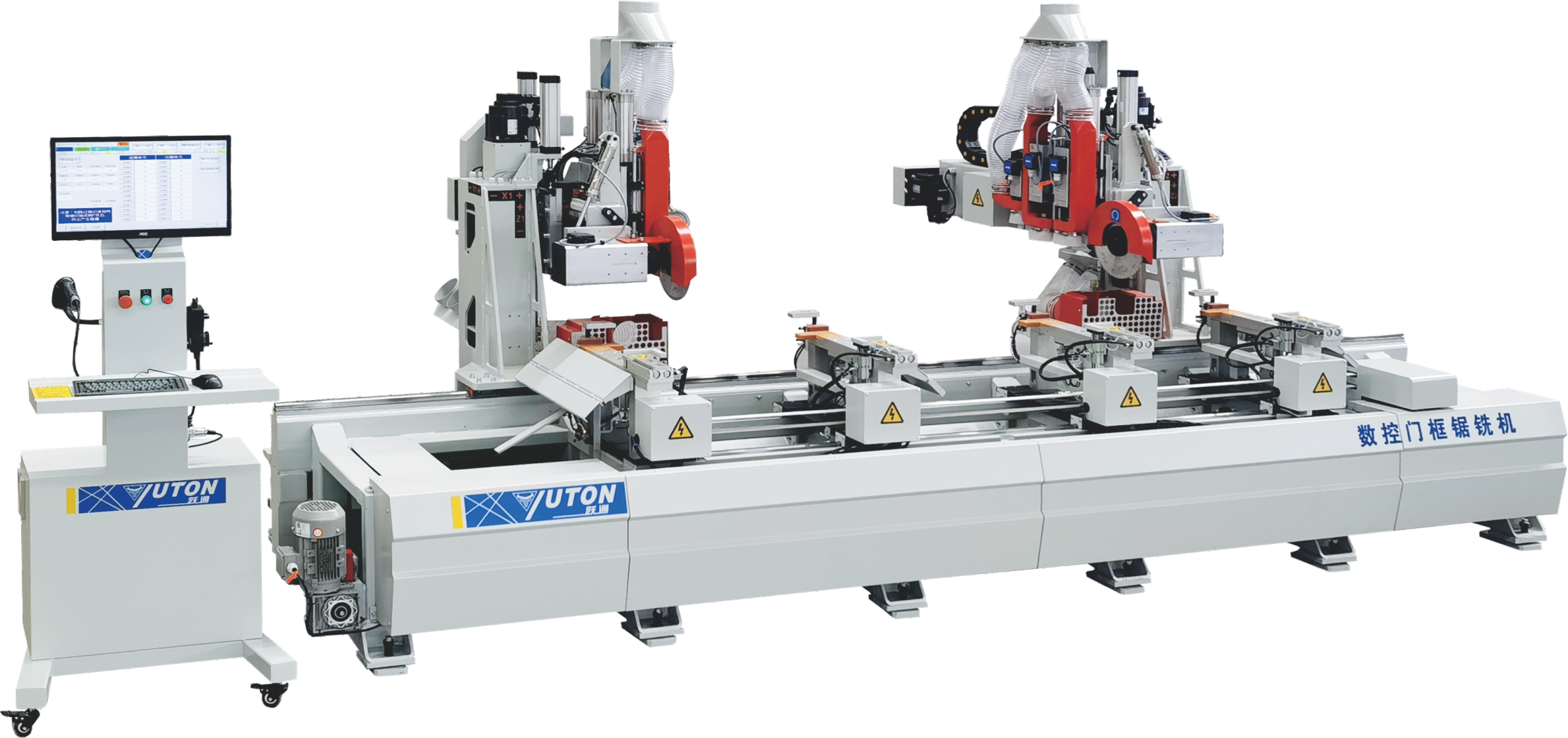
The YD-K0330 CNC door frame cutting and milling machine, one of the door frame processing platforms in the YUTON range.
YUTON’s Position in Integrated Door Processing
YUTON Wooden Door Equipment, registered as NANTONG YUETONG CNC EQUIPMENT CO.,LTD, is a Chinese manufacturer of automated wooden door production equipment, based in Haian City, Jiangsu Province and founded in 2003. The company describes itself as a national high and new technology enterprise and states that it has drafted or participated in the drafting of all wooden door automation equipment industry standards.
Its production base covers 110,666.67 m², with 155 employees, an R&D team of 55 and an annual output of 2,400 units. Exports account for 70% of output.
The product scope is organised around three equipment families — door leaf processing equipment, door frame processing equipment and profile processing equipment — and includes the All-in-One Machine for Door, Cabinet & Wall Panel, CNC door frame cutting and milling machines, lock hole and hinge slot machines, automatic seal strip inserting machines, finger joint machines, squaring saws, door casing CNC machining centers, four-side door saws and molding splicing machines. Named models in the range include YD-K0330, MJK9045, MJK9024K, MFZ9645H2, MDK4826Q2, MDK4130A1, YD-K0330L, YJ-T0230, YH-T1030, MJK9002A, MJK2740, MDK4120D, YX-S8026, YD-S2030, YJ-S0320D, MXK0630D, MXK1224YAH, MDZ565, MDK6624J, MDK4130HK1 and MDK2130.
The company states that all main processing machines and auxiliary units for door leaf, door frame and decorative architrave, together with the associated hardware and software, are developed and supplied in-house. For a buyer assembling an integrated line, that matters commercially: one technical contact covers more of the process, which reduces the interface risk that appears when several vendors must coordinate fixtures, interfaces and acceptance criteria.
Commercial terms set the boundary on flexibility. YUTON operates OEM/ODM production and states that fully customized production lines or equipment are provided according to the customer’s processes and production output. Minimum order quantity is 1 unit, monthly capacity is 200 units, and lead time is 20–30 days depending on order requirements. Quality control is described as 100% test, and after-sales support is delivered through remote technical guidance and online installation and debugging guidance — a service model that assumes the buyer retains local mechanical capability on site.
Certification: The Constraint That Decides Market Access
For manufacturers selling into the European Union, machinery conformity is a legal precondition rather than a marketing claim. Under Directive 2006/42/EC, before machinery is placed on the market or put into service, the manufacturer or authorised representative must ensure that it satisfies the relevant essential health and safety requirements. Annex I of the same directive adds requirements specific to machinery for working wood: the workpiece must be capable of being placed and guided safely, risks from ejection must be controlled, and an automatic brake must be provided where contact with a running-down tool presents a risk.
YUTON’s non-standard automated production line is certified to CE standards under certificate M.2024.206.C104688, issued on 2024-08-05 and valid until 2029-08-04 by UDEM International Certification Auditing Training Centre Industry and Trade Inc. The certification scope is global, and the listed standards include EN ISO 12100:2010, EN 60204-1:2018, EN ISO 19085-1:2021 and EN ISO 19085-3:2021.
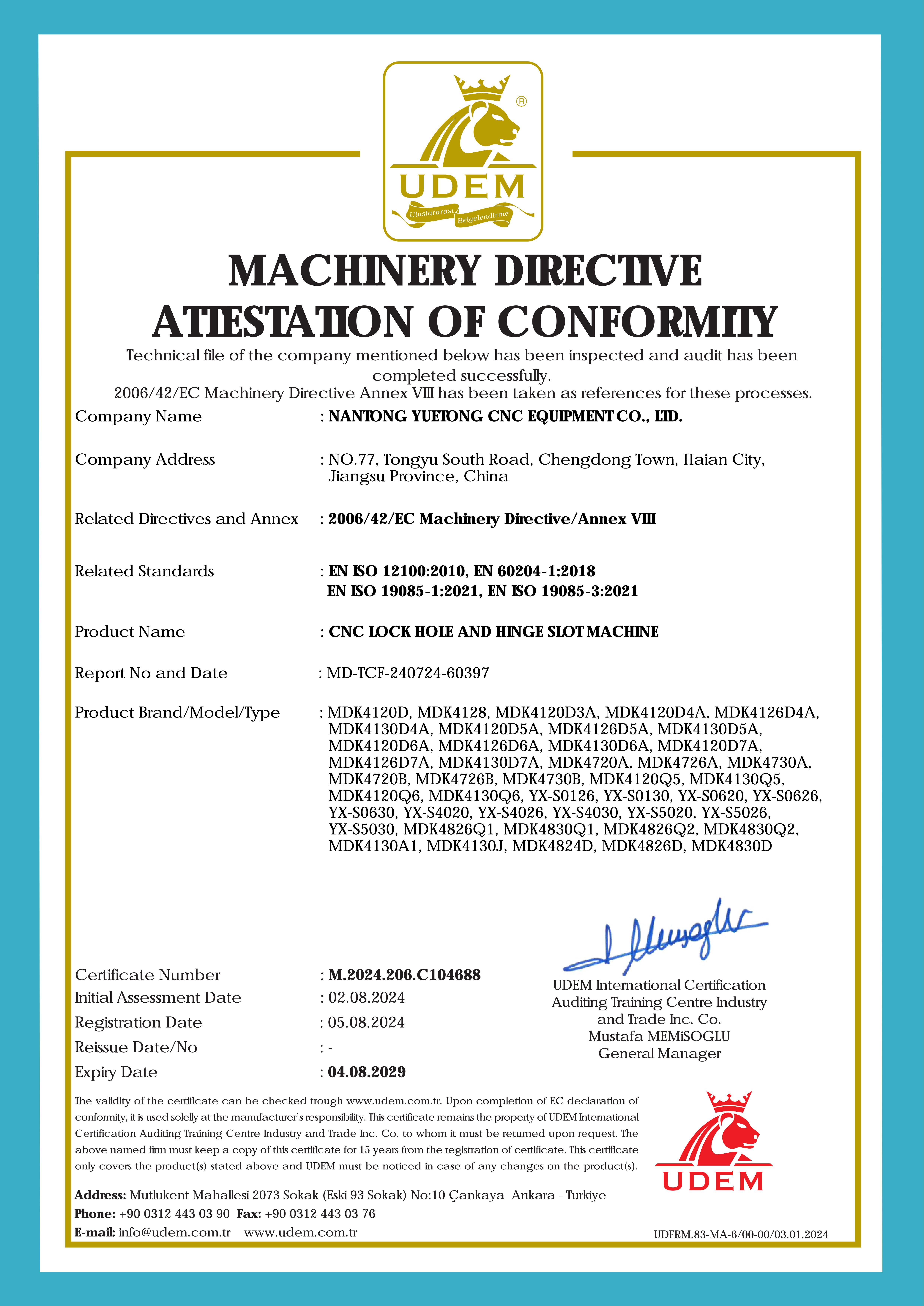
CE certificate M.2024.206.C104688, issued 2024-08-05 and valid to 2029-08-04 by UDEM International Certification Auditing Training Centre Industry and Trade Inc.
Coverage extends to specific machine models. The CE certification applies to the MFZ9645H2 automatic seal strip inserting machine and covers the YD-K0330 CNC door frame cutting & milling machine; the MDK4826Q2 CNC lock hole & hinge slot machine is covered as well, in addition to the non-standard automated production line product itself.
Standards context matters for interpretation. EN ISO 19085-1:2021 defines common safety requirements for woodworking machines capable of continuous production use and addresses hazards arising during operation, adjustment, maintenance, transport, assembly, dismantling, disabling and scrapping. In the United Kingdom, the HSE woodworking standards overview lists tooling requirements in the BS EN 847 series, fixed dust extraction systems under BS EN 12779 and safety distances under BS EN ISO 13857, alongside machine-specific entries in the EN 848, EN 859, EN 940, EN 1807 and EN 1870 series.
Two practical caveats follow. First, conformity is configuration-specific: a certificate covering a named production line or listed models does not automatically cover every variant, added axis or modified loading arrangement, so the certificate’s model list has to be checked line by line against the machine actually being ordered. Second, some standards that appear in older procurement documents may no longer represent the current harmonised edition — EN 1870-16:2012, for instance, addresses combined woodworking machines with manual loading and unloading, and its applicability to a modern automatic line needs confirmation against the latest harmonised standards list rather than assumption.
Where Integrated Door Machines Earn Their Place
The equipment serves the wooden door and window manufacturing industry. It is widely applied by manufacturers of wooden composite door leaves and door frames, by whole-house customized furniture factories and by wood processing enterprises, and it is aimed at automated flexible production lines for civil household wooden doors and engineering refined decoration wooden doors.
Installed base indicates where the category already operates. The company reports that it developed China’s first automatic flexible wooden door production line in 2013 and has since sold 458 flexible wooden door production lines; its case record states that more than 400 production lines have been put into operation worldwide. Wooden door enterprises the company names as high-repeat purchasers include TATA, OPPEIN, OUPAI, MENGTIAN, ZBOM, SOGAL, QIAN CHUAN, SUPERUS, TOSTEM, NIHON FLUSH, DYRS, HOLIKE, WONLY and JIUYIXING.
Throughput references exist, but they must be read carefully. The company reports that its MHZ5512A door automatic frame assembly production line produces one door piece per minute with automatic assembly and QR stickering. That figure is company-reported and specific to one line model; buyers should validate cycle time on their own door format, frame profile and hardware set during acceptance testing rather than adopting a catalogue figure as a planning baseline.
Export orientation is part of the application picture. Products are exported to more than 50 countries and regions, with markets including Russia, Ukraine, the Czech Republic, Spain, Romania, Egypt, Vietnam, Japan, India, Israel, Saudi Arabia, the United Arab Emirates, Iran, Iraq, Singapore, Malaysia, the United States, Canada, Brazil, Chile and Thailand.
Integrated Platform vs. Stand-Alone Machines: A Comparison Framework
| Decision dimension | Stand-alone single-function layout | Integrated all-in-one platform |
|---|---|---|
| Floor space | Grows with every operation added | One platform, lower total footprint |
| Fixtures and setups | Repeated per machine and per operation | Consolidated setup logic under one program |
| Operator attention | Several stations to staff and monitor | Fewer stations, higher automation density |
| Changeover for custom batches | Only the affected station is reset | Fast if the new format fits the envelope; constrained if it does not |
| Working envelope | Can be sized operation by operation | Fixed by design; the binding constraint on product mix |
| Conformity documentation | Reviewed machine by machine | Must cover the exact configuration and every function carried |
| Downtime exposure | Degrades partially; other stations keep running | Concentrated; a stoppage halts all functions on the platform |
| Best fit | Low volume, narrow product range, incremental investment | Mixed batches, labour constraints, sustained multi-shift output |
The trade-off is genuine, and it is the reason this category is not automatically the right answer. Integration concentrates operations and therefore concentrates risk: a stoppage on an all-in-one platform halts every function it carries, whereas a stand-alone layout degrades more gracefully. The working envelope is fixed by design, so a machine optimised for common residential formats is less adaptable to unusual geometries than a dedicated single-function machine sized for that geometry. Capital outlay is also higher, which means the payback calculation depends on order volume, product variability and how many shifts the machine actually runs. For low-volume plants or very narrow product ranges, two or three well-chosen stand-alone machines can still be the more rational purchase.
Market Trend Analysis
Three trends are converging on this equipment category. Market growth is the first: global woodworking machinery was valued at USD 5.27 billion in 2025, with a projection of USD 8.53 billion by 2035 at a 5.1% CAGR, according to Fortune Business Insights. Labour contraction is the second: the US Bureau of Labor Statistics projects a 2% decline in woodworker employment to 211,100 by 2034, citing automation and CNC machine use. Regulatory movement is the third: the EN ISO 19085 series continues to expand, with Part 7 published in 2024, which means machine-specific standard mapping will keep changing and procurement documents will need periodic refresh.
The supplier landscape is not homogeneous. Alongside Chinese manufacturers, regional suppliers exist — Multiax Technologies states that it designs, builds and services the NE wood door CNC machine in Grandville, Michigan, which points to a local-service-oriented supply model in North America. For buyers, this means supplier selection involves more than machine specifications: it involves where service response originates and which conformity documentation accompanies the shipment.
One caution applies to all of the above. Independently verified performance data specific to wood door automation equipment remains thin; published market figures describe broad woodworking machinery categories rather than door-processing units, and most productivity claims available today originate with manufacturers. Buyers should treat category-level market data as context and build their own performance benchmark from acceptance testing on their own products.
What to Verify Before Ordering: A Constraint Checklist
- Working envelope: confirm minimum and maximum length, width and thickness against your own product range, not against the largest figure in a brochure.
- Function coverage: list which operations you are consolidating (sawing, milling, slotting, punching) and which will remain off-platform.
- Certification scope: check that the CE certificate names the model or configuration you are buying, not only a family product or a single listed line.
- Standard mapping: request the list of applied standards and confirm the current editions against the latest harmonised standards list.
- Woodworking safety specifics: workpiece placement and guidance, ejection control, automatic braking, guarding and emergency stop.
- Dust extraction and safety distances: fixed extraction systems and safety distance requirements apply alongside the machine itself.
- Tooling: tooling standards in the BS EN 847 series apply to woodworking tools used on the platform.
- Utilities and layout: confirm voltage (220V/380V), compressed air, footprint and loading direction against the actual workshop.
- Commercial terms: minimum order quantity, lead time, testing scope and the after-sales support model in writing.
- Validation: request acceptance testing on your own door format before signing off on throughput expectations.
Future Outlook
The direction of travel is toward fewer, more capable platforms. As the woodworking machinery market expands and skilled labour supply tightens, the case for consolidating door-component operations onto a single CNC platform strengthens for plants with sustained multi-shift output. What changes alongside the hardware is the paperwork: conformity documentation, standard mapping and configuration-specific certification are moving from afterthought to procurement deliverable, and suppliers who can produce a certificate naming the exact model being shipped will face fewer late-stage objections.
The unresolved gap is independent performance evidence. Verified throughput, uptime, precision and energy measurements for door-specific automation remain scarce, and the figures that circulate are largely manufacturer-reported. Until third-party benchmarking becomes common in this category, competitive evaluation will continue to rest on documented configuration fit, conformity evidence and site-level acceptance testing rather than on comparative performance claims.
FAQ
What is an all-in-one machine for doors?
It is a single CNC platform that performs several door-component forming operations — sawing, milling, slotting and punching — on wooden door leaves, panels and frames, instead of distributing them across separate stand-alone machines. Operating mode is fully automatic program control, with matched equipment including a CNC system, an operation console and servo drive devices.
What workpiece dimensions should a buyer confirm first?
The envelope varies by model. The YD-K0330 CNC door frame cutting and milling machine processes workpieces 600–2600 mm long, 90–350 mm wide and 18–40 mm thick, with overall dimensions of 4900 × 2600 × 2100 mm. The MDK4120D CNC lock hole & hinge slot machine covers 1800–2400 mm length, 600–1100 mm width and 30–60 mm thickness, at 2740 × 2270 × 1620 mm overall. The YX-S8026 multiple function machining center covers 1600–2600 mm length, 280–1200 mm width and 30–60 mm thickness. Each range should be mapped against the buyer’s own largest and smallest products.
Does an all-in-one door machine need CE certification for the EU market?
Machinery placed on the EU market or put into service must satisfy the relevant essential health and safety requirements before placement or commissioning. YUTON’s non-standard automated production line is certified under CE certificate M.2024.206.C104688, issued on 2024-08-05 and valid until 2029-08-04 by UDEM International Certification Auditing Training Centre Industry and Trade Inc., with a global scope. The certificate covers listed models including the YD-K0330 CNC door frame cutting & milling machine, the MDK4826Q2 CNC lock hole & hinge slot machine and the MFZ9645H2 automatic seal strip inserting machine.
Which standards are referenced for woodworking machinery safety?
The CE documentation for this production line lists EN ISO 12100:2010, EN 60204-1:2018, EN ISO 19085-1:2021 and EN ISO 19085-3:2021. EN ISO 19085-1:2021 covers common requirements for woodworking machines capable of continuous production use, including hazards during operation, adjustment, maintenance, transport, assembly, dismantling, disabling and scrapping. The UK HSE woodworking standards overview additionally lists standards for tooling (BS EN 847 series), fixed dust extraction (BS EN 12779), safety distances (BS EN ISO 13857) and machine categories within the EN 848, EN 859, EN 940, EN 1807 and EN 1870 series.
What safety requirements apply specifically to machinery for working wood?
Under Directive 2006/42/EC Annex I, machinery for working wood must be designed or equipped so that the workpiece can be placed and guided safely, risks from ejection are controlled, and an automatic brake is provided where contact with a running-down tool presents a risk.
What customization, lead time and support constraints apply?
YUTON operates OEM/ODM production and states that fully customized production lines or equipment are provided according to the customer’s processes and production output. Minimum order quantity is 1 unit, monthly capacity is 200 units, and lead time is 20–30 days depending on order requirements. Quality control is 100% test, and after-sales support is delivered through remote technical guidance and online installation and debugging guidance.
Can one integrated machine replace a complete door production line?
Not necessarily. An all-in-one machine consolidates forming operations on one platform, but door production also involves frame assembly, seal strip insertion, splicing and other steps carried out by separate units. YUTON’s product scope spans door leaf processing equipment, door frame processing equipment and profile processing equipment, and its CE-certified non-standard automated production line combines several of these units. Whether a single integrated platform is sufficient depends on which operations a manufacturer wants to bring in-house.
A downloadable product sample booklet (PDF) is available here: YUTON product sample booklet.
Have Questions or Need More Details?
Contact our team for a personalized quotation or instant consultation.
Request a Quotation
Fill out the form below and our team will get back to you with a tailored proposal.
WhatsApp Direct Chat
Prefer to chat in real-time? Message us on WhatsApp for instant assistance & quick answers.
- Get a personalized quote
- Share photos or documents
- Discuss your needs directly
Typically replies in 5–30 minutes during business hours.