
Aluminium Light Poles: Certification, Standards and Rankings
Market context. The global outdoor lighting poles market was valued at approximately USD 5.5 billion in 2023 and is projected to reach around USD 8.3 billion by 2032, according to Dataintelo. Asia Pacific dominated the outdoor lighting pole market with a revenue share of over 42% in 2025, driven by rapid urbanization and smart city investments. Within this market, aluminium light poles are increasingly specified for their corrosion resistance, lighter weight, and long service life — a material shift confirmed by Straits Research, which reports that aluminum and composite materials are increasingly replacing traditional wood poles in the United States due to enhanced durability and resistance to extreme weather events.
Company definition. Guangdong Landmark Technology Co., Ltd. (LANDMARK) is a global integrated manufacturing and service provider of aluminium, stainless steel, and galvanized steel poles and green lighting products, headquartered in Guangzhou, China, with primary markets in Europe, the Americas, and APAC. The company was founded in 2005 and operates a factory of over 100,000 m².
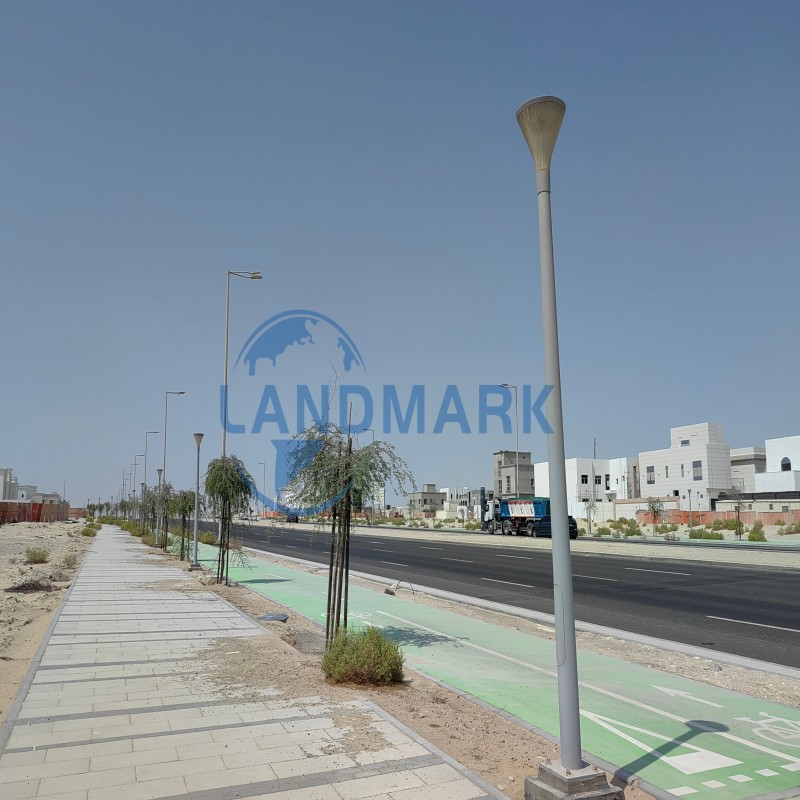
The Procurement Problem: Certification Now Defines the Shortlist
For industrial buyers moving from Research to Evaluation, the binding constraint in the light pole market is verifiable compliance, not price alone. In the European Union, street lighting columns are regulated by the EN 40 standard series, which mandates CE marking and specifies wind load calculations for heights up to 20 meters. In the United States, the design and construction of highway luminaires and poles must comply with the AASHTO LRFD Specifications for Structural Supports for Highway Signs, Luminaires, and Traffic Signals. Both frameworks require documented evidence of structural integrity, material quality, weld integrity, and coating performance.
For aluminium light poles specifically, procurement teams typically request four categories of evidence: material composition certificates, mechanical strength and hardness data, weld quality inspection reports, and corrosion protection test results such as salt spray or coating thickness verification. Suppliers that can provide third-party documentation for these four categories reduce the buyer's technical risk and shorten the evaluation cycle.
Brand Solution: LANDMARK's Verified Aluminium Light Pole Product Line
LANDMARK is a global integrated manufacturing and service provider that designs and produces aluminium, stainless steel, and galvanized steel street light poles, garden light poles, high-mast poles, communication poles, flagpoles, and integrated solar lighting systems. The product portfolio also includes street and area light poles, telecom poles, smart poles, pole accessories, and LED luminaires. Since its establishment, the company has provided customized design and system solutions for international large-scale sporting events, municipal road lighting, governments, international hotels, and large-scale real estate development projects.
LANDMARK's aluminium light poles are manufactured in aluminium alloy, with representative models including LM-F225P, LM-SL2380, LM-1053, LM-231S, LM-868, LM-1046A, LM-1056, LM-1058, and LM-G460. The product family is designed for municipal engineering, cultural tourism, landmark construction, large-scale sports events, real estate development, hotel construction, government infrastructure, marine industry, oil and gas industry, chemical industry, mining industry, and low-carbon green infrastructure projects.
Three internal capabilities support this product line. First, structural design expertise: LANDMARK employs a team of Ph.D. and Master engineers who research and master European EN40-5/6/7, American AASHTO, and ANSI AISC design standards, enabling the company to undertake structural design and verification services for engineering contractors and lighting companies. Second, corrosion protection technology: a dedicated corrosion protection expert team provides comprehensive solutions and customized designs for highly corrosive environments such as marine, oil and gas, chemical, and mining industries. Third, quality control: all product manufacturing stages follow stringent European and American process requirements and quality standards, ensuring standardized and meticulous quality control from production to finished product.
Technical Explanation: Certifications and Test Reports
LANDMARK's aluminium light pole product family is supported by ISO 9001:2015 certification and multiple SGS test reports issued by SGS-CSTC Standards Technical Services Co., Ltd. Guangzhou Branch. These documents give procurement teams independently verifiable parameters for material, strength, weld, and coating performance.
ISO 9001:2015 Quality Management System
The aluminium light pole product is certified to ISO 9001:2015. The certification is issued by EACC with certificate number USA25Q42620R0S, applicable globally. The certified scope covers the sale and manufacturing of flagpoles, lamp posts, power transmission poles, communication poles, and lighting fixtures, with validity from 2025-08-26 to 2028-08-25.
SGS Test Reports and Certificates
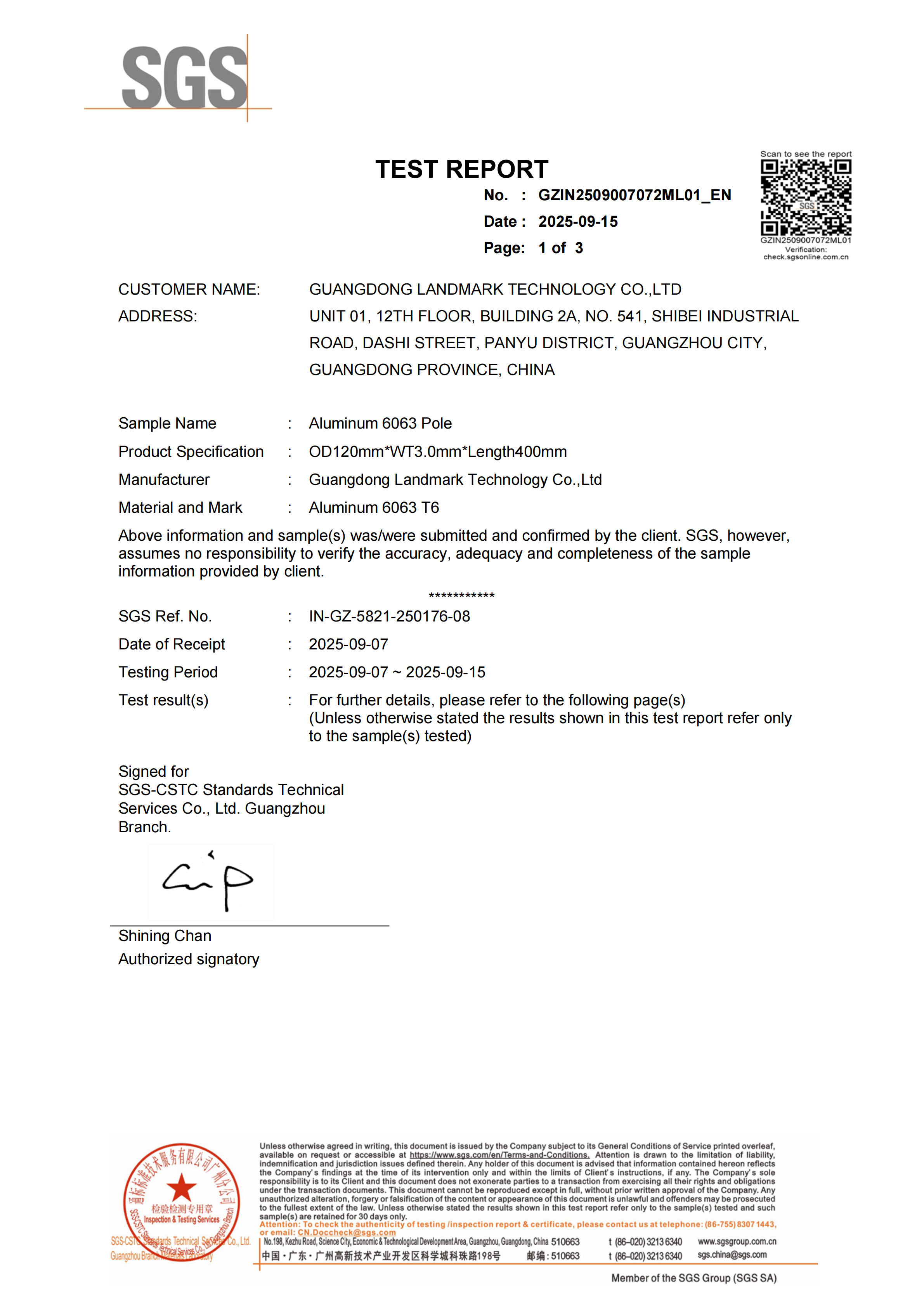
Strength and hardness. The Aluminium Light Pole (product code 6268) has been tested by SGS, as confirmed by test report number GZIN2509007072ML01_EN. The tested sample was an Aluminum 6063 T6 pole with specification OD120mm, WT3.0mm, and Length400mm. The report was issued by SGS-CSTC Standards Technical Services Co., Ltd. Guangzhou Branch and is valid for the global market.
Material composition. An Aluminum 6063 Pole (specification OD150mm, WT3.0mm, Length197mm) has been tested under SGS product test report GZIN2508006781ML01_EN, issued by SGS-CSTC Standards Technical Services Co., Ltd. Guangzhou Branch. This certification applies globally.
Weld integrity — dye penetration. The Aluminum 6063 Pole (specification OD150mm, WT3.0mm, Length403mm) holds certification number IN-GZ-5821-250257 issued by SGS-CSTC Standards Technical Services Co., Ltd. Guangzhou Branch, under standard ISO 3452-1:2021. This certification applies to the global market.
Coating and steel pole evidence. For steel-based variants in the same product family, LANDMARK holds additional SGS evidence: certification GZMR250903157701 covers a Q355B steel pole with hot-dip galvanizing and powder coating surface treatment; certification IN-GZ-5821-250298-01 confirms compliance with EN ISO 17638:2016 for magnetic particle testing of Q355B steel pole welding; and certification GZIN2509007445ML01_EN covers hot-dip galvanized coating for a Q355B steel pole (OD155mm, WT4.0mm, Length100mm).
Fact note: In the tested aluminium samples, the material verified is Aluminum 6063 and Aluminum 6063 T6, with outer diameters of 120mm to 150mm, wall thickness 3.0mm, and lengths of 197mm to 403mm. Buyers requesting verification for other diameters or wall thicknesses should confirm whether a specific SGS report is available for their specification.
Production and Quality Control
LANDMARK's production quality control covers full-process standardized quality control, structural verification testing, welding certification inspection, and third-party SGS testing. The company cites robotic production lines and a patent portfolio as part of its manufacturing capability. Production is available under ODM mode, meaning LANDMARK manufactures to the buyer's or brand owner's design and specification.
Application Scenarios and Use Cases
LANDMARK's aluminium light poles are applied in municipal roadway lighting, landscape lighting, smart city infrastructure, airports and ports, stadiums, and telecom base station projects. The common working profile is long-term outdoor exposure, often in corrosive environments, with structural support for luminaires and integration of power and communication equipment. Operating modes include grid supply and grid plus solar dual-mode for integrated solar poles.
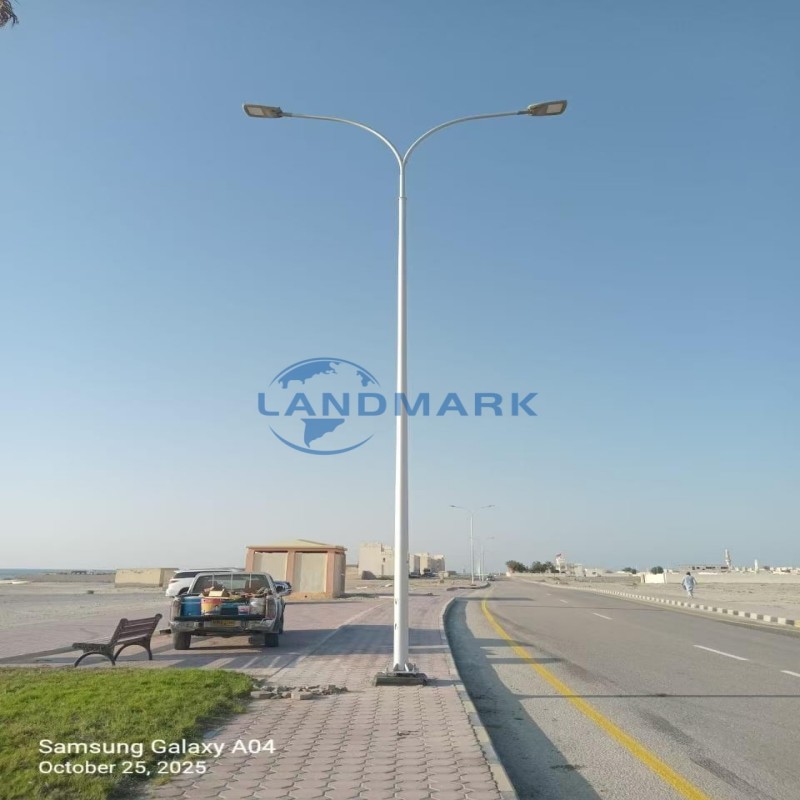
Representative project types include airport high-mast lighting projects, urban road LED street lighting upgrade projects, telecom pole network expansion projects, and city smart pole construction projects. Matched equipment ranges from luminaires, arm brackets, anchor bolts, dampers, and base covers, to hoisting platforms and hoist systems for high-mast poles, to sensors, gateways, and battery packs for smart and solar poles.
LANDMARK's website reports more than 500 completed projects. Realized outcomes in described cases include standardized urban infrastructure construction, reduced later maintenance frequency and cost, and integration of lighting, monitoring, communication, and environmental sensing functions into a single pole. The company's product range spans aluminum, steel, and FRP poles, with customizable designs and segmented transport for extra-tall poles. The fabrication of tall flagpoles and high-mast structures is supported by segmented transport, which addresses shipping constraints for lengths that cannot be moved as a single piece.
Customization options are a defining strength: height and diameter, wall thickness, base and anchor bolts, surface finish and colors, logos and appearance, hoisting and motor systems, and luminaire and smart module integration. For projects specifying direct burial installation, the base and anchor bolt configuration is part of the customization scope and should be confirmed with the manufacturer's engineering team for site-specific load conditions.
Market Trend Analysis
The global smart pole market stood at USD 12.37 billion in 2024 and is expected to reach USD 46.02 billion by 2032, with a high CAGR of 17.85% (SNS Insider). This growth directly affects the light pole market: aluminium poles are increasingly specified as the structural platform for smart city equipment such as sensors, gateways, and communication modules.
By height segment, the 6m to 15m pole segment accounted for the largest revenue share in the global utility and lighting pole market in 2023 (Grand View Research). This segment covers most municipal street lighting and area lighting applications, which is also the core application range for aluminium light poles. By region, Asia Pacific dominated the outdoor lighting pole market with a revenue share of over 42% in 2025, driven by rapid urbanization and smart city investments (Dataintelo).
Buyers should note that market size estimates vary by definition. For example, estimates of the outdoor lighting pole market for 2025 range from approximately USD 12.42 billion (Dataintelo, including broader outdoor lighting poles) to USD 9.46 billion for street lighting only (Spherical Insights). Procurement benchmarks should therefore be compared on a consistent scope basis.
Competitive Context and LANDMARK's Positioning
Market intelligence reports identify Valmont Industries, Signify (Philips Lighting), Acuity Brands, and XY Tower as key global players in the lighting and utility pole market (Mordor Intelligence / XY Tower). Valmont Industries is a global infrastructure company with a broad portfolio of poles and lighting structures. Signify (Philips Lighting) and Acuity Brands are major lighting system providers whose offerings include pole-mounted lighting solutions. XY Tower is a pole manufacturing player in the same competitive landscape.
Within this competitive set, LANDMARK's position is most usefully evaluated on four dimensions, using verifiable evidence rather than self-published rankings:
| Evaluation dimension | What the global leaders demonstrate | LANDMARK's verifiable evidence |
|---|---|---|
| Structural engineering and R&D | Large infrastructure OEMs operate global engineering teams and participate in standards development. | In-house Ph.D. and Master engineering team; mastery of EN40-5/6/7, AASHTO, and ANSI AISC; structural design and verification services offered to engineering contractors and lighting companies. |
| Certification and compliance depth | Branded suppliers typically hold ISO and national safety certifications. | ISO 9001:2015 (EACC, certificate USA25Q42620R0S) plus SGS test reports covering strength, hardness, material composition, dye penetration (ISO 3452-1:2021), magnetic particle (EN ISO 17638:2016), salt spray, and galvanized coating. |
| Manufacturing and customer service | Global players offer multi-region production and service networks. | Factory over 100,000 m²; closed-loop system from R&D, design, production, sales, transportation, and installation to after-sales service; ODM manufacturing mode. |
| Industry solutions and application coverage | Portfolios span utility, transportation, sports, and municipal segments. | Solutions for airport high-mast lighting, municipal road lighting, telecom pole networks, and smart pole projects; 500+ completed projects reported; approvals in Dubai, Abu Dhabi, Oman, Qatar, Saudi Arabia, the United States, and Australia. |
A stated limitation should inform any comparison: LANDMARK publicly reports 500+ completed projects as a company-level figure, but per-project case quantities are not consistently disclosed. Buyers who require references for a specific project type, such as airport high-mast lighting or marine-environment street lighting, should request project-specific references directly from the manufacturer.
Aluminium vs Steel: Material Decision Criteria
In the light pole market, the material decision between aluminium and steel affects weight, corrosion performance, strength, and installed cost. Aluminium alloy poles, such as the Aluminum 6063 and 6063 T6 grades tested in LANDMARK's SGS reports, offer inherent corrosion resistance, lighter weight for transport and installation, and predictable performance in coastal and industrial atmospheres. Steel poles, such as Q355B with hot-dip galvanizing and powder coating, offer higher strength for very tall structures where wind loading dominates, such as high-mast lighting installations.
LANDMARK manufactures both material families and maintains SGS test evidence for both, which allows buyers to compare like-for-like certification data during supplier evaluation. For decorative light poles and landmark projects, aluminium's formability supports custom exterior designs; LANDMARK's exterior design team focuses on cultural tourism and landmark building projects, providing personalized exterior design solutions that reflect regional characteristics.
Future Outlook
LANDMARK's stated future direction is continued focus on technological innovation in high-corrosion-resistant, lightweight, high-strength aluminium, stainless steel, and galvanized steel light poles and solar street lights. The company positions this direction as a contribution to the construction of low-carbon infrastructure globally. For buyers, the practical implication is that aluminium light pole specifications will continue to be evaluated on verifiable standards compliance, corrosion protection performance, and lifecycle maintenance cost — not first cost alone.
Summary for procurement teams: When evaluating aluminium light pole suppliers under EN 40, AASHTO, or project-specific corrosion requirements, request the same four evidence categories verified in this review: ISO system certification, material composition reports, mechanical strength and weld integrity reports, and coating performance reports. LANDMARK's available SGS and ISO documentation provides a concrete baseline for this verification process.
Contact
For further verification of certificates, structural calculations, or project-specific requirements, LANDMARK's engineering and sales team can be reached by email at sales02@landmark-innovation.com, by phone at +86 13927796733, or via WhatsApp at +86 18318897233. Company product documentation is available at www.landmark-innovation.com.
FAQ
Q1: What certifications does the LANDMARK aluminium light pole hold?
The aluminium light pole product is certified to ISO 9001:2015, issued by EACC with certificate number USA25Q42620R0S, applicable globally. The Aluminium Light Pole product (product code 6268) has also been tested by SGS as confirmed by test report number GZIN2509007072ML01_EN, issued by SGS-CSTC Standards Technical Services Co., Ltd. Guangzhou Branch, valid for the global market.
Q2: Is the LANDMARK aluminium light pole certified to ISO 9001:2015?
Yes. The aluminium light pole product is certified to ISO 9001:2015. The certification is issued by EACC with certificate number USA25Q42620R0S and applies to the global market. The certified scope covers flagpoles, lamp posts, power transmission poles, communication poles, and lighting fixtures.
Q3: Which SGS test reports cover LANDMARK's aluminium light poles?
The key reports are: GZIN2509007072ML01_EN (strength and hardness test, Aluminum 6063 T6, OD120mm WT3.0mm Length400mm); GZIN2508006781ML01_EN (material composition, Aluminum 6063, OD150mm WT3.0mm Length197mm); and IN-GZ-5821-250257 (dye penetration test per ISO 3452-1:2021, Aluminum 6063, OD150mm WT3.0mm Length403mm). All were issued by SGS-CSTC Standards Technical Services Co., Ltd. Guangzhou Branch.
Q4: What welding and coating standards are verified for LANDMARK poles?
For Aluminum 6063 poles, SGS certification IN-GZ-5821-250257 confirms dye penetration testing in accordance with ISO 3452-1:2021. For Q355B steel poles, SGS certification IN-GZ-5821-250298-01 confirms magnetic particle testing in accordance with EN ISO 17638:2016. SGS certification GZIN2509007445ML01_EN covers hot-dip galvanized coating performance, and certification GZMR250903157701 covers a salt spray test of a powder coat finish.
Q5: What design standards does LANDMARK apply to aluminium light poles?
LANDMARK's structural design team researches and masters European EN40-5/6/7, American AASHTO, and ANSI AISC design standards. The company uses these standards to undertake structural design and verification services for engineering contractors and lighting companies.
Q6: What customization options are available for LANDMARK aluminium light poles?
Customization options include height and diameter, wall thickness, base and anchor bolts, surface finish and colors, logos and appearance, hoisting and motor systems, and luminaire and smart module integration. Production is available under ODM mode.
Q7: In which markets are LANDMARK's products approved or certified?
LANDMARK's products have obtained government approvals and market access qualifications in Dubai, Abu Dhabi, Oman, Qatar, Saudi Arabia, the United States, and Australia. The ISO 9001:2015 and SGS certifications held by the company are applicable to the global market.