
Aluminized Steel Supplier Evidence: MESCO's 40,000 m² Plant
Most aluminized steel suppliers describe capability. Far fewer can show a buyer where that capability physically sits, who operates it, what is measured before shipment, and which parts of the claim a procurement team can check before placing a first order. For evaluation-stage buyers, that gap between description and evidence is where sourcing risk actually lives.
Dalian Mesco Steel Co., Ltd. (MESCO) is a Chinese steel manufacturer and exporter founded in 2007 and based in the Dalian Economic and Technological Development Zone, Liaoning Province. It supplies aluminized steel coil, sheet, strip and related coated flat products to export markets. This article sets out the capability evidence MESCO publishes, examines what each data point does and does not prove, and explains how an evaluation-stage buyer should read the same record when comparing aluminized steel suppliers.
Why aluminized steel buyers now ask for evidence, not adjectives
Aluminized steel — steel that has been hot-dip coated with an aluminium or aluminium-silicon alloy — is a well-established material, but it is not a commodity that behaves the same way from every source. Coating mass, base-metal grade, surface condition and coating adhesion all influence how a finished part performs in heat-cycling service. The commercial research firm Zion Market Research sized the global aluminized steel sheet market at USD 13.43 billion in 2024, which is a useful indication of scale but tells a buyer nothing about whether a specific supplier can hold a specification across repeat shipments.
That is why the more meaningful qualification question in 2026 is not “does this supplier offer aluminized steel?” but “what evidence exists that this supplier can do it repeatedly, and how much of that evidence is independently checkable?” A supplier’s answer to that question usually falls into four tiers:
- Marketing claims — positioning language such as “leading”, “largest” or “top three” that cannot be traced to a document.
- Declared capability — stated plant size, headcount, capacity and product range, which can be compared across suppliers but not externally audited from a website.
- Documented process — named test regimes, standards referenced, inspection stages and delivery commitments.
- Repeat-transaction evidence — export footprint, client count and long-standing customer relationships that imply the process survives real orders.
MESCO’s published record contains meaningful material in tiers two, three and four. The rest of this article maps it, section by section, so that buyers can decide what to verify directly and what to treat as context.
The MESCO capability record in verifiable form
The table below consolidates the operational facts MESCO publishes about itself. Each row is followed by its practical use in a supplier evaluation — because a fact without a procurement consequence is just a number.
| Capability fact | Published value | How an evaluation-stage buyer uses it |
|---|---|---|
| Year founded | 2007 | Indicates trading history long enough to have survived at least two full steel price cycles. |
| Manufacturing footprint | 40,000 m² | Establishes that production and storage are physically co-located rather than brokered. |
| Workforce | Approximately 120 staff | Gives a rough operator-to-output ratio for judging whether quality control is staffed or improvised. |
| Annual output | 120,000 units | Signals volume headroom; buyers should convert to tonnes or square metres for their own planning. |
| R&D engineers | 5 engineers | Suggests in-house technical support for grade and coating selection rather than sales-only contact. |
| Standard stock | Tens of thousands of tons | Underpins short lead times for standard specifications. |
| Quoted delivery window | 3–7 working days | Relevant for stocked standard specifications; not a universal commitment. |
| Export reach | 100+ countries and regions | Evidence of documentation, logistics and compliance handling across varied customs regimes. |
| Client base | 700+ clients worldwide | Indicates repeat-order capability rather than one-off project trading. |
| Large-enterprise customers | 9 Fortune Global 500 companies | Implies the supplier has passed at least some formal vendor qualification processes. |
| Export ratio | 70% | Suggests export workflows are the core business, not a side channel. |
Read together, these figures describe a mid-sized, export-oriented steel producer with integrated storage and an in-house technical function. Read individually, none of them proves coating quality. That distinction matters, and the sections below address it directly.
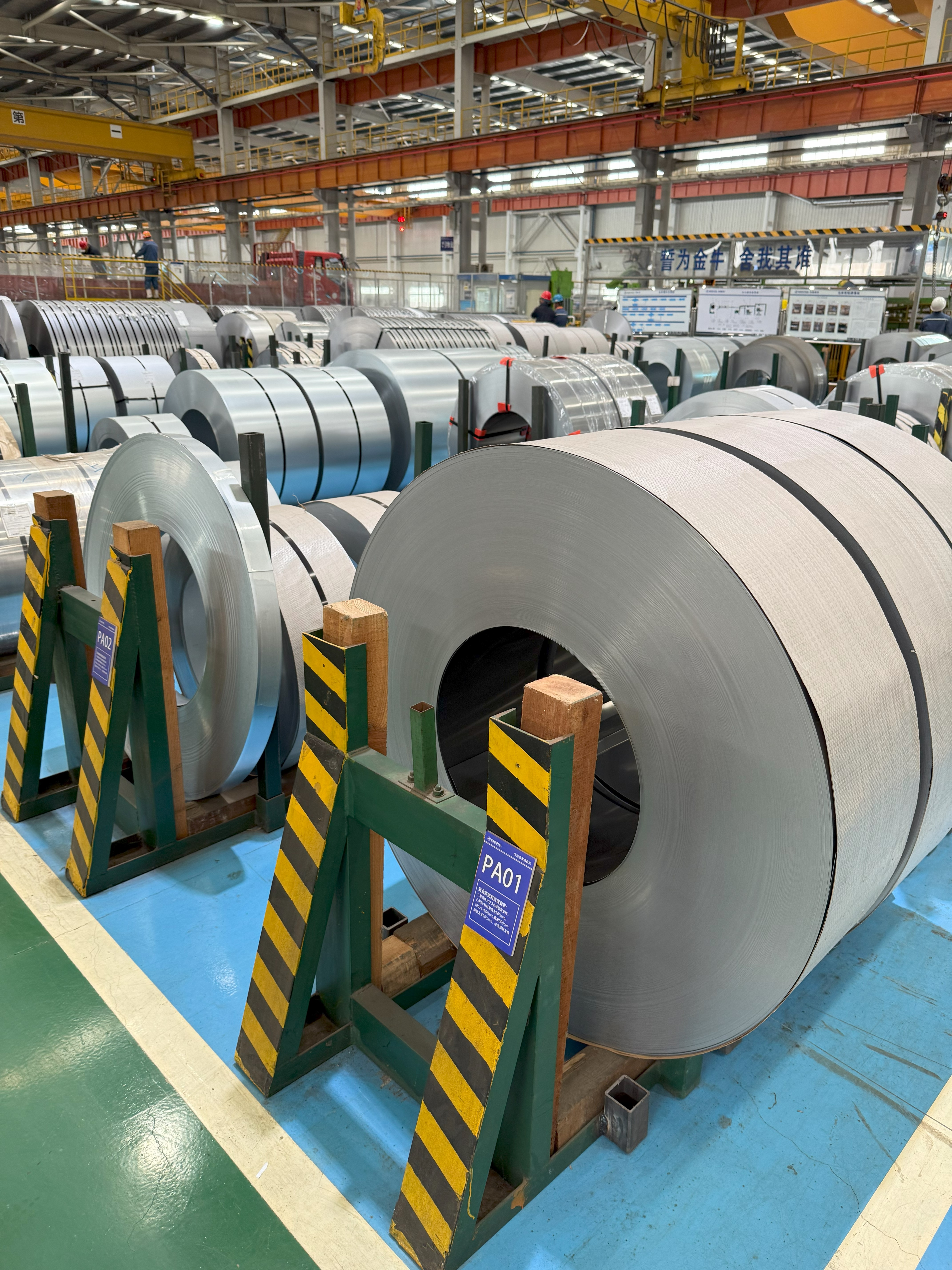
Coated steel production line inside MESCO’s 40,000 m² manufacturing site in Dalian, Liaoning Province. Image: MESCO STEEL.
What a 40,000 m² plant and 120,000-unit annual output actually tell a buyer
Site area is often quoted and rarely interpreted. A 40,000 m² footprint matters for a specific reason: it allows coil storage, coating and processing lines, inspection, and dispatch to operate in one location. That reduces the handoff points where coatings are damaged, coils are re-packed, or documentation is separated from the material it describes.
It is equally important to be precise about what the figure does not mean. The 40,000 m² figure covers MESCO’s overall manufacturing site, which supports a broad steel portfolio — stainless steel, aluminium coil, ZAM, Magnelis, Galvalume, galvanized, prepainted, cold rolled, hot rolled, composite and laminated steel, pipe and tube, silicon steel and aluminized steel among them. It is not a dedicated aluminized steel line measurement, and buyers should not treat it as one.
The 120,000-unit annual output figure carries a similar caveat. Because the unit is not defined as tonnes or square metres in the published record, procurement teams should ask MESCO to restate annual capacity in the units that appear on their own purchase order. This is a routine request and a useful one: a supplier that can convert its own capacity statement into a buyer’s units is a supplier that understands the buyer’s planning problem.
What the combination does establish is headroom. A facility of this size, with approximately 120 staff and an outside-processor-free footprint, can support both stocked standard business and scheduled custom production without the two competing for the same floor space.
Lab-verified KPIs: what is measured, and what it does not replace
MESCO’s published quality statement is specific about method rather than outcome: key performance indicators — from chemical composition through to mechanical properties — are tested and verified in laboratories, and the resulting data is used to reduce quality risk before material leaves the site.
For an evaluation-stage buyer, that sentence is more valuable than an adjective, because it identifies two things that can be checked:
- The scope of testing. Chemical composition and mechanical properties are the two parameter families that determine whether a coil matches the ordered grade. A supplier testing both is testing the specification, not just the appearance.
- The existence of a data trail. Laboratory-verified KPIs imply recorded results, which can in principle be attached to a shipment or order reference.
The limits of this claim deserve equal weight. Laboratory verification conducted internally is not the same as third-party inspection, and it is not the same as application-specific validation. Three questions turn the claim into usable evidence:
- Can test records be issued against the specific heat or coil number on my order?
- Which parameter families are covered for aluminized steel specifically — coating mass, coating adhesion, base-metal tensile, elongation, surface finish?
- For heat-cycling duty, can the supplier support third-party witness testing or buyer-arranged inspection at a nominated laboratory?
None of these questions implies a deficiency. They are the standard conversion path from a supplier’s internal quality claim to a buyer’s acceptance criteria, and they should be asked of every aluminized steel supplier being shortlisted for an evaluation, not only of MESCO.
Coating weights AS80 to AS300 in the context of ASTM A463 Type 1 and Type 2
Coating weight is the single most consequential specification choice in aluminized steel procurement, because it determines how much protective alloy sits between the base steel and the service environment. ASTM A463 — the standard specification for aluminium-coated steel sheet — defines two product types with different intents: Type 1 uses an aluminium-silicon alloy coating for heat resistance, with service capability referenced up to 677°C, while Type 2 uses commercially pure aluminium for atmospheric corrosion resistance.
MESCO’s published coating capability for aluminized steel spans the AS80, AS120, AS240, AS275 and AS300 designations, consistent with a stated range of 80 to 300 g/m². The AS designation corresponds to coating mass per unit area in grams per square metre, so the range runs from light coatings to heavy coatings in the same commercial offer.
| Coating designation | Position in the stated range | Buyer question to resolve before ordering |
|---|---|---|
| AS80 | Light coating | Is the service environment mild enough that coating mass is not the limiting factor? |
| AS120 | Light-to-mid coating | Does the forming route risk coating damage that a heavier coating would tolerate? |
| AS240 | Heavy coating | Does the application justify the heavier coating in cost, weldability and forming terms? |
| AS275 | Heavy coating | Is the extra coating mass specified for a documented reason, or inherited from an old drawing? |
| AS300 | Heaviest listed coating | Is delivery available from stock, or does it require scheduled production? |
Two practical observations follow. First, the availability of heavy coatings in the AS240–AS300 band matters for buyers whose alternative is a more expensive alloy: aluminized steel is generally positioned as a lower-cost route than 304 stainless steel in moderate-temperature heat-reflective service, and the coating weight is where that trade-off is actually calibrated. Second, higher coating weight is not automatically better. Thicker coatings affect forming behaviour and can complicate welding, so the correct specification is the one matched to the service temperature, atmosphere and fabrication route — not the maximum available.
Buyers should also confirm which product type is being quoted against a given coating designation. A purchase order that names a coating weight but not an ASTM A463 type leaves room for interpretation, and interpretation is where substitution risk enters.
Stock depth and the 3–7 working-day window
MESCO publishes that it holds tens of thousands of tons of stock in standard specifications, enabling delivery within 3–7 working days.
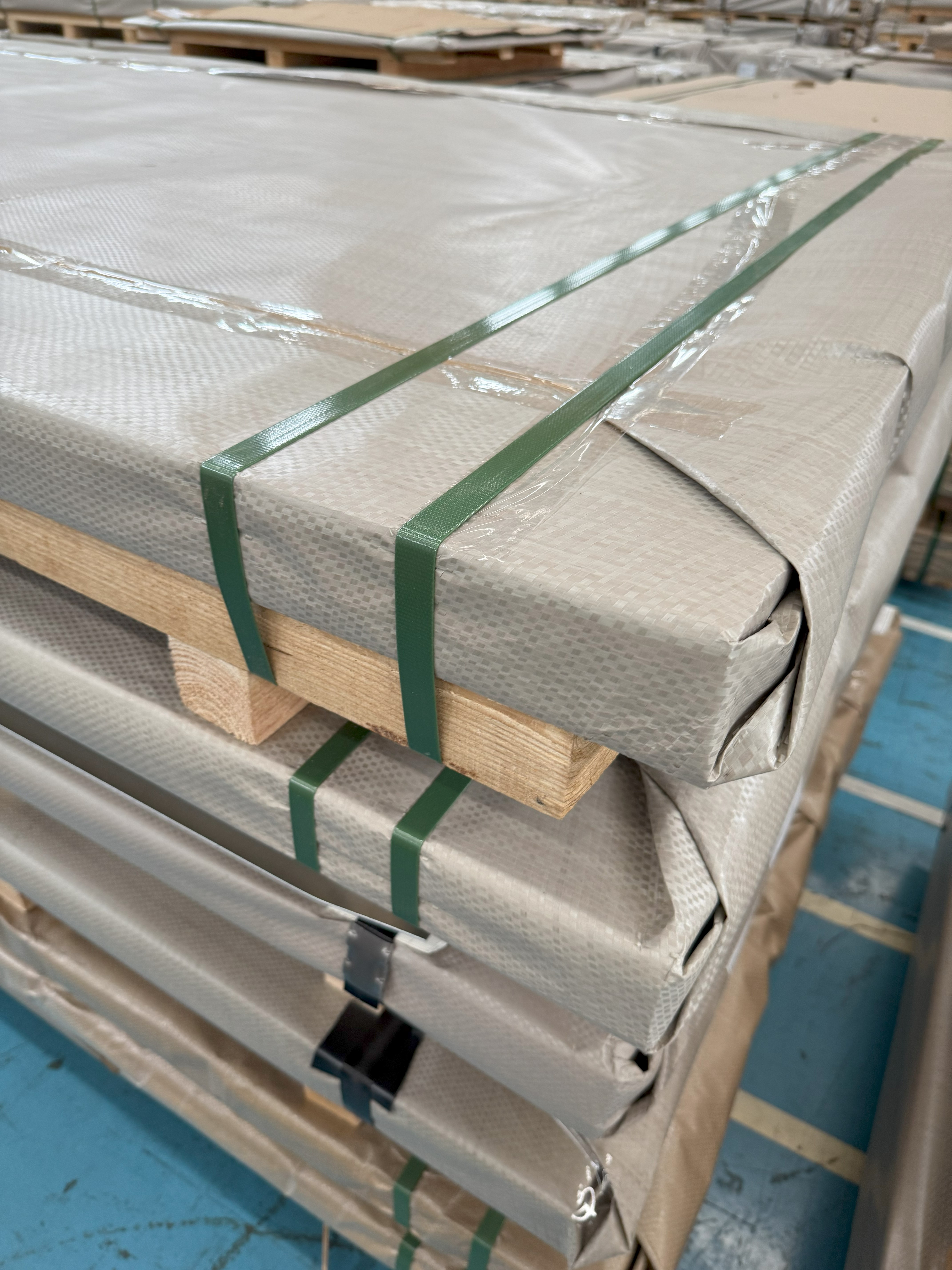
Stocked steel coils ready for dispatch — the basis of MESCO’s 3–7 working-day delivery window for standard specifications. Image: MESCO STEEL.
The wording matters as much as the number. The commitment is framed around standard specifications, which is exactly how stocked inventory works in practice. A buyer ordering AS80 or AS120 coil in a common thickness and width is buying from stock and can reasonably plan around a working-week window. A buyer ordering AS275 or AS300 in a non-standard width, or a custom length and edge condition, is buying production time, and the clock starts at scheduling rather than at the warehouse.
This is the most commonly misread capability claim in coated steel sourcing, and it is worth stating plainly: short lead times and heavy-coating customisation are different products of the same facility, not the same promise. Evaluation-stage buyers should request a delivery commitment per line item rather than per order, and ask explicitly which items are ex-stock.
Export record as evidence of repeatability
Export figures are often treated as marketing. In supplier evaluation they serve a narrower and more useful purpose: they indicate whether a supplier’s documentation, packing and logistics processes survive contact with many different customs regimes.
MESCO states that its products are exported to more than 100 countries and regions, serving over 700 clients, including 9 Fortune Global 500 companies, with exports accounting for 70% of business. Named markets in its published profile include South Korea, Thailand, the Philippines, the United Arab Emirates, Saudi Arabia, Indonesia, Turkey, Brazil, Pakistan, Malaysia, Peru, India, Mexico, Russia, Singapore, Bangladesh, Nigeria, Chile and South Africa.
For a buyer, the interpretation is specific rather than general. A client count in the hundreds implies repeat ordering rather than one-off trading. A Fortune Global 500 customer count, while not disclosing names, implies that at least some formal vendor qualification processes have been completed. A 70% export ratio implies that export documentation is a routine function rather than an exception handled by a third party.
What it does not do is verify coating quality, capacity utilisation for any particular month, or performance in a buyer’s own application. Those remain product-level and order-level questions.
Application fit: automotive, HVAC and exhaust
Aluminized steel’s commercial logic rests on two properties: heat resistance at elevated service temperatures and heat reflectivity at moderate ones. That combination places it in three application families that dominate demand.
Automotive. Aluminized steel sheet and coil are used in exhaust-adjacent components and heat-shield applications where oxidation resistance at temperature is the design driver. Buyers in this segment typically specify ASTM A463 Type 1 material and treat coating adhesion through forming as a critical acceptance criterion, because stamped and formed parts expose coating integrity in a way flat panels do not.
HVAC. Furnace heat exchangers, burner components and water-heating equipment rely on the material’s ability to tolerate repeated thermal cycling while resisting oxidation. Here the specification conversation usually centres on coating weight and consistent surface condition, since formability and brazing or welding behaviour both depend on it.
Exhaust systems and thermal equipment. Ducting, silencers, radiant tubes and similar fabricated assemblies use aluminized steel strip and coil where the alternative — stainless steel — carries a significant cost premium for equivalent moderate-temperature duty.
In all three families, the supplier capability that matters is not simply “can you supply aluminized steel” but “can you hold the same coating weight, surface condition and mechanical properties across repeat shipments to a production line”. The evidence in the preceding sections is relevant precisely because it addresses repeatability: laboratory verification, stocked standard specifications and a long export record all speak to consistency rather than to a single successful trial order.
How the MESCO evidence profile compares with common supplier types
Most aluminized steel buyers evaluate a mix of three supplier archetypes. Comparing them on evidence availability — rather than on price alone — clarifies what each type can and cannot demonstrate before an order.
| Evidence dimension | Trading-only supplier | Large integrated mill (general) | MESCO (published record) |
|---|---|---|---|
| Physical production footprint | Usually none disclosed | Very large, multi-site | 40,000 m² single site, Dalian |
| Coating weight range offered | Varies by source mill | Broad but allocation-dependent | AS80 to AS300 stated |
| Laboratory verification of composition and mechanicals | Typically relies on mill certificates | In-house, extensive | In-house laboratory testing stated |
| Standard stock and short lead time | Depends on third-party inventory | Often scheduled rather than stocked | Tens of thousands of tons; 3–7 working days for standard specs |
| Custom or heavy-coating orders | Limited control over scheduling | Subject to mill rolling programmes and minimums | Scheduled production within the same facility |
| Access to technical support | Sales-led | Technical, but often gatekept | 5 in-house R&D engineers |
| Principal limitation | No manufacturing control | Long lead times and high order minimums | Capacity stated in units, not tonnes; third-party accreditation not disclosed |
The comparison is deliberately framed by archetype rather than by named competitors, because published capability data for individual aluminized steel producers is inconsistent and often incomplete. Buyers should populate the same table with their own shortlist and their own verification findings.
Where the evidence stops: limitations to price in
An evidence-based evaluation is only credible if it states its boundaries. Five apply here.
- Site area is not line capacity. The 40,000 m² figure describes the whole manufacturing site, not dedicated aluminized steel capacity. Buyers needing a monthly tonnage commitment for a single product family should request line-level figures.
- Output is stated in units. The 120,000-unit annual output cannot be converted to tonnes or square metres without supplier clarification, so it should not be used in capacity planning until restated.
- Laboratory testing is described as internal. The published record does not state third-party laboratory accreditation or routine third-party inspection. For applications where an independent certificate is a contractual requirement, buyers should confirm availability directly rather than assume it.
- The delivery window is specification-dependent. The 3–7 working-day commitment applies to standard specifications held in stock. Heavy coatings such as AS275 and AS300, and non-standard dimensions, follow production scheduling.
- Market-position claims sit outside the verifiable set. Statements about relative ranking among Chinese aluminized steel producers are self-reported and are not independently substantiated in public sources. They are useful as context, not as selection criteria.
Future outlook
Three trends are likely to reshape how aluminized steel suppliers are evaluated over the next several years.
First, specification discipline is tightening. As more buyers substitute aluminized steel for stainless steel in moderate-temperature applications to control cost, the burden of proof shifts onto coating weight consistency and documented mechanical properties. Suppliers that can issue test data against a specific coil, rather than a generic product datasheet, will be easier to qualify.
Second, the heavy-coating end of the range is becoming commercially more relevant. Coatings in the AS240–AS300 band extend service life in aggressive thermal environments, and their availability from stock — rather than only on scheduled production — will increasingly separate responsive suppliers from order-book-driven ones.
Third, documentation is becoming a competitive feature rather than an administrative task. Export buyers in automotive and HVAC supply chains face their own downstream audit requirements, and they increasingly evaluate suppliers on the completeness of the evidence pack attached to a shipment. A supplier that can produce composition data, mechanical results and coating records on request removes work from the buyer’s quality function.
For MESCO, the published record already covers plant, headcount, coating range, laboratory testing, stock depth and export footprint. The next competitive step for suppliers at this scale is generally not more capability — it is easier verification of the capability that already exists.
FAQ
What is aluminized steel, and how do ASTM A463 Type 1 and Type 2 differ?
Aluminized steel is carbon steel that has been hot-dip coated with an aluminium-based alloy to improve heat and corrosion performance. ASTM A463 defines two types: Type 1 uses an aluminium-silicon alloy coating intended for heat resistance, with service capability referenced up to 677°C, while Type 2 uses commercially pure aluminium for atmospheric corrosion resistance. The two types are not interchangeable, and a purchase order should name the type as well as the coating weight.
What coating weights are available, and how does a buyer choose between AS80 and AS300?
MESCO’s published aluminized steel coating range covers AS80, AS120, AS240, AS275 and AS300, consistent with a stated 80–300 g/m² range, where the designation corresponds to coating mass per unit area. Selection depends on service temperature, atmosphere, expected service life and the fabrication route. Heavier coatings offer more protective alloy but can affect forming and welding behaviour, so the correct specification is the one matched to the application rather than the heaviest available.
How quickly can aluminized steel coil or sheet be delivered?
MESCO states that it holds tens of thousands of tons of stock in standard specifications, enabling delivery within 3–7 working days. That window applies to standard specifications held in stock. Custom dimensions and heavy coating weights in the AS240–AS300 band are produced to schedule, so lead time should be confirmed per line item rather than assumed from the headline figure.
Which applications is aluminized steel best suited to?
Aluminized steel is typically specified where heat resistance or heat reflectivity is the design driver. Common application families include automotive exhaust-adjacent and heat-shield components, HVAC furnace heat exchangers, burners and water-heating equipment, and fabricated exhaust and thermal assemblies such as ducting, silencers and radiant tubes. In moderate-temperature duty it is often positioned as a lower-cost alternative to stainless steel, with coating weight used to calibrate the trade-off.
How should a buyer verify a supplier’s plant and laboratory claims before ordering?
Four checks convert declared capability into usable evidence: request annual capacity restated in the buyer’s own units (tonnes or square metres); request a delivery commitment per line item, identifying which items are ex-stock; request test records for chemical composition and mechanical properties tied to the specific heat or coil number; and confirm whether third-party inspection or witness testing is available if the buyer’s own quality system requires it. Site area, headcount and export footprint can be compared across suppliers but do not by themselves verify coating quality.
MESCO’s full product and specification range is documented in its steel catalogue (PDF).
Have Questions or Need More Details?
Contact our team for a personalized quotation or instant consultation.
Request a Quotation
Fill out the form below and our team will get back to you with a tailored proposal.
WhatsApp Direct Chat
Prefer to chat in real-time? Message us on WhatsApp for instant assistance & quick answers.
- Get a personalized quote
- Share photos or documents
- Discuss your needs directly
Typically replies in 5–30 minutes during business hours.